

« Making Sense of the Vedic Universe, a Higher-Dimensional Reality
How does it relate to modern theories?
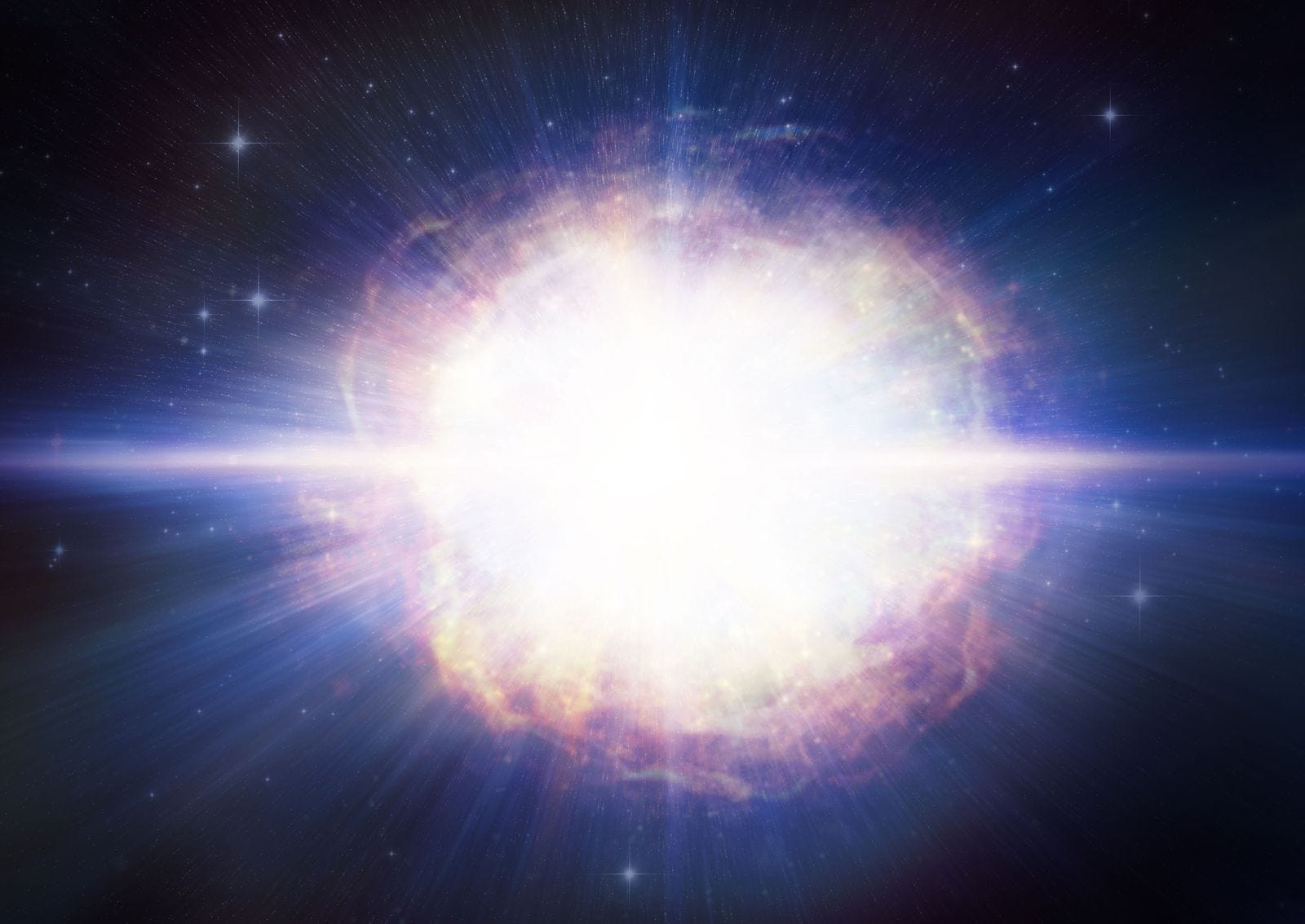
How does this description of the Śrīmad-Bhāgavatam relate to modern theories?
Nowadays, the most accepted scientific theory for the origin of the universe is the Big Bang theory. Their idea is that a great explosion led to a rapid expansion of the fundamental material particles, which created the physical laws that govern the cosmos, and a mass of energy that gradually expanded and cooled down, leading to the creation of hydrogen, which condensed in the first stars, leading to the gradual creation of the other atomic elements by nuclear fusion inside these stars. These atomic elements then spread throughout the cosmos as these first stars exhausted their fuel and exploded into supernovae.
Some believe that this passage of the Śrīmad-Bhāgavatam connects well with this scientific description of the initial stages of the universe, with the sequential creation of the fabric of space-time (ether), followed by the expansion of matter (air), which was, in turn, surcharged with light and energy (fire), leading to the creation of hydrogen (water) and finally the other atomic elements (earth) by the process of nuclear fusion inside the stars. This initial creation, they believe, was followed by the appearance of Brahmā, who used these elements to create the sun, the planets, and the different forms of life.
Whether this is correct or not, we can’t tell, since the evidence is merely subjective, but there are indeed certain similarities between these two explanations, and this can be used to describe the version of the Śrīmad-Bhāgavatam to scientifically inclined people.
It’s interesting to note that the explanations given in the Śrīmad-Bhāgavatam and other Purāṇas also closely relate to modern scientific theories in other factors, such as the dates for the creation of both the universe and the solar system, dates for the main cycles of extinction on our planet, such as the Permian-Triassic extinction, etc. They also agree on the idea of the sun becoming in the future a red giant and destroying the planets in the inner solar system (including the earth). According to the Purāṇas, this is supposed to happen at the end of the day of Brahmā, in a time frame that is within the range that is predicted by current theories.
Good material science is based on making experiments and creating theories based on the results. In the Vedic tradition, these two processes are called pratyakṣa and anumāna. They are not considered perfect processes for obtaining knowledge because they are based on using our material senses and intelligence, which are imperfect, but they are still accepted as secondary valid methods. Sometimes, the conclusions achieved by these methods may be correct, and sometimes not.
The most perfect form of obtaining knowledge, according to the Vedas, is śabda-pramāṇa, receiving perfect knowledge from the scriptures, trying to understand the explanations about the origin of the universe and other topics given in the Śrīmad-Bhāgavatam and other books. That’s what we are trying to do here. The point about following the process of śabda-pramāṇa is that we need to study the explanations of the scriptures carefully, so we may properly understand them; otherwise, we may end up fanatically trying to push theories that are the fruit of our misunderstanding and are not at all supported in the sastras.
The fact that some scientific theories agree with the Vedas on some points reinforces the validity of the scriptures and also makes the point that maybe in the future, the knowledge from the Śrīmad-Bhāgavatam and other scriptures, when properly understood, may be used to correct and expand scientific theories and thus arrive at unified theories that are supported by both Vedic knowledge and experimental knowledge. This would prove beyond doubt the authenticity of the knowledge of the Vedas.
More scientific than it appears
In chemistry and physics, the chemical elements are classified according to their atomic number. Hydrogen is composed of atoms with one proton and one electron, lithium is composed of atoms with three of each, iron is made of atoms with 26, and so on. Elements also have ions (losing or gaining electrons) as well as isotopes, which differ in the number of neutrons. Tritium, for example, is a hydrogen isotope with one proton and two neutrons.
The Vedas, however, classify the elements according to their characteristics and not according to their atomic structure. The reason is that material reality is composed of different levels of existence, which go from gross to subtle. At the gross level, where we live, matter is composed of atoms, but in the subtle realms of the inhabitants of Bhū-mandala, of the demigods in Svargaloka, of great sages in the higher planetary systems, etc., matter has different compositions. The modern classification, based on types of atoms, is valid only for our plane, while the classification of the Vedas in terms of fire, ether, water, smell, taste, sight, hearing, etc. describes reality in all planes, because everywhere people see, taste, and hear, and matter has properties of having taste, form, odor, and so on. This classification of elements is thus much more scientific than it may seem at first.
There are many separate details in the explanation of the material elements, but one essential point to understand is that all energies are part of Kṛṣṇa, the Supreme Brahmān. There is nothing separate or independent from Him. At the same time, however, He has multiple potencies, and they have different characteristics and distinctions. As souls, we are parts and parcels of Kṛṣṇa, but at the same time, we are separate individuals. All these apparent contradictions were harmonized by Śrī Caitanya Mahāprabhu in his achintya-bheda-abheda tattva philosophy, which describes the inconceivable simultaneous oneness and difference.
The study of the material elements should, therefore, not be seen as something separated from Kṛṣṇa, because the material elements are part of Kṛṣṇa’s energy. By studying the material elements and the interactions between them, we can better understand how the material creation works, what keeps us bound here, and how we can free ourselves. People are naturally curious about the structure of the universe, and this curiosity leads to the development of material science. However, because there are no studies about the soul and the subtle material manifestations, scientific theories are incomplete and don’t help us on the path of self-realization. The Śrīmad-Bhāgavatam fills this gap, giving us a metaphysical explanation of the nature and structure of the universe we live in.
Read the whole book:
« Making Sense of the Vedic Universe, a Higher-Dimensional Reality
This is a publication for thoughtful readers who want to go deeper into Kṛṣṇa consciousness. I publish daily, trying to offer high-quality spiritual content, and all posts are available to free subscribers. If you wish, you can also choose a paid subscription to support this work.
You can also receive the updates on WhatsApp or Telegram.
If you would like to contribute further, you can find the donation links here.