

Subscribe to receive new articles by e-mail. It’s free, but if you like, you can pledge a donation:
A few days ago, we studied the story of Bharata Maharaja becoming attached to a deer.
Apart from the attachment per see, another problem Maharaja Bharata faced as a result of his attachment, which is extremely relevant to us, was inattention in his spiritual practice. He was spending most of his time taking care of the deer, and when he would try to finally perform some spiritual practice, he couldn’t concentrate, as described in text 5.8.14:
“When Mahārāja Bharata was actually worshiping the Lord or was engaged in some ritualistic ceremony, although his activities were unfinished, he would still, at intervals, get up and see where the deer was. In this way he would look for it, and when he could see that the deer was comfortably situated, his mind and heart would be very satisfied, and he would bestow his blessings upon the deer, saying, “My dear calf, may you be happy in all respects.”
This verse illustrates how material attachment can hamper our spiritual practice. Unfortunately, things we do don’t just go to the background when we want to chant or worship. The mind keeps bringing them to our attention, just like a mental carousel that keeps distracting us from our practice. Before, Bharata Maharaja was able to fully concentrate on his practice and was thus collecting the fruits, but now, because of his attachment to the deer, he could barely concentrate for more than a few minutes, just as many of us do. His story thus serves as an alert of where this can lead us.
The mind does not even distinguish between serious attachments, such as children, and unimportant things, such as short videos from social networks. Everything we see and have an emotional impact on us, is absorbed by the mind and keeps coming when we want to practice. In most cases, we may not be able to renounce all material attachments, especially as long as we are in family life, but we can at least reduce them by trying to avoid non-essential distractions, such as social networks. Viral content, such as short videos, is especially damaging because it is especially created to invoke an emotional response, and that’s precisely what gets imprinted in the mind and keeps coming back, undermining our spiritual practice.
Most types of entertainment we have nowadays are “free” in the sense that we don’t have to pay any money for them, just like Bharata Maharaja didn’t have to pay anything for the company of the deer. However, they carry a hidden price tag, which is a potential string of several additional births in this material world.
Most of us have our personal deer already in the form of the phone, which keeps distracting us in our spiritual practice and can be hard to give up. The whole pastime of Bharata Maharaja serves thus as an illustration of our own struggles, and a warning of where wrong choices can take us.
Traditionally, Vaiṣnavas would go to live in Vṛndāvana or other holy places, making a small cottage or other simple habitation and having very simple lives, chanting most of the time, meeting other Vaiṣnavas to have discussions about Krsna Consciousness. Their social connections would be limited to going out once a day to beg alms. By such a simple life, free of distractions, they would be able to remain fixed. This style of life is not possible or even recommended for most of us, but it makes the point of how we should be attentive to our practice and to the importance of reducing distractions.
“If Bharata Mahārāja sometimes could not see the deer, his mind would be very agitated. He would become like a miser, who, having obtained some riches, had lost them and had then become very unhappy. When the deer was gone, he would be filled with anxiety and would lament due to separation. Thus he would become illusioned and speak as follows.” (SB 5.8.15)
Ultimately, all material attachments lead to suffering, because sooner or later we have to part from the object of our attachment due to different circumstances. We thus suffer from anxiety from the anticipation of loss, and eventually from experiencing the loss itself. We experience this cycle many times during our lives, connected with different objects of attraction. It’s very difficult to destroy all attachments, just as it is to stop all thoughts, but attachment can be transferred. As Prabhupāda explains:
“Śrīla Rūpa Gosvāmī prayed to the Lord that he would be as naturally attracted to the Lord’s service as young men and young women are naturally attracted to each other. Śrī Caitanya Mahāprabhu exhibited such attachment to the Lord when He jumped into the ocean or cried at night in separation. However, if our attachment is diverted to material things instead of to the Lord, we will fall down from the spiritual platform.”
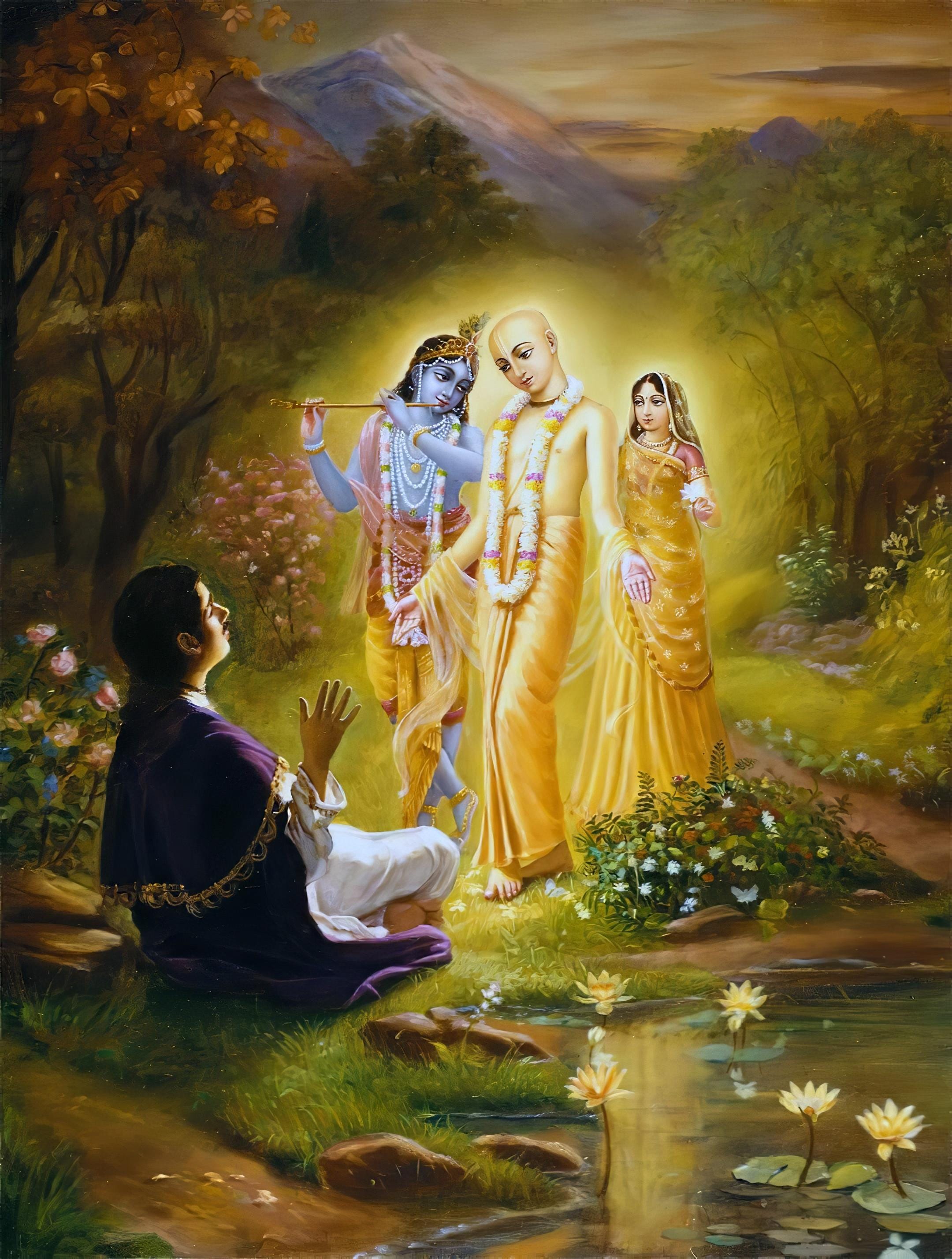
The Six Gosvāmīs and Śrī Caitanya Mahāprabhu Himself taught us this mood of always looking for Kṛṣṇa and hankering for His company. If by serving and chanting the holy names we can gradually develop this mood of always looking for the Lord, it can save us from all kinds of material attachments and distractions.
You can also donate using Buy Me a Coffee, PayPal, Wise, Revolut, or bank transfers. There is a separate page with all the links. This helps me enormously to have time to write instead of doing other things to make a living. Thanks!