


You can receive new articles directly in your inbox. Subscription is free; donations are welcome.
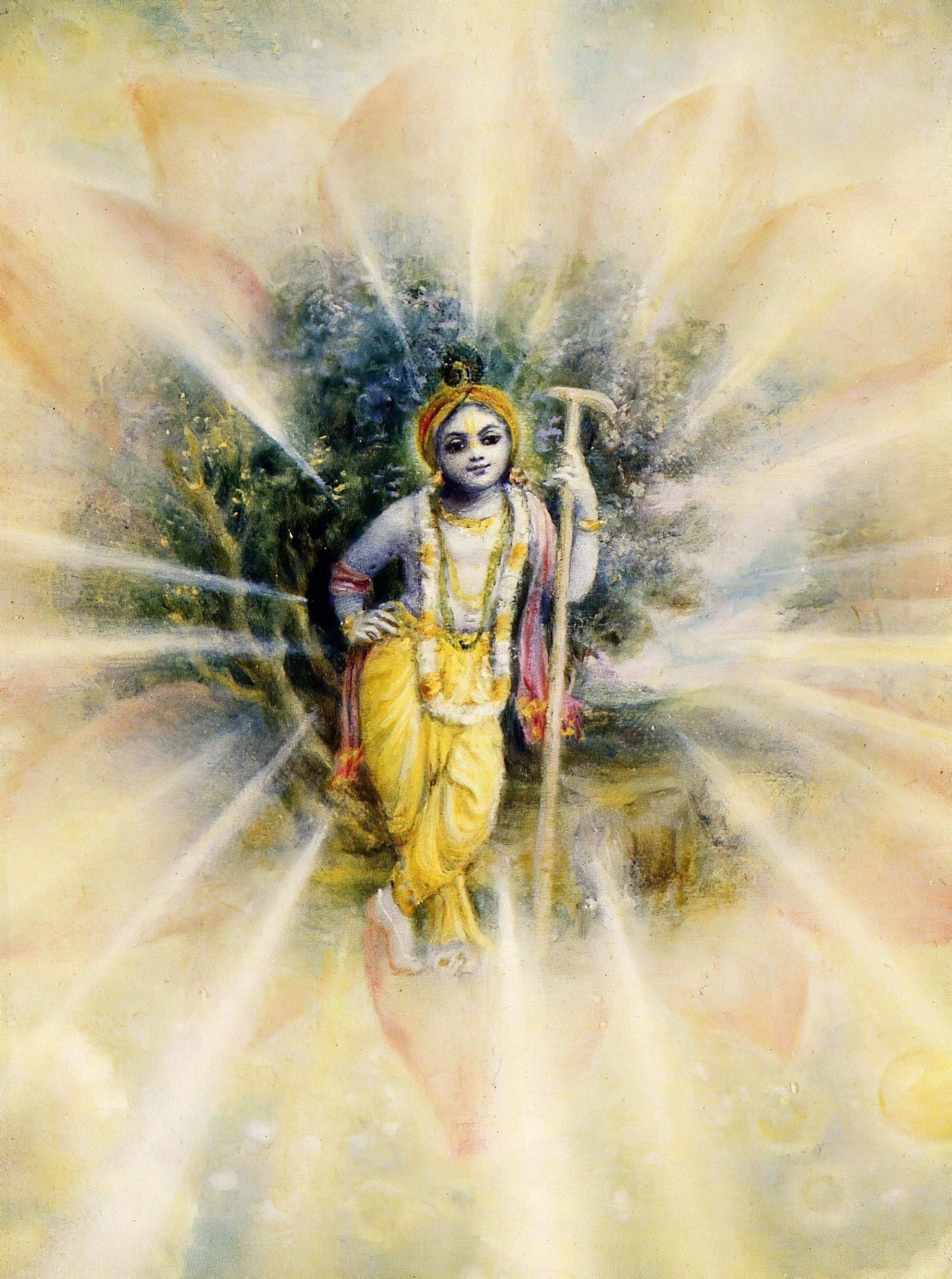
Gaudiya Vaiṣnavas accept the conclusion that Kṛṣṇa is the Supreme Personality of Godhead, the source of all incarnations, including the many forms of Viṣnu. This is supported by many verses of the scriptures, including Śrīmad-Bhāgavatam 1.3.28, which is defined by Jīva Gosvāmi as the paribhāṣā-sūtra:
ete cāṁśa-kalāḥ puṁsaḥ, kṛṣṇas tu bhagavān svayam
indrāri-vyākulaṁ lokaṁ, mṛḍayanti yuge yuge“All of the above-mentioned incarnations are either plenary portions or portions of the plenary portions of the Lord, but Lord Śrī Kṛṣṇa is the original Personality of Godhead. All of them appear on planets whenever there is a disturbance created by the atheists. The Lord incarnates to protect the theists.”
There is, however, another verse from the Bhāgavatam itself that appears to contradict this conclusion. That’s SB 10.43.23:
etau bhagavataḥ sākṣād, dharer nārāyaṇasya hi
avatīrṇāv ihāṁśena, vasudevasya veśmani“[The people said:] These two boys are certainly expansions of the Supreme Lord Nārāyaṇa who have descended to this world in the home of Vasudeva.”
This is already the BBT translation, not the interpretation of an opposing party. It’s part of the later chapters of the 10th canto that were translated after the departure of Śrīla Prabhupāda by a team of disciples.
How can we explain it?
The first point is the context. The verse appears during the triumphal entrance of Kṛṣṇa and Balarāma in Mathurā to challenge King Kaṁsa. Kṛṣṇa had already defeated the powerful elephant Kuvalayāpīḍa, and now was entering the arena together with Balarāma.
It is described that different people of Mathurā saw Kṛṣṇa in different ways, according to their level of understanding. The wrestlers saw Kṛṣṇa as a lightning bolt, the men of Mathurā as the best of males, the women as Cupid in person, the cowherd men as their relative, the impious rulers as a chastiser, His parents as their child, Kaṁsa saw Him as death, the unintelligent as the universal form, the yogīs as the Absolute Truth, and the Vṛṣṇis as their supreme worshipable Deity.
When they finally entered the arena, they overpowered the minds of all onlookers with their effulgence. This brings us to the passage:
“O King, as the citizens of the city and the people from outlying districts gazed upon those two Supreme Personalities from their seats in the galleries, the force of the people’s happiness caused their eyes to open wide and their faces to blossom. They drank in the vision of the Lords’ faces without becoming satiated.
The people seemed to be drinking Kṛṣṇa and Balarāma with their eyes, licking Them with their tongues, smelling Them with their nostrils and embracing Them with their arms. Reminded of the Lords’ beauty, character, charm and bravery, the members of the audience began describing these features to one another according to what they had seen and heard.
[The people said:] These two boys are certainly expansions of the Supreme Lord Nārāyaṇa who have descended to this world in the home of Vasudeva.” (SB 10.43.20-23)
The words are thus presented as the words of common people, who were struggling to understand who this powerful and effulgent personality in front of them was. Some of them, thus, repeating rumors they have heard, conclude that they must be expansions of Lord Nārāyaṇa who have descended to this world as the sons of Vasudeva.
Śrīla Jīva Gosvāmi, however, explains that although the statement comes from nātividvaj-jana (people who are not very learned), their words are sarasvatī-preritatayā, inspired by Sarasvatī. This indicates that the verse is not improper or incorrect, but that there is a deeper level of meaning in it that is inaccessible to ordinary people.
In other words, the commoner who spoke had the idea that Kṛṣṇa and Balarāma are incarnations of Viṣnu, and the ones who heard it probably got the same understanding, but Sarasvatī Herself made their words contain the real truth, even if hidden.
Jīva Gosvāmi mentions this passage in a section of the Śrī Kṛṣṇa-sandarbha where he is defending the conclusion of the paribhāṣā-sūtra (SB 1.3.28): kṛṣṇas tu bhagavān svayam – Kṛṣṇa is Bhagavān Himself, the Supreme Personality of Godhead.
In his exposition, he systematically examines verses that appear to suggest that Kṛṣṇa is an aṁśa (a part) or other form of incarnation of Viṣnu and shows how they can be properly understood.
So, how does he explain SB 10.43.20-23? “These two boys are certainly expansions of the Supreme Lord Nārāyaṇa who have descended to this world in the home of Vasudeva.”
He begins by explaining a previous verse, SB 10.1.2:
yadoś ca dharma-śīlasya, nitarāṁ muni-sattama
tatrāṁśenāvatīrṇasya, viṣṇor vīryāṇi śaṁsa naḥ“O best of munis, you have also described the descendants of Yadu, who were very pious and strictly adherent to religious principles. Now, if you will, kindly describe the wonderful, glorious activities of Lord Viṣṇu, or Kṛṣṇa, who appeared in that Yadu dynasty with Baladeva, His plenary expansion.”
He calls our attention to the word “aṁśena” in the verse. He explains that aṁśena means “together with Baladeva.” Balarāma is the aṁśa, the expansion, and Kṛṣṇa is the original. Kṛṣṇa appears together with Balarāma, His expansion. There is another parallel in SB 10.41.46, where the word aṁśena is again used with the exact same meaning. This shows that this is not just his interpretation; it is the consistent meaning given in the Śrīmad-Bhāgavatam itself.
Therefore, as he explains, the word aṁśena in SB 10.43.23 should be interpreted in the same way. Instead of appearing “as expansions” of Nārāyaṇa, Kṛṣṇa appears “with His expansions”.
This changes the interpretation of the verse.
The superficial meaning, as the simple people of Mathurā understood it, which is included in the BBT translation, following the context, is:
“[The people said:] These two boys are certainly expansions of the Supreme Lord Nārāyaṇa who have descended to this world in the home of Vasudeva.”
How can the people not immediately recognize Kṛṣṇa as the Supreme? Jīva Gosvāmi explains that it is because He appears covered by Yogamāyā. Because of this covering, only a partial manifestation of His fullness is perceived by ordinary people. This explains why different classes of people saw Him in different ways. The central idea is that Kṛṣṇa is pūrṇa, complete, but ordinary people may perceive only a partial manifestation of Him.
The deeper meaning of the verse, however, as explained by Jīva Gosvāmi, is:
“Krsna, the Original Personality of Godhead, Krsna, togueter with Balarāma, have descended to this material world accompanied by all Their plenary expansions. They have appeared in the home of Vasudeva.”
The verse is thus understood as:
etau: these two (Kṛṣṇa, the Supreme Personality of Godhead, and Balarāma, His expansion, who is the source of all other expansions).
bhagavataḥ sākṣād dharer nārāyaṇasya hi: of Bhagavān, Hari Nārāyaṇa Himself.
avatīrṇāv iha aṁśena: They have descended to this world together with all their expansions (all the forms of Bhagavān Hari Nārāyaṇa).
vasudevasya veśmani: [They have appeared] in the house of Vasudeva.
In his purport to SB 10.1.2, Prabhupāda gives us the final theological conclusion, wrapping up all these conclusions:
“Govinda, Kṛṣṇa, is the original Personality of Godhead. Kṛṣṇas tu bhagavān svayam. Even Lord Mahā-Viṣṇu, who by His breathing creates many millions upon millions of universes, is Lord Kṛṣṇa’s kalā-viśeṣa, or plenary portion of a plenary portion. Mahā-Viṣṇu is a plenary expansion of Saṅkarṣaṇa, who is a plenary expansion of Nārāyaṇa. Nārāyaṇa is a plenary expansion of the catur-vyūha, and the catur-vyūha are plenary expansions of Baladeva, the first manifestation of Kṛṣṇa. Therefore when Kṛṣṇa appeared with Baladeva, all the viṣṇu-tattvas appeared with Him.”
Prabhupāda also gives us a masterful demonstration of the application of these conclusions in his translation of SB 2.7.26.
bhūmeḥ suretara-varūtha-vimarditāyāḥ
kleśa-vyayāya kalayā sita-kṛṣṇa-keśaḥ
jātaḥ kariṣyati janānupalakṣya-mārgaḥ
karmāṇi cātma-mahimopanibandhanāni
Ordinary scholars usually interpret the words “sita-kṛṣṇa-keśaḥ jātaḥ” in the verse as “a portion of Viṣṇu, being born of white and black hair”, while the correct interpretation, given by Rupa Gosvāmi, is “the Lord, with beautiful black hair, descends with His plenary portion.” (the plenary portion being Lord Balarama, Kṛṣṇa’s immediate expansion).
We can see Prabhupāda applying this meaning in his purport:
“When the world is overburdened by the fighting strength of kings who have no faith in God, the Lord, just to diminish the distress of the world, descends with His plenary portion. The Lord comes in His original form, with beautiful black hair. And just to expand His transcendental glories, He acts extraordinarily. No one can properly estimate how great He is.”
Read more:


This is a publication for thoughtful readers who want to go deeper into Kṛṣṇa consciousness. I publish daily, trying to offer high-quality spiritual content, and all posts are available to free subscribers. If you wish, you can support this work with a monthly contribution. When you subscribe, you can choose between a free subscription and a monthly contribution, and you can switch from a free subscriber to a supporter at any time.
You can also receive updates on WhatsApp or Telegram.
If you would like to contribute further, you can find the donation links here.