


You can receive new articles directly in your inbox. Subscription is free; donations are welcome.
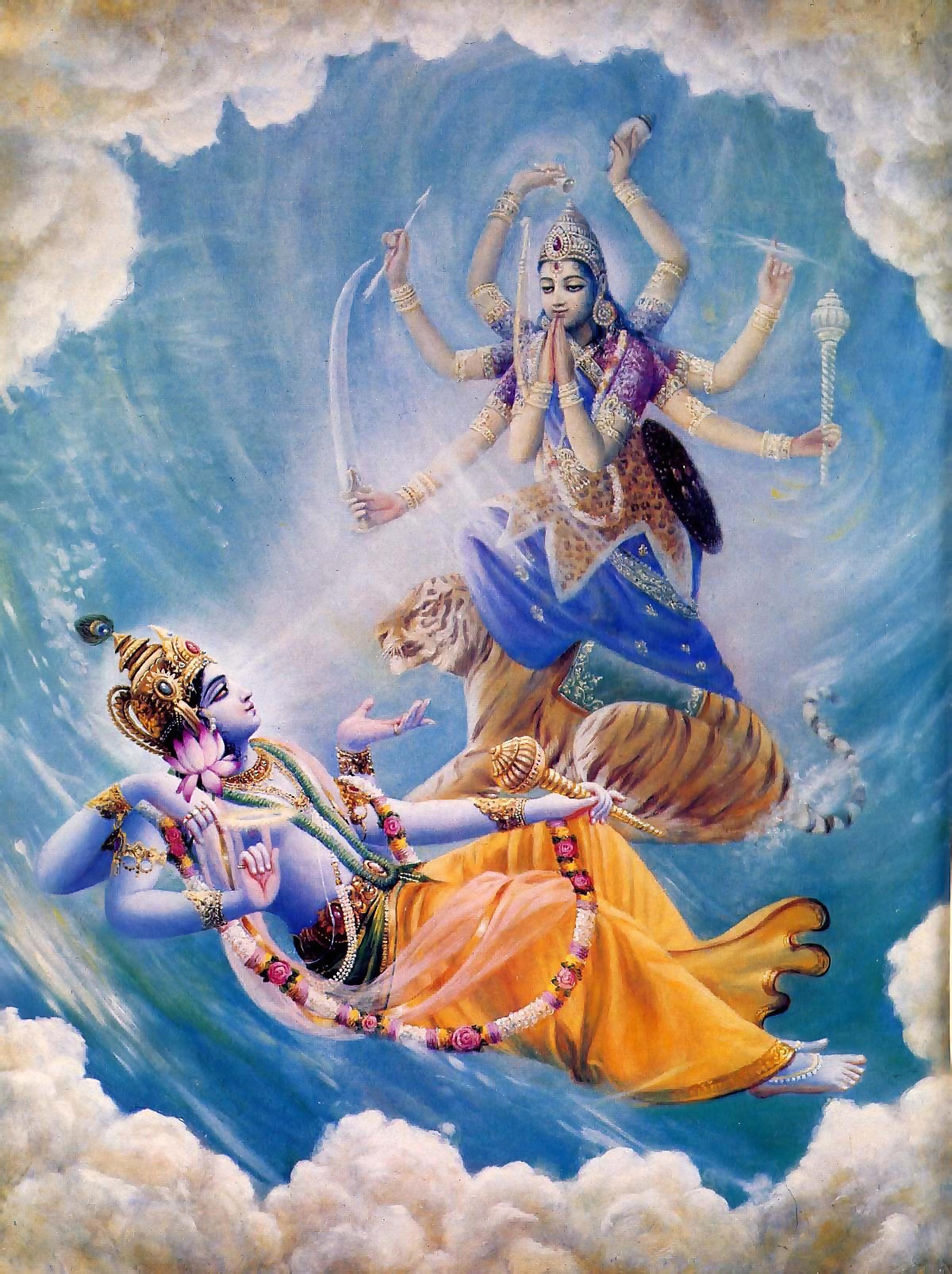
God appears in the form of many incarnations. He came as Varahadeva to fight the powerful Hiranyaksa when he submerged the earth in the cosmic waters. He appeared as Hiranyakaṣipu to protect Prahlada Maharaja; He appeared as Lord Kapila to explain transcendental knowledge, and so on. However, after describing all the different incarnations of Godhead, the Śrīmad-Bhāgavatam concludes:
ete cāṁśa-kalāḥ puṁsaḥ
kṛṣṇas tu bhagavān svayam“All of the above-mentioned incarnations are either plenary portions or portions of the plenary portions of the Lord, but Lord Śrī Kṛṣṇa is the original Personality of Godhead.”
Everything starts with Krsna. Krsna is the original, Supreme Personality of Godhead. Krsna is just like a candle that ignites other candles. All candles may provide a similar illumination, but still, there is a candle that ignited all the others and is thus the origin of all illumination.
There are many forms of Viṣnu, and they are all-powerful, but still, Krsna is the original, Supreme Personality of Godhead: kṛṣṇas tu bhagavān svayam.
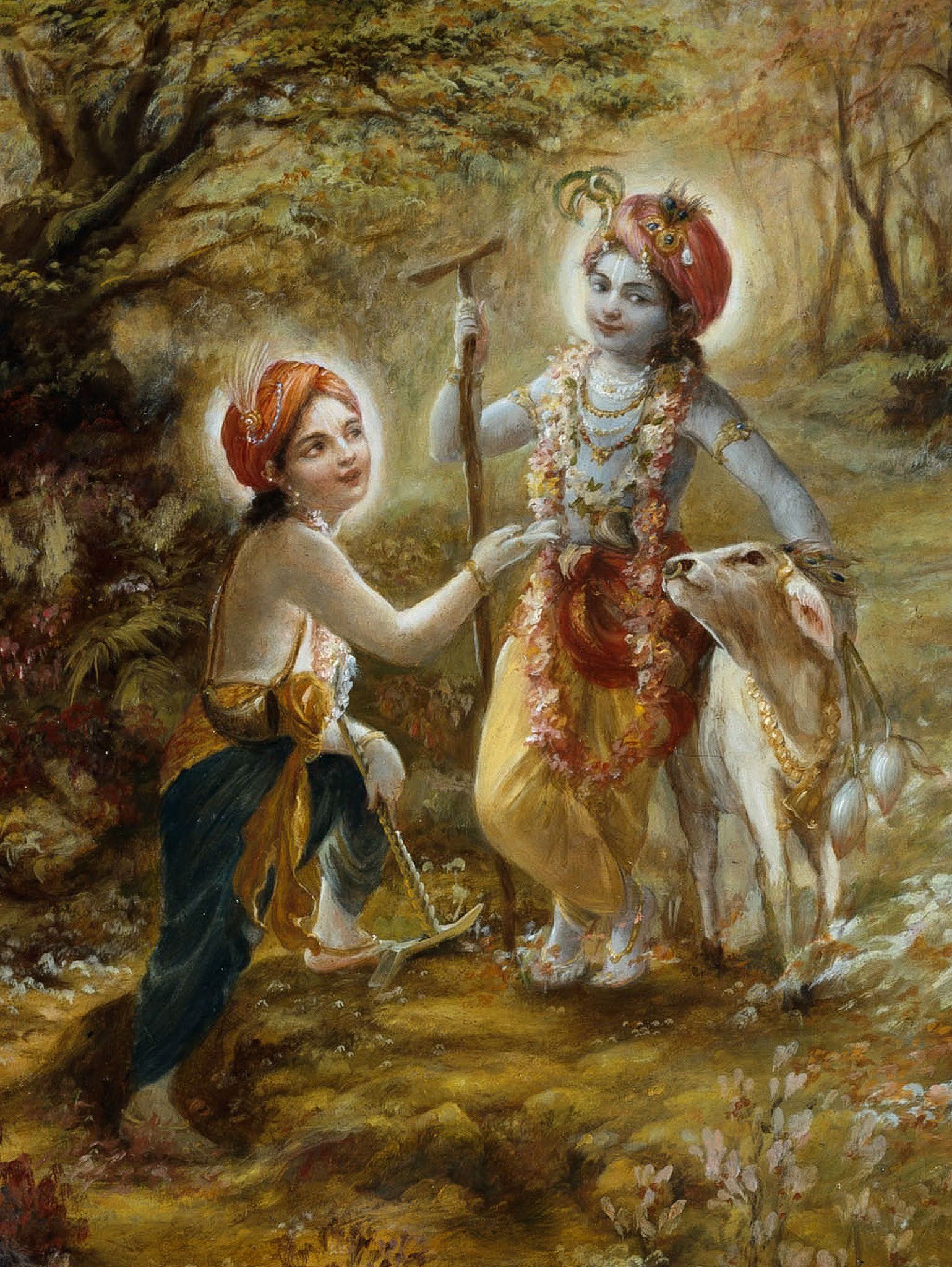
Krsna expands Himself into many. The first expansion is Balalarama, who is the original Servitor God. Krsna is the Supreme God, and Balarama is the Servitor God. Both are God, and both are equally worshipable, but between them, Krsna is served, and Balarama is the servitor. Balarama expands himself into all forms of paraphernalia used by Krsna and even most of His associates, facilitating Krsna’s pastimes. Balarama also appears to us in the form of the spiritual master to teach us how to serve Krsna. The spiritual master is not directly God, but he is empowered by God to help us. Being the representative of God, the spiritual master is thus as worshipable as God himself.
From Balarama comes the first Saṅkarṣaṇa, who is the origin of all the different forms of Viṣnu. From the first Saṅkarṣaṇa comes Nārāyaṇa, the Lord of Vaikunta, and from Nārāyaṇa comes the second Saṅkarṣaṇa, who is the origin of all the Puruṣa avataras, the expansions of the Lord who take charge of the creation and maintenance of the material universes.
Who are these Puruṣa avataras?
The first is Lord Maha-Viṣnu, who comes from the second Saṅkarṣaṇa. As Lord Maha-Viṣnu, Krsna creates the whole material manifestation by generating the Maha-tattva (the sum of all material elements). The Maha-tattva is also called the Karana Ocean or Causal Ocean. Because Maha-Vishnu lies down on this ocean, He is also called Karanarnavasayi Viṣnu.
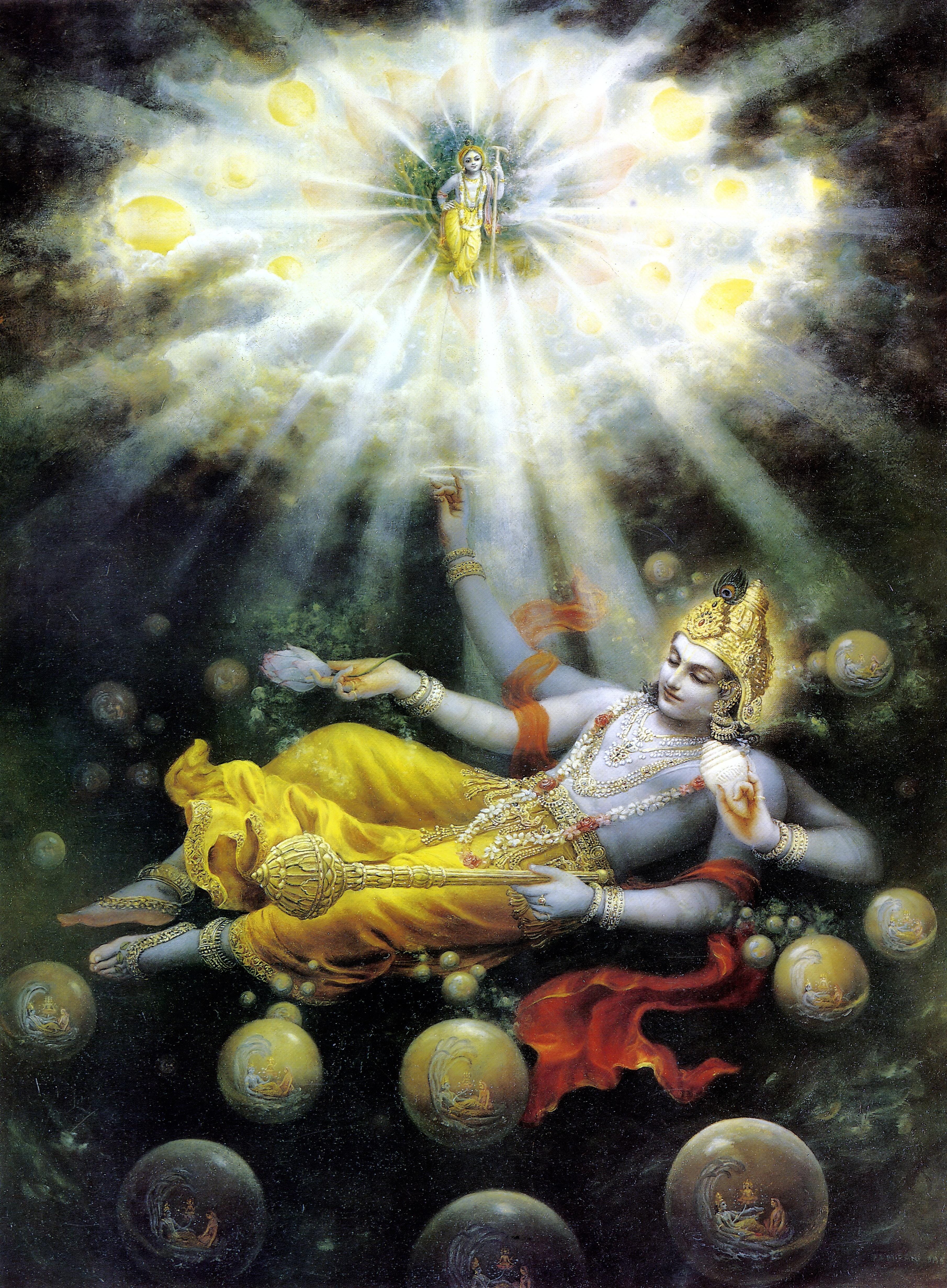
The Karana Ocean is the combination of all the material elements, the three modes of material nature, the souls who want to take part in the material creation, and the time energy (Kala) that puts everything in movement. The Karana Ocean is also known as pradhāna or mahat-tattva. What is the difference between these two terms? When the energy is inactive, it is called pradhāna, which is just like a cloud that covers a small part of the spiritual sky, and when it becomes active by the influence of time and the three modes of the material nature, it is called mahat-tattva. The two terms thus speak about two stages of the same thing.
What agitates the pradhāna and transforms it into the mahat-tattva? It’s the look of Maha-Viṣnu. It’s described that Maha-Viṣnu impregnates pradhāna with all the souls who want to participate in the material creation, just like a man making a woman pregnant. Being all-powerful, the Lord can generate innumerable living entities in the womb of material nature simply by His look.
The look itself becomes Lord Sadha Śiva, who acts as a guardian for all souls who enter into the material nature. Originally, Lord Śiva is Viṣnu-tattva, a direct expansion of Lord Maha-Viṣnu. Sadha Śiva lives outside of the material universes, on his own planet, situated on the border between the spiritual and material creation. From there, he expands himself into the innumerable Śivas who are present inside each material universe. As Lord Śiva, he associates with the material nature, and thus part of his qualities are covered. He becomes thus Śiva-tattva. Prabhupada explains that Lord Śiva is just like yogurt. Yogurt is nothing more than a transformation of milk, but it can’t be used in place of milk in recipes. Lord Śiva acts thus as the greatest devotee and also as a demigod, giving blessings to materialists who worship him in search of material wealth and power.
The look of Maha-Viṣnu also transports kāla, or the time energy. There is Kāli, Kali, and kāla, which are three different things. Kāli is the material potency of the Lord. Kali is the current age, Kali-yuga, and kāla is the time-potency.
Due to the influence of time, everything in the material world is created and destroyed, including the universe itself. Because of the influence of time, everything here is temporary, and the material universes go through cycles of creation and destruction. When the universes are destroyed, all the souls merge back into the mahat-tattva, and the mahat-tattva itself merges back into the body of Lord Maha-Viṣnu.
The manifestation of the material universes lasts for 311.04 trillion years. That’s the lifespan of Lord Brahma calculated according to our time. This equals one breath of Maha-Viṣnu. When He exhales, all universes come out, and everything becomes active; and when He inhales, all the universes are destroyed, and everything merges back into His body.
This time lasts for the same period of time as the manifestation of the universes, also 311,04 trillion years. During this time, all the souls stay dormant inside the body of Maha-Viṣnu. After this period, He again exhales, and all the universes become active again. The souls have thus another opportunity to perform material activities, satisfying their material desires, performing devotional service, and eventually going back to Godhead, back to the spiritual world.
Time is eternal as an energy, but its effect upon material energy has a beginning, the start of creation. In this way, time is eternal (as a cause), but at the same time, it has a beginning (as an effect).
What about Garbhodakasayi Viṣnu and Ksirodakasayi Viṣnu?
All the different material universes emanate through the pores of Maha-Viṣnu, so from this, we can have an idea of how big He is. After generating all the universes, He enters into each of these different universes as Garbhodakasayi Viṣnu. This is the form of the Lord who lies down in the Garbhodaka ocean (inside each universe). At first, the universe is completely empty, without any place to rest, so He fills half of it with water. Lord Seṣa then manifests Himself, acting as a bed, where the Lord comfortably rests.
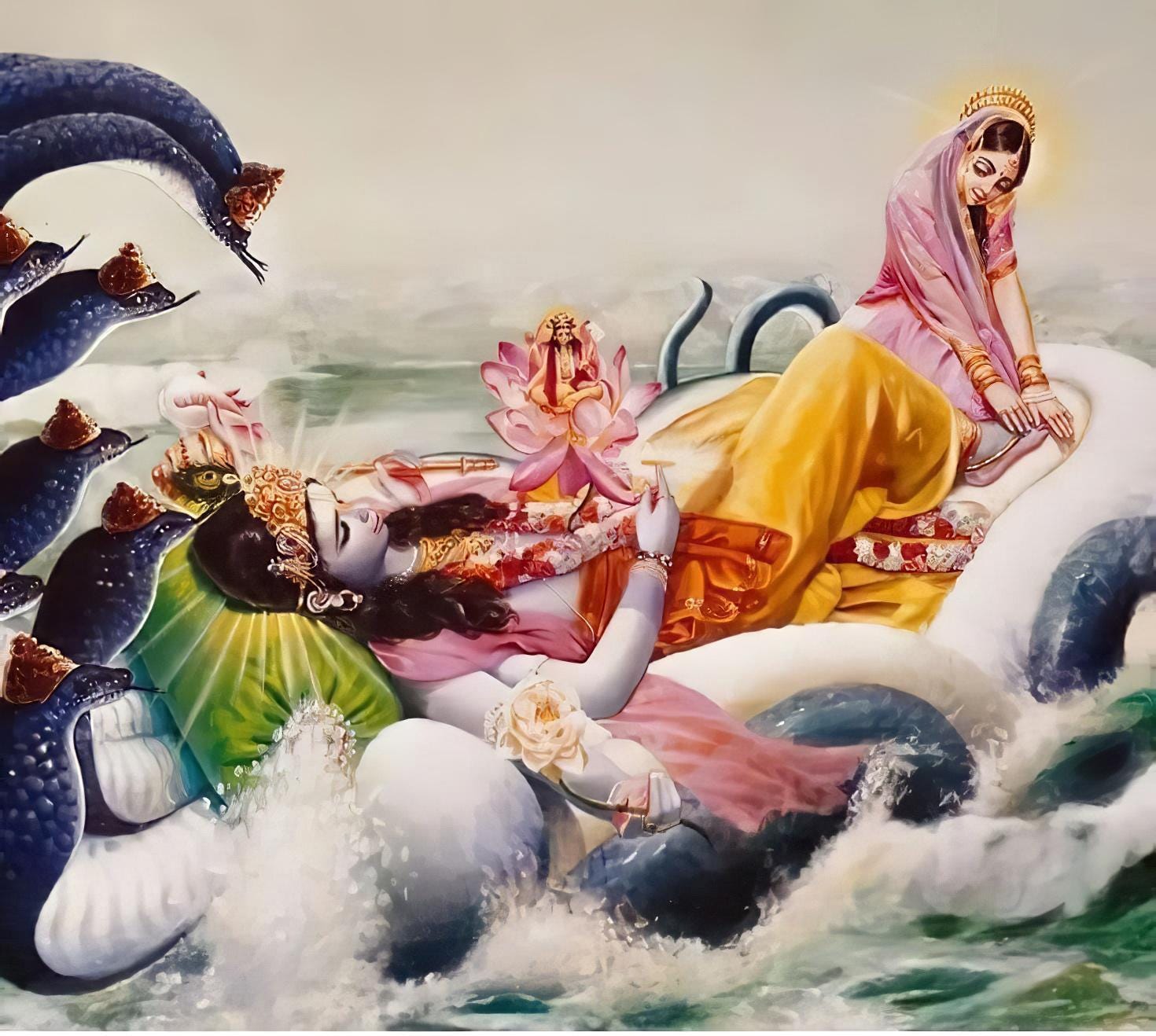
He then gives birth to Lord Brahma through a lotus flower coming from His navel. The Lord then expands again and becomes Ksirodakasayi Vishnu, entering into everything as Paramatma, appearing in the heart of all living beings and even inside the atoms.
We often think that there is a separate form of Paramatma in each living being and every atom, but in reality there is just one Ksirodakasayi Vishnu who just observes everything and is present everywhere. The same Ksirodakasayi Viṣnu lives on a small island in the ocean of milk on His own planet, the same planet, the Polestar. This is the same planet given to Dhruva Maharaja to rule. This is the form of Lord Viṣnu to whom the demigods pray when they are defeated by the demons, as described in different pastimes of Śrīmad-Bhāgavatam.
Lord Ksirodakasayi Viṣnu is also known as Lord Hari, and He is the source of all the different incarnations that appear in this universe. As He himself comes from Lord Garbhodakasayi Viṣnu, some passages say that Garbhodakasayi Viṣnu is the source of all incarnations. In the same way, since Garbhodakasayi Viṣnu comes ultimately from Krsna, we can also say that all incarnations come from Krsna. There is no contradiction.
Krsna appears as unlimited incarnations in the different universes. He appears as the different forms of Viṣnu to create and maintain the universes; He comes to perform different pastimes (lila-avataras); He comes in every age to teach Dharma (yuga-avataras); He appears as an incarnation during the reign of each Manu (manvantara-avataras); He empowers different living beings to perform amazing activities (saktyavesa-avataras), and so on. All these incarnations appear as expansions of Lord Ksirodakasayi Vishnu (ete cāṁśa-kalāḥ puṁsaḥ).
There are thus three different forms of Vishnu who participate in the creation of the material universes. They are all partial expansions of Krsna but perform different roles.
In short:
Maha-Viṣnu: That’s the Lord Who lays down on the causal ocean and creates all the universes. Lord Maha-Viṣnu is just one, and His form is truly gigantic, with all the universes passing through His pores.
Garbhodakasayi Viṣnu: After creating the universes, Lord Maha-Viṣnuexpands Himself and enters each and every one of the different universes. He lies down on the Garbhodaka ocean in the middle of each universe and gives birth to Lord Brahma.
Ksirodakasayi Viṣnu: In this third form, the Lord lies down in the ocean of milk and permeates everything as Paramatma. He also listens to the prayers of the demigods when they have difficulties.
Śrila Prabhupada (on SB 6.16.37) mentions:
“The origin of the material creation is Mahā-viṣṇu, who lies in the Causal Ocean. While He sleeps in that ocean, millions of universes are generated as He exhales, and they are all annihilated when He inhales. This Mahā-viṣṇu is a plenary portion of a portion of Viṣṇu, Govinda (yasya kalā-viśeṣaḥ). The word kalā refers to a plenary portion of a plenary portion. From Kṛṣṇa, or Govinda, comes Balarāma; from Balarāma comes Saṅkarṣaṇa; from Saṅkarṣaṇa, Nārāyaṇa; from Nārāyaṇa, the second Saṅkarṣaṇa; from the second Saṅkarṣaṇa, Mahā-viṣṇu; from Mahā-viṣṇu, Garbhodakaśāyī Viṣṇu; and from Garbhodakaśāyī Viṣṇu, Kṣīrodakaśāyī Viṣṇu. Kṣīrodakaśāyī Viṣṇu controls every universe. This gives an idea of the meaning of ananta, unlimited. What is to be said of the unlimited potency and existence of the Lord? This verse describes the coverings of the universe (saptabhir daśa-guṇottarair aṇḍa-kośaḥ). The first covering is earth, the second is water, the third is fire, the fourth is air, the fifth is sky, the sixth is the total material energy, and the seventh is the false ego. Beginning with the covering of earth, each covering is ten times greater than the previous one. Thus we can only imagine how great each universe is, and there are many millions of universes.”
Go deeper:

This is a publication for thoughtful readers who want to go deeper into Kṛṣṇa consciousness. I publish daily, trying to offer high-quality spiritual content, and all posts are available to free subscribers. If you wish, you can also choose a paid subscription to support this work.
You can also receive updates on WhatsApp or Telegram.
If you would like to contribute further, you can find the donation links here.
Explained very nicely, but if you would have explained by using schematic diagrams that would be more helpful to understand very easily.
🙏🙏🙏