

« Making Sense of the Vedic Universe, a Higher-Dimensional Reality
Chapter 2: Studying the structure of Jambūdvīpa
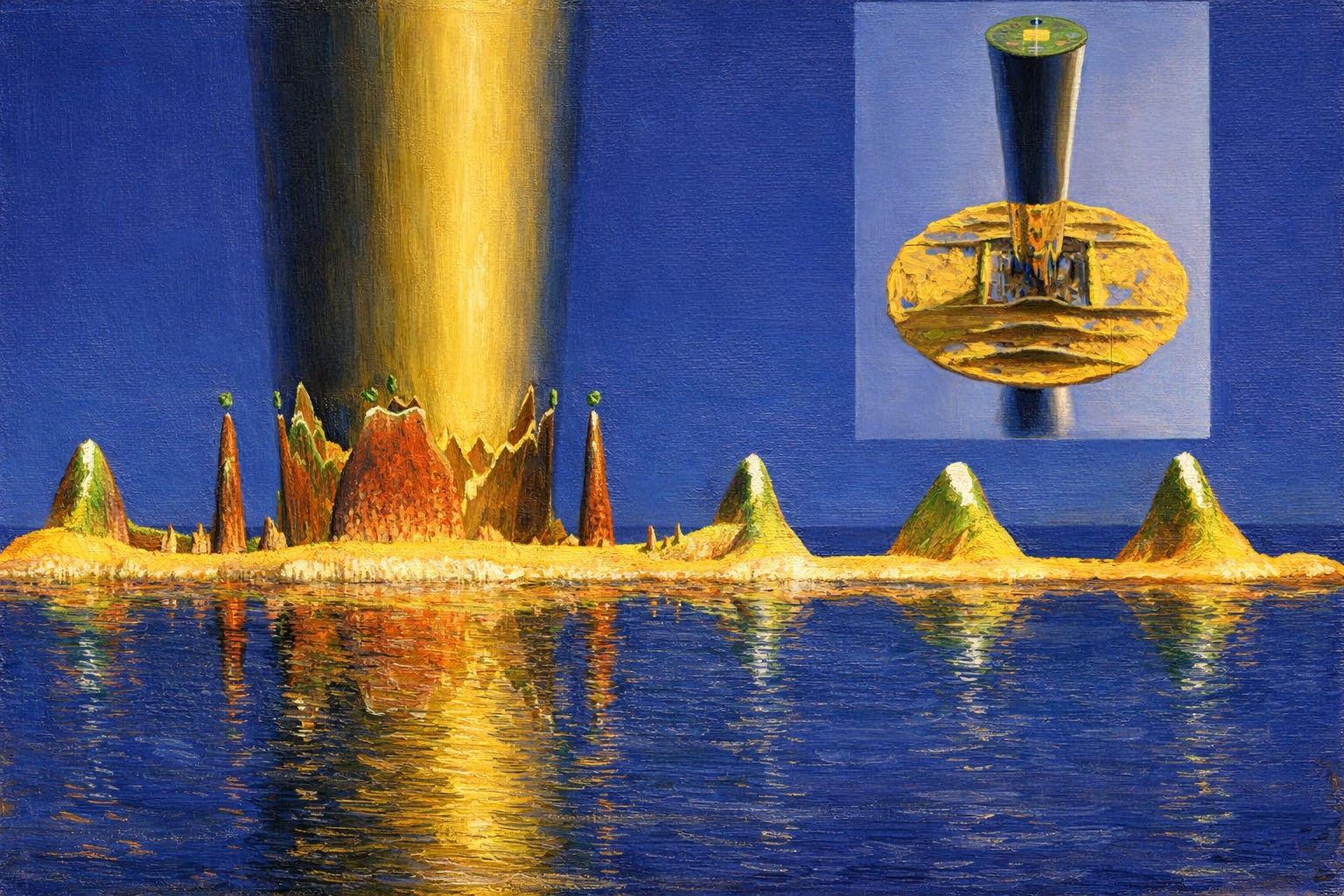
The first part of the Fifth Canto of Śrīmad-Bhāgavatam describes the descendants of Mahārāja Priyavrata, including the activities of Mahārāja Āgnīdhra, the pastimes of Lord Ṛṣabhadeva, the fall of King Bharata, and so on. These were all very prominent kings in the lineage of Svāyambhuva Manu, who ruled during the first manvantara, in the initial stages of the universe. Pṛthu Maharaja leveled the surface of the planet and expanded the use of agriculture, Priyavrata divided Bhū-mandala into its different tracts of land, and so on.
The second part, starting from chapter 16, goes into detail about Vedic cosmology, including the structure of Bhū-mandala, the orbit of the sun, the heavenly and hellish planets, and so on.
One could question why such a description of the universe is necessary, since the main purpose of the Śrīmad-Bhāgavatam is to discuss spiritual topics. In truth, this description is far more important than it may look at first.
The view we have of the universe around us is very influential in our concept of identity. If I believe the universe is an empty wasteland governed by mechanical physical laws, where things happen by chance, I will be much more inclined to believe that there is no God, that life comes from matter, and that my existence serves no purpose beyond immediate gratification. This will, in turn, influence my practical actions.
Kṛṣṇa describes this mentality in the Bhagavad-gītā (16.8-9):
“They say that this world is unreal, with no foundation, no God in control. They say it is produced of sex desire and has no cause other than lust. Following such conclusions, the demoniac, who are lost to themselves and who have no intelligence, engage in unbeneficial, horrible works meant to destroy the world.”
It is possible to live happily in this world by following dharma, the divine laws explained in the scriptures. The concept of dharma ensures that one lives in a progressive way, without committing unnecessary violence against other living beings. By following this system, one is gradually elevated to the mode of goodness, which leads to promotion to higher planets and, ultimately, liberation. That is the divine plan for the progression of all human beings. If, however, I give up this restraint and become absorbed in immediate sense gratification, I move in the opposite direction, becoming absorbed in lust, anger, and other base qualities, and acting in ways that bring only destruction. This leads to the progression described by Kṛṣṇa in the next verses:
“Taking shelter of insatiable lust and absorbed in the conceit of pride and false prestige, the demoniac, thus illusioned, are always sworn to unclean work, attracted by the impermanent. They believe that to gratify the senses is the prime necessity of human civilization. Thus until the end of life their anxiety is immeasurable. Bound by a network of hundreds of thousands of desires and absorbed in lust and anger, they secure money by illegal means for sense gratification.” (Bg 16.10-12)
The concept of asura (demon) in the Vedas is different from what is commonly understood in modern contexts. A demon is not a mythical creature with horns and a tail, but anyone who follows this path. In this context, the human population of the universe is divided into two classes: suras and asuras. Suras follow the progressive path of dharma, whereas asuras reject it in favor of base materialism. The danger of this path is that my actions affect my consciousness, and the consciousness I develop in this life determines where I will go next. The path of lust and anger leads me to perform destructive actions, which further degrade my consciousness, leading me to lower species of life, or to hell, which is also a feature of the Vedic universe, described in detail in later chapters of the Fifth Canto.
“The demoniac person thinks: “So much wealth do I have today, and I will gain more according to my schemes. So much is mine now, and it will increase in the future, more and more. He is my enemy, and I have killed him, and my other enemies will also be killed. I am the lord of everything. I am the enjoyer. I am perfect, powerful and happy. I am the richest man, surrounded by aristocratic relatives. There is none so powerful and happy as I am. I shall perform sacrifices, I shall give some charity, and thus I shall rejoice.” In this way, such persons are deluded by ignorance.
Thus perplexed by various anxieties and bound by a network of illusions, they become too strongly attached to sense enjoyment and fall down into hell.” (Bg 16.13-16)
Every human being is endowed with intelligence, which can be used to analyze the world and find the right path. The education we receive, however, plays a very important role. Because atheists now control most of the educational system, they teach a view of the universe that fosters atheism, and puts people on this path described by Kṛṣṇa. The Vedas, on the other hand, offer a model of the universe that nurtures our self-realization.
The main purpose of the cosmological model described in the Śrīmad-Bhāgavatam is to help us see the universe and everything that exists around us as a manifestation of Kṛṣṇa’s potencies, a wonderful creation that sprouts from just a small fraction of His power. When we see the universe as Kṛṣṇa’s creation and a place where He performs His pastimes, instead of a place for our enjoyment, we begin to perceive the spiritual reality behind the material illusion.
Because everything comes from Kṛṣṇa, ultimately nothing is material. When we see everything in connection with Kṛṣṇa, and we use everything in His service, this hidden spiritual nature is revealed before our eyes.
The difficulty in the description of the universe given in the Śrīmad-Bhāgavatam is that it is very difficult to understand and relate to our practical reality. At first, it appears to be a primitive description of a flat earth, with surreal lands inhabited by mythical creatures. However, when it is studied in detail, it reveals a complex model that gives us a more relevant view of the universe than what is described in modern science.
Read the whole book:
« Making Sense of the Vedic Universe, a Higher-Dimensional Reality
This is a publication for thoughtful readers who want to go deeper into Kṛṣṇa consciousness. I publish daily, trying to offer high-quality spiritual content, and all posts are available to free subscribers. If you wish, you can also choose a paid subscription to support this work.
You can also receive the updates on WhatsApp or Telegram.
If you would like to contribute further, you can find the donation links here.