

« Making Sense of the Vedic Universe, a Higher-Dimensional Reality
Introduction: Different perceptions of reality
According to modern astronomy, our universe is extremely vast but almost empty. The different stars and planets are separated by such extreme distances that it is practically impossible for one to go from one to the other. According to modern astronomers, Proxima Centauri is about 25 trillion miles away from earth, and that’s the closest star. There is even doubt if life exists on other planets or if it’s an anomaly that appeared just once on earth.
The universe of the Vedas is almost the opposite. Far from being just a sparse and uninhabited space, it is described as a hierarchical and organized structure, with the many planets and stars being divided into different planetary systems, and most of the inhabitants being able to travel from one world to another. How can we explain such differences?
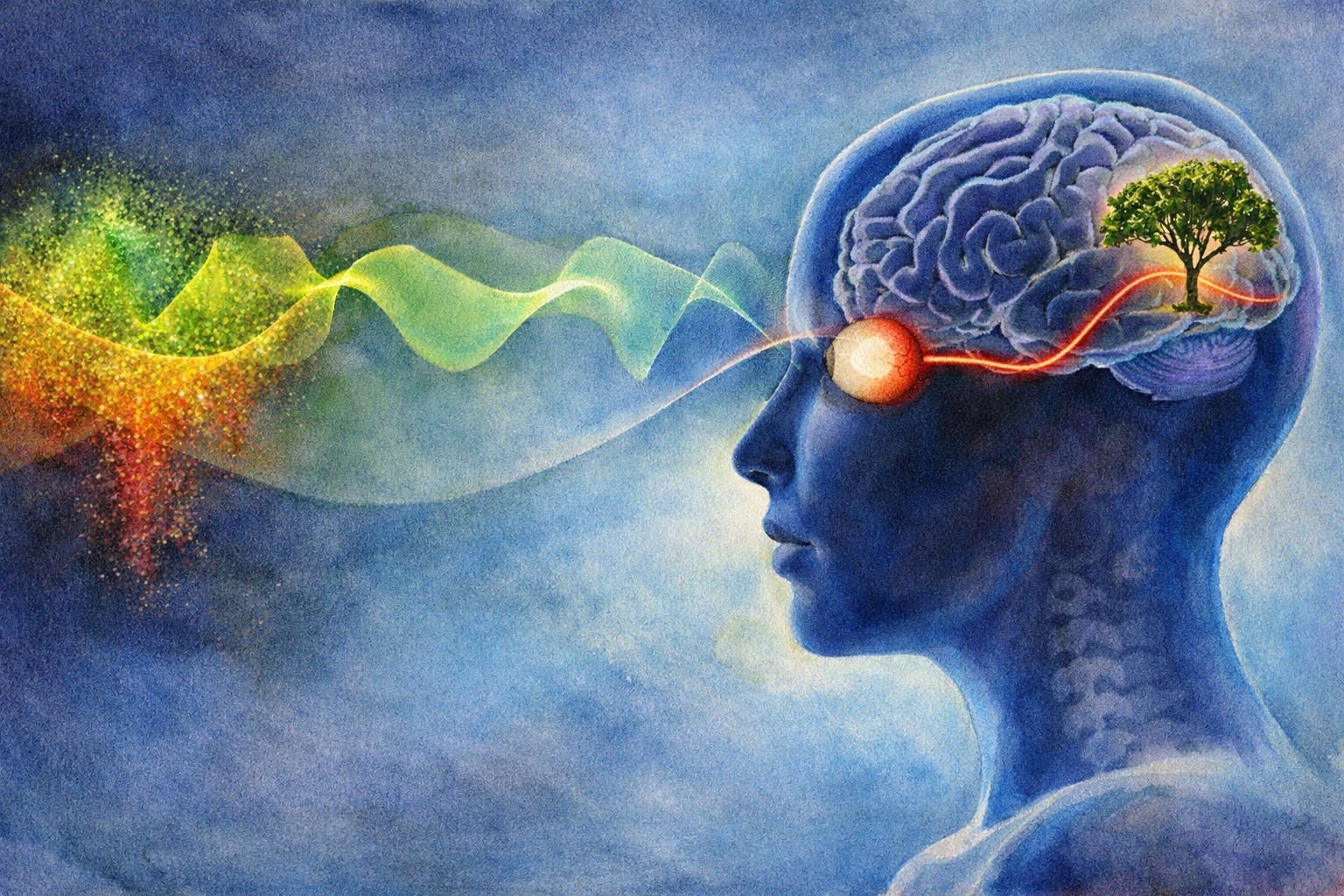
The first point to understand is that the view of the universe given by modern cosmology is based on sense perception, or what we can observe using our vision and other senses. It doesn’t matter if one tries to observe the universe using the naked eye, a telescope, or even advanced mathematical models. One will be limited by his senses and intelligence.
In the jyotiṣa-śāstras, the Vedas also give a view of the universe that is similar to modern science. The Sūrya-siddhānta gives formulas to calculate the circumference of the earth and the moon, the distance to the moon and different planets of our solar system, and so on, offering numbers close to modern estimates. Therefore, the view of the universe described by modern science was not unknown to the sages of previous ages. The point is that the Vedas offer something more.
Modern astronomy, as well as the Sūrya-siddhānta, describes the universe according to the sense perception of human beings, matching what we can perceive using our senses and intellect. The Purāṇas, on the other hand, describe the universe from the perspective of the demigods, who have different sets of senses and thus perceive reality differently from what we do.
Most of the books in the Vedas were received by humanity from higher beings. Most of them were spoken by great sages or by inhabitants of the higher planetary systems, while others were spoken by perfect devotees from the spiritual realm. The Sūrya-siddhānta, however, was received through Maya Dānava, the main architect in the lower planetary systems. Being a materialist, Maya Dānava is interested in the practical aspects of matter. Therefore, he gave humanity practical knowledge for astronomical calculations, which is close to the model conceived by modern cosmology. The main reason is that both are based on what we can see when we look into the sky.
The main topic of the Sūrya-siddhānta is calculations for the positions of the planets and the passage of time. Following these calculations, one can calculate the position of a planet at any given time, as well as understand the passages of years, yugas, etc., within the current cycle of creation. Nowadays, the calculation of the orbits of planets is done by complex software that takes a lot of processing power to run, while the calculations in the Sūrya-siddhānta were developed to be simple enough to be solvable by hand. This knowledge was used by sages in ancient times to calculate the position of different planets, eclipses, etc. It was thus important for both ritual and astrological purposes.
Both the calculations of the positions of the planets used in astrology and the correct times for vows, fasting, and religious functions were considered fundamental for people in previous ages and are still central for devotees. Śrīla Bhaktisiddhānta Sarasvatī Thākura wrote a commentary on the Sūrya-siddhānta, bringing back many corrections for astrological calculations that had been lost over time. However, ultimately, he abandoned it to focus on his main mission of spreading Kṛṣṇa consciousness.
Thus, the focus of the Sūrya-siddhānta is to give humanity a model to compute the apparent motions of the luminaries and the passage of time for practical purposes. It is not identical to modern cosmology but offers a model closer to it.
The description of the universe we find in the Śrīmad-Bhāgavatam, on the other hand, has the purpose of giving us a direct map of the universe we live in, but it does so from a perspective very different from modern cosmology. It describes a higher level of reality that we gain access to as we progress in spiritual realization, guiding us on a journey through different levels of existence, all the way to the highest level of all: life in the spiritual world in the company of Kṛṣṇa. This is surely a level of reality superior to what we can perceive with our current senses.
The mistake we often make is to try to directly relate the description of the Śrīmad-Bhāgavatam with telescope observations, point for point. When we do that, we force the description of the Bhāgavatam into a category it does not claim for itself. Unless we are demigods, we will not directly see the universe in the same way the Bhāgavatam describes. The fact that it describes a reality different from what we observe when we look at the sky is thus not a fault, but a feature. The purpose is exactly to guide us into connecting with higher levels of reality, gradually breaking the shackles that bind us to this gross reality. For this, of course, we need to first understand the model described in the Śrīmad-Bhāgavatam. That’s what we try to facilitate in this book.
In short, we have thus three different models of the universe:
a) Modern cosmology offers a description of the physical reality we perceive with our senses. It has practical and theoretical applications. The limitation is that it doesn’t help us at all in terms of self-realization. Generally, we observe the opposite.
b) The Sūrya-siddhānta offers practical calculations of the orbits of the luminaries and the passage of time. It has indirect spiritual value by helping us to determine the correct times for religious observances and making astrological calculations that can help us to understand our current position in the wheel of saṃsāra.
c) The Śrīmad-Bhāgavatam describes the universe as it is perceived by demigods and great sages and has direct spiritual application in guiding us through these higher realms and beyond. It is basically a guide that leads us through different levels of reality instead of a geographical map of our physical plane.
Which description is correct? It depends on our purpose. If one wants to try to build a colony on Mars, modern cosmology may appear more useful, but this will not solve the real problem, which is birth, disease, old age, and death. If we want to calculate lunar days for observing religious festivals, the Sūrya-siddhānta will give the formulas. If, however, we want to go back to Godhead, then the Bhāgavatam is the book with the relevant explanation. It is just like a political map (borders), a topographical map (elevation), and a road map (driving). Which map is correct? It depends on the purpose.
In any case, it may sound strange that different beings can have different conceptions of reality, but this is something that can be observed even on our own planet. Many carnivorous animals, such as tigers, see in black and white, while we see in color. Butterflies can see ultraviolet light that is invisible to us, while certain animals can’t see at all, being guided only by smell. In fact, our concept of reality is based on electrical signals our brain receives from our eyes, nose, ears, etc. If we were to receive a different set of senses, we would perceive reality differently. In other words, we can only experience the world to the extent our senses allow. Therefore, our sense perception is not the most reliable instrument to understand reality.
Just as a completely blind person will never be able to understand what color is, the limitations of our current senses prevent us from seeing and understanding how the universe really operates. The question thus is not in matching the description of the Śrīmad-Bhāgavatam to the way we perceive the cosmos with our senses, but in using this higher-dimensional map to elevate our consciousness.
Apart from determining the set of senses we receive at birth, our level of consciousness also shapes our perception of reality in other ways. The concept of reality of an ant is rudimentary if compared to that of a human being. It is not just about how an ant perceives reality but how it understands it. Similarly, our current concept of reality is very limited compared to the view of great sages and demigods.
One way in which our understanding is different from the way demigods see is that they can perceive and understand the hierarchical organization of the cosmos on different levels of existence. For us, the numerous planets and stars that compose the universe are distributed in a more or less random fashion throughout the cosmos and very far from each other. Practically speaking, everything, apart from our immediate planetary neighbors, is inaccessible to us. For the demigods, however, planets and stars are grouped according to different levels of existence, and inhabitants have access to different planets and planetary systems according to their position in the hierarchy. We thus have access only to our plane, while demigods can access both the earthly and heavenly realms, and so on. This goes up to Brahmā, who is at the very top of the hierarchy and can access everything.
These positions, however, are not fixed. We can progress to higher levels or be demoted to lower levels according to the consciousness we develop in this life. The description of the Śrīmad-Bhāgavatam serves thus as a map of the different abodes that constitute the material universe (as well as the spiritual planets beyond it). By studying the map, we can decide where to go next and find out how to get there.
A crude example of how the material reality may be perceived so differently by different beings is that we can have different frequencies of radio signals in the same room, like AM, FM, TV, 3G, 4G, 5G, WiFi, etc., each one carrying a particular set of information. Although all the signals are simultaneously available, people can tune in according to the device they are using. Not only may different frequencies carry completely distinct sets of information, but the same content may be organized in different ways on different media. On the TV, programs are organized linearly, and therefore two chapters of the same series may be very “distant” from each other (one may have to wait for a whole week), while on the internet, the same programs are organized by topic, and one can go from one episode to the next effortlessly. On the TV, an episode of the series may be “closer” to a news program that is exhibited immediately after it, while the next episode may be very “far” being shown only in the following week, but on the internet, things are organized semantically, and therefore, one who is using the internet sees them “close” to each other, in the same site or playlist, while the news program may be “distant”, in an entirely different page.
Similarly, the different planets that compose Bhū-mandala appear to be close to their inhabitants because they can travel from one to another, but they appear very distant to us. Similarly, Svargaloka, the planetary system of the demigods, is composed of most of the visible stars we can see with the naked eye, extending to the polestar. For us, they are hundreds of light-years away, but the demigods have no problem traveling between them, just as we travel to different cities. Not only is their concept of distance and time different, but their very concept of reality is far more complete than ours.
We can explain such differences in terms of different bodies and senses, but the real question is, what is the cause of such differences? Ultimately, the cause is a difference in consciousness. A soul receives the body of an ant not due to some glitch in the process of transmigration, but because that is the body suited to the consciousness of that particular soul at that particular time. When it comes to understanding and experiencing the universe, the question is less about how to build a better telescope, and more about elevating our consciousness. As soon as we attain the consciousness of a demigod, the consequence is that we also attain the body of a demigod. When we see it in this way, we can understand the reason for the spiritual emphasis in the teachings of the Śrīmad-Bhāgavatam.
Access the whole book:
« Making Sense of the Vedic Universe, a Higher-Dimensional Reality
This is a publication for thoughtful readers who want to go deeper into Kṛṣṇa consciousness. I publish daily, trying to offer high-quality spiritual content, and all posts are available to free subscribers. If you wish, you can also choose a paid subscription to support this work.
You can also receive the updates on WhatsApp or Telegram.
If you would like to contribute further, you can find the donation links here.
Very useful information and detailed article about Universe Sir.. Also it is stirring my own thoughts on the Consciousness of the Universe.. Because some days back, I was reading article on Research about the Brain's function and frequency and it's similarity to synchronisation with the Universe itself.
Now I am seeing here, That it is like Universe itself is a genuine concious model. Because your article source arrived near me to catch my own brain's concious level. How come the Universe know about my brain's concious choice or thoughts. Is the Universe watching from the background or from my Subconscious mind. !?
That article did mentioned, that our subconscious mind is vast and diverse and is ridiculously poised to drive us. It's also 90 percent of in control of us. Also not been totally discovered by the science.. Just you mentioned about the same as The Brahmanda (Universe).
Thank you so much sir.