

« Making Sense of the Vedic Universe, a Higher-Dimensional Reality
Jambūdvīpa: the central region of Bhū-mandala
The discussion on the structure of the universe in the Fifth Canto starts in chapter 5.16, with a description of the island of Jambūdvīpa, which forms the central and most densely inhabited part of Bhū-mandala. Many saintly kings mentioned in the previous passages of Śrīmad-Bhāgavatam ruled over these tracts of land, as well as the other parts of Bhū-mandala.
“King Parīkṣit said to Śukadeva Gosvāmī: O brāhmaṇa, you have already informed me that the radius of Bhū-mandala extends as far as the sun spreads its light and heat and as far as the moon and all the stars can be seen.” (SB 5.16.1)
As it will be explained in more detail in chapter 5.21, the sun has its orbit set around Mount Sumeru, and its light spreads over a great distance, covering all the seven islands, from Jambūdvīpa to Puṣkaradvīpa.
At the end of the structure, the huge Loka-loka mountains establish the boundary between the area illuminated by the sun and the dark outskirts of Bhū-mandala, Aloka-varsa, which are described as being completely dark and uninhabited. Prabhupāda adds a series of important points in his purport:
“In the Gāyatrī mantra, we chant om bhūr bhuvaḥ svaḥ. The word bhūr refers to Bhū-mandala. Tat savitur vareṇyam: the sunshine spreads throughout Bhū-mandala. Therefore the sun is worshipable. The stars, which are known as nakṣatra, are not different suns, as modern astronomers suppose. From Bhagavad-gītā (10.21) we understand that the stars are similar to the moon (nakṣatrāṇām ahaṁ śaśī). Like the moon, the stars reflect the sunshine. Apart from our modern distinguished estimations of where the planetary systems are located, we can understand that the sky and its various planets were studied long, long before Śrīmad-Bhāgavatam was compiled.” (SB 5.16.1)
We can summarize it in two points:
a) The model of Bhū-mandala is not just to satisfy our curiosity about our cosmic surroundings: it helps us to see the universe as a manifestation of the Lord. When we chant the Gāyatrī mantra, for example, we meditate on how the sun spreads its light through the three planetary systems: bhūr (Bhū-mandala, the intermediate planetary system), bhuvaḥ (Bhuvarloka, the subtle realm that starts in the upper atmosphere, inhabited by rākṣasas, spirits, and lower demigods), and svaḥ (Svargaloka, the celestial planetary system). The lower planetary systems inhabited by nāgas and asuras are subterranean and receive no sunlight, while the upper planetary systems of Maharloka, Janaloka, Tapoloka, and Satyaloka are too distant for the light of the sun to reach. These planetary systems, however, are self-illuminated and do not depend on it.
b) Different from what is believed in modern astronomy, in the Vedic model there is just one sun per material universe. Just like the moon, the stars shine primarily by reflecting light from the sun, and secondarily by emitting light due to the presence of a celestial type of kuśa grass that emits mild, pleasing flames (SB 5.20.13). It is difficult to understand how exactly this translates to our gross plane, but this is a point that explains some of the differences between the two models. It also makes the point that, for their inhabitants, the surfaces of the stars are pleasant places, with grass and other forms of natural beauty.
“My dear Lord, the rolling wheels of Mahārāja Priyavrata’s chariot created seven ditches, in which the seven oceans came into existence. Because of these seven oceans, Bhū-mandala is divided into seven islands. You have given a very general description of their measurement, names and characteristics. Now I wish to know of them in detail. Kindly fulfill my desire.” (SB 5.16.2)
Previously, in the first chapter of the Fifth Canto, texts 5.1.30 to 5.1.33, preliminary details about the structure of Bhū-mandala were given as part of the description of the activities of Maharaja Priyavrata.
“While so excellently ruling the universe, King Priyavrata once became dissatisfied with the circumambulation of the most powerful sun-god. Encircling Sumeru Hill on his chariot, the sun-god illuminates all the surrounding planetary systems. However, when the sun is on the northern side of the hill, the south receives less light, and when the sun is in the south, the north receives less. King Priyavrata disliked this situation and therefore decided to make daylight in the part of the universe where there was night. He followed the orbit of the sun-god on a brilliant chariot and thus fulfilled his desire. He could perform such wonderful activities because of the power he had achieved by worshiping the Supreme Personality of Godhead.
When Priyavrata drove his chariot behind the sun, the rims of his chariot wheels created impressions that later became seven oceans, dividing the planetary system known as Bhū-maṇḍala into seven islands. The names of the islands are Jambū, Plakṣa, Śālmali, Kuśa, Krauñca, Śāka and Puṣkara. Each island is twice as large as the one preceding it, and each is surrounded by a liquid substance, beyond which is the next island. The seven oceans respectively contain salt water, sugarcane juice, liquor, clarified butter, milk, emulsified yogurt, and sweet drinking water. All the islands are completely surrounded by these oceans, and each ocean is equal in breadth to the island it surrounds. Mahārāja Priyavrata, the husband of Queen Barhiṣmatī, gave sovereignty over these islands to his respective sons, namely Āgnīdhra, Idhmajihva, Yajñabāhu, Hiraṇyaretā, Ghṛtapṛṣṭha, Medhātithi and Vītihotra. Thus they all became kings by the order of their father.” (SB 5.1.30-33)
As with many other descriptions of the Śrīmad-Bhāgavatam, the idea of Priyavrata creating a second sun may not appear to make much sense at first, but when we examine it from the right perspective, it becomes clearer.
Day and night, due to the movement of the sun, happen somehow in all planets of Bhū-mandala, not just here. Priyavrata became dissatisfied with this movement and desired to create a second sun moving on the opposite side so the inhabitants of Bhū-mandala could always have light. For this, he created a special chariot that was as brilliant as the sun. This may sound mythical to us, but again, we must consider that there are many things we don’t know. In the Third Canto, it is described how Kardama Muni built a flying castle, as big as a city, that could travel all over the universe, and later we hear that Priyavrata created a chariot that not only could travel around the cosmos, but was as brilliant as the sun.
Just as we may build a plane or a computer, these great personalities can build interplanetary castles and chariots that are so powerful. The verse gives the key for understanding that with the words bhagavad-upāsanopacitāti-puruṣa-prabhāvas: Priyavrata became so powerful due to being empowered by the Supreme Lord, who was fully satisfied with His service.
Since the Lord can create countless universes out of His breath, it is not difficult to imagine that He can empower his devotees to create such wonders.
How did Priyavrata use his chariot? He drove it around Bhū-mandala on the opposite side of the sun, illuminating the whole planetary system. In the hot months of the year, the chariot provided a form of cooling light, similar to the rays of the moon, and it provided extra heat in the winter months, increasing the comfort of all inhabitants.
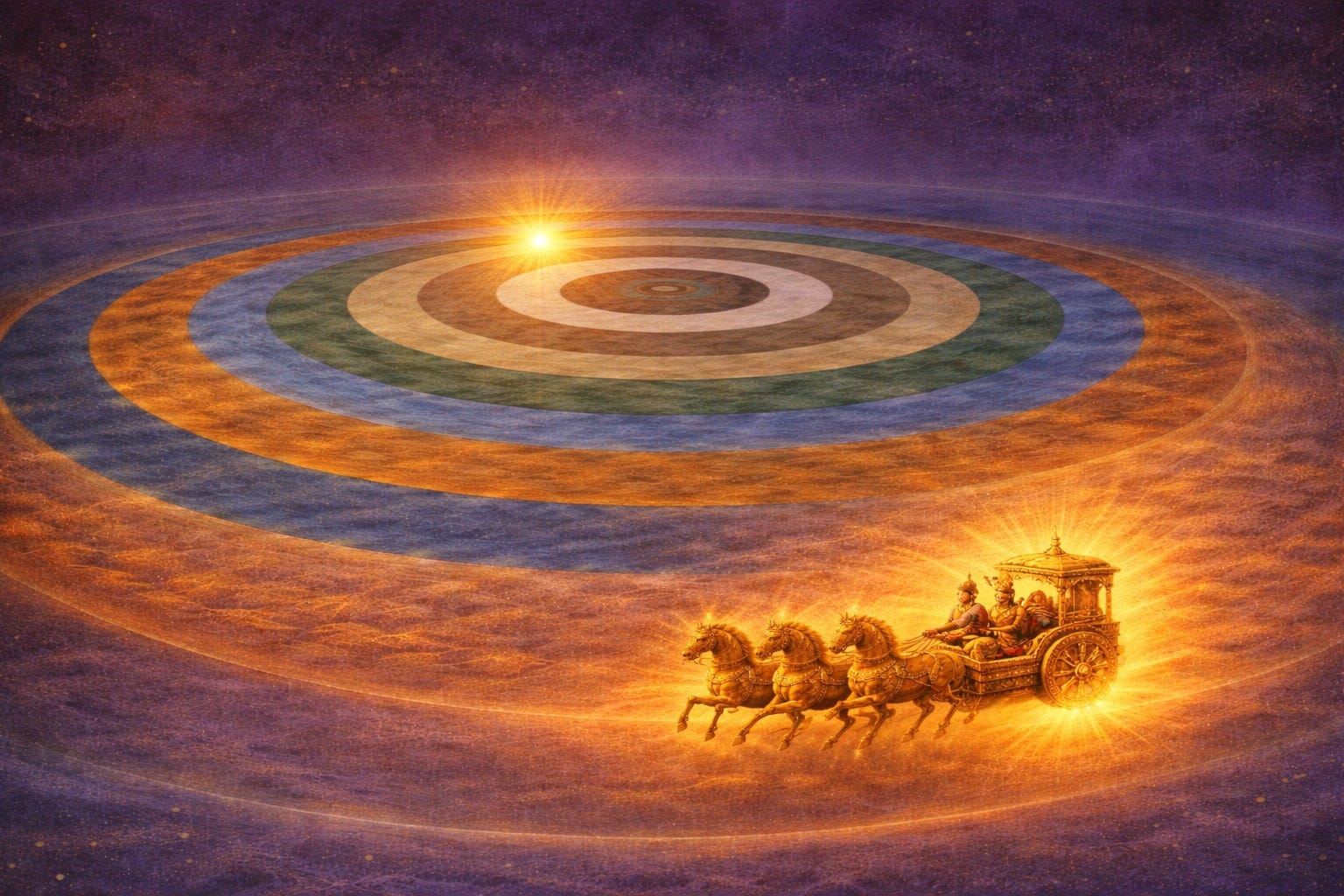
Apart from producing extra light, his circumambulation of Bhū-mandala did something else: it divided the planetary system into the seven great islands and oceans. The names of the islands are Jambūdvīpa, Plakṣadvīpa, Śālmalīdvīpa, Kuśadvīpa, Krauñcadvīpa, Śākadvīpa, and Puṣkaradvīpa, and each island is twice as broad as the one preceding it. This can be understood in the sense of different types of planets, containing different types of oceans, being formed in the early universe. According to the Śrīmad-Bhāgavatam, Priyavrata ruled in the first manvantara, very early in the universe’s history.
When we take into consideration Śrīdhara’s factor of two, the date for the beginning of the current day of Brahmā, and the start of the current cycle of creation is 4.562 billion years ago. Each manvantara lasts for 306.72 million years, which puts the beginning of the reign of Priyavrata at about 4.5 billion years ago.
In this context, it is interesting to note that in modern astrophysics, it is believed that the planets of our solar system were formed about 4.5 billion years ago, within the first 100 million years after the sun was formed, which corresponds precisely to the period of the first manvantara, very close to the period Priyavrata reigned. Coincidence?
Another point is that each of the islands that form Bhū-mandala is surrounded by a corresponding ocean, equal in breadth to the island it surrounds. We can observe that on our planet, the continents are surrounded by the ocean. In geology, it is believed that they were even closer in the past. Other planets spread around the universe may be similar in basic geography but contain other types of oceans.
However, after stating his question on SB 5.16.1-2, Maharaja Parīkṣit reveals the purpose of studying the Vedic model of the universe. It is not just an intellectual exercise, but a tool to help us to concentrate our minds on Kṛṣṇa.
“When the mind is fixed upon the Supreme Personality of Godhead in His external feature made of the material modes of nature — the gross universal form — it is brought to the platform of pure goodness. In that transcendental position, one can understand the Supreme Personality of Godhead, Vāsudeva, who in His subtler form is self-effulgent and beyond the modes of nature. O my lord, please describe vividly how that form, which covers the entire universe, is perceived.” (SB 5.16.3)
As Prabhupāda explains in his purport, ultimately nothing is material. Everything is an expansion of the energy of Kṛṣṇa, and what makes us see it as material is simply the covering of Māyā, which makes us see this universe as an object of our enjoyment. When we learn the art of seeing everything as connected with Kṛṣṇa and meant to be used in His service, this bewildering covering of Māyā is removed, and we can see the spiritual reality behind it.
Still, one could argue that instead of discussing the structure of the universe, it would be better to discuss Kṛṣṇa directly. To deflect this argument, Prabhupāda explains that Maharaja Parīkṣit Mahārāja had no need for geographical knowledge of the universe. Previously (in the Second Canto), Śukadeva Goswami had already described the universal form of the Lord, which frames the universe as an expansion of His energy. From that description, Maharaja Parīkṣit had already become fully Kṛṣṇa conscious. Why, then, did he ask for a description of the universe in the Fifth Canto?
The answer is that this is not just geographical knowledge: it is spiritual and transcendental. Because Parīkṣit was so fully absorbed in Kṛṣṇa consciousness, he could see the universe as an expansion of the energy of Kṛṣṇa and could thus see the description of the universe as fully connected with Him. If we study the description with the right attitude, we can also learn how to see it in the same light, which will help us to improve our Kṛṣṇa consciousness. As soon as the covering of Māyā is removed, we become fully happy and free from anxiety.
The modern description of the universe is very negative for our spiritual development. It teaches us to see the universe as something inert, which in turn leads us to develop an attitude of enjoyment or even exploitation. As long as we see it in this way, it becomes very difficult to see it as connected with Kṛṣṇa. This is one of the reasons Prabhupāda insisted on the construction of the Temple of the Vedic Planetarium, a place where people could learn about the Vedic model. Prabhupāda saw it as instrumental in bringing people to Kṛṣṇa consciousness.
He gives, then, an example that can help us to frame it in this light:
“In our preaching work also, we deal with so much property and money and so many books bought and sold, but because these dealings all pertain to the Kṛṣṇa consciousness movement, they should never be considered material. That one is absorbed in thoughts of such management does not mean that he is outside of Kṛṣṇa consciousness. If one rigidly observes the regulative principle of chanting sixteen rounds of the mahā-mantra every day, his dealings with the material world for the sake of spreading the Kṛṣṇa consciousness movement are not different from the spiritual cultivation of Kṛṣṇa consciousness.”
As long as we maintain ourselves in a platform of Kṛṣṇa consciousness, we can see everything as connected with Kṛṣṇa and engage everything in His service.
Read the whole book:
« Making Sense of the Vedic Universe, a Higher-Dimensional Reality
This is a publication for thoughtful readers who want to go deeper into Kṛṣṇa consciousness. I publish daily, trying to offer high-quality spiritual content, and all posts are available to free subscribers. If you wish, you can also choose a paid subscription to support this work.
You can also receive the updates on WhatsApp or Telegram.
If you would like to contribute further, you can find the donation links here.