

« Making Sense of the Vedic Universe, a Higher-Dimensional Reality
Krauñcadvīpa: the abode of the fearless mountain
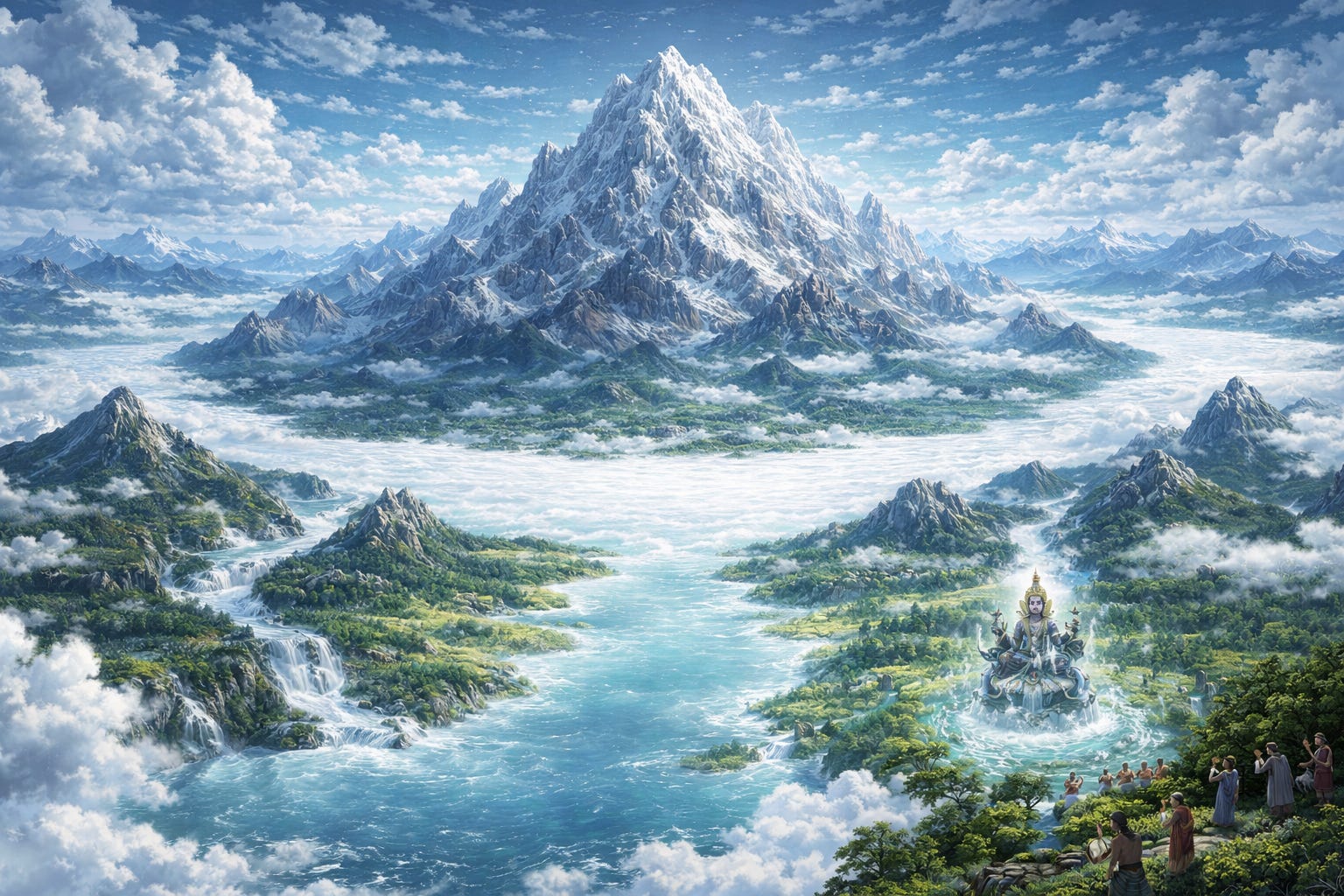
“Outside the ocean of clarified butter is another island, known as Krauñcadvīpa, which has a width of 1,600,000 yojanas [12,800,000 miles], twice the width of the ocean of clarified butter. As Kuśadvīpa is surrounded by an ocean of clarified butter, Krauñcadvīpa is surrounded by an ocean of milk as broad as the island itself. On Krauñcadvīpa there is a great mountain known as Krauñca, from which the island takes its name.
Although the vegetables living on the slopes of Mount Krauñca were attacked and devastated by the weapons of Kārttikeya, the mountain has become fearless because it is always bathed on all sides by the Ocean of Milk and protected by Varuṇadeva.
The ruler of this island was another son of Mahārāja Priyavrata. His name was Ghṛtapṛṣṭha, and he was a very learned scholar. He also divided his own island among his seven sons. After dividing the island into seven parts, named according to the names of his sons, Ghṛtapṛṣṭha Mahārāja completely retired from family life and took shelter at the lotus feet of the Lord, the soul of all souls, who has all auspicious qualities. Thus he attained perfection.
The sons of Mahārāja Ghṛtapṛṣṭha were named Āma, Madhuruha, Meghapṛṣṭha, Sudhāmā, Bhrājiṣṭha, Lohitārṇa and Vanaspati. In their island there are seven mountains, which indicate the boundaries of the seven tracts of land, and there are also seven rivers. The mountains are named Śukla, Vardhamāna, Bhojana, Upabarhiṇa, Nanda, Nandana and Sarvatobhadra. The rivers are named Abhayā, Amṛtaughā, Āryakā, Tīrthavatī, Rūpavatī, Pavitravatī and Śuklā.
The inhabitants of Krauñcadvīpa are divided into four castes, called the Puruṣas, Ṛṣabhas, Draviṇas and Devakas. Using the waters of those sanctified rivers, they worship the Supreme Personality of Godhead by offering a palmful of water at the lotus feet of Varuṇa, the demigod who has a form of water.
[The inhabitants of Krauñcadvīpa worship with this mantra.] O water of the rivers, you have obtained energy from the Supreme Personality of Godhead. Therefore you purify the three planetary systems, known as Bhūloka, Bhuvarloka and Svarloka. By your constitutional nature, you take away sins, and that is why we are touching you. Kindly continue to purify us.” (SB 5.20.18-23)
Krauñcadvīpa is again twice as broad as the previous island. This again makes the point that the planetary structure of Jambūdvīpa is not accidental, but an ordered and measured construction done by a conscious being.
In the Vedanta-sūtra, Vyāsadeva concludes: janmādy asya yataḥ, “Brahman, the Supreme Personality of Godhead, is He from whom everything emanates.”
Everything that exists is created by the Supreme Lord through His innumerable potencies. Nothing exists by chance; everything is the result of a conscious effort. Although Lord Viṣnu is not directly involved in the material creation, He creates the whole project of the universe during the primary creation. Brahmā simply sets the bricks, so to say. The structure of Bhū-mandala, with each island being twice as broad as the previous, is thus intentional, following the pattern of a lotus flower, as chosen by the Lord.
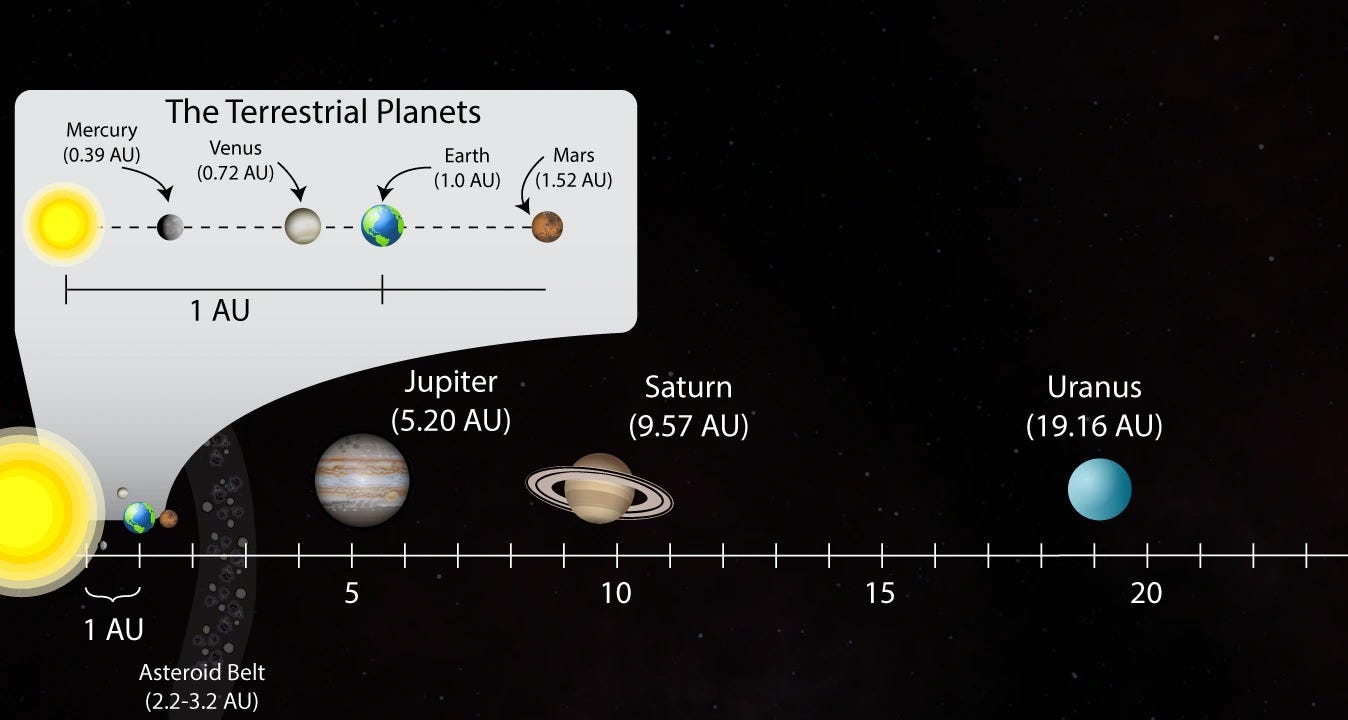
A similar pattern is also found in our solar system. In his research, Sadāpūta Prabhu found that when we calculate from a geocentric perspective, the orbits of the planets of the solar system form a mandala-like pattern with the limits of the orbits of the planets roughly matching the limits of the islands of Bhū-mandala, as described in the Śrīmad-Bhāgavatam.


This doesn’t mean Bhū-mandala is directly our solar system, but makes the point that the ordered patterns chosen by the Lord apply even to our gross reality. Even from the heliocentric perspective adopted in modern astronomy, the orbits of the planets and asteroid belts follow roughly a doubling pattern. The average orbital distances are as follows: Mercury, 0.39 AU; Venus, 0.72 AU; Mars, 1.52 AU; the middle of the main asteroid belt between Mars and Jupiter, 2.7 AU; Jupiter, 5.2 AU; Saturn, 9.57 AU; and Uranus, 19.16 AU.
Back to the description, the defining characteristic of Krauñcadvīpa is the great mountain Krauñca, which is bathed by the milk ocean. Once, during a war between the devas and asuras, Vāṇa, the son of Bali, took refuge in this mountain, leading Kārttikeya to attack it with his mystical weapons, disturbing the plants and animals there (this episode is described in the Mahābhārata, Śalya-parva). Despite this troubled past, the mountain is described as fearless, because it is protected by Varuṇa, the predominating deity of the island.
The names of the seven tracts of land that compose the dvīpa are Āma (the pristine abode), Madhuruha (the land of sweet fruits), Meghapṛṣṭha (the land capped by clouds), Sudhāmā (the excellent abode), Bhrājiṣṭha (the radiant land), Lohitārṇa (the red-tinted land), and Vanaspati (the land of great trees).
Apart from the Krauñca mountain, the island has seven other great mountains that separate the seven tracts of land. They are called Śukla (the shining mountain), Vardhamāna (the mount that supports growing), Bhojana (the giver of nourishment), Upabarhiṇa (the provider of paraphernalia for sacrifices), Nanda (the giver of happiness), Nandana (the giver of joy), and Sarvatobhadra (auspicious on all sides).
The rivers are named Abhayā (giver of fearlessness), Amṛtaughā (torrent of nectar), Āryakā (nourisher of dharma), Tīrthavatī (stream of pilgrimage sites), Rūpavatī (river of beauty), Pavitravatī (the stream of sanctified waters), and Śuklā (the milk-like stream).
The inhabitants of Jambūdvīpa are especially fortunate because they can purify themselves by bathing in the Ganges, which bathes all the nine tracts of land, including Bhārata-varṣa. The Ganges purifies one of all sins and directly awakens devotion to the Lord, being mixed with dust from His lotus feet. The inhabitants of the other islands don’t have the same facility directly, but they also have auspicious rivers that grant all kinds of positive traits and opulences, supporting their spiritual growth.
Just like in the other islands, the inhabitants of Krauñcadvīpa are also divided into four classes: Puruṣas (the guiding men), Ṛṣabhas (the bull-like ones), Draviṇas (the processors of wealth), and Devakas (divine servants). This again shows a varnāśrama-like structure, with the classes determined by people’s natural characteristics (and not by birth) and entirely dedicated to the service of the Lord, indirectly worshiped by the inhabitants of the island through Varuṇa, who is worshiped in deity form with with offerings of water from the different rivers that bathe the island.
Read the whole book:
« Making Sense of the Vedic Universe, a Higher-Dimensional Reality
This is a publication for thoughtful readers who want to go deeper into Kṛṣṇa consciousness. I publish daily, trying to offer high-quality spiritual content, and all posts are available to free subscribers. If you wish, you can also choose a paid subscription to support this work.
You can also receive the updates on WhatsApp or Telegram.
If you would like to contribute further, you can find the donation links here.