

« Making Sense of the Vedic Universe, a Higher-Dimensional Reality
Kṛṣṇa becomes the Puruṣa-avatāras
One of the differences between God and ordinary souls is that God is unlimited. He can thus assume unlimited forms, each of them unlimited in potency. While we can do only one thing at a time, Kṛṣṇa can perform unlimited pastimes simultaneously in His unlimited forms. Kṛṣṇa is the source of all Viṣnu forms, just like a candle used to ignite many other candles. All candles emit a similar light, but still, there is one candle that is the original. Among the unlimited Viṣnu forms, there are three that are important in relation to the creation of the material universes. These are the Puruṣa-avatāras.
They are explained in a somewhat enigmatic way in the first canto of the Śrīmad-Bhāgavatam:
“Sūta said: In the beginning of the creation, the Lord first expanded Himself in the universal form of the puruṣa incarnation and manifested all the ingredients for the material creation. And thus at first there was the creation of the sixteen principles of material action. This was for the purpose of creating the material universes. A part of the puruṣa lies down within the water of the universe, from the navel lake of His body sprouts a lotus stem, and from the lotus flower atop this stem, Brahmā, the master of all engineers in the universe, becomes manifest. It is believed that all the universal planetary systems are situated on the extensive body of the puruṣa, but He has nothing to do with the created material ingredients. His body is eternally in spiritual existence par excellence.
The devotees, with their perfect eyes, see the transcendental form of the puruṣa who has thousands of legs, thighs, arms and faces — all extraordinary. In that body there are thousands of heads, ears, eyes and noses. They are decorated with thousands of helmets and glowing earrings and are adorned with garlands. This form [the second manifestation of the puruṣa] is the source and indestructible seed of multifarious incarnations within the universe. From the particles and portions of this form, different living entities, like demigods, men and others, are created.” (SB 1.3.1-5)
What does it mean?
The scriptures explain that the spiritual planets comprise three-quarters of everything that exists. These spiritual planets are the abode of liberated souls and the stage for the performance of unlimited, eternal pastimes. The remaining quarter comprises the causal ocean and the material creation.
Around these spiritual planets is the light of the impersonal Brahmājyoti, where many impersonalists live. In a corner of this vast spiritual, blissful existence is the causal ocean (kāraṇodaka), which is the abode of Lord Mahā-Viṣnu, the first of the Puruṣa-avatāras, responsible for creating and maintaining the material world.
The waters of the causal ocean are fully spiritual and mark the boundary between the spiritual and material worlds. They serve as the border between the two. The causal ocean is also described as the Virajā River, emphasizing this idea of a border between the spiritual and material realms. In the metaphor, one of the banks represents the spiritual world, and the other represents the material energy, the external potency of the Lord.
Beyond the waters of the causal ocean, there is pradhāna, the unmanifested, undifferentiated amalgamation of all material elements, the place where all material elements remain dissolved in perfect equilibrium. Pradhāna is the material energy in its dormant state, with no variety, no activity, and no manifestation of the three material modes. Sometimes it is described as being like a cloud on top of the waters of the causal ocean, but without ever touching them.
One way to imagine this dissolved stage of the material elements is to imagine pradhāna as being like milk, which is a mixture of carbs, proteins, fats, etc., everything dissolved in a homogeneous liquid. This pradhāna is agitated by the glance of Lord Mahā-Viṣṇu, which contains three components: kāla (the time energy), all the souls who desire to participate in the material creation, and Lord Sadāśiva, who acts as a guardian for them.
Just as cream comes to the top when raw milk is left overnight, this contact with kāla makes the three material modes become apparent. This, in turn, leads to a series of permutations, resulting in the appearance of the material elements. These elements amalgamate with the seeds of the universes that emanate from the breath of Mahā-Viṣṇu, resulting in the many material universes in their inactive state.
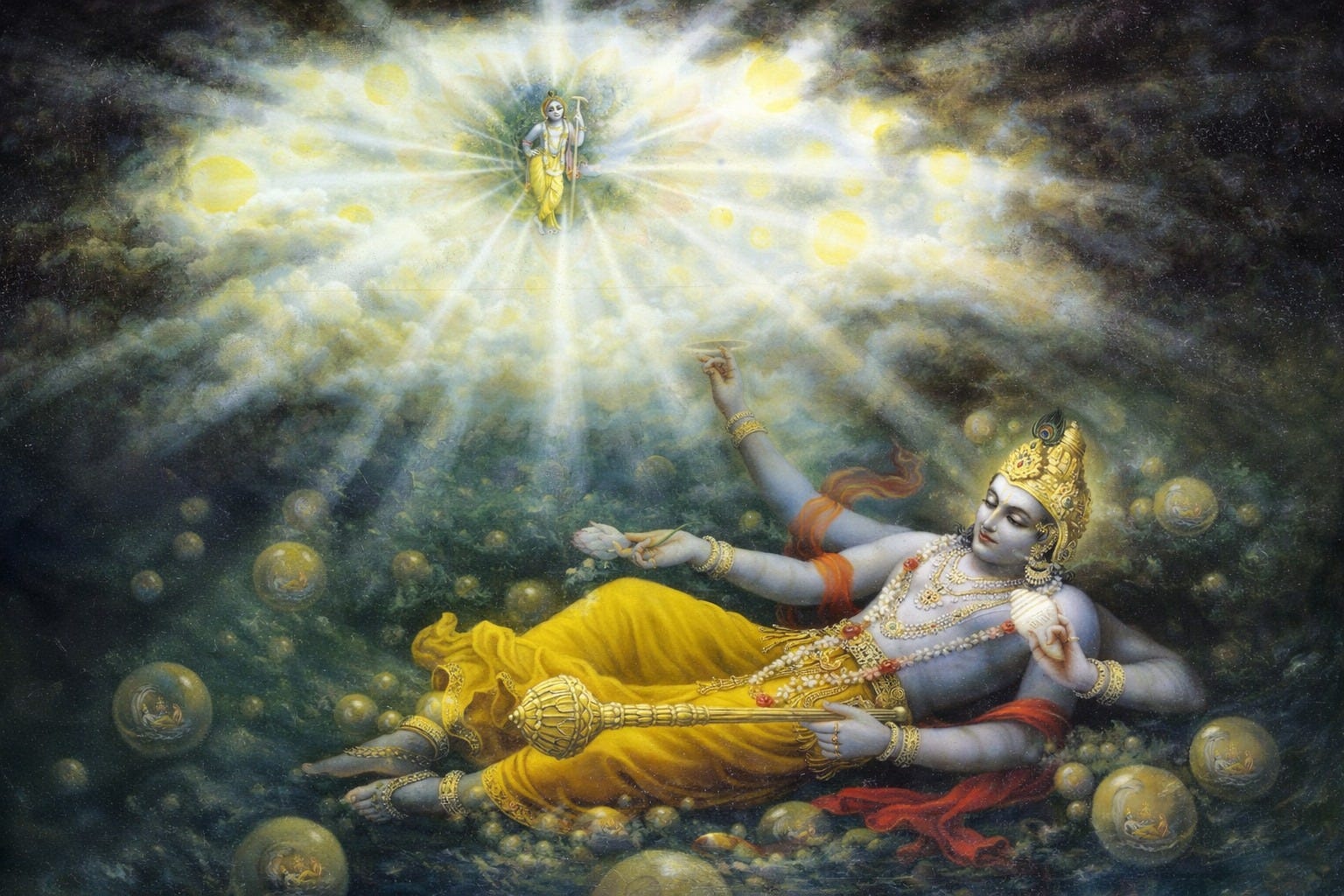
Sometimes we think that Mahā-Viṣṇu creates the universes already as fully formed balls of matter, but this view is not entirely correct. The universes are originally subtle, as reflections of the spiritual creation. They are covered by matter later on, as they move in the direction of the external potency. These innumerable universes float on top of the causal ocean, just like many balls or bubbles floating on water.
Great as it may be from our perspective, our universe is just one of these innumerable bubbles floating on the causal ocean. Since we can’t even estimate the limits of our own universe, it is impossible for us to understand the extent of the Lord’s creation.
However, just the appearance of huge balls of matter is not sufficient to create universes. After this process is completed, the Lord expands Himself and enters into each of these different universes as Garbhodakaśāyī Viṣnu. This is the form of the Lord who lies down on the Garbhodaka Ocean inside each universe. At first, the universe is empty, just like an empty shell, without any place to rest, so He fills half of it with water. Lord Śeṣa then manifests himself, acting as a bed, where the Lord comfortably rests.
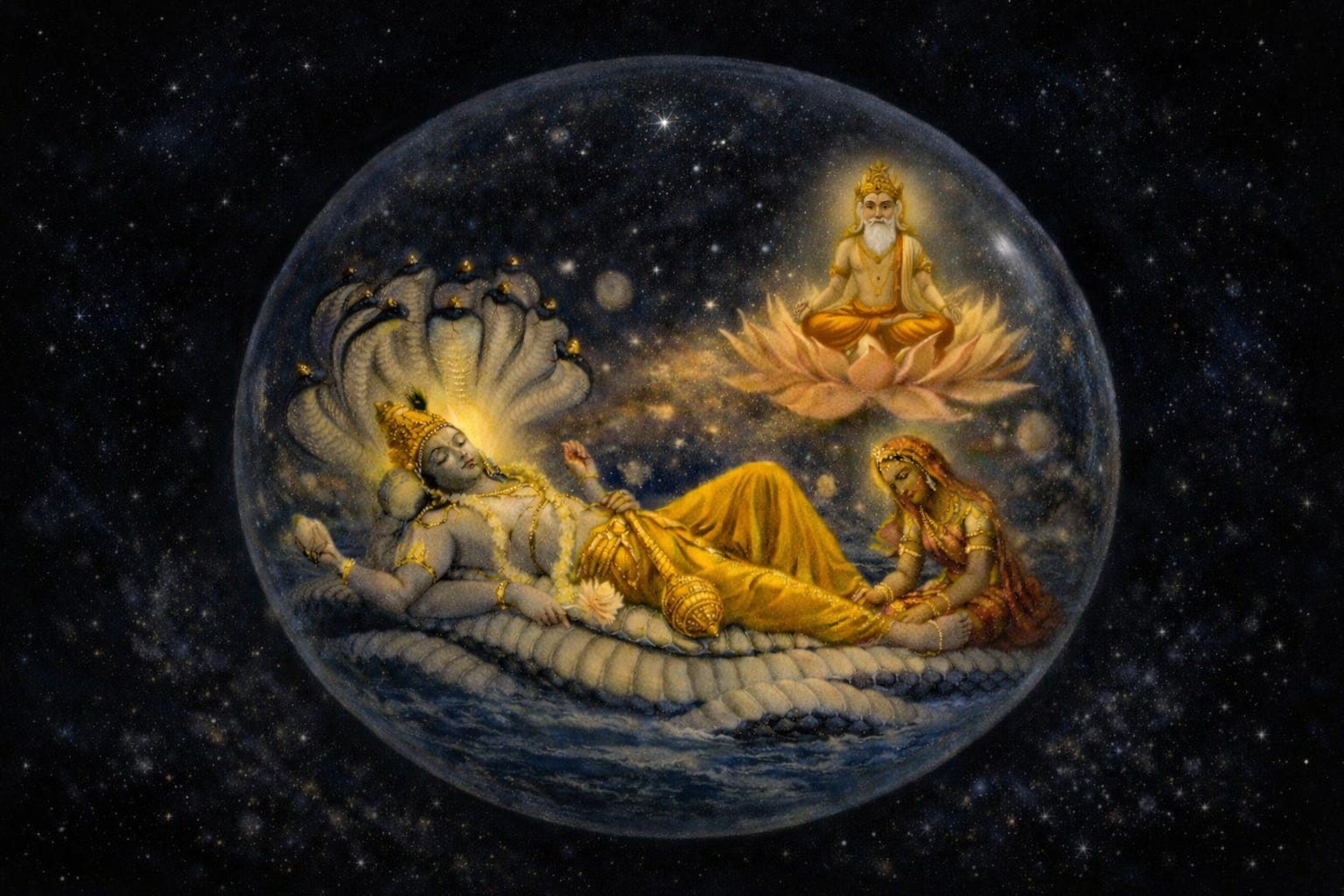
Garbhodakaśāyī Viṣnu then gives birth to Lord Brahmā through a lotus flower coming from His navel. Brahmā is called “unborn,” not because he lives eternally, but because, different from everyone else, he has no material father or mother. His father is Lord Viṣnu Himself.
The Lord then expands again and becomes Kṣīrodakaśāyī Viṣnu, entering into everything as Paramātma, appearing in the heart of all living beings and even inside the atoms. We often think that there is a separate form of Paramātma in each living being and every atom, but in reality, there is just one Kṣīrodakaśāyī Viṣnu who sees everything and is present everywhere, just like the sun is one but at the same time shines everywhere.
The same Kṣīrodakaśāyī Viṣnu lives on a small island on the ocean of milk on the Polestar. This is the form of Lord Viṣnu to whom the demigods pray when they are defeated by the demons, as described in different pastimes of the Śrīmad-Bhāgavatam.
Lord Kṣīrodakaśāyī Viṣnu is also known as Lord Hari, and He is the source of all the different incarnations that appear in this universe. Kṛṣṇa appears as unlimited incarnations in the different universes. He appears as the different forms of Viṣnu to create and maintain the universes, He comes to perform different pastimes (līlā-avatāras), He comes in every age to teach dharma (yuga-avatāras), He appears as an incarnation during the reign of each Manu (manvantara-avatāras), He empowers different living beings to perform wonderful activities (śaktyāveśa-avatāras), and so on. All these incarnations appear as expansions of Lord Kṣīrodakaśāyī Viṣnu.
There are thus three different forms of Viṣnu who participate in the creation of the material universes. They are all partial expansions of Kṛṣṇa but perform different roles. As Prabhupāda explains in his purport to SB 6.16.37:
“The origin of the material creation is Mahā-Viṣṇu, who lies in the Causal Ocean. While He sleeps in that ocean, millions of universes are generated as He exhales, and they are all annihilated when He inhales. This Mahā-viṣṇu is a plenary portion of a portion of Viṣṇu, Govinda (yasya kalā-viśeṣaḥ). The word kalā refers to a plenary portion of a plenary portion. From Kṛṣṇa, or Govinda, comes Balarāma; from Balarāma comes Saṅkarṣaṇa; from Saṅkarṣaṇa, Nārāyaṇa; from Nārāyaṇa, the second Saṅkarṣaṇa; from the second Saṅkarṣaṇa, Mahā-viṣṇu; from Mahā-viṣṇu, Garbhodakaśāyī Viṣṇu; and from Garbhodakaśāyī Viṣṇu, Kṣīrodakaśāyī Viṣṇu. Kṣīrodakaśāyī Viṣṇu controls every universe. This gives an idea of the meaning of ananta, unlimited. What is to be said of the unlimited potency and existence of the Lord? This verse describes the coverings of the universe (saptabhir daśa-guṇottarair aṇḍa-kośaḥ). The first covering is earth, the second is water, the third is fire, the fourth is air, the fifth is sky, the sixth is the total material energy, and the seventh is the false ego. Beginning with the covering of earth, each covering is ten times greater than the previous one. Thus we can only imagine how great each universe is, and there are many millions of universes.”
Brahmā lives for 311.04 trillion years, which corresponds to 100 years in his perspective. What happens at the end of this period? At the end of his life, the creation is withdrawn, and all the souls who were taking part in it merge back into the body of Mahā-Viṣṇu for a very long sleep during the inactive phase of the material manifestation. The material energy then returns to its original state as pradhāna.
The idea of the jīvas merging into the body of Mahā-Viṣṇu may sound strange at first, but it doesn’t mean they lose their identity. It’s just like a fish entering the ocean or a bird entering a tree. It simply describes proximity, not loss of identity.
In this way, we can see that all the components of the material creation are different potencies of the Lord. Mahā-Viṣṇu is His expansion, who lies on the causal ocean, which is a feature of His spiritual potency. Both pradhāna and māyā are features of His external potency. The time-energy and the jīvas are also potencies of the Lord, just as Lord Sadāśiva. The material elements and the cosmic manifestation itself are nothing more than the same material energy previously present in the pradhāna after being agitated by the contact with these different potencies.
The material energy is also spiritual in nature, being one of the potencies of the Lord. However, the presence of Māyā, the illusory potency, makes us see it as separate from the Lord, as an object of our enjoyment. This is what makes the cosmic creation appear material. The material creation is thus illusory, but it is not false. The Lord appears inside of it in many different incarnations, but He never comes in contact with the material energy and never falls under the control of Māyā. Because He remains transcendental, He can free us if we so desire.
Read the whole book:
« Making Sense of the Vedic Universe, a Higher-Dimensional Reality
This is a publication for thoughtful readers who want to go deeper into Kṛṣṇa consciousness. I publish daily, trying to offer high-quality spiritual content, and all posts are available to free subscribers. If you wish, you can also choose a paid subscription to support this work.
You can also receive the updates on WhatsApp or Telegram.
If you would like to contribute further, you can find the donation links here.