


You can receive new articles directly in your inbox. Subscription is free; donations are welcome.
If we pay attention, we can find an apparent contradiction in the 11th chapter of the Gītā. In text 52, Kṛṣṇa says:
“The Supreme Personality of Godhead said: My dear Arjuna, this form of Mine you are now seeing is very difficult to behold. Even the demigods are ever seeking the opportunity to see this form, which is so dear.”
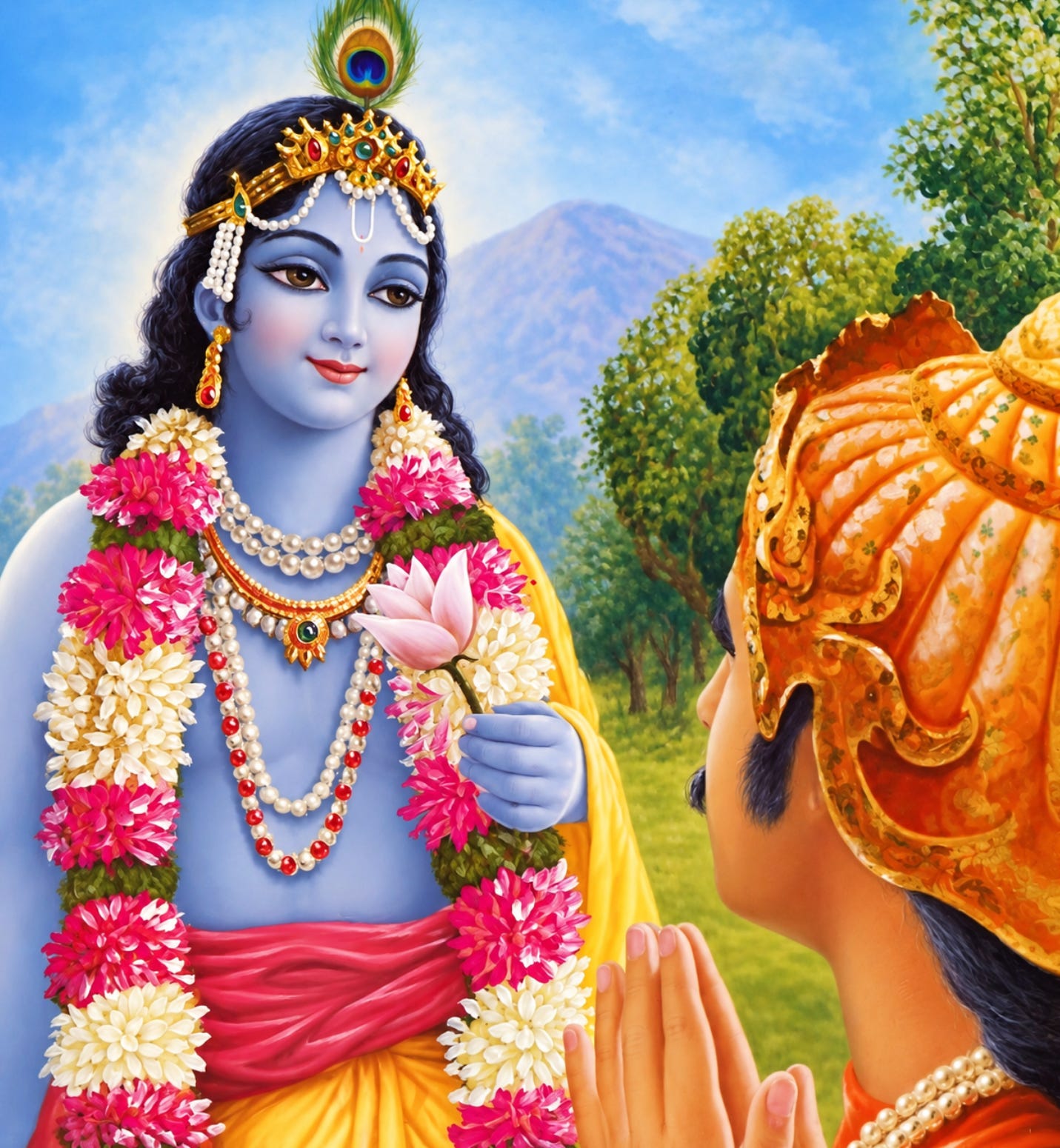
Here, Kṛṣṇa mentions that He is very difficult to behold, and even demigods cannot see Him. At the same time, however, when He was present on earth, everyone could see Him, including even common people. How can this two ideas be reconciled?
Bhaktivinoda Ṭhākura deals with this question in his Rasika-Rañjana commentary. He explains that there are three levels at which one can see Kṛṣṇa: avidvat-pratīti, yauktita-pratīti, and vidvat-pratīti. In the three levels, one sees something, but only in the third level can one truly see Kṛṣṇa. In the other two, Kṛṣṇa remains covered by His yoga-māyā potency.
What are these levels?
Avidvat-pratīti means perception without knowledge. This is the level of common people. They see Kṛṣṇa with their material eyes and material minds, and as a result they can’t at all perceive Him. They think He is just an ordinary man. We can see that many demons who encountered Kṛṣṇa, such as Śiśupāla, had this mentality.
The second level, yauktita-pratīti, means logical perception. This is the view of jñānis and others who are proud of their knowledge, including even demigods. Demigods, of course, are devotees, and many of them came to meet Kṛṣṇa, but this was due to His mercy, and not to their own personal ability. We can thus say that demigods cannot see Kṛṣṇa, but sometimes they meet Kṛṣṇa by His mercy, when He desires to show Himself to them. One example of this is Brahma. Even though Kṛṣṇa was present on earth, Brahmā could not recognize Him at first, and even kidnapped His cowherd boys to test His power. Only later, when Kṛṣṇa showed him His potency, could Brahmā understand, by His mercy.
If even demigods cannot see Kṛṣṇa by their own power, what to say about others? Those who rely only on their knowledge and intellect end up concluding that Kṛṣṇa must be subordinate to Brahman or the universal form. They then accept Kṛṣṇa as just a temporary worshipable form. Again, they fail to see Him.
Modern speculators conclude that it is not to Kṛṣṇa that we should surrender, but to the eternal unborn speaking through Him, but those who receive the Gitā through the disciplic succession accept Kṛṣṇa’s words and Arjuna’s conclusion.
Who can see Kṛṣṇa then? Only devotees can truly see Kṛṣṇa, for they have spiritual eyes by which they directly experience Kṛṣṇa’s spiritual form, the supreme abode of eternity, knowledge, and the ultimate expression of spiritual bliss. This is called vidvat-pratīti (perception with real knowledge), and is achievable only through pure devotion, as in the case of Arjuna.
Without devotion, even study, austerity, charity, and sacrifice cannot produce this realization. The human brain cannot penetrate the covering of yoga-māyā, and thus all speculative interpretations will fail to reveal Kṛṣṇa. One also cannot find Him by just officially following some religious process. Only one who develops pure devotion by receiving transcendental knowledge through the process of paramparā and practicing the devotional process with faith can come to understand Kṛṣṇa as He is.
This conclusion is offered by Kṛṣṇa Himself in the last two verses of the chapter: Kṛṣṇa can be understood as He is only by undivided devotional service. This is the only process by which one can see Kṛṣṇa directly. For others, He is a great mystery.
In his purports to the two verses, Prabhupāda summarizes the whole process of devotional service, from the beginning of the devotional practices, all the way to the point of dedicating our whole existence to Kṛṣṇa.
Interested?
Here is an expansion of the points he makes:
1) The first point is that Kṛṣṇa can be understood only through undivided devotional service. Although the study of the Vedas, austerity, charity, and even worship are not sufficient to reveal Kṛṣṇa independently, they become effective when practiced with a devotional attitude. Bhakti is thus the active principle of any effective process of self-realization.
2) What are the practical examples? As penance, we can fast on Janmāṣṭamī and on Ekādaśīs. For charity, we can give money to devotees who are engaged in devotional service, spreading Kṛṣṇa consciousness throughout the world, and worship should be offered in temples of Kṛṣṇa. Worship in the temple is essential, especially in the beginning of the process.
3) We should be guided in the spiritual process by a bona fide spiritual master, who is a faithful representative in the disciplic succession. Without the guidance of a spiritual master, we will get lost and will not be able to even begin to understand Kṛṣṇa. Just as we have faith in Kṛṣṇa, we should have a similar faith in the spiritual master, accepted as His representative. Prabhupāda connects this point with the words bhaktyā tv ananyayā śakya in the verse (only by undivided devotional service can I be understood as I am), because accepting a bona fide spiritual master is the very beginning of the process of devotional service, as explained by Kṛṣṇa in chapter four. There are different types of spiritual masters—the vartma-pradarśaka-guru, dīkṣā-guru and śikṣā-gurus—and Prabhupāda himself serves as the main instructing guru through his books. The point is that we should always be under guidance to be able to advance. No one can come to Kṛṣṇa independently.
4) On the other hand, by repeatedly hearing about Kṛṣṇa from authoritative sources, we develop affection for Him. From this initial affection, we can fully engage in devotional service, practicing the nine devotional processes: hearing, chanting, remembering, worshiping, serving the lotus feet of the Lord, offering prayers, carrying out the orders of the Lord, making friends with Him, and surrendering everything to Him. Even one of these nine processes, when perfected, can lead us to the supreme goal, and by practicing under the guidance of the spiritual master, we can avoid the many traps that can prevent our advancement.
5) By following this process, we can understand whom we are worshiping. Kṛṣṇa is the original Supreme Personality of Godhead, and He is the source of Nārāyaṇa and all other expansions.
6) As our devotion develops, Kṛṣṇa’s personal form becomes the center of our attraction, because in His personal form Kṛṣṇa inspires loving devotion, and reciprocates with our service. This is exemplified in the case of Arjuna, who prefers to see Kṛṣṇa instead of the powerful universal form.
7) The ultimate goal of life is to revive our eternal relationship with Kṛṣṇa and return to Him, back home, back to Godhead. The Bhagavad-gītā is meant to help us attain that, and the process of attainment is devotional service.
8) We should invest our energy in serving Kṛṣṇa. Material life means seeing ourselves as the proprietors and enjoyers, while Kṛṣṇa consciousness means working for Kṛṣṇa. One can work according to one’s inclinations and means. A rich man can dedicate his business to Kṛṣṇa, accepting Him as the real proprietor and using the results to advance His mission. Instead of constructing a big building just for one’s prestige or comfort, one can construct a nice temple for Kṛṣṇa, establish His worship there, and use this temple to bring Kṛṣṇa consciousness to others.
Making one’s house a temple of Kṛṣṇa does not prevent one from living there, and making one’s company Kṛṣṇa’s company does not prevent one from acting as the CEO or executive head there, just as offering a preparation to Kṛṣṇa does not prevent one from accepting the prasāda. There is, however, a great change in consciousness that makes all the difference. Similarly, if one has a garden, one can cultivate tulasīs, as well as flowers and fruits for Kṛṣṇa, and even if we have no material asset or talent that can be directly used for Kṛṣṇa, then we can simply offer our work, cleaning the temple, plowing the land, etc.
9) We should make Kṛṣṇa the highest goal of life, rejecting not only immediate sense gratification, but even promotion to the higher planets or to the impersonal Brahman. Our desire should be fixed in attaining the association of Kṛṣṇa in Goloka Vṛndāvana. With this goal in mind, we should always engage ourselves in the nine processes of devotional service, culminating with full surrender to Kṛṣṇa.
10) Throughout this process, we should dissociate ourselves from all forms of material contamination that create obstacles to the development of our devotional service, including the different forms of material desires, ambitions, and speculative pursuits. We should also give up the association of persons who are inimical to Kṛṣṇa, remaining without enmity, but not associating closely. Our devotional service should become free from separate material desires and be cultivated favorably for the pleasure of Kṛṣṇa. When we complete this process, we come to the platform of pure devotional service.
11) A devotee of Kṛṣṇa is friendly to everyone. This means a devotee understands that Kṛṣṇa consciousness is the only real solution for all the problems of life, and thus works to spread it among all classes, even to the point of risking his life. This is the most powerful method for attracting the mercy of Kṛṣṇa.
As Prabhupāda concludes:
“A Kṛṣṇa conscious person knows that if a man is suffering it is due to his forgetfulness of his eternal relationship with Kṛṣṇa. Therefore, the highest benefit one can render to human society is relieving one’s neighbor from all material problems. In such a way, a pure devotee is engaged in the service of the Lord. Now, we can imagine how merciful Kṛṣṇa is to those engaged in His service, risking everything for Him. Therefore it is certain that such persons must reach the supreme planet after leaving the body.”
12) At the highest level of devotional service, a devotee does not even desire to attain Goloka Vṛndāvana. His goal becomes not liberation, or even the direct association of Kṛṣṇa, but simply the service itself. At this stage, a devotee simply desires to serve Kṛṣṇa wherever he may be. His service is not conditioned on attaining liberation or not. This supremely selfless desire to serve Kṛṣṇa is the fullest expression of devotion.
Read more:


This is a publication for thoughtful readers who want to go deeper into Kṛṣṇa consciousness. I publish daily, trying to offer high-quality spiritual content, and all posts are available to free subscribers. If you wish, you can support this work with a monthly contribution. When you subscribe, you can choose between a free subscription and a monthly contribution, and you can switch from a free subscriber to a supporter at any time.
You can also receive updates on WhatsApp or Telegram.
If you would like to contribute further, you can find the donation links here.