

« The Song of God—Volume 1, chapters 1-6
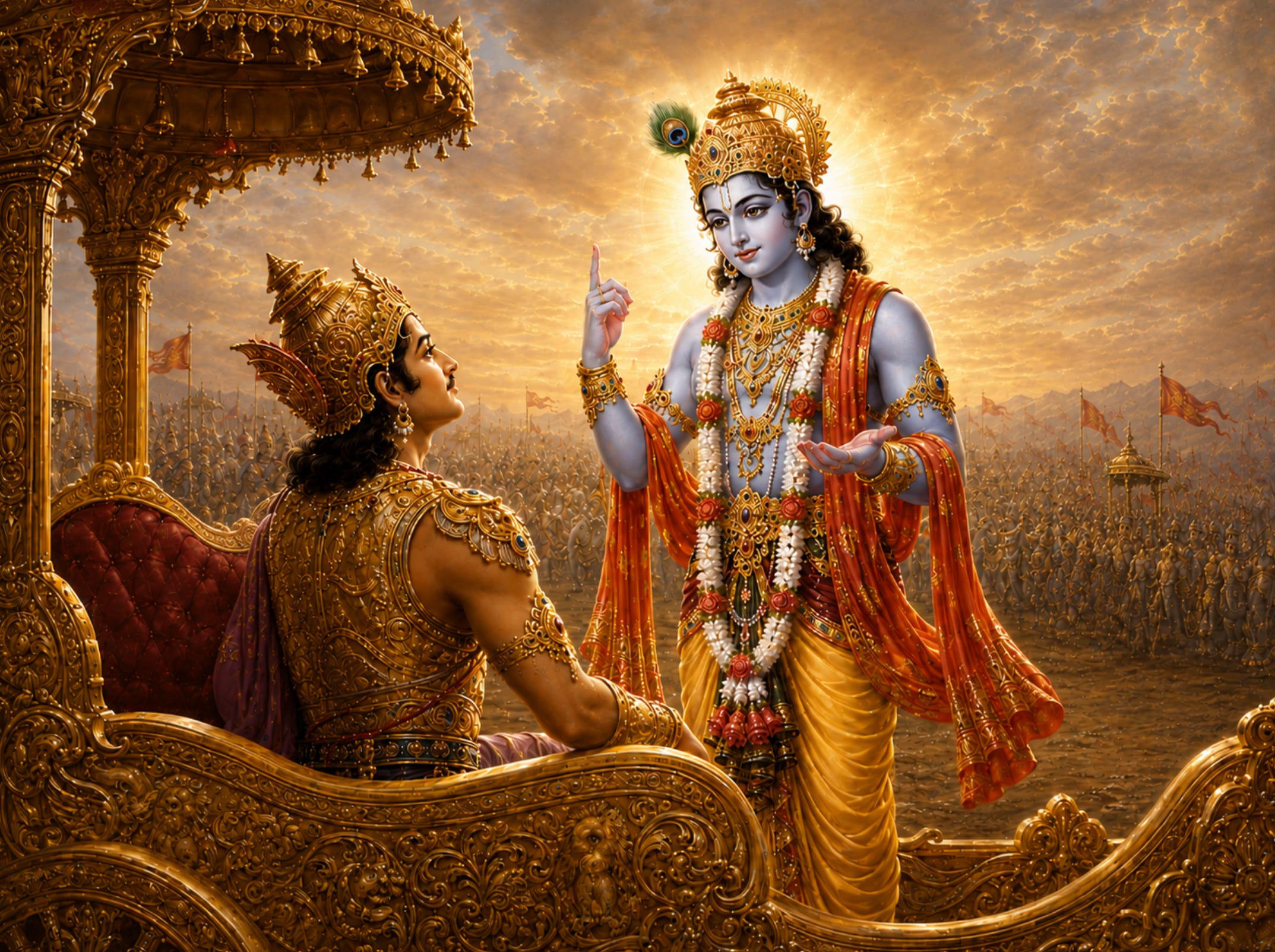
Kṛṣṇa explains the path of buddhi-yoga (Bg 2.39 to 2.41)
After laying the foundation of detached work, Kṛṣṇa now turns to the practical process of buddhi-yoga, working for Kṛṣṇa in spiritual knowledge, which will be further described in the following sections. “I am the soul” is just the first step. After that, we need to learn to act as a soul. A person in material consciousness is constantly distracted by many different thoughts and plans, but once we come to the platform of real Kṛṣṇa consciousness, we can become fixed and resolute in purpose, connected with our real, eternal nature.
Text 39: eṣā te ’bhihitā sānkhye, buddhir yoge tv imām śṛṇu
buddhyā yukto yayā pārtha, karma-bandham prahāsyasi
Thus far I have described this knowledge to you through analytical study. Now listen as I explain it in terms of working without fruitive results. O son of Pṛthā, when you act in such knowledge you can free yourself from the bondage of works.
Text 40: nehābhikrama-nāśo ’sti, pratyavāyo na vidyate
sv-alpam apy asya dharmasya, trāyate mahato bhayāt
In this endeavor there is no loss or diminution, and a little advancement on this path can protect one from the most dangerous type of fear.
Text 41: vyavasāyātmikā buddhir, ekeha kuru-nandana
bahu-śākhā hy anantāś ca, buddhayo ’vyavasāyinām
Those who are on this path are resolute in purpose, and their aim is one. O beloved child of the Kurus, the intelligence of those who are irresolute is many-branched.
The arguments Kṛṣṇa gives from verses 2.11 to 2.38 are well-founded in logic. He analyzes the situation from different points of view and concludes that Arjuna should fight because this is the course of action that will bring the best results not only for him but for all his relatives. This type of logical philosophical analysis is called Sāṅkhya, and because it is connected with devotional service to the Lord, it is called sāṅkhya-yoga. In this verse, the connection between sāṅkhya-yoga and buddhi-yoga is established. Kṛṣṇa uses the analytical description of the body and the soul and the results of fruitive activities to bring him to the platform of buddhi-yoga, working for Kṛṣṇa without material attachment and with deep philosophical understanding.
In his purport, Śrīla Prabhupāda takes time to explain the difference between the three types of Sāṅkhya. The first is the original, devotional Sāṅkhya philosophy described by Lord Kapila to his mother Devahūti at the beginning of the current day of Brahmā, which is explained in the Third Canto of Śrīmad-Bhāgavatam. The second is the atheistic Sāṅkhya, propagated by the false Kapila during the last Dvāpara-yuga. Although loosely based on the Vedas, this is a mistaken philosophical system that Vyāsadeva debunks in the Vedānta-sūtra. What Kṛṣṇa describes here is, however, a third type of Sāṅkhya, disconnected from the other two. The process of sāṅkhya-yoga mentioned here is just an analytical description of the body and the soul, enunciated by the Lord to bring Arjuna to the point of buddhi-yoga, or bhakti-yoga.
On the other hand, because both the Sāṅkhya enunciated by Lord Kapila and the analytical knowledge offered by Kṛṣṇa here are aimed at reestablishing our relationship with the Lord, they are simultaneously one and the same, since both are connected with the process of bhakti-yoga. This may sound ambiguous, but that’s just how it works in the transcendental platform. Just like the soul and Kṛṣṇa are simultaneously one and different, most other philosophical points also have multiple points of view that are reconciled when we understand the truth behind them. Prabhupāda explains these points in his purport to text 39:
“Thus the buddhi-yoga mentioned in this verse is the devotional service of the Lord, and the word Sāṅkhya mentioned herein has nothing to do with the atheistic sānkhya-yoga enunciated by the imposter Kapila. One should not, therefore, misunderstand that the sānkhya-yoga mentioned herein has any connection with the atheistic Sāṅkhya. Nor did that philosophy have any influence during that time; nor would Lord Kṛṣṇa care to mention such godless philosophical speculations. Real Sāṅkhya philosophy is described by Lord Kapila in the Śrīmad-Bhāgavatam, but even that Sāṅkhya has nothing to do with the current topics. Here, Sāṅkhya means analytical description of the body and the soul. Lord Kṛṣṇa made an analytical description of the soul just to bring Arjuna to the point of buddhi-yoga, or bhakti-yoga. Therefore, Lord Kṛṣṇa’s Sāṅkhya and Lord Kapila’s Sāṅkhya, as described in the Bhāgavatam, are one and the same. They are all bhakti-yoga.”
Now, starting from text 2.39, all the way to text 2.53, Kṛṣṇa explains the process of buddhi-yoga.
There are two basic levels inside the process of working in Kṛṣṇa consciousness described in the Bhagavad-gītā: sakāma-karma-yoga, and niṣkāma-karma-yoga. Before coming to these two levels, there are two other lower levels: sinful action (vikarma) and karma-kānda (pious fruitive activity).
Everything starts with the lowest level, sinful action, executed out of whimsical desire, against the principles of the scriptures. The next level is karma-kānda, the materialistic process of piety offered in the Vedas, where one follows religious principles in exchange for material progress and elevation to the celestial planets after death. Karma-kānda is still materialistic, but it at least gives a path for progression.
The next level is sakāma-karma-yoga, which is where the path of devotional service begins. Sakāma-karma-yoga means one tries to serve Kṛṣṇa from a platform where one still has material desires and is attached to the results. On this platform, one offers the results of his work to Kṛṣṇa, and in this way gradually becomes purified of these desires. One may have the desire to eat nice food, for example, but by cooking it for Kṛṣṇa, offering it to Him, and then accepting the prasādam, this desire is connected with the Lord, and thus purified. Offering the results of one’s work to Kṛṣṇa does not necessarily mean one is deprived of them, but that one accepts the supremacy of the Lord and receives His prasādam. The fact that one builds a big house and makes it a temple of the Lord does not prevent him from living there. Thus, the desire to live in a beautiful house can be reconciled with the service of the Lord.
As one gradually becomes detached from sense enjoyment and from the desire to enjoy the results of his activities, one gradually comes to the stage of simply working for Kṛṣṇa, without being concerned about results. This is the stage of niṣkāma-karma-yoga, which is a higher, purer form of karma-yoga. Finally, when we speak directly about a devotee who works for Kṛṣṇa without attachment and with deep philosophical understanding, we call it buddhi-yoga: a firm connection with Kṛṣṇa through the use of intelligence.
Śrīla Prabhupāda gives a deep explanation of the process in his purport to text 2.39:
“One should therefore understand that buddhi-yoga means to work in Kṛṣṇa consciousness, in the full bliss and knowledge of devotional service. One who works for the satisfaction of the Lord only, however difficult such work may be, is working under the principles of buddhi-yoga and finds himself always in transcendental bliss. By such transcendental engagement, one achieves all transcendental understanding automatically, by the grace of the Lord, and thus his liberation is complete in itself, without his making extraneous endeavors to acquire knowledge.”
In this way, in texts 2.39 to 2.53, Kṛṣṇa gives a summary study of the different levels of the process of karma-yoga, which will be explained in more detail in the next chapters of the Bhagavad-gītā, culminating in buddhi-yoga. It’s important to note that although there is a technical distinction between these different processes, which is useful for understanding the differences and progressing through these different phases, these are all different stages in the process of devotional service.
Karma is the basic force that binds us to the material world. The results of our past activities not only force us to accept material bodies one after the other, but also determine the situation we live in, the type of body and mental disposition we have, and even the way we think!
It may be hard to accept, but the way we think now is not based on what we are or even what we currently want, but is just a result of our previous activities in this material world. Because of our previous activities, we are put in a certain condition of life, and due to the particular influence of the three modes we receive in such a condition, we think in a particular way. If we somehow end up receiving the body of a dog, we will start barking like a dog; if we receive the body of a demigod, we will start acting like a demigod, and so on. The way we think now is thus more a result of our past karma than of our current desire.
The process of becoming free from material contamination thus involves becoming free from karma, which is really possible only by the process of devotional service, since other processes may destroy the results of past actions, but they can’t extinguish the material desire that burns inside the heart, and as long as material desires are there, we will be impelled to material action, which will create new karma, keeping us entangled in the same circle.
The instructions Kṛṣṇa gives us here are intended to elevate us to the path of bhakti-yoga, and that’s why He mentions that “O son of Pṛthā, when you act in such knowledge you can free yourself from the bondage of works.”
Apart from being the only process capable of completely destroying the seed of material desire from inside the heart, devotional service has another property: it’s eternal, and it awards transcendental results even when done imperfectly. In the material world, all endeavors award results only when completed. I may bake a very beautiful birthday cake, but if I don’t deliver it in time, I won’t get any money for it. Even Vedic sacrifices award pious results only if successfully completed. The results of devotional service, however, are awarded directly by the Lord, who takes into consideration one’s intention. Different from demigods, who award results according to one’s practical actions, the Lord is present inside the heart, and He rewards His devotees based on their sincerity. There are cases of devotees attaining perfection by just performing devotional service mentally, without performing physical actions at all. Because the results of practicing devotional service are purely spiritual, they follow the soul and continue with us even when we change to a new body. Devotional service executed in this life leads to more opportunities to practice devotional service in future lives, and as the results accumulate, our consciousness changes, and we become more serious on the spiritual path, up to the point of achieving pure love for Kṛṣṇa. We can thus see that our activities in devotional service are the most important and sublime part of our lives. This is the meaning of the Lord saying that “there is no loss or diminution”.
When He says that “a little advancement on this path can protect one from the most dangerous type of fear” (sv-alpam apy asya dharmasya, trāyate mahato bhayāt), He refers to the possibility of falling back into the animal species, losing our higher human consciousness, by which we can understand Him. Even a little devotional service awards us a human body in our next life, by which we can continue. Later, Kṛṣṇa reveals that when a devotee tries to develop his devotional service in this life but is not capable of concluding the process, he takes his next birth in a pious or rich family, where he has a comfortable life and facilities for continuing his service. If this is the result for those who fail, we can only imagine the prize for those who succeed.
In text 2.41, Kṛṣṇa mentions that those who are seriously practicing the process of Kṛṣṇa consciousness have resolute intelligence and a single goal (vyavasāyātmikā buddhir ekeha). The word vyavasāyātmikā in the first line is a compound word that breaks into vyavasāya (determination, resolve) and ātmikā (one’s nature). Buddhir means intelligence, and ekeha is the combination of eka (one) and iha (in this world), indicating a single-pointed aim. Conversely, bahu-śākhā hy anantāś ca, buddhayo ’vyavasāyinām: the intelligence of those who are irresolute is many-branched. Because their minds are full of material desires, their intelligence becomes absorbed in making plans to satisfy such desires, and because the desires of the mind are unlimited, the plans of the intelligence to satisfy them are also unlimitedly branched.
How is it that the intelligence of devotees who are serious about the process of Kṛṣṇa consciousness becomes resolute and fixed, unlike that of regular materialists? Because they renounce the material conception of life. If I believe I’m the body and mind, I will surely identify with the needs of the body and the desires of the mind, thinking they are my needs and desires. My intelligence will then work to satisfy these, and because they are unlimited, my intelligence will always hop from one material plan to the other, without an end. This is what we call material life. When, however, I understand that I’m not the body or the mind, these needs and desires become very distant. When a man is attracted to a woman, he will identify with her and work very hard to try to satisfy all her desires, but the same man will not be at all willing to satisfy the desires of some random woman he has no relationship with. When we are able to renounce this bodily concept of life, we start identifying with our real nature as souls, and as souls, we have only one desire, which is to please Kṛṣṇa. When all material desires are taken away, this single, intrinsic spiritual nature manifests. Then the intelligence also becomes purified and starts to work to satisfy this sole desire, becoming firmly fixed on this single goal of self-realization. This is the meaning of vyavasāyātmikā buddhir, ekeha.
By practicing Kṛṣṇa consciousness, such an enlightened soul renders the best service to everyone, including his family, country, etc., just as one who waters the root of a plant automatically serves the branches and leaves. As Prabhupāda mentions: “If Kṛṣṇa is satisfied by one’s actions, then everyone will be satisfied.”
This determination in the process of Kṛṣṇa consciousness is, however, not just sentimental. As Śrīla Prabhupāda mentions in his purport to verse 2.41, it is based on knowledge. One who is now sentimental about Kṛṣṇa consciousness will be sentimental about something else tomorrow. Without solid spiritual knowledge and realization, one will not be able to attain the stage of fixed practice described in this verse. Śrīla Bhaktivinoda Thākura explains the spiritual process as being divided into three stages: sambandha, abhidheya, and prayojana. To attain the ultimate goal (prayojana), one has to follow the appropriate spiritual practice, and to determine what this practice should be, one has to have proper spiritual understanding, sambandha. This philosophical understanding is the basis of our spiritual lives, the foundation upon which everything else is built. If the foundation is not properly built, everything can collapse later at the smallest sign of disturbance. As Prabhupāda mentions in his purport, for the best results, one should practice under the guidance of a bona fide spiritual master, who knows the nature of the student and who can guide him to act in Kṛṣṇa consciousness.
Spiritual knowledge starts with study, which is done through the process of hearing. Hearing means both directly hearing and reading. This book knowledge (jñāna), however, has to be converted into realized knowledge (vijñāna). To obtain that, the study of the scriptures under proper guidance should be combined with the practice of devotional service. As Śrīla Prabhupāda mentions in his purport to verse 39, it is also possible to obtain transcendental knowledge automatically by the practice of devotional service if one is exceptionally determined and sincere in his service. Śrīla Gaurakiśora Dāsa Bābājī, for example, was illiterate, but due to his pure devotion, he had perfect philosophical understanding and could instruct even Śrīla Bhaktisiddhānta Sarasvatī Ṭhākura, the greatest scholar of the time.
Main points in the purports of Śrīla Prabhupāda:
“Thus far I have described this knowledge to you through analytical study. Now listen as I explain it in terms of working without fruitive results. O son of Pṛthā, when you act in such knowledge you can free yourself from the bondage of works.”
a) Arjuna’s desire not to fight was based on sense gratification. He thought that by avoiding the fight he would be happier than by fulfilling his duty of fighting against his relatives.
b) Kṛṣṇa counteracted that through analytical knowledge (Sāṅkhya), explaining the eternity of the soul, the fact that we are eternal individuals, etc. The goal of this knowledge is to bring Arjuna to the stage of bhakti-yoga.
c) The analytical knowledge Kṛṣṇa gives here has no relationship with the atheistic Sāṅkhya of the atheistic Kapila. It is also different from the devotional Sāṅkhya of Lord Kapila, although in another sense, they are the same because both deal with devotional service. As Kṛṣṇa explains, “only the less intelligent class of men make a distinction between sānkhya-yoga and bhakti-yoga”.
d) What are the basic teachings of the Sāṅkhya philosophy of Lord Kapila? The Lord creates the material world by glancing over it. The souls join the material creation due to free will and remain here due to the desire for sense gratification. All conditioned souls want to be the enjoyer, and the last snare of Māyā is impersonal liberation, which offers the possibility of becoming free from material suffering without accepting one’s eternal position of service to Kṛṣṇa.
e) Kṛṣṇa will now describe to Arjuna the process of buddhi-yoga (work in devotion combined with intelligence nourished by transcendental knowledge), the highest stage of the karma-yoga system. Buddhi-yoga results in direct communion with the Lord and is possible only by the mercy of the Lord, granted to one who is sincerely situated in devotional service.
f) “Buddhi-yoga means to work in Kṛṣṇa consciousness, in the full bliss and knowledge of devotional service.” When we are fixed in working for the Lord, regardless of difficulty, we enjoy transcendental bliss and achieve transcendental realization. Such transcendental work is very different from ordinary fruitive activities.
“In this endeavor there is no loss or diminution, and a little advancement on this path can protect one from the most dangerous type of fear.”
a) Different from material work, which has to be completed before awarding results, work in Kṛṣṇa consciousness results in a permanent transcendental effect, even if done imperfectly or left unfinished. It is thus the highest type of work.
b) Even if one can’t conclude his process of devotional service, he will obtain a human body in his next birth and continue from where he stopped.
c) All material activities ultimately result in no benefit, since all the results are temporary and end with the body. Work in Kṛṣṇa consciousness, on the other hand, awards eternal results, which bring a person back to the practice of Kṛṣṇa consciousness in his next life until he achieves perfection. Therefore, even a failure in the practice of Kṛṣṇa consciousness is much more valuable than success in material activities.
“Those who are on this path are resolute in purpose, and their aim is one. O beloved child of the Kurus, the intelligence of those who are irresolute is many-branched.”
a) Vyavasāyātmikā intelligence means firm faith in the process of Kṛṣṇa consciousness.
b) The highest perfection of Kṛṣṇa consciousness is renunciation of the material conception of life. One who achieves this platform performs activities on the absolute plane. He becomes free from obligations to family, nation, etc., because by just serving Kṛṣṇa, he performs the best service to everyone.
c) The resolute purpose of a person in Kṛṣṇa consciousness is based on spiritual realization, which is in turn nourished by his practice of Kṛṣṇa consciousness. Service in Kṛṣṇa consciousness is best practiced under the guidance of a bona fide spiritual master, who acts as a representative of Kṛṣṇa, guiding the student and engaging him according to his nature. Under the guidance of the spiritual master, the student can develop not just book knowledge, but genuine spiritual realization, which keeps him fixed in the devotional path, avoiding a fall back into the path of fruitive activities and sense gratification.
Next: Rejecting aparā-vidyā (Bg 2.42 to 2.46)
Read the entire book:
« The Song of God—Volume 1, chapters 1-6

This is a publication for thoughtful readers who want to go deeper into Kṛṣṇa consciousness. I publish daily, trying to offer high-quality spiritual content, and all posts are available to free subscribers. If you wish, you can also choose a paid subscription to support this work.
You can also receive the updates on WhatsApp or Telegram.
If you would like to contribute further, you can find the donation links here.
Amazing article
Hare krishna