


⤴️ There is a narration of the article in my voice. You have the option to hear it instead of reading.
You can receive new articles directly in your inbox. Subscription is free; donations are welcome.
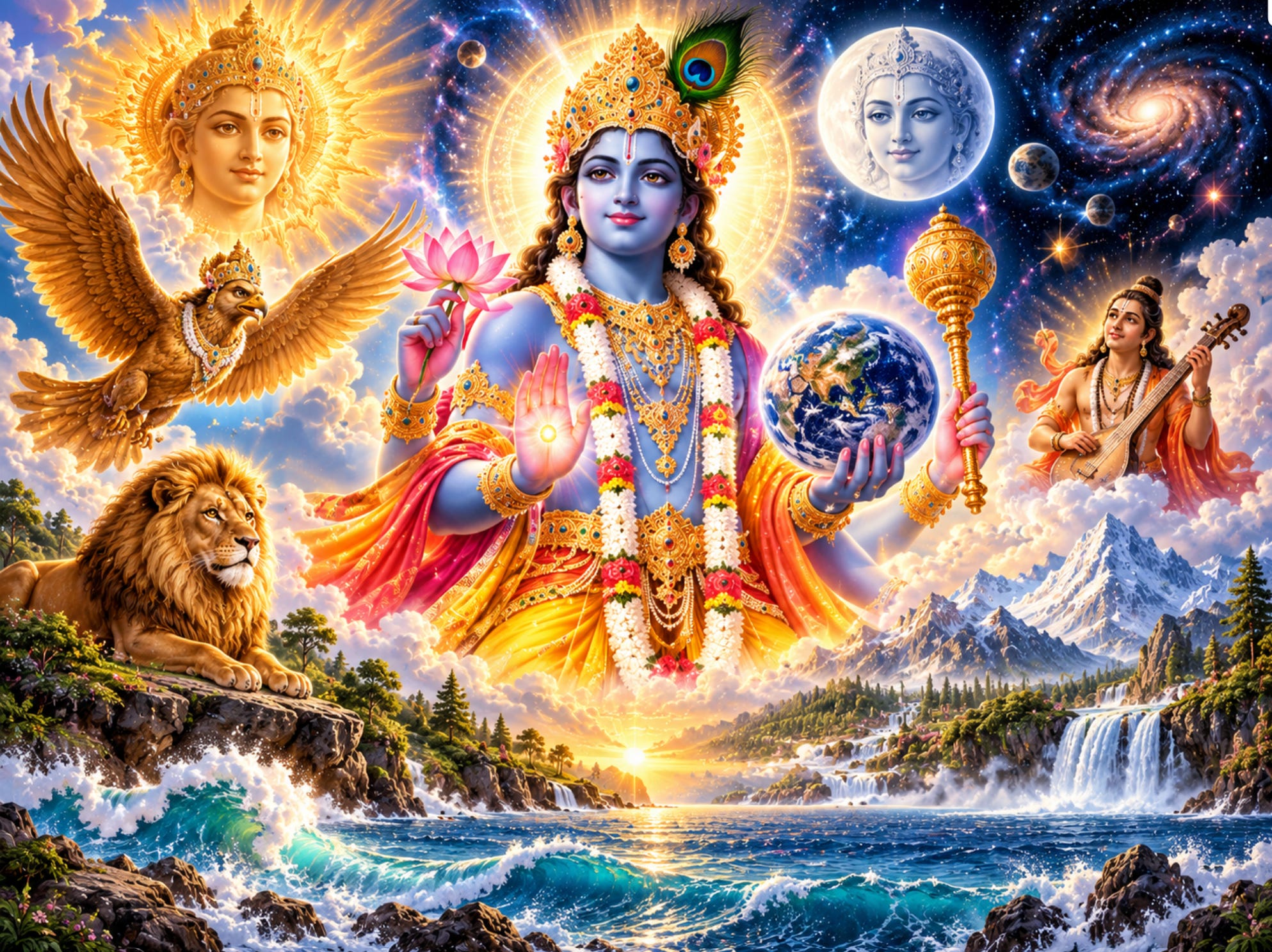
In the tenth chapter of the Gītā, Kṛṣṇa describes His vibhūtis, or divine opulences. The purpose of these descriptions is not to give us a catalog of cosmic manifestations but to teach us to see Kṛṣṇa behind all wonderful manifestations. When we learn to see Kṛṣṇa behind all attractive manifestations and objects, the vision of the world starts bringing us closer to Kṛṣṇa, instead of distracting us from Him.
Some of the manifestations Kṛṣṇa mentions are easy to understand. Of immovable things, He is the Himālayas, and of vibrations, He is the transcendental oṁ. However, other manifestations can be difficult to explain.
In this article, we will try to answer some of the questions you may have while reading it.
What does “I am” mean?
While describing His opulences, Kṛṣṇa identifies Himself with each one of them with the expression “I am.” We can understand that Kṛṣṇa is Viṣnu, but Kṛṣṇa being the lion or the shark may sound confusing.
The point is that Kṛṣṇa’s “I am” for each manifestation does not imply the same type of relationship in every case. Sometimes the manifestation is an extraordinary living entity like Airāvata, sometimes an empowered incarnation, as in the case of Nārada Muni or the four Kumāras, and sometimes it is a direct incarnation, as in the case of Kapila and Vāmanadeva. The common point is, therefore, not that all these manifestations belong to the same exact category, but that they manifest Kṛṣṇa’s opulence in different ways.
Nārada, Prahlāda and Garuḍa
Nārada is supreme among the great sages and demigods because of his exceptional quality of devotional service. While most of the other empowered beings are mentioned because of exceptional material qualities, Nārada is mentioned because of his extraordinary potency in giving Kṛṣṇa consciousness to others. Wherever he goes, knowledge of Kṛṣṇa and devotional service follows. Nārada can enter the life of a materially conditioned person like Mṛgāri or Prācīnabarhi and redirect their whole existence toward Kṛṣṇa.
Prahlāda is supreme among the demons because of his extraordinary steadfastness in devotion to Kṛṣṇa, while Garuḍa is supreme among birds because of his service as the carrier of Lord Viṣṇu. Their excellence is thus not measured by material power, but by their extraordinary devotion and service to the Lord.
Why is Kṛṣṇa the thunderbolt?
The meaning of Kṛṣṇa as the thunderbolt among weapons is explained in the Śrīmad-Bhāgavatam. After the demigods were defeated by Vṛtrāsura, they approached Lord Viṣṇu and begged for assistance in defeating the demon. The Lord instructed them to beg the great sage Dadhyañca to give them his body, and fashion a weapon from his bones, guaranteeing that the weapon would be augmented by His own power. Dadhyañca, in an unprecedented act of renunciation, entered samādhi and left his body, so the demigods could use it. This weapon, wielded by Indra, was thus empowered by both the great austerities of Dadhyañca and the power of the Lord.
Why does Kṛṣṇa say He is sexual desire?
Kṛṣṇa mentions prajanaś cāsmi kandarpaḥ – “Of causes for procreation I am Kandarpa.” Kandarpa, or Cupid, is the demigod of sensual desire, who shoots his arrows, awakening the senses in a practically irresistible way. Prabhupāda, however, connects it with text 7.11, where Kṛṣṇa mentions that “I am sex life which is not contrary to religious principles.” This adds an important qualification: Cupid represents Kṛṣṇa as a force, but not all sexual desire is a representation of Kṛṣṇa. He becomes prominent only when sexual desire is properly directed to the generation of good children, meant to be educated in Kṛṣṇa consciousness. In other contexts, sexual desire is just part of the material illusion.
There is yet another meaning. Kandarpa is a manifestation of Kṛṣṇa’s energy, but Kṛṣṇa is the controller of the energy itself, and therefore can protect His devotees from his attraction.
Why the wind among purifiers, and not the fire?
In text 10.31, one could ask why Kṛṣṇa identifies Himself as the wind among purifiers. Why not fire? One point is that He already mentioned fire in text 10.23. Among the Vasus, He is Agni, the presiding deity of fire. There is also another small point raised by both Viśvanātha and Baladeva in their commentaries. The exact word Kṛṣṇa uses is pavatām. Both ācāryas explain this expression in two senses: those that purify and those that move swiftly. The broader meaning would thus be “Of purifiers and things that move swiftly, I am the wind.” Taken in this way, the connection with the wind appears more natural.
“Rāma” means Rāmacandra or Paraśurāma?
When Kṛṣṇa mentions “of the wielders of weapons I am Rāma,” the mental image many will have is of Rāma as Lord Rāmacandra. There is, however, another Rāma mentioned in the scriptures as an incarnation: Paraśurāma.
This is an example of a small detail where the ācāryas appear to disagree. Śrīdhara Svāmī mentions in his commentary: rāmo dāśarathiḥ, yad vā rāmaḥ paraśurāmaḥ – “Rāma means the son of Daśaratha; alternatively, Paraśurāma.” Viśvanātha Cakravartī, on the other hand, identifies Rāma as Paraśurāma, adding that Paraśurāma’s status as a specially empowered jīva (śaktyāveśa) makes him particularly appropriate to be technically classified as a vibhūti.
Small, apparent disagreements like these are frequent, and do not mean one is right and the other is wrong; they simply mean that the two ācāryas are raising points that are simultaneously correct. Both Rāma and Paraśurāma are incarnations of Kṛṣṇa. Rāmacandra is a direct incarnation, while Paraśurāma is a śaktyāveśa, a jīva invested with Kṛṣṇa’s power. Viśvanātha, however, makes the point that Paraśurāma can very appropriately be counted as a vibhūti, maintaining the main thread of the chapter. He mentions. This doesn’t invalidate the other point. Both ācāryas are correct; our duty is simply to understand how.
Why the Ganges and not the Yamunā?
Another question may arise from the connection with the Ganges. Why does Kṛṣṇa declare that among the flowing rivers, He is the Ganges? Why not the Yamunā?
The first point is that the importance of the Ganges should not be minimized. Gangā appears when the Lord, as Vāmanadeva, pierces the covering of the universe with His foot, opening a crack in it, through which the spiritual water from the Causal Ocean flows inside. This water directly bathes the lotus feet of the Lord, and then flows throughout the universe, falling upon the head of Lord Śiva and then passing through Dhruvaloka, the planets of the great sages, Candraloka, and so on before reaching our planet. Having washed the lotus feet of the Lord, this water sanctifies these different regions as it descends.
In his purport to SB 1.19.6, Prabhupāda mentions that the Yamunā is even more directly connected with Kṛṣṇa, because He came into contact with the river much more extensively during His earthly pastimes. He, however, concludes with a point that can help us to reconcile the two statements. He mentions that “According to the Varāha Purāṇa, as quoted by Śrīla Jīva Gosvāmī, there is no difference between the water of the Ganges and the Yamunā, but when the water of the Ganges is sanctified one hundred times, it is called the Yamunā.”
In this way, when Kṛṣṇa mentions “of flowing rivers I am the Ganges,” this does not exclude the Yamunā. Both are spiritual and connected with Kṛṣṇa, but they represent two different aspects of the relationship with Him. The Yamunā represents the intimate aspect, being inseparably connected with His pastimes in Vṛndāvana, while Gangā is connected with His divine power and majesty, displaying His potency in purifying the material creation.
Seven feminine opulences
In text 10.34, Kṛṣṇa mentions a set of qualities that represent Him: fame, fortune, fine speech, memory, intelligence, steadfastness, and patience. These are qualities that make a person glorious, and whenever we see someone who has these qualities, we can remember Kṛṣṇa, for they represent Him. Prabhupāda mentions that these qualities are considered feminine, even though men can also possess them. What is the reason? There are a few. The first is that the Sanskrit nouns for all of them are feminine. The second is that all of these seven qualities emanate from feminine predominating deities. Kīrti (fame), Medhā (intelligence), Dhṛti (firmness), Smṛti (memory), and Kṣamā (patience) appear among the daughters of Dakṣa. Śrī (fortune) is the consort of Viṣṇu; and Vāk (fine speech, especially connected with the Sanskrit language) is the daughter of Brahmā. Therefore, when Kṛṣṇa mentions that, “Among women I am fame, fortune, fine speech, memory, intelligence, steadfastness and patience,” this points to these seven deities as His representatives among exalted women.
How can Kṛṣṇa be “the gambling of cheats”?
Later, in text 10.36, Kṛṣṇa mentions, “I am also the gambling of cheats.” The exact word Kṛṣṇa uses is chalayatām. Viśvanātha explains that this applies to the context of two persons trying to deceive one another: chalayatām anyo ’nya-vañcana-parāṇāṁ sambandhi dyūtam asmi – “Among cheaters, those intent on deceiving one another, I am gambling.”
Gambling is thus not simply an arbitrary dishonest activity. It is an especially destructive form of deception, capable of taking everything from the loser. No one can cheat Kṛṣṇa. Anyone who tries ends up being cheated himself.
Once, the demigods were defeated by the demons due to a curse from Durvāsā Muni. They went to Brahmā for help, and Brahmā led them to the shores of the milk-ocean where they prayed to Kṣīrodakaśāyī Viṣṇu for protection. Answering to their prayers, Lord Viṣṇu gave them a plan: make a temporary truce with the demons, cooperate with them in churning the milk-ocean, and produce nectar to save them from their vulnerable position and restore the cosmic administration. The demons accepted the truce, but they had a sinister plan: use the demigods and the cooperation of Lord Viṣṇu to obtain the nectar, but then take it without sharing with the demigods. Thus, after the churning of the ocean, when Dhanvantari appeared carrying the pot of nectar, they immediately seized it, and the stronger among them wanted to drink it immediately without sharing it with the weaker demons. Kṛṣṇa, however, appeared as Mohinī-mūrti. In the form of an extraordinarily attractive woman, He gained the confidence of the demons and convinced them to hand the nectar over to Him for distribution. The demons were convinced that Mohinī was favoring them, but instead She distributed all the nectar to the demigods. The Bhāgavatam explicitly mentions the word vañcayan, “cheating,” and Prabhupāda explains that the Lord’s policy was to cheat the demons with sweet words. In this way, the demons entered the arrangement planning to cheat, but ended up being cheated by Kṛṣṇa.
Kṛṣṇa is the master of everything, including even cheating. Everything is an expansion of His energy, and Kṛṣṇa possesses it in its superlative form. The point is that everything exists in Kṛṣṇa in its original, uncontaminated form, and becomes contaminated by being misused by conditioned souls. In the material world, cheating is conducted as a form of aggression, to harm or hinder someone, while cheating in the spiritual platform is for one’s ultimate good. Kṛṣṇa may take away a devotee’s material opulence to make him fit to receive pure devotional service, for example. Even when He kills a demon through some process of cheating, this is for one’s ultimate benefit, for demons who are killed by Kṛṣṇa attain liberation.
Read more:


This is a publication for thoughtful readers who want to go deeper into Kṛṣṇa consciousness. I publish daily, trying to offer high-quality spiritual content, and all posts are available to free subscribers. If you wish, you can support this work with a monthly contribution. When you subscribe, you can choose between a free subscription and a monthly contribution, and you can switch from a free subscriber to a supporter at any time.
You can also receive updates on WhatsApp or Telegram.
If you would like to contribute further, you can find the donation links here.