

« Making Sense of the Vedic Universe, a Higher-Dimensional Reality
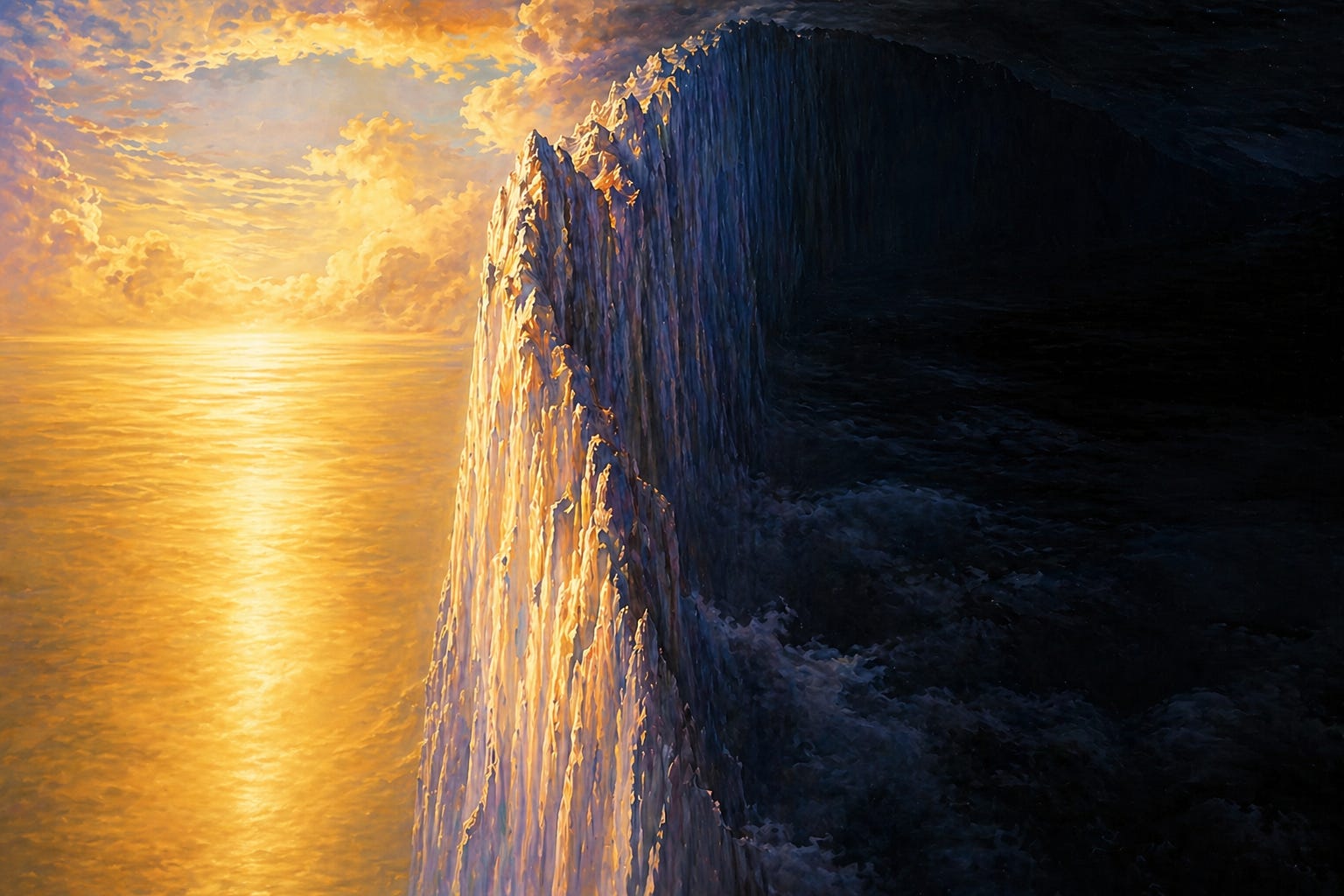
Lokāloka: The edge of the observable universe
After the islands of Bhū-mandala, the next structure described in the Bhāgavatam is the mysterious Lokāloka:
“Thereafter, beyond the ocean of sweet water and fully surrounding it, is a mountain named Lokāloka, which divides the countries that are full of sunlight from those not lit by the sun.
Beyond the ocean of sweet water is a tract of land as broad as the area between the middle of Mount Sumeru and the boundary of Mānasottara Mountain. In that tract of land there are many living beings. Beyond it, extending to Lokāloka Mountain, is another land, which is made of gold. Because of its golden surface, it reflects light like the surface of a mirror, and any physical article that falls on that land can never be perceived again. All living entities, therefore, have abandoned that golden land.
Between the lands inhabited by living entities and those that are uninhabited stands the great mountain which separates the two and which is therefore celebrated as Lokāloka.
By the supreme will of Kṛṣṇa, the mountain known as Lokāloka has been installed as the outer border of the three worlds — Bhūrloka, Bhuvarloka and Svarloka — to control the rays of the sun throughout the universe. All the luminaries, from the sun up to Dhruvaloka, distribute their rays throughout the three worlds, but only within the boundary formed by this mountain. Because it is extremely high, extending even higher than Dhruvaloka, it blocks the rays of the luminaries, which therefore can never extend beyond it.
Learned scholars who are free from mistakes, illusions and propensities to cheat have thus described the planetary systems and their particular symptoms, measurements and locations. With great deliberation, they have established the truth that the distance between Sumeru and the mountain known as Lokāloka is one fourth of the diameter of the universe — or, in other words, 125,000,000 yojanas [1 billion miles]. (SB 5.20.34-38)
Outside Puṣkaradvīpa, there is an ocean of sweet water, which is, again, as broad as the island itself. Beyond this ocean, there is another island, the largest of all, which extends all the way to the Lokāloka mountains that mark the boundary of the illuminated part of the universe.
This huge island is, in turn, divided into two portions, without a new ocean between them. The internal part is inhabited land, the abode of many living entities, while the outer part is deserted.
The inhabited part of the island is as broad as the area from Mount Sumeru to the middle of Mānasottara Mountain in Puṣkaradvīpa, and the uninhabited part, the bhūmiḥ kāñcanī (golden land) mentioned in the text, is even broader.
This mysterious, uninhabited land, is described in the text as adarśa-talopamā yasyāṁ prahitaḥ padārtho na kathañcit punaḥ pratyupalabhyate. The first quality is that the surface is perceived as being just like the surface of a mirror. This indicates one can’t properly see while there. The second is that although one can perceive an object held in one’s hand, as soon as this object is dropped, it can’t be found again by any means. The word kathañcit indicates that not only vision fails, but other senses, like touch, hearing, and taste, become unusable.
This indicates that this is not simply a place with a gold-like surface, but a place where ordinary sense perception fails. For this reason, it is described that no one lives there. This indicates that this mysterious golden land marks a place where the conditions that sustain ordinary life cease to exist.
Outside of it is what is described as a cosmic range of mountains, the mysterious Lokāloka. These mountains are described as going as high as Dhruvaloka. In other words, they encapsulate the whole inhabited area of the universe, both horizontally and vertically. It is clear that these are not ordinary mountains composed of rock, but some kind of structure composed of some very subtle form of matter or energy, rather than a solid barrier.
Beyond Lokāloka is Aloka-varṣa, a completely uninhabited region that is not reached by the light of the sun or any of the stars. Lokāloka is thus similar in concept to what is discussed in modern cosmology as the cosmic light horizon, the very edge of the universe. The Vedas, however, point to the size of the universe as fixed, different from modern cosmology, which generally presumes that the universe is expanding. A fixed cosmic light horizon again implies that the universe may have a fundamental structure that is very different from what is currently believed in modern cosmology.
What exactly is Aloka-varṣa? That’s a region where living conditions cease to exist. All life in the three worlds depends on the cycles of light, time, and energy provided by the sun and moon. Aloka-varṣa is beyond their influence. It is thus not just a dark or empty space, but a domain where the conditions that sustain ordinary life no longer operate.
Beyond this area are the seven coverings of the universe, each ten times thicker than the previous, and composed of a progressively subtler element. That’s the end of the universal structure. Beyond the final covering lies the Causal Ocean (Kāraṇodaka), an entirely different plane of reality, based on spiritual existence. Here the difference between “subtle” and “spiritual” comes into view. “Subtle” means something that is beyond our ordinary sense perception (like the subtle body, or the subtle realms of the demigods), but it is still material. It is just a more refined level of material existence. “Spiritual”, however, is an entirely different category. That’s a sphere where there is influence of time, no decay, no imperfection, and no misery or anxiety of any kind. It is simply based on positive, conscious spiritual existence.
There resides Lord Mahā-Viṣṇu, and from Him emanate the innumerable universes, which appear like seeds floating on the surface of that Causal Ocean.
In the pastime in which Arjuna brings back to sons of the brāhmaṇa who had been taken by Mahā-Viṣnu, Kṛṣṇa guides Arjuna through this whole region, reaching the causal ocean, where Kṛṣṇa gives darśana to Mahā-Viṣnu Himself.
This episode is described in the Tenth Canto:
“Having thus advised Arjuna, the Supreme Personality of Godhead had Arjuna join Him on His divine chariot, and together they set off toward the west. The Lord’s chariot passed over the seven islands of the middle universe, each with its ocean and its seven principal mountains. Then it crossed the Lokāloka boundary and entered the vast region of total darkness.
In that darkness the chariot’s horses — Śaibya, Sugrīva, Meghapuṣpa and Balāhaka — lost their way. Seeing them in this condition, O best of the Bhāratas, Lord Kṛṣṇa, the supreme master of all masters of yoga, sent His Sudarśana disc before the chariot. That disc shone like thousands of suns. The Lord’s Sudarśana disc penetrated the darkness with its blazing effulgence. Racing forward with the speed of the mind, it cut through the fearsome, dense oblivion expanded from primeval matter, as an arrow shot from Lord Rāma’s bow cuts through His enemy’s army.
Following the Sudarśana disc, the chariot went beyond the darkness and reached the endless spiritual light of the all pervasive Brahmājyoti. As Arjuna beheld this glaring effulgence, his eyes hurt, and so he shut them. From that region they entered a body of water resplendent with huge waves being churned by a mighty wind. Within that ocean Arjuna saw an amazing palace more radiant than anything he had ever seen before. Its beauty was enhanced by thousands of ornamental pillars bedecked with brilliant gems. Lord Kṛṣṇa offered homage to Himself in this boundless form, and Arjuna, astonished at the sight of Lord Mahā-Viṣṇu, bowed down as well.” (SB 10.89.46-52, 57)
This same pastime is described vividly by Śrila Prabhupāda in chapter 89 of Kṛṣṇa Book, where he also gives us extra insight in his view of the islands of Bhū-mandala and their surrounding planets:
“Seated on His chariot with Arjuna, Kṛṣṇa proceeded north, crossing over many planetary systems. These are described in Śrīmad-Bhāgavatam as sapta-dvīpa. Dvīpa means “island.” These planets are sometimes described in the Vedic literature as dvīpas. The planet on which we are living is called Jambūdvīpa. Outer space is taken as a great ocean of air, and within that great ocean of air there are many islands, which are the different planets. On each and every planet there are oceans also. On some of the planets the oceans are of salt water, and on some of them there are oceans of milk. On others there are oceans of liquor, and on others there are oceans of ghee or oil. There are different kinds of mountains also. Each and every planet has a different type of atmosphere.”
He gives a similar account on his purport to SB 3.23.43:
“All the planets are here described as gola, round. Every planet is round, and each planet is a different shelter, just like islands in the great ocean. Planets are sometimes called dvīpa or varṣa. This earth planet is called Bhārata-varṣa because it was ruled by King Bharata. Another significant word used in this verse is bahv-āścaryam, “many wonderful things.” This indicates that the different planets are distributed all over the universe in the eight directions, and each and every one of them is wonderful in itself. Each planet has its particular climatic influences and particular types of inhabitants and is completely equipped with everything, including the beauty of the seasons. In the Brahmā-saṁhitā (5.40) it is similarly stated, vibhūti-bhinnam: on each and every planet there are different opulences. It cannot be expected that one planet is exactly like another. By God’s grace, by nature’s law, each and every planet is made differently and has different wonderful features.”
These two passages combine with other references where Prabhupāda states his view of the planetary system of Bhū-mandala as a collective of different types of planets, and the surrounding oceans as nothing more than different types of oceans surrounding their respective continents, just as on earth.
The way this structure is perceived by other inhabitants of the universe is certainly different from the way we perceive it. From the description of the Śrīmad-Bhāgavatam, it appears that they perceive it as a more or less continuous structure, just like many islands connected by causeways, or cities connected by planes and airports. However, from our perspective, these islands and oceans appear in the form of numerous planets spread through the cosmos. These planets are connected to each other by the branches of the cosmic tree, but such cosmic branches can’t be perceived by us, giving us the impression that the planets are unrelated.
Read the whole book:
« Making Sense of the Vedic Universe, a Higher-Dimensional Reality
This is a publication for thoughtful readers who want to go deeper into Kṛṣṇa consciousness. I publish daily, trying to offer high-quality spiritual content, and all posts are available to free subscribers. If you wish, you can also choose a paid subscription to support this work.
You can also receive the updates on WhatsApp or Telegram.
If you would like to contribute further, you can find the donation links here.