

« Making Sense of the Vedic Universe, a Higher-Dimensional Reality
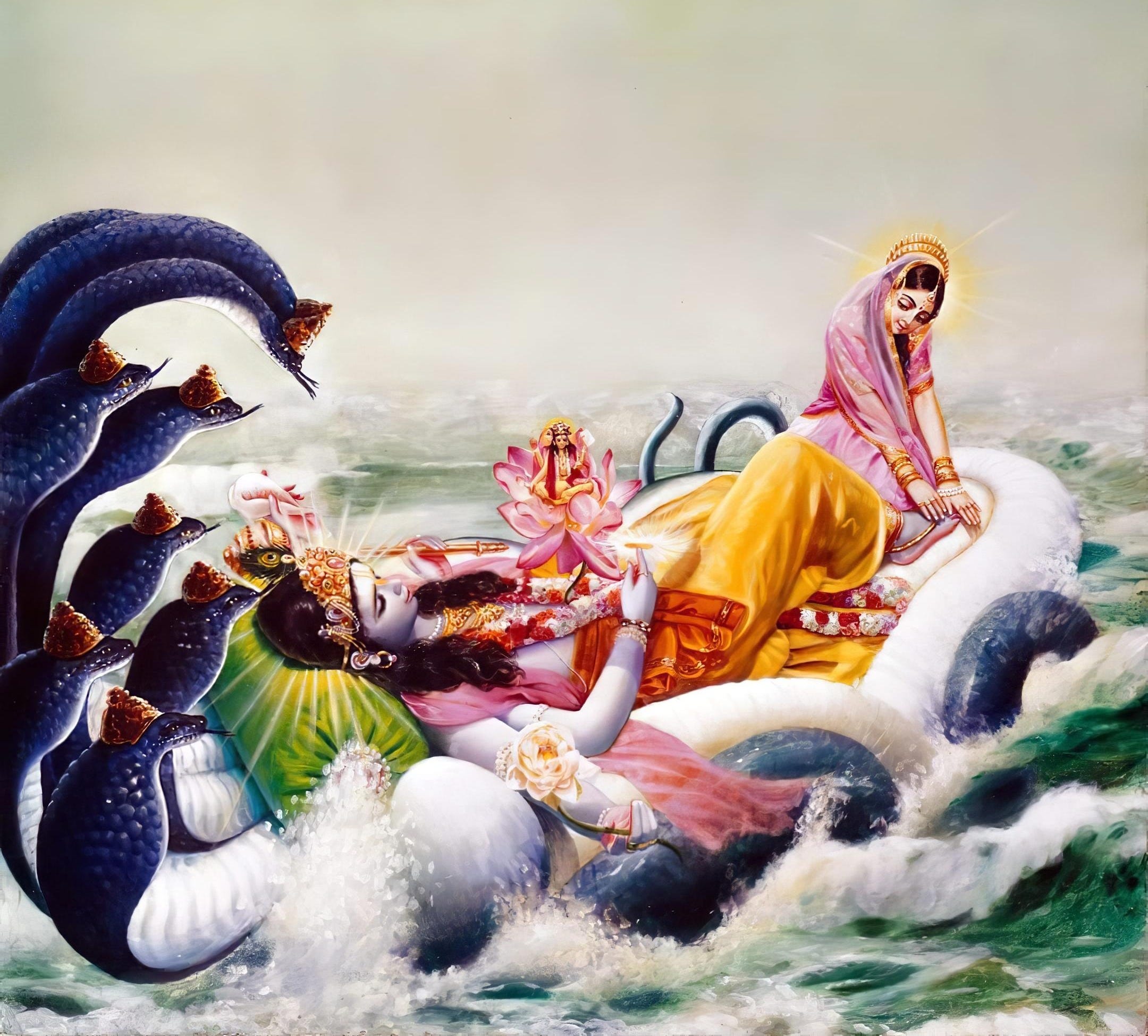
Lord Ananta at the bottom of the universe
“Śrī Śukadeva Gosvāmī said to Mahārāja Parīkṣit: My dear King, approximately 240,000 miles beneath the planet Pātāla lives another incarnation of the Supreme Personality of Godhead. He is the expansion of Lord Viṣṇu known as Lord Ananta or Lord Saṅkarṣaṇa. He is always in the transcendental position, but because He is worshiped by Lord Śiva, the deity of tamo-guṇa or darkness, He is sometimes called tāmasī. Lord Ananta is the predominating Deity of the material mode of ignorance as well as the false ego of all conditioned souls. When a conditioned living being thinks, “I am the enjoyer, and this world is meant to be enjoyed by me,” this conception of life is dictated to him by Saṅkarṣaṇa. Thus the mundane conditioned soul thinks himself the Supreme Lord.” (SB 5.25.1)
Below Pātāla lives Lord Ananta, who is also known as Śeṣa, or Saṅkarṣaṇa, the incarnation of the Lord who sustains the whole universe and is the resting place of Lord Garbhodakaśāyī Viṣnu. He is the source of Lord Śiva and is also tasked with destroying the material universe when the time comes. As Prabhupāda explains in his purport to text six, “Anantadeva’s main mission is to dissolve this material creation, but He checks His anger and intolerance. This material world is created to give the conditioned souls another chance to go back home, back to Godhead, but most of them do not take advantage of this facility. After the creation, they again exercise their old propensity for lording it over the material world. These activities of the conditioned souls anger Anantadeva, and He desires to destroy the entire material world. Yet, because He is the Supreme Personality of Godhead, He is kind toward us and checks His anger and intolerance. Only at certain times does He express His anger and destroy the material world.”
As Saṅkarṣaṇa, He is the presiding deity over the principle of false ego, which is the basic driving force of the whole material existence. When a soul desires to become a competitor God and enjoy the material creation, Lord Saṅkarṣaṇa empowers him to assume a material identity and perform his activities. However, when one becomes frustrated with this process, Lord Saṅkarṣaṇa can help to become free from the false ego.
Lord Ananta is also the source of Lord Śiva, who constantly meditates on and worships Him. Because Lord Śiva is the predominating deity of the mode of ignorance, Anantadeva is also called tāmasī because of this connection. This indicates that although the material mode of ignorance remains under His full control, He is unaffected by it.
“Śukadeva Gosvāmī continued: This great universe, situated on one of Lord Anantadeva’s thousands of hoods, appears just like a white mustard seed. It is infinitesimal compared to the hood of Lord Ananta.
At the time of devastation, when Lord Anantadeva desires to destroy the entire creation, He becomes slightly angry. Then from between His two eyebrows appears three-eyed Rudra, carrying a trident. This Rudra, who is known as Sāṅkarṣaṇa, is the embodiment of the eleven Rudras, or incarnations of Lord Śiva. He appears in order to devastate the entire creation.” (SB 5.25.2-3)
Up to here, all the universal structures described by Śukadeva Goswami were measurable. Everywhere, from Satyaloka, all the way to Pātāla, distances can be measured in yojanas. Now, however, he comes to someone who, although technically situated as part of the universe, is not measurable or quantifiable. Lord Ananta is unlimited. He has thousands of hoods, and the whole universe is just like a mustard seed on top of just one of these hoods.
How can Lord Ananta be situated inside the universe, between Pātāla and the Garbhodaka Ocean, if He is millions of times larger than the entire universe? That’s exactly the point. This is the same mystic potency that allows Kṛṣṇa to be present in Vṛndāvana and, at the same time, show the entire universe inside His mouth to mother Yaśodā.
What about the point about universal devastation? This is made clear by Prabhupāda in his purport to text three: “In each creation, the living entities are given a chance to close their business as conditioned souls. When they misuse this opportunity and do not go back home, back to Godhead, Lord Saṅkarṣaṇa becomes angry. The eleven Rudras, expansions of Lord Śiva, come out of Lord Saṅkarṣaṇa’s eyebrows due to His angry mood, and all of them together devastate the entire creation.”
“The pink, transparent toenails on the Lord’s lotus feet are exactly like valuable gems polished to a mirror finish. When the unalloyed devotees and the leaders of the snakes offer their obeisances to Lord Saṅkarṣaṇa with great devotion, they become very joyful upon seeing their own beautiful faces reflected in His toenails. Their cheeks are decorated with glittering earrings, and the beauty of their faces is extremely pleasing to see.
Lord Ananta’s arms are attractively long, beautifully decorated with bangles and completely spiritual. They are white, and so they appear like silver columns. When the beautiful princesses of the serpent kings, hoping for the Lord’s auspicious blessing, smear His arms with aguru pulp, sandalwood pulp and kuṅkuma, the touch of His limbs awakens lusty desires within them. Understanding their minds, the Lord looks at the princesses with a merciful smile, and they become bashful, realizing that He knows their desires. Then they smile beautifully and look upon the Lord’s lotus face, which is beautified by reddish eyes rolling slightly from intoxication and delighted by love for His devotees.
Lord Saṅkarṣaṇa is the ocean of unlimited spiritual qualities, and thus He is known as Anantadeva. He is nondifferent from the Supreme Personality of Godhead. For the welfare of all living entities within this material world, He resides in His abode, restraining His anger and intolerance.
Śukadeva Gosvāmī continued: The demigods, the demons, the Uragas [serpentine demigods], the Siddhas, the Gandharvas, the Vidyādharas and many highly elevated sages constantly offer prayers to the Lord. Because He is intoxicated, the Lord looks bewildered, and His eyes, appearing like flowers in full bloom, move to and fro. He pleases His personal associates, the heads of the demigods, by the sweet vibrations emanating from His mouth. Dressed in bluish garments and wearing a single earring, He holds a plow on His back with His two beautiful and well-constructed hands. Appearing as white as the heavenly King Indra, He wears a golden belt around His waist and a vaijayantī garland of ever-fresh tulasī blossoms around His neck. Bees intoxicated by the honeylike fragrance of the tulasī flowers hum very sweetly around the garland, which thus becomes more and more beautiful. In this way, the Lord enjoys His very magnanimous pastimes.” (SB 5.25.4-7)
When we imagine God as unlimitedly big and powerful, we tend to start imagining Him as someone to whom we can’t relate, which pushes us in the direction of impersonalism. To counter that, Śukadeva Goswami immediately describes the personal features of the Lord. Just as Kṛṣṇa appears simultaneously as the universal form and in the form of the deity, Lord Ānanda, who has such a gigantic form, also appears in a form suitable to receive the worship of His devotees.
As Prabhupāda explains in his purport, not only is Lord Ananta completely transcendental, but the nāga princesses who worship him in conjugal love have spiritual bodies. In other words, they are His eternal associates. The material world is created as an inverted reflection of the spiritual world, and thus, everything that exists here exists there in its pure form. Material lust is most degraded, but spiritual lust is the purest manifestation of spiritual rasa.
This is one of the first passages in the Śrīmad-Bhāgavatam where conjugal love directed to the Lord is directly described. In his purport to text five, Prabhupāda explains that this is part of the gradual preparation for the description of the conjugal relationships of Kṛṣṇa and the gopis in the 10th canto: “However, spiritual lust and material lust are as completely different as gold and iron. Only one who is very highly elevated in spiritual realization can understand the lusty feelings exchanged between Rādhā and Kṛṣṇa, or between Kṛṣṇa and the damsels of Vraja. Therefore, unless one is very experienced and advanced in spiritual realization, he is forbidden to discuss the lusty feelings of Kṛṣṇa and the gopīs. However, if one is a sincere and pure devotee, the material lust in his heart is completely vanquished as he discusses the lusty feelings between the gopīs and Kṛṣṇa, and he makes quick progress in spiritual life.”
Apart from His eternal associates, Lord Ananta is constantly glorified by both demigods and demons, as well as Siddhas, Gandharvas, Vidyādharas, Nāgas, and many great sages. He appears in a form with a whitish complexion, dressed in blue garments. His eyes move in a most charming way due to spiritual love, as if He were intoxicated. He is full of bliss and enjoys many pastimes.
In the Third Canto (chapter eight), it is described that the four Kumāras once visited Him to hear descriptions about the creation of the universe. How did they get there? They traveled using the waters of the Ganges, like yogis do. Even on our planet, yogis were, in previous ages, able to travel using rivers and other reservoirs of water. A yogī can submerge in a river and emerge in any other point downstream or upstream. Since the Ganges flows all over the universe, the Kumāras and others can use it to go practically anywhere.
“If persons who are very serious about being liberated from material life hear the glories of Anantadeva from the mouth of a spiritual master in the chain of disciplic succession, and if they always meditate upon Saṅkarṣaṇa, the Lord enters the cores of their hearts, vanquishes all the dirty contamination of the material modes of nature, and cuts to pieces the hard knot within the heart, which has been tied tightly since time immemorial by the desire to dominate material nature through fruitive activities. Nārada Muni, the son of Lord Brahmā, always glorifies Anantadeva in his father’s assembly. There he sings blissful verses of his own composition, accompanied by his stringed instrument [or a celestial singer] known as Tumburu.” (SB 5.25.8)
Here, Śukadeva Gosvāmi touches on the central point in understanding not only the person of Lord Anantadeva, but the whole model of Vedic universe he just explained. We can understand these explanations only when we hear and accept the proper conclusions through the system of paramparā. Without following this process, we will end up thinking that these are imaginary descriptions.
Ultimately, our lack of knowledge comes from our material contamination caused by association with the two lower modes of nature: passion and ignorance, which manifest in the form of lust, hankering, etc. Liberated souls in the spiritual world have perfect knowledge of the Lord and the cosmic creation, but the more we become covered by material illusion, the more we become connected with the illusory reality we live in, and can’t see anything beyond it. Theoretical knowledge from books can help to a certain extent, but to become fully effective, this knowledge has to be supported by proper spiritual practice, and such proper spiritual practice can be practiced only under proper guidance. As a result, without accepting the system of disciplic succession, one can’t even properly understand the nature of material reality we live in, let alone become free from it.
“By His glance, the Supreme Personality of Godhead enables the modes of material nature to act as the causes of universal creation, maintenance and destruction. The Supreme Soul is unlimited and beginningless, and although He is one, He has manifested Himself in many forms. How can human society understand the ways of the Supreme?
This manifestation of subtle and gross matter exists within the Supreme Personality of Godhead. Out of causeless mercy toward His devotees, He exhibits various forms, which are all transcendental. The Supreme Lord is most liberal, and He possesses all mystic power. To conquer the minds of His devotees and give pleasure to their hearts, He appears in different incarnations and manifests many pastimes.” (SB 5.25.9-10)
In our original position, as pure souls, we have natural knowledge of the Lord and His potencies. However, it is very difficult to understand from our current, conditioned perspective. How to understand someone who is powerful to the extent universes come out of the pores of His body? Someone who can activate the whole material creation by just looking at it? Who can hold all the innumerable universes on His hoods without even feeling their weight? It becomes even harder when we consider the personal dealings of the Lord and His devotees. How can someone who is so powerful deal on such a personal level with His servants? How can He have a personal form and perform so many types of activities without falling into human imperfections?
“Even if he be distressed or degraded, any person who chants the holy name of the Lord, having heard it from a bona fide spiritual master, is immediately purified. Even if he chants the Lord’s name jokingly or by chance, he and anyone who hears him are freed from all sins. Therefore how can anyone seeking disentanglement from the material clutches avoid chanting the name of Lord Śeṣa? Of whom else should one take shelter?
Because the Lord is unlimited, no one can estimate His power. This entire universe, filled with its many great mountains, rivers, oceans, trees and living entities, is resting just like an atom on one of His many thousands of hoods. Is there anyone, even with thousands of tongues, who can describe His glories?
There is no end to the great and glorious qualities of that powerful Lord Anantadeva. Indeed, His prowess is unlimited. Though self-sufficient, He Himself is the support of everything. He resides beneath the lower planetary systems and easily sustains the entire universe.” (SB 5.25.11-13)
Although the Lord is so great and difficult to understand, He can be realized through purified intelligence. Śukadeva Gosvāmi now reveals the process for achieving that: to chant the holy name of the Lord. This is a point that will be further elaborated on at the beginning of the Sixth Canto, in the history of Ajāmila, and further deepened in the rest of Śrīmad-Bhāgavatam. The glories of the Lord can’t be understood by just material study; we have to practice the spiritual process, become purified, and come in touch with the spiritual energy. With this, he gives the key for understanding the whole cosmological model he just explained.
“My dear King, as I heard of it from my spiritual master, I have fully described to you the creation of this material world according to the fruitive activities and desires of the conditioned souls. Those conditioned souls, who are full of material desires, achieve various situations in different planetary systems, and in this way they live within this material creation. My dear King, I have thus described how people generally act according to their different desires and, as a result, get different types of bodies in higher or lower planets. You inquired of these things from me, and I have explained to you whatever I have heard from authorities. What shall I speak of now?” (SB 5.25.14-15)
Having revealed so many details, Śukadeva Gosvāmi concludes his description of the material universe. In his purport, Prabhupāda gives us the correct mood to understand our relationship with it:
“In this regard, Śrīla Bhaktivinoda Ṭhākura sings, anādi karama-phale, paḍi’ bhavārṇava-jale, taribāre nā dekhi upāya “My Lord, I do not know when I commenced my material life, but I can certainly experience that I have fallen in the deep ocean of nescience. Now I can also see that there is no other way to get out of it than to take shelter of Your lotus feet.” Similarly, Śrī Caitanya Mahāprabhu offers the following prayer: ayi nanda-tanuja kiṅkaraṁ, patitaṁ māṁ viṣame bhavāmbudhau, kṛpayā tava pāda-paṅkaja sthita-dhūlī-sadṛśaṁ vicintaya “My dear Lord, son of Nanda Mahārāja, I am Your eternal servant. Somehow or other, I have fallen into this ocean of nescience. Kindly, therefore, save me from this horrible condition of materialistic life.”
Read the whole book:
« Making Sense of the Vedic Universe, a Higher-Dimensional Reality
This is a publication for thoughtful readers who want to go deeper into Kṛṣṇa consciousness. I publish daily, trying to offer high-quality spiritual content, and all posts are available to free subscribers. If you wish, you can also choose a paid subscription to support this work.
You can also receive the updates on WhatsApp or Telegram.
If you would like to contribute further, you can find the donation links here.