


You can receive new articles directly in your inbox. Subscription is free; donations are welcome.
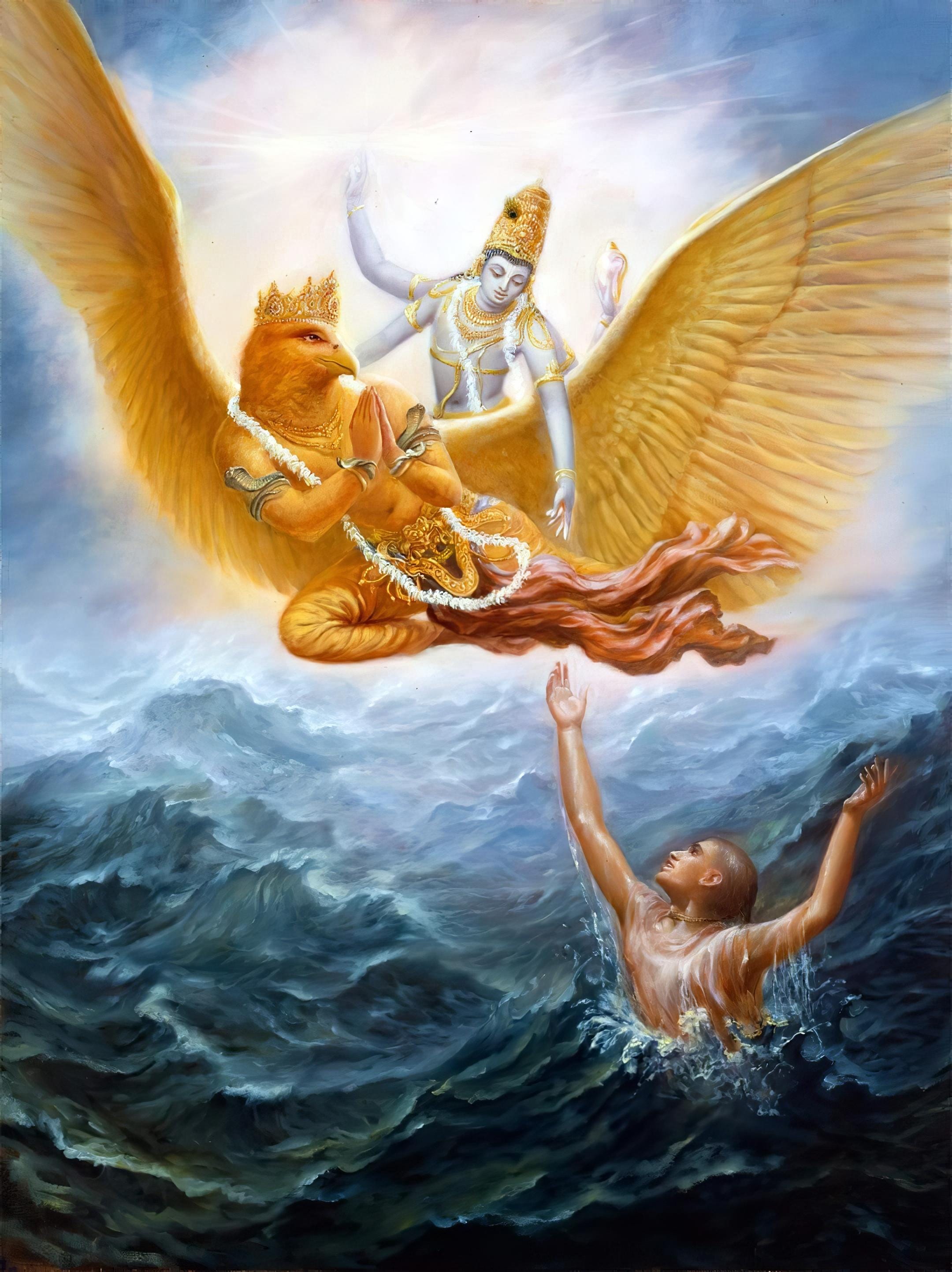
Most of us have seen this painting of Lord Viṣnu appearing on Garuda's shoulders to save a devotee from the ocean of material existence. We can appreciate it as a metaphor, but we usually don’t think this happens in practice. Maybe He may send the Viṣnudutas, we may think, but coming personally?
That’s a point we misunderstand. We think that just because Kṛṣṇa is so great, He is too busy for His devotees. That’s not true. This coming on Garuda's shoulders is not metaphorical; it is literal.
See what He mentions in the Bhagavad-gītā, 12.6-7:
“But those who worship Me, giving up all their activities unto Me and being devoted to Me without deviation, engaged in devotional service and always meditating upon Me, having fixed their minds upon Me, O son of Pṛthā—for them I am the swift deliverer from the ocean of birth and death.”
Yogīs have to follow the path of light when leaving their bodies if they hope to attain liberation, as Kṛṣṇa explains in chapter eight. On this path, they are taken upwards by a succession of demigods. This process is, however, very uncertain and difficult, and without bhakti, even the successful yogī cannot progress further than the impersonal brahmajyoti by it. In any case, even for the yogī, entrance into the spiritual planets is possible only if one develops his devotional service. Pṛthu Maharaja transferred himself to the Vaikuṇṭha planets at the time of death by the mystical process because he was a pure devotee of the Lord (SB 4.23.11). His qualification was his devotional service, and not his yoga practice.
Yogīs who are not devotees usually can’t even leave the material universe. They typically reach the higher planets, from where they have a chance of engaging in devotional service and gradually progressing over billions of years (Iso 14). If they fail to do so, they eventually fall back to earth.
A devotee, however, is taken directly by Kṛṣṇa all the way, as indicated by the words teṣām ahaṁ samuddhartā (for them I am the deliverer) in text 12.7. Baladeva Vidyābhūṣaṇa also notes the words na cirāt (swiftly), which indicate Kṛṣṇa’s unwillingness to tolerate any delay in the devotee’s attainment of Him.
Prabhupāda supports this point by quoting the Varāha Purāṇa in his purport:
nayāmi paramaṁ sthānam, arcir-ādi-gatiṁ vinā
garuḍa-skandham āropya, yatheccham anivāritaḥ.
In this verse, Kṛṣṇa makes clear that He personally takes His devotee out of the cycle of birth and death. The meaning is:
Placing My devotee on Garuḍa’s shoulders, I take him to the supreme abode according to My will, without obstruction and without him having to follow the path of light taken by yogīs.
Prabhupāda gives us a purport to this verse:
“The purport of this verse is that a devotee does not need to practice aṣṭāṅga-yoga in order to transfer his soul to the spiritual planets. The responsibility is taken by the Supreme Lord Himself. He clearly states here that He Himself becomes the deliverer. A child is completely cared for by his parents, and thus his position is secure. Similarly, a devotee does not need to endeavor to transfer himself by yoga practice to other planets. Rather, the Supreme Lord, by His great mercy, comes at once, riding on His bird carrier Garuḍa, and at once delivers the devotee from material existence. Although a man who has fallen in the ocean may struggle very hard and may be very expert in swimming, he cannot save himself. But if someone comes and picks him up from the water, then he is easily rescued. Similarly, the Lord picks up the devotee from this material existence. One simply has to practice the easy process of Kṛṣṇa consciousness and fully engage himself in devotional service. Any intelligent man should always prefer the process of devotional service to all other paths.”
This explains many details of the relationship between Kṛṣṇa and His pure devotees that may appear inexplicable to an outsider. After being instructed by Nārada Muni and receiving the audience of the Lord, Citraketu attained great opulence as the king of the Vidyādhara planet. After some time, however, he was cursed by Mother Pārvatī to become a demon.
Why is it that Kṛṣṇa arranged such a situation for His devotee? Why didn’t He protect him as He promises in the Gītā? The point is that Kṛṣṇa became so anxious to bring His pure devotee to the spiritual world that He was not willing to wait until his long celestial life ended (SB 6.17.17). He thus created a situation where Citraketu was moved from this position to a very short life as Vṛtrāsura, where he attained perfection in his Kṛṣṇa consciousness and returned home, back to Godhead.
Similarly, other devotees may at different points face material difficulties that are ultimately organized by Kṛṣṇa to bring them back home, back to Godhead as soon as possible. For ordinary souls, Kṛṣṇa is patient, as Paramātmā, waiting for them to turn to Him. With His pure devotees, however, Kṛṣṇa becomes impatient and cannot wait.
This shows us the extent of His reciprocation. On his part, however, a pure devotee does not make liberation a condition for his service. Śrī Caitanya Mahāprabhu gives us the perfect example in His Śikṣāṣṭakam:
na dhanaṁ na janaṁ na sundarīṁ, kavitāṁ vā jagad-īśa kāmaye
mama janmani janmanīśvare, bhavatād bhaktir ahaitukī tvayi“O almighty Lord, I have no desire to accumulate wealth, nor do I desire beautiful women, nor do I want any number of followers. I only want Your causeless devotional service, birth after birth.”
A pure devotee simply serves Kṛṣṇa out of love, simply aspiring for more service. Kṛṣṇa, on His part, however, can’t wait to be with His devotee; therefore, He brings him back as quickly as possible, even though the devotee does not ask for it. This is the paradox of their relationship. The more a devotee is unwilling to accept, the more Kṛṣṇa is eager to give.
Read more:


This is a publication for thoughtful readers who want to go deeper into Kṛṣṇa consciousness. I publish daily, trying to offer high-quality spiritual content, and all posts are available to free subscribers. If you wish, you can support this work with a monthly contribution. When you subscribe, you can choose between a free subscription and a monthly contribution, and you can switch from a free subscriber to a supporter at any time.
You can also receive updates on WhatsApp or Telegram.
If you would like to contribute further, you can find the donation links here.