

Subscribe to receive new articles by e-mail. It’s free, but if you like, you can pledge a donation:
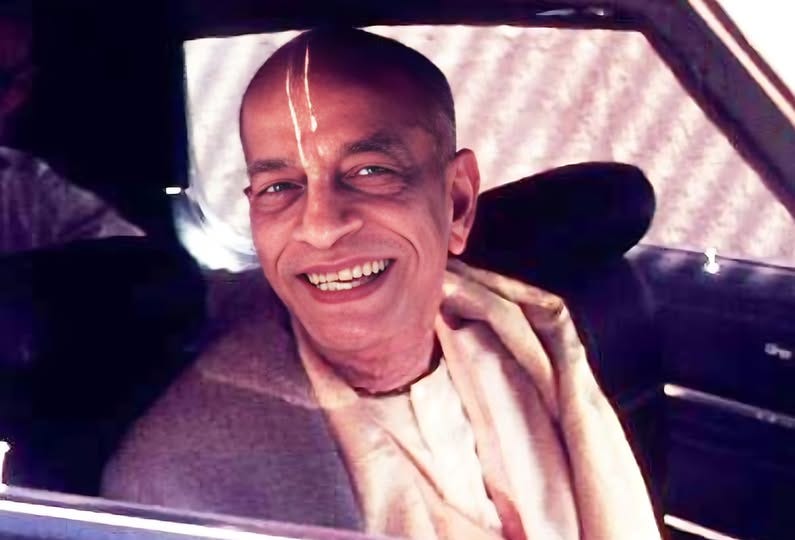
When Śrila Prabhupada started the first temple in New York, he used prasāda as a tactical weapon to attract his first disciples, telling them to eat as much as possible. Of course, they very gladly followed the instruction, and many of them gained quite a few pounds. After some time, Śrila Prabhupada started explaining that from now on, they should restrict their eating. Some immediately protested. Śrila Prabhupada jabbed, "Oh, when I said to eat more, you didn't protest!"
When we are starting our spiritual lives, the priority is to get free of bad habits, like eating meat, eating food cooked by non-devotees, using intoxicants, and so on. In this first phase, eating a lot of prasāda can be very useful, since when one is filled with nice prasāda up to the neck, he will naturally not have the desire to eat other things. Prasāda is also an excellent way to attract people. Many of us are "prasāda bhaktas", who started our devotional practice attracted by prasāda.
Prasāda was and is still used to make new devotees, and it is usually quite effective. However, as Śrila Prabhupada emphasizes in many passages, once we reach a certain level in spiritual life, we are supposed to start controlling our senses, and at this stage, it becomes important to start eating less.
The benefit of prasāda is not in the quantity but in our attitude when honoring it. A small piece of prasāda honored with the proper respect can be more powerful than several kilos of the same prasāda eaten with an enjoying mentality. We can also benefit from prasāda by distributing it to others, not just by eating it ourselves.
While prasāda is always powerful, an improper consciousness can quite effectively deprive us of the benefit.
In the Nectar of Instruction, it is mentioned that "A sober person who can tolerate the urge to speak, the mind’s demands, the actions of anger and the urges of the tongue, belly, and genitals is qualified to make disciples all over the world." Śrila Prabhupada explains that to control the stomach and the genitals, one has to first learn to control the tongue. Considering the volume of problems that a lack of sexual control can cause in our lives, this sounds like a useful instruction.
In the second verse of the Nectar of Instruction, the word atyāhāra has two meanings: eating more than necessary and accumulating more resources than required. These two factors are the two sides of a greater problem: a broader acquisitive mentality of the conditioned soul. The conditioned mind wants more food, more possessions, more money, and more recognition than we actually need, and the more we accumulate, the more we become entangled in the web of material complexities.
Śrila Bhaktisiddhānta Sarasvatī Thākura used to be very concerned about his disciples who were gaining weight, concluding that if one is gaining weight, it means one is not advancing in spiritual life. When we start gaining weight, it usually means we are succumbing to the mentality of enjoying the world instead of keeping the mind in the careful and sober mentality that is necessary for serious spiritual practice.
There are, of course, many variations. Some tend to be thinner and others larger, but we can compare with ourselves. When our weight stabilizes or starts gradually reducing, this is usually a good signal, but when it continues to increase, it probably means there may be something we can improve.
In modern medicine, it's calculated that an adult male needs about 2500 calories per day to sustain his metabolism, while an adult woman needs a little less, at about 2000 calories. Here we come across two problems. The first problem is that most of us actually eat much more than 2000 or 2500 calories. We may not notice it, but when we start calculating exactly how many calories we are eating over the day, the sum may be much higher. The second problem is that these numbers can be misleading. Different people will have different requirements, according to the size of the body, activities, and so on. The body can adjust the amount of energy it uses quite efficiently according to how much we eat. When we eat more, the body spends more energy, and when we eat less, it starts to work in a more efficient way. A person who is not doing strong physical activity (like most of us) may be able to live quite well with far less than 2500 calories per day.
There are many places in the world where people live on meager diets, sometimes down to 1000 calories or so. These are not emaciated people in desolate countries, but people like you and me, who have productive lives, raise their children, and so on.
The main point about eating is not just in the number of calories but in obtaining the proper nutrients from the food. When one has a diet rich in quality foods, like vegetables, fruits, and good-quality milk products, one may eat quite little and still get all the nutrients one's body needs.
Eating less can bring several health benefits and improve our mental clarity considerably. It happens that digesting food uses a lot of energy. When we eat too much, the body has to use a significant amount of energy to digest the food and convert the excess into fat. It doesn't stop there, since this fat needs to be maintained and carried around. Each cell of fat in our body demands nutrients, oxygen, and other resources that need to be carried by the body. The extra fat taxes the whole body. The result is that we end up having much less energy and disposition than we would have otherwise. In other words, we operate below our true potential.
It's also scientifically proven that overconsumption of fats and sugar can have a noticeable impact on brain activity. Too much fat depresses brain activity, making us sluggish, as if living inside a constant mental fog, and while sugar can create a temporary burst of energy, it also makes us feel sluggish after the burst passes.
Considering that our intelligence is the tool we have to control our minds, understand the scriptures, and go somewhere in our human existence, our choices on this subject can have a profound impact on how far we go in spiritual life. At some point, we may have to choose between overindulging in "prasāda" and going back to Godhead.
Read more:

Subscribe to receive all updates by email if you haven’t yet. You can subscribe for free or pledge a small monthly or annual donation to support my work. Either way, you receive everything:
You can also donate using Buy Me a Coffee, PayPal, Wise, Revolut, or bank transfers. There is a separate page with all the links. This helps me enormously to have time to write instead of doing other things to make a living. Thanks!