

« Making Sense of the Vedic Universe, a Higher-Dimensional Reality
Primary and secondary creation
One important concept in Vedic cosmology is the idea of primary and secondary creation. While the Vedas explain that the universe we live in is created by Brahmā, the first living being, who appears directly from Lord Viṣnu, Brahmā is accepted as just a secondary creator. The primary creator is still the Lord Himself. How does it work?
Imagine a company constructing a new branch. Who takes the credit for building it? The owner, the engineer, or the worker who is setting the bricks? Kṛṣṇa gives the order but is not directly involved in the construction. Mahā-Viṣnu is like the engineer who makes the project, and Brahmā is like the worker who builds the physical construction according to His plan.
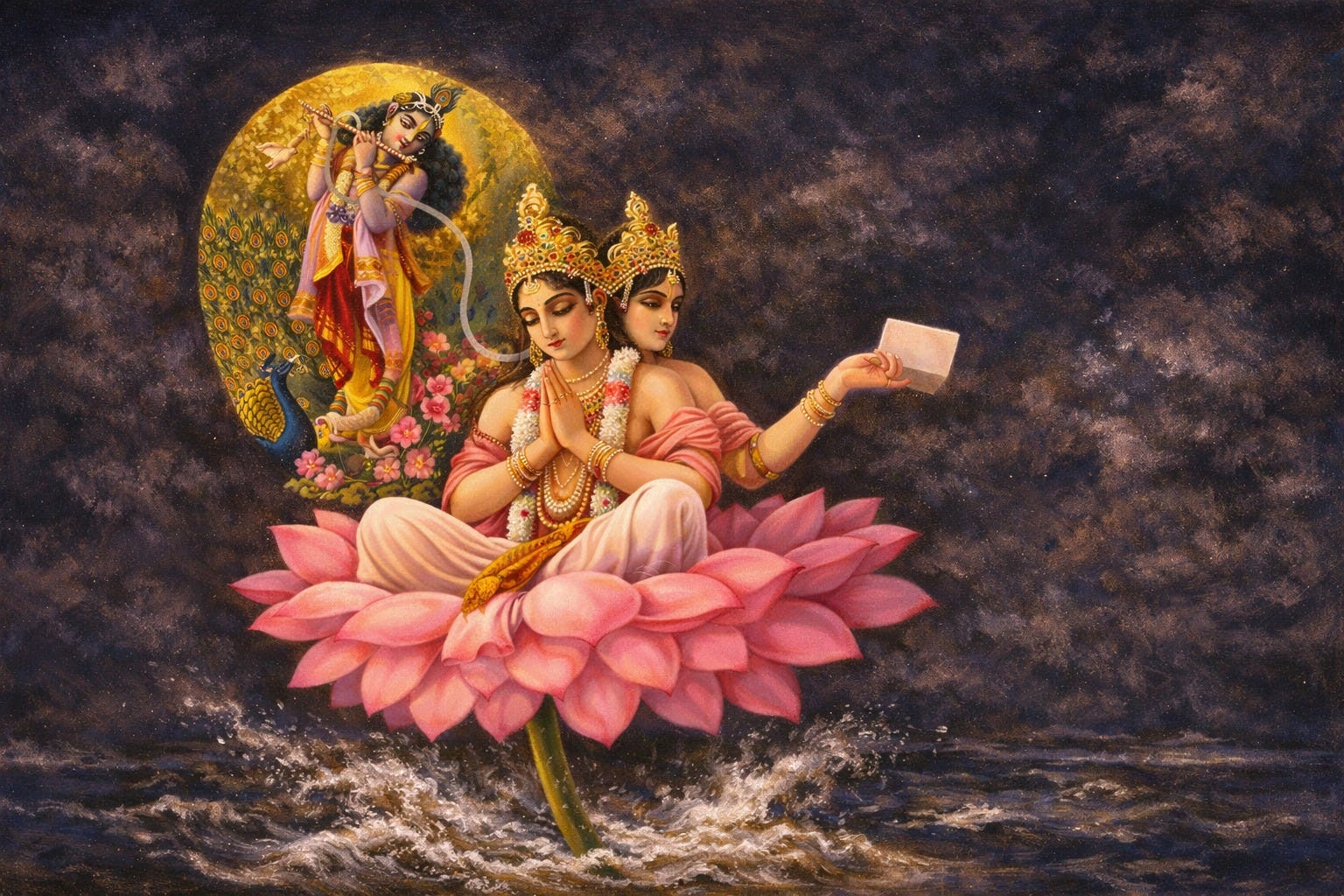
Another point to consider: When does the building come into existence? Only when the physical bricks are set, or when the engineer makes the project? These are two distinct phases, but we can say that when the project is ready, the building already exists, but in a subtle form, as an idea that later gains a physical form.
That’s what Brahmā means when he reveals to his son Nārada Muni:
“Inspired by Him only, I discover what is already created by Him [Nārāyaṇa] under His vision as the all-pervading Supersoul, and I also am created by Him only.” (SB 2.5.17)
Just as a book is first conceived by the author as an idea before being physically printed, or a product starts as a project before being effectively produced, Lord Mahā-Viṣnu creates everything that exists in the numerous universes in a subtle form (like a project or an idea). This is the primary creation. Later, Brahmā is inspired from the heart to give physical forms to this project, performing the secondary creation, which is the physical construction of the universe itself.
This process is described in the second canto of Śrīmad-Bhāgavatam. In chapter five, Brahmā himself describes how the Lord created the whole cosmic manifestation before his birth, as the subtle universal form:
“The Lord [Mahā-Viṣṇu], although lying in the Causal Ocean, came out of it, and dividing Himself as Hiraṇyagarbha, He entered into each universe and assumed the virāṭ-rūpa, with thousands of legs, arms, mouths, heads, etc.
Great philosophers imagine that the complete planetary systems in the universe are displays of the different upper and lower limbs of the universal body of the Lord. The brāhmaṇas represent His mouth, the kṣatriyas His arms, the vaiśyas His thighs, and the śūdras are born of His legs. The lower planetary systems, up to the limit of the earthly stratum, are said to be situated in His legs. The middle planetary systems, beginning from Bhuvarloka, are situated in His navel. And the still higher planetary systems, occupied by the demigods and highly cultured sages and saints, are situated in the chest of the Supreme Lord. From the forefront of the chest up to the neck of the universal form of the Lord are situated the planetary systems named Janaloka and Tapoloka, whereas Satyaloka, the topmost planetary system, is situated on the head of the form. The spiritual planets, however, are eternal.
My dear son Nārada, know from me that there are seven lower planetary systems out of the total fourteen. The first planetary system, known as Atala, is situated on the waist; the second, Vitala, is situated on the thighs; the third, Sutala, on the knees; the fourth, Talātala, on the shanks; the fifth, Mahātala, on the ankles; the sixth, Rasātala, on the upper portion of the feet; and the seventh, Pātāla, on the soles of the feet. Thus, the virāṭ form of the Lord is full of all planetary systems.” (SB 2.5.35-41)
When Mahā-Viṣnu performs the primary creation, he creates all forms, manifestations, and experiences that exist in the material universes. These same forms are established inside each individual universe as the subtle universal form by Garbhodakaśāyī Viṣnu. Later, during the secondary creation, Brahmā follows this project, creating the 14 planetary systems, each one containing an enormous volume of forms and experiences. According to our consciousness, we take birth into one of these places, and there we perform our small role in the creation, manipulating the different material objects and interacting with other living entities.
The description of the creation of the universe given in the Śrīmad-Bhāgavatam gives us an idea of the work necessary for creating the environment we live in. It also helps us to better understand the illusory nature of this world. Śrila Prabhupāda frequently explains in his teachings that life in this material world is, in a sense, similar to a dream. We spend time in this dream thinking that we are a man or a woman, that we have this or that position, and so on, but because none of it is true in the ultimate sense, we need to leave these positions in due time, just like someone awakening from a dream. This, however, should not be misunderstood.
Like all analogies, the comparison of material life and a dream offers many similarities with reality, but like all analogies, it doesn’t represent all the intricacies. We should thus take the main meaning, which is the temporary nature and illusion of our current situation, and not start believing that we are literally living inside a dream and that everything around us doesn’t exist.
A dream is illusory, but it is not false. It is real in the sense that someone is experiencing it, but at the same time, it is illusory in nature, since in the dream we forget our real identity and become absorbed in imaginary situations. A dream is thus not false, but it is illusory and based on the forgetfulness of our real self. Similarly, this whole material manifestation is not false. We are here experiencing it, as are all the people around us. Things are happening. It is compared to a dream because we become forgetful of our real nature and become absorbed in the different temporary roles we play here.
Because they are not connected with our eternal nature, all the roles we play in this material world are temporary. We play for some time, but eventually, we are forced to leave, and this is called death. After that, if we are still not ready to accept our real nature, a new temporary role is accepted, which we call birth.
Read the whole book:
« Making Sense of the Vedic Universe, a Higher-Dimensional Reality
This is a publication for thoughtful readers who want to go deeper into Kṛṣṇa consciousness. I publish daily, trying to offer high-quality spiritual content, and all posts are available to free subscribers. If you wish, you can also choose a paid subscription to support this work.
You can also receive the updates on WhatsApp or Telegram.
If you would like to contribute further, you can find the donation links here.