

Subscribe to receive new articles by e-mail. It’s free, but if you like, you can pledge a donation:
🔉 Audio of the lesson »
🎙Podcast (Search for “Mysteries of the Vedas” on Spotify, iTunes, etc. to hear all the lessons
Check this post if you would like to join the live lessons. This course is maintained with your donations. Click here to donate.
💬 Text of the lesson
Priyavrata returns to reign over Bhū-Mandala (Chapter 5.1)
Previously in the Śrīmad Bhāgavatam, it was explained that Svāyambhuva Manu had two very qualified sons, of whom Uttānapāda, the younger, inherited the throne. The reason was that the elder son, Priyavrata, had a strong tendency to renunciation and retired at a younger age, becoming a disciple of Nārada Muni.
Uttānapāda was the father of Dhruva Maharaja, who succeeded him on the throne. Dhruva became the head of a great dynasty, which continued up to the Pracetas, who produced a single son through their wife, Marisa: Daksa (in his second birth). Daksa, however, was not interested in becoming a human king. His goal was to regain his original position as the principal Prajāpati. He thus practiced austerities for a very long time, and never ascended to the throne. With this, the lineage of Dhruva Maharaja was broken.
There was, however, one descendant of Svāyambhuva Manu who was alive, and had never ascended to the throne: Priyavrata, his elder son. With the breakage of his brother’s dynasty, the duty of ruling would naturally fall on him.
Prabhupāda summarizes the situation in his purport to 5.1.7:
“It is understood from previous explanations that the father of Dhruva Mahārāja, King Uttānapāda, ruled over the universe because his elder brother, Priyavrata, practiced austerity from the very beginning of his life. Thus up to the point of the Pracetās, the kings of the universe were all descendants of Uttānapāda Mahārāja. Since there were no suitable kings after the Pracetās, Svāyambhuva Manu went to the Gandhamādana Hill to bring back his eldest son, Priyavrata, who was meditating there.”
Because he was practicing austerities as a perfect Brahmacārī, Priyavrata had never grown old. Even though millions of years had passed, he was still a young man, and his profound level of spiritual realization made him extremely qualified. If he were to ascend to the throne, he would surely become a great saintly king. However, being instructed by Nārada Muni and having acquired a taste for serving the Lord in a life of renunciation, how could he be convinced to step down from this exalted platform to assume a mundane duty as a king?
At the end of the Fourth Canto, Śukadeva Goswami had stated:
“O best of kings [King Parīkṣit], I have now finished telling about the descendants of the first son of Svāyambhuva Manu, Uttānapāda. I shall now try to relate the activities of the descendants of Priyavrata, the second son of Svāyambhuva Manu. Please hear them attentively.
Although Mahārāja Priyavrata received instructions from the great sage Nārada, he still engaged in ruling the earth. After fully enjoying material possessions, he divided his property among his sons. He then attained a position by which he could return home, back to Godhead.” (SB 4.31.26-27)
This description triggered the question of Maharaja Parīkṣit that opens the Fifth Canto:
“King Parīkṣit inquired from Śukadeva Gosvāmī: O great sage, why did King Priyavrata, who was a great, self-realized devotee of the Lord, remain in household life, which is the root cause of the bondage of karma [fruitive activities] and which defeats the mission of human life? Devotees are certainly liberated persons. Therefore, O greatest of the brāhmaṇas, they cannot possibly be absorbed in family affairs.
Elevated mahātmās who have taken shelter of the lotus feet of the Supreme Personality of Godhead are fully satiated by the shade of those lotus feet. Their consciousness cannot possibly become attached to family members.” (SB 5.1.1-3)
Parīkṣit was surprised that Priyavrata could accept the throne and enter into household life after attaining such an exalted level of devotional service. More than that, Parīkṣit knew very well the lives of previous great kings. He had heard that Priyavrata was a great king who had performed many great material deeds, such as creating a second sun and dividing Bhū-Mandala into the seven great islands using his chariot. These are not deeds that an unattached person, who hesitantly accepts the duties of a king, can perform. Parīkṣit thus concludes that Priyavrata had not only entered family life but had become attached. This, in turn, triggered yet another question: Having become attached, how could he attain perfection in Krsna Consciousness at the end? This leads to the conclusion of his question in text 5.1.4:
“The King continued: O great brāhmaṇa, this is my great doubt. How was it possible for a person like King Priyavrata, who was so attached to wife, children and home, to achieve the topmost infallible perfection in Kṛṣṇa consciousness?”
The argument of Parīkṣit was anchored on two propositions:
a) A devotee who becomes advanced in Krsna consciousness cannot embrace materialistic life again.
b) A person living a materialistic life cannot take up Krsna consciousness at any stage.
In text five, Śukadeva Goswami accepts both propositions as true. Once one becomes advanced in devotional service, there is no possibility of returning to material life, and when one is absorbed in material life, there is no possibility of coming to Krsna Consciousness; one simply remains a materialist life after life, as it can be practically noted. Taking these two points as rigid truths, the case of Priyavrata becomes inexplicable, since he appears to have done both. He came from an advanced stage of Krsna Consciousness back to active fruitive life, and later ascended again, attaining perfection. No wonder Parīkṣit Maharaja was surprised.
The point is that, as in almost all other philosophical points, there are nuances. When we don’t properly understand these nuances, everything appears black and white, and we see so many contradictions in the scriptures. However, when the subtleties are understood, everything becomes clear.
It’s true that a materialistic person never comes to Krsna Consciousness, remaining absorbed in matter, life after life. However, a change of heart can happen due to the association with devotees. Similarly, as Śukadeva Gosvāmī answers, an advanced devotee may sometimes be checked by some impediment, but one never loses the exalted position previously acquired. This again reinforces the point that devotional service is eternal and is never lost. At the same time, however, it can be temporarily covered by certain impediments. These impediments can never destroy one’s devotional service, but they can hide it for the time being.
In his purport, Prabhupāda explains that the first impediment is vaiṣṇava-aparādha. As he explains: “When a mad elephant enters a beautiful garden, it destroys everything, leaving a barren field. Similarly, the power of vaiṣṇava-aparādha is so great that even an advanced devotee becomes almost devoid of his spiritual assets if he commits it. Since Kṛṣṇa consciousness is eternal, it cannot be destroyed altogether, but advancement may be checked for the time being.”
In the Third Canto, we studied the episode of Jaya and Vijaya, who came from Vaikuṇṭha for three lives because of an offense against the Kumāras. This offense, however, had another component behind it, which was the plan of the Lord. Jaya and Vijaya had desired to fight with the Lord, and similarly, the Lord desired to fight with His strongest associates; therefore, this pastime was arranged. This eventual desire of the Lord is thus described as the second impediment.
A pure devotee is surrendered to the desire of the Lord, and thus, if the Lord desires that he come to the material world and become a materialist to take a role in some pastime, the devotee will do that. While playing his role, a devotee may appear to have become fallen, but this is just superficial. Under this covering, his devotional service is still existing. Prabhupāda substantiates this with another example, the story of Bilvamaṅgala Ṭhākura:
“By the order of the Lord, a perfect devotee sometimes comes to this material world like an ordinary human being. Because of his previous practice, such a perfect devotee naturally becomes attached to devotional service, apparently without cause. Despite all kinds of impediments due to surrounding circumstances, he automatically perseveres in devotional service and gradually advances until he once again becomes perfect. Bilvamaṅgala Ṭhākura had been an advanced devotee in his previous life, but in his next life he became greatly fallen and was attached to a prostitute. Suddenly, however, his entire behavior was changed by the words of the very prostitute who had so much attracted him, and he became a great devotee. In the lives of exalted devotees, there are many such instances, proving that once one has taken to the shelter of the lotus feet of the Lord he cannot be lost (kaunteya pratijānīhi na me bhaktaḥ praṇaśyati).”
Why is it that the Lord sometimes puts His devotees in such difficulties? So they can serve as examples to all of us. An easy test may be passed by any student, but a very hard test can be passed only by the most advanced. When He wants to show how one should persevere and surpass all obstacles, He has to send devotees of the caliber of the Pandavas to play this role. Similarly, when He wants to give the example of how one can progress from the depths of materialistic life all the way to the platform of pure devotion, He has to send an advanced devotee to become a materialist and from there show how to get out of this platform by seriously practicing devotional service, like in the case of Bilvamaṅgala Ṭhākura.
Priyavrata was peacefully practicing devotional service under the feet of Nārada Muni; therefore, there was no question of his having committed offenses. Śrīla Viśvanātha Cakravartī concludes that his case was due to the divine arrangement of the Lord, who wanted him to play the role of an exemplary king and, from there, achieve full self-realization, serving as an example for others.
Priyavrata is approached by Svāyambhuva Manu and Brahmā
The spiritual practice of Priyavrata is described in the first part of text six:
“Śukadeva Gosvāmī continued: My dear King, Prince Priyavrata was a great devotee because he sought the lotus feet of Nārada, his spiritual master, and thus achieved the highest perfection in transcendental knowledge. With advanced knowledge, he always engaged in discussing spiritual subjects and did not divert his attention to anything else.”
Prabhupāda emphasizes that the reason Priyavrata attained such an exalted status of devotional service was his service to his spiritual master, Nārada Muni. One may perform mechanical austerities and gain entrance to the celestial planets by himself, but pure devotional service can only be acquired with the help of the spiritual master.
Priyavrata was, however, approached by Svāyambhuva Manu, who requested him to fulfill his duty, accepting the rule of Bhu-Mandala, and protecting all living entities:
“The Prince’s father then asked him to take charge of ruling the world. He tried to convince Priyavrata that this was his duty as indicated in the revealed scriptures. Prince Priyavrata, however, was continuously practicing bhakti-yoga by constantly remembering the Supreme Personality of Godhead, thus engaging all his senses in the service of the Lord. Therefore, although the order of his father could not be rejected, the Prince did not welcome it. Thus he very conscientiously raised the question of whether he might be diverted from devotional service by accepting the responsibility of ruling over the world.”
Priyavrata was concerned that accepting the role of a king would undermine his devotional service, and he was thus not at all inclined to accept it. Nārada Muni was right there, supporting his decision, which made the work of Svāyambhuva Manu extremely difficult. Nārada had instructed many kings in the lineage of Svāyambhuva Manu, and later, it is described how he liberated all the sons of Daksa in the 6th Manvantara. Against such a powerful ācārya, what could Manu do? He was, however, soon reinforced by Brahmā, who came all the way from his abode to convince Priyavrata. As Prabhupāda mentions: “Lord Brahmā did not come alone. He came with other great sages like Marīci, Ātreya and Vasiṣṭha. To convince Priyavrata that it was necessary for him to follow the Vedic injunctions and accept the responsibility of ruling over the world, Lord Brahmā also brought with him the personified Vedas, his constant associates.”
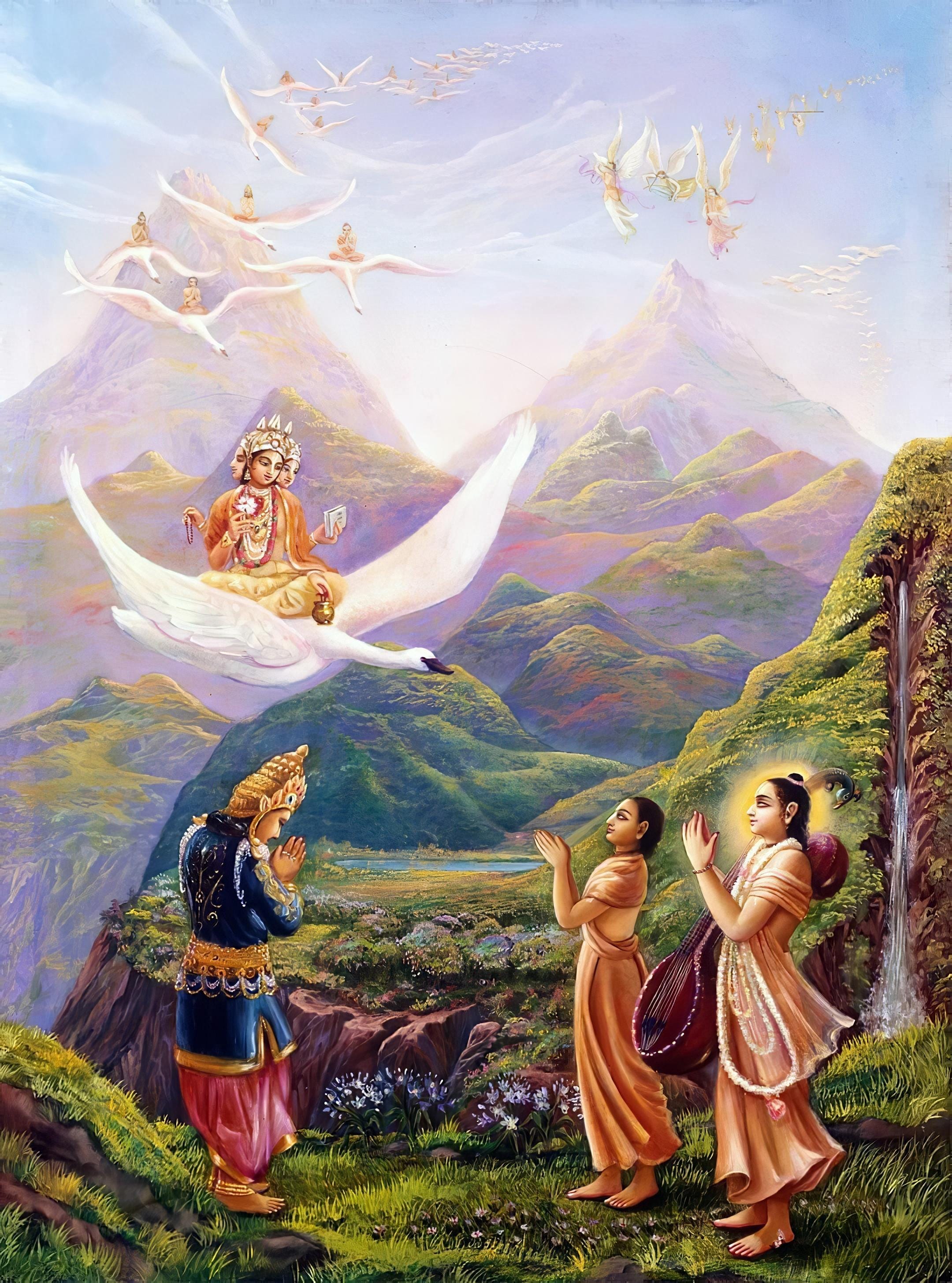
Brahmā is the spiritual master of Nārada Muni, and thus, with his support, the plea of Svāyambhuva Manu became much stronger. The scene is described in text eight:
“As Lord Brahmā descended on his carrier, the great swan, all the residents of the planets named Siddhaloka, Gandharvaloka, Sādhyaloka and Cāraṇaloka, as well as great sages and demigods flying in their different airplanes, assembled within the canopy of the sky to receive Lord Brahmā and worship him. As he received respect and adoration from the residents of the various planets, Lord Brahmā appeared just like the full moon surrounded by illuminating stars. Lord Brahmā’s great swan then arrived at the border of Gandhamādana Hill and approached Prince Priyavrata, who was sitting there.” (SB 5.1.8)
Brahmā’s understanding was that although Priyavrata was free from material desires, he should accept the throne as a service, fulfilling his duty inside the Varnāśrama system without grudge, as an offering to the Lord. As he explained, even he and Lord Śiva, as well as Nārada and others, cannot disobey His orders. Since there was an urgent service to be performed, Priyavrata should put aside his personal convenience and perform it in the best possible way. By acting for the satisfaction of the Lord, he would continue walking in the direction of spiritual perfection, even while in family life.
We can see that this is consistent with the instructions we receive from the Bhagavad-gītā. Everyone is forced to act according to the combination of the material modes he or she has obtained in this birth, according to activities in past lives; therefore, the way to become free from this conditioned nature is by executing the duties that are appropriate to us according to the instructions of the Lord and His representatives. A person who has material desires has no reason to avoid fulfilling his duties, because by fulfilling duties one gets the best results, and one without desires also has no reason not to perform his duties, understanding that this is the desire of the Lord.
By allowing the Lord to guide our lives, instead of fighting His control, we obtain the peace of mind necessary to practice devotional service. As Prabhupāda beautifully explains in his purport to text 15:
“The previous verse has given the analogy of bulls moving under the direction of the driver of a bullock cart. The bulls, being completely surrendered to the driver, remain wherever he wants to place them and eat whatever he wants them to eat. Similarly, being completely surrendered to the Supreme Personality of Godhead, we should not aspire for happiness, or regret distress; we must be satisfied with the position allotted to us by the Lord. We should follow the path of devotional service and not be dissatisfied with the happiness and distress He has given. People in the material modes of passion and ignorance generally cannot understand the plan of the Supreme Personality of Godhead with its 8,400,000 forms of life, but the human form affords one the special privilege to understand this plan, engage in devotional service and elevate oneself to the highest position of perfection by following the Lord’s instructions.”
In text 16, Brahmā makes the point that even if one is liberated, he still uses the body he received according to his past karma, living in whatever circumstances are allotted to him by the Lord. Instead of lamenting the past, he acts in a way that he will not have to accept a new body in the future. Most of the sufferings and difficulties we experience in life come exactly from not accepting our current situation as it is. We lament for what was lost, or what could have been, and in this way waste our energy and lose focus on the present. However, when we accept the plan the Lord chalked for us, being satisfied with whatever situation we are currently in, and using whatever energy and resources we have for serving the Lord, we can easily progress. When we finally realize our eternal position of service to Krsna, the tribulations of our current illusory existence are put into the proper perspective.
As Prabhupāda mentions in his purport: “Regardless of what we have done in our past lives, if we engage ourselves in unalloyed devotional service to the Lord in this life, we will always be situated in the brahma-bhūta (liberated) state, free from reactions, and will not be obliged to accept another material body. Tyaktvā dehaṁ punar janma naiti mām eti so ’rjuna (Bg. 4.9). After giving up the body, one who has acted in that way does not accept another material body, but instead goes back home, back to Godhead.”
Understanding the instructions of Brahmā
One could get the impression that Brahmā was being diplomatic in his instructions, trying to convince Priyavrata of what was convenient for the administration of the universe, and not necessarily what was best for him. However, this was not the case. As Prabhupāda confirms in his purport to text 11, Brahmā was not just acting politically in instructing Priyavrata to become the king. He was acting under the dictation of the Lord. As he mentions, “When Lord Brahmā went to induce Priyavrata to accept the responsibility for ruling the universe, he did not go whimsically; he was following the dictations of the Supreme Lord. Indeed, Brahmā and other genuine authorities never do anything without His permission.”
Brahmā argued that even in the forest, one can be defeated if his senses are not controlled, while one who has controlled his senses will not fall into bondage even inside family life. The question is thus in being properly situated in Krsna Consciousness, and not so much the external situation.
“Even if he goes from forest to forest, one who is not self-controlled must always fear material bondage because he is living with six co-wives — the mind and knowledge-acquiring senses. Even householder life, however, cannot harm a self-satisfied, learned man who has conquered his senses.” (SB 5.1.17)
This verse also brings the key for reconciling the instructions received from Nārada Muni and the instructions from Brahmā. Since both are authorities in the disciplic succession, there can be no contradiction amongst them. Nārada Muni, the spiritual master, had instructed Priyavrata to remain detached, while Brahmā is now telling him to enter into family life. Priyavrata will reconcile these two sets of instructions by accepting a wife and ruling the kingdom as a matter of duty, performing these activities perfectly while internally remaining detached.
This conclusion is supported by the next two verses, where Brahma gives practical instructions on how to attain this state of consciousness:
“One who is situated in household life and who systematically conquers his mind and five sense organs is like a king in his fortress who conquers his powerful enemies. After one has been trained in household life and his lusty desires have decreased, he can move anywhere without danger.
Lord Brahmā continued: My dear Priyavrata, seek shelter inside the opening in the lotus of the feet of the Lord, whose navel is also like a lotus. Thus conquer the six sense organs [the mind and knowledge-acquiring senses]. Accept material enjoyment because the Lord, extraordinarily, has ordered you to do this. You will thus always be liberated from material association and be able to carry out the Lord’s orders in your constitutional position.” (SB 5.1.18-19)
In his purport to text 19, Prabhupāda summarizes these instructions from Brahmā:
a) Brahmā instructs Priyavrata to take shelter in the lotus feet of the Lord, and thus remain transcendental even while in family life. The analogy is that one who takes shelter at the lotus feet of the Lord is protected from all dangers, just as a bumblebee who enters a lotus flower is fully protected by the petals and is thus not disturbed by sunshine and other external influences.
b) As already explained in the previous cantos, our constitutional position is that of an eternal servant of the Lord. Therefore, our primary duty is to carry out His orders. When we remain fixed in this determination, we can never fall, even in the midst of material enjoyment as a king or family man.
c) There is a difference between material wealth and enjoyment received because of our previous karma (which can sometimes bewilder a devotee and make one forget Krsna), and opulence given by the Lord, which ultimately brings one to a platform of perfect renunciation. We can see that Dhruva Maharaja was blessed by the Lord to enjoy as a king for 30,000 years, and by the end of this period, he was ready to go back home, back to Godhead. As hinted by Brahmā, the opulence Priyavrata was meant to receive as a king was ordained by the Lord, and would not affect his elevated spiritual status.
Priyavrata becomes the king
Having received the order of Brahmā, Priyavrata immediately offered obeisances and accepted it. Both he and Nārada looked at Brahmā without any tinges of resentment. As Prabhupāda mentions, “Both Priyavrata and Nārada were exalted personalities who knew how to respect Lord Brahmā. Therefore, instead of looking upon Brahmā with resentment, they very feelingly offered him their respect. Lord Brahmā then returned to his celestial abode, known as Satyaloka, which is described here as being impeccable and being unapproachable by words.”
In reality, there was no contradiction between the instructions of Brahmā and Nārada. The ultimate goal of both is to serve the Lord in pure devotional service. Previously, Priyavrata had been relieved from the responsibility of being the king by his younger brother, and thus Nārada instructed him on the path of renunciation. Now that there was an acute need, Brahmā instructed him on how to cultivate the same spirit of renunciation while fulfilling his duty. Priyavrata showed the perfect example as a disciple, fulfilling the instructions without being attached to a particular path, and Nārada also played the role of a perfect guru by being satisfied in his disciple receiving instructions that would put him on the path of ultimate success.
This also illustrates another important point in spiritual life. Often, we appear to receive contradictory instructions from superiors or from different scriptures. When this happens, we should not disregard one in favor of the other, but should instead use our intelligence to understand how they fit together. As Prabhupāda explains in his purport to text 12:
“The word manīṣayā (“by intelligence”) is of special significance. Priyavrata might argue that Lord Brahmā was requesting him to accept family life and the responsibility for ruling a kingdom although Nārada Muni had advised him not to enter household life and be entangled in material affairs. Whom to accept would be a puzzle for Priyavrata because both Lord Brahmā and Nārada Muni are authorities. Under the circumstances, the use of the word manīṣayā is very appropriate, for it indicates that since both Nārada Muni and Lord Brahmā are authorized to give instruction, Priyavrata should neglect neither of them but should use his intelligence to follow the advice of both.”
Having accepted the instructions, Priyavrata was installed on the throne. Text 5.1.23 summarizes his mood while ruling:
“Following the order of the Supreme Personality of Godhead, Mahārāja Priyavrata fully engaged in worldly affairs, yet he always thought of the lotus feet of the Lord, which are the cause of liberation from all material attachment. Although Priyavrata Mahārāja was completely freed from all material contamination, he ruled the material world just to honor the orders of his superiors.”
Maharaja Parīkṣit was under the impression that Priyavrata had fallen down after accepting the duties of a king, becoming attached, but Śukadeva Gosvāmi revealed that it was not so. He executed his duties so perfectly that he appeared to have become attached, but in reality, it was not so.
Ordinarily, materialists execute duties because of attachment to the result, and therefore, people who are not attached can’t perform their duty very well. How is it then possible that a pure devotee may perform material duties better than a materialist?
Prabhupāda explains in his purport to text 23:
“A devotee who is actually advanced is not afraid of anything, provided he has the opportunity to execute the order of the Supreme Personality of Godhead. This is the proper explanation of why Priyavrata engaged in worldly affairs although he was a liberated person. Also, only because of this principle does a mahā-bhāgavata, who has nothing to do with the material world, come down to the second platform of devotional service to preach the glories of the Lord all over the world.”
Devotees in the second platform usually have one foot in the material world and another in the spiritual world. They have knowledge of the scriptures and some attachment for Krsna, but at the same time, they are still attached to acting in particular ways in this material world. A devotee on this platform can progress further by using his talents for Krsna, spreading Krsna Consciousness, or simply working for the Lord. A devotee in the first platform, on the other hand, is fully situated in the spiritual platform and sees no need to intervene in the world affairs. However, sometimes, a mahā-bhāgavata comes down to the second platform, adjusting his vision to act in the material platform, while maintaining his perfect Krsna Consciousness. These are empowered ācāryas who can spread Krsna Consciousness all over the world. Priyavrata was meant to become one of these perfect teachers by playing the role of a perfect king.
The whole pastime of Priyavrata is extremely instructive, because it describes the situation most of us are in, trying to reconcile our duties in family life with the goal of becoming fully Krsna-conscious in this life. Priyavrata is the teacher who showed how to pass this test in the perfect way, and by studying his example, we can learn how to navigate our own challenges.
More details on the rule of the Manus
In his purport to SB 5.1.22, Śrīla Prabhupāda mentions:
“From Bhagavad-gītā we get information that Vaivasvata Manu was the son of the sun-god and that his son, Mahārāja Ikṣvāku, ruled this planet earth. Svāyambhuva Manu, however, appears to have been in charge of the entire universe, and he entrusted to his son, Mahārāja Priyavrata, the responsibility for maintaining and protecting all the planetary systems. Dharā-maṇḍala means “planet.” This earth, for instance, is called dharā-maṇḍala. Akhila, however, means “all” or “universal.” It is therefore difficult to understand where Mahārāja Priyavrata was situated, but from this literature his position certainly appears greater than that of Vaivasvata Manu, for he was entrusted with all the planetary systems of the entire universe.”
The system followed by kṣatriyas in Vedic societies is that each king would rule over a certain tract of land and rule over other smaller kings, who would control smaller sections of the country, down to single villages. Sometimes, however, a single emperor would be accepted by all other kings and would become the ruler of the whole planet, like in the case of Maharaja Yudhiṣṭhira.
In this purport, Prabhupāda reveals that a similar system exists in the universe. Each planet or star has its own ruler, from the hellish planets, ruled by Yamarāja, all the way up to Satyaloka, ruled by Brahma. Ordinarily, a Manu reigns only over Bhu-Mandala and passes the responsibility to his descendants. Dhruva Maharaja was ruling over Bhu-Mandala, just like Pṛthu, for example.
Bhu-Mandala is often equated to our planet, since it is the only visible part of the structure in our plane. We can see that Prabhupada uses the term “Earth” in the Śrimad Bhagavatam sometimes as meaning just our particular planet, and sometimes as meaning the extended Earth, including the whole Bhu-Mandala, while in some other passages he refers to Bhu-Mandala directly. This reflects the usage of different terms in the Sanskrit text itself. The reason for this apparent ambiguity is that what appears as Bhu-Mandala in higher planes appears as our planet in the gross reality we live in, and therefore, both are, in one sense, one. We need to go beyond the interpretation of individual words and understand the larger context to follow his explanation.
This said, what exactly is the function of the Manus?
Each Manu stays in his post for an entire Manvantara, or 306.72 million years (71 divya-yugas, plus the sandhyās), the same period during which all the different demigods also stay in their posts. The primary function of the Manus is that of law-givers and progenitors of humanity. They restore order in the lower and intermediate planetary systems (up to Svargaloka) after the chaos that follows the end of the previous Manvantara, appointing demigods, repopulating the planets, and so on. In the process, they also assume the function of rulers of Bhu-Mandala, producing descendants and starting a dynasty of kings.
As soon as a qualified son appears, they transmit to him the political leadership. In this way, Svāyambhuva Manu transmitted the rule of Bhu-Mandala to Uttānapāda, who transmitted it to Dhruva and so on.
At the same time, Manu remains the universal patriarch and maintainer of religious principles, as well as an overseer of the universal affairs. When some delicate matter appears, as in the case of the breakage in the line of Dhruva Maharaja, Manu intervenes to restore the universal order.
An example that can be given to describe these different levels of rulership is that sometimes the owner of a restaurant may personally work in the kitchen for some time while establishing the business, training the employees, and establishing the standards, and later give up this function when a qualified chef is found to focus on other aspects of the business. He continues to be responsible for the kitchen in a sense, but now as an overseer.
As mentioned, apart from the rule of the Manus over Bhu-Mandala, there are many other departmental heads in the universe. Each planet has its governor and predominant deity. Some Manus or descendants, however, may be so qualified that they may be accepted as rulers of the whole universe, with all the rulers of different planets accepting their authority, just like smaller kings accepting the rule of the emperor. In this case, it doesn’t mean Manu micromanages the affairs of each individual planet, but just that he gains authority over all these different rulers of different planets across the universe, who follow the directives established by him.
As Prabhupāda explains, the words “akhila-dharā-maṇḍala” in text 22 indicate that Svāyambhuva Manu was one of such cases, being accepted as the ruler of the entire universe, and passing the responsibility to Priyavrata.
Nowadays, we see that politicians try to hold to their posts until the end of life, without considering what awaits them, but the Manus and other saintly kings are not like that. They would rule as a matter of duty and pass the responsibility as soon as qualified descendants would be available. Their ultimate goal is self-realization, and not political power. Svāyambhuva Manu was not at all inclined to accept again the post of king of Bhu-Mandala, which involves performing so many material activities, but by the arrangement of the Lord, he was relieved by Priyavrata, who was in turn empowered to perform the function without becoming entangled. In this sense, we can understand the description of Śukadeva Goswami in the next two verses:
“Svāyambhuva Manu, with the assistance of Lord Brahmā, thus fulfilled his desires. With the permission of the great sage Nārada, he delivered to his son the governmental responsibility for maintaining and protecting all the planets of the universe. He thus achieved relief from the most dangerous, poisonous ocean of material desires.
Following the order of the Supreme Personality of Godhead, Mahārāja Priyavrata fully engaged in worldly affairs, yet he always thought of the lotus feet of the Lord, which are the cause of liberation from all material attachment. Although Priyavrata Mahārāja was completely freed from all material contamination, he ruled the material world just to honor the orders of his superiors.” (SB 5.1.22-23)
In his purport, Prabhupāda compares the situation of Priyavrata with Arjuna, who also didn’t want to fight in the battle of Kurukṣetra for his personal gain, but fought with all his might for the satisfaction of Krsna. Mundane persons may sometimes act out of attachment or avoid it out of aversion, but a pure devotee acts with even more energy for the satisfaction of Krsna, regardless of any personal consideration.
You can also donate using Buy Me a Coffee, PayPal, Wise, Revolut, or bank transfers. There is a separate page with all the links. This helps me enormously to have time to write instead of doing other things to make a living. Thanks!