

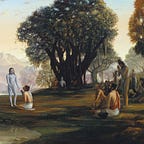

Previously in the Śrīmad Bhāgavatam, it was explained that Svāyambhuva Manu had two very qualified sons, of whom Uttānapāda, the younger, inherited the throne. The reason was that the elder son, Priyavrata, had a strong tendency to renunciation and retired at a younger age, becoming a disciple of Nārada Muni.
Uttānapāda was the father of Dhruva Maharaja, who succeeded him on the throne. Dhruva became the head of a great dynasty, which continued up to the Pracetas, who produced a single son through their wife, Marisa: Daksa (in his second birth). Daksa, however, was not interested in becoming a human king. His goal was to regain his original position as the principal Prajāpati. He thus practiced austerities for a very long time, and never ascended to the throne. With this, the lineage of Dhruva Maharaja was broken.
There was, however, one descendant of Svāyambhuva Manu who was alive, and had never ascended to the throne: Priyavrata, his elder son. With the breakage of his brother’s dynasty, the duty of ruling would naturally fall on him...


