


« The Friend Who Never Left: A Dialog on the “Fall” of the Jīva

You can receive new articles directly in your inbox. Subscription is free; donations are welcome.
Chapter Thirteen: Remembering the Friend
That evening, Mādhava sat at his desk with a notebook open in front of him, pen in hand. At first, he thought of writing down the different philosophical conclusions they had reached in the past few days, but then he remembered that the assignment was not about philosophy but about what had changed in him during their discussions and what he intended to do with what he had learned.
He put the pen aside and looked at the Bhagavad-gītā on his shelf. That was the same Gītā that Sarasvatī Prabhu had given to him, years earlier, when he was walking to university. He remembered the question that had made him stop: Who is the “I” that possesses the body and mind?
That question had changed his life. Now, after all these years, he was starting to understand how much is inside it.
The next morning, Mādhava found his mentor sitting on the veranda, enjoying the morning sunshine.
Gaurāṅga Dāsa: Haribol! You came early again.
You look well. Did you finish your homework?
Mādhava Dāsa: I think so, but I didn’t really write anything.
Gaurāṅga Dāsa: That’s fine. Our purpose is to learn, not necessarily to write many books. So what did you conclude?
Mādhava Dāsa: When I started practicing Kṛṣṇa consciousness, I was happy to read Prabhupāda’s books, chant, and try to serve Kṛṣṇa. At that stage, the relationship was developing naturally. Now I understand that this is what Kṛṣṇa consciousness is all about.
Then, I read the other book and everything changed. I started thinking that I misunderstood the philosophy and that the conclusions I had accepted were incorrect. Now I understand why this affected my practice so strongly; I allowed it to undermine the very foundations of it.
Now I understand that I don’t have to solve every single philosophical mystery before I can sincerely practice devotional service. I don’t need to keep arguing inside my mind with people who are not even there.
Different conditioned souls act in different ways in the material world, according to their desires. Some think they are great emperors; others think they are great philosophers. Everyone has their own illusion, but if we try to compete with them, we get caught in the same trap. I need to learn to observe others without becoming disturbed by their activities and instead focus on my own practice, unless, of course, dealing with them has some purpose that can somehow bring them to Kṛṣṇa.
Gaurāṅga Dāsa: Very good! You got it. But what will you do next time you encounter a very difficult question? Certainly, there will be more.
Mādhava Dāsa: I’ll examine it carefully. I will try to understand the context of the passage. Which question the speaker is answering, the purpose of the explanation, and how it connects with other passages. I will not immediately consider that everything I understood previously may be wrong just because of a few arguments I cannot answer.
I will also be attentive to the fact that translations can be influenced by the biases of the author. Actually, I realized that it is not really possible to translate Sanskrit. Literal translations rarely transmit what the verse is about. It’s always about finding the right interpretation, which is dependent on the author’s judgment and therefore vulnerable to his biases.
I think we become a little spoiled in this sense, because we are used to living in this safe environment, where we are spoon-fed the right conclusions through the purports of Prabhupāda, and we forget that there is a dangerous jungle of speculation outside.
Gaurāṅga Dāsa: That’s true. But the central point is not that there are different translations and interpretations. This is expected in the age we live in. Nāsau munir yasya mataṁ na bhinnam: “One cannot be considered a muni unless his opinion differs from other munis.”
The point is not that there are many books around and many of them have incorrect concepts. All of this is expected. The point is who we accept as authority.
The challenge for your generation is how to reconcile the huge volume of information that is available nowadays with the eternal constants Prabhupāda teaches us in his books. For devotees of my generation, it was easier in a sense, because we had less contact with other philosophies. We would study Prabhupāda’s books and advance by practicing what he wrote.
Nowadays, the environment is much more hostile. This brings many challenges, but there is also a positive: devotees who have faith in Prabhupāda’s books and can understand everything else through the purview of his conclusions can become very learned and effective in spotting and correcting misunderstandings. They can become very powerful philosophically, because they are constantly coming in contact with other ideas and learning how to defeat them.
Mādhava Dāsa: Like Rāma Tīrtha!
Gaurāṅga Dāsa: How do you know this story?
Mādhava Dāsa: I read about it.
Gaurāṅga Dāsa: Ha! This is a good example. He presented himself as an Advaitin scholar to study the arguments of the Advaita-siddhi thoroughly enough to refute it. He lived with the Māyāvādīs and studied with them, all for Kṛṣṇa. Of course we should not imitate, but that’s an interesting connection.
Mādhava Dāsa: I think I understand it much better now. Before, my faith in Prabhupāda was, we can say, passive; I was reading but not really studying it deeply. I was not following the process of asking questions and hearing the answers. Then, when someone presented arguments I couldn’t refute or reconcile, I began to doubt.
Now I can see that Prabhupāda’s teachings are much deeper than I was thinking at first. This study of the previous ācāryas helped me to appreciate his explanations more, not less. I can see that we are not the first ones to study these commentaries; Prabhupāda studied them much more deeply than we have, and wrote their conclusions.
Gaurāṅga Dāsa: That’s good. But there is another danger here.
Mādhava Dāsa: Which one?
Gaurāṅga Dāsa: The more we become learned, the more we risk becoming proud, thinking we are better than everyone else.
Bhakti is just like water. It automatically flows to the lowest point, to the humble one. The more we become proud, the more we deprive ourselves of it. If we fall into this trap, we can end up becoming scholars who are proud enough to act as judge and jury over the ācārya.
Unfortunately, false ego doesn’t disappear simply because we understand that we are not the body. If we are not approaching spiritual knowledge with the right mentality, study can actually nourish the false ego instead of destroying it.
Mādhava Dāsa thought for a considerable time. Gaurāṅga didn’t rush him.
Mādhava Dāsa: I should be careful with my attitude to what I learned. In the Gītā, Kṛṣṇa says He is the intelligence of the intelligent and also that He is the one who gives knowledge. So when I come to understand something, I should understand that Kṛṣṇa is the one giving me both the knowledge and the means to understand this knowledge.
Gaurāṅga Dāsa: Exactly. And you may use it to help other devotees who have doubts, just as you did.
But remember how you felt when you came here a few days ago. You were not looking for someone to debate with; you were looking for someone who could help you understand.
Mādhava Dāsa: That’s true. And you never told me to stop asking questions.
Gaurāṅga Dāsa: Why should I? Kṛṣṇa gave you intelligence. You should use it in His service. The function of the intelligence is to question and understand. That’s the way we can use it for Kṛṣṇa.
Mādhava Dāsa: There is another thing I realized yesterday. I was thinking about Sarasvatī Prabhu. Do you remember I told you how he stopped me on my way to university?
Gaurāṅga Dāsa: Yes. He asked you who the “I” was.
Mādhava Dāsa: Exactly. He didn’t explain any complicated philosophy. He just asked me a question I couldn’t answer and offered me a book with the solution. I read that Gītā in a few days, and that was the beginning of everything.
Now that he has passed away, I sometimes wish I could meet him again and tell him how much that book changed my life.
Gaurāṅga Dāsa: We started more or less at the same time, and we were initiated together. He was always into book distribution. He used to joke that he was more like a karmī because he liked to work with his body, while I was more like a jñani. Now he is there with Kṛṣṇa while I’m still here.
Gaurāṅga laughed to himself.
Do you know what he said to me when he was passing away?
Mādhava Dāsa: I have no idea.
Gaurāṅga Dāsa: He said, “You should cry for yourself, not for me. I’m going back to Kṛṣṇa, you are the one staying in this material world.”
Mādhava Dāsa smiled.
This looks exactly like him!
Gaurāṅga Dāsa: Some devotees get the essence, and they just advance quickly, without impediments, and they are often the first to go, because Kṛṣṇa is anxious to be again with them in the spiritual world.
He thought for some time. This time Mādhava was the one waiting.
Gaurāṅga Dāsa: Prabhupāda once said that everyone has received some special ability from Kṛṣṇa, and using this ability for Kṛṣṇa is the perfection of life.
When we try to suppress our talents and fit into some stereotype, spiritual life can become very difficult. If you tell a devotee who likes to study to break bricks all day long, convincing him that this is what devotional service means, how long will he be able to do it? Eventually he will reject the whole idea and conclude that this is what devotional service is; he does not want it. But if we engage him according to his nature, nourish him, and teach him to use his natural inclination for Kṛṣṇa, we give him a much more stable platform.
You should study the books very deeply and at the same time hear from advanced devotees and learn from them how to apply this knowledge in practice. How to help people to engage in devotional service and connect with their eternal spiritual natures, answering all questions they have in the process.
For this, we need to continue our own practice, for we cannot give others what we don’t have. As we free ourselves from material illusion, we gain the capacity of also helping others, and we also learn that the way to do that is not always through grand philosophical discourses. Often all that is necessary is some understanding or some small encouragement. Or a question at the exact moment.
Gaurāṅga again became thoughtful. He looked outside. For a while, they remained silent, looking at the birds in the courtyard.
Gaurāṅga Dāsa: So what are the ultimate philosophical conclusions of all these discussions?
Mādhava Dāsa: When I chant, I’m not trying to establish a new relationship with someone I don’t know, or someone who doesn’t know me. We may spend many lifetimes in this material world, absorbed in selfish activities, forgetful of our original relationship with Him, but Kṛṣṇa never forgets us. He accompanies us as Paramātmā, and gives us all opportunities to hear about Him.
We are eternally, constitutionally His servants. That’s what we are; it’s impossible to become something else. Material conditioning covers our awareness of this relationship, but it cannot change who we are. This is why devotional service can awaken our original consciousness. We are awakening to something that belongs to our eternal nature, not producing something new.
The soul is eternal. We were never created; therefore, our eternal relationship with Kṛṣṇa cannot be explained as something that began at a particular moment. Similarly, we can’t use material time to try to calculate the beginning of our conditioning. Anādi means from time immemorial; this single word can’t be abused to try to make conditioning our constitutional position.
When we study the scriptures, we should try to see how different points fit together, and try to understand them within the purview of Prabhupāda’s teachings, which bring the conclusions of the previous ācāryas.
Gaurāṅga Dāsa: You learned well; I’m proud of you.
Mādhava offered his obeisances and thanked Gaurāṅga Dāsa for helping him.
As he cycled toward the university, he felt that something had come to an end. Not his studies, nor the process of asking questions and receiving answers from his mentor, but the anxiety that had accompanied him since he read the book that challenged his understanding.
He passed along the street where Sarasvatī had stopped him a few years earlier. Back then, he couldn’t answer Sarasvatī’s question. He had come a long way since then.
Sarasvatī had given him a beginning, teaching him who he is. Gaurāṅga Dāsa had helped him to deepen this understanding, and Kṛṣṇa had been present quietly the whole time, arranging for these encounters to happen.
He still had a long way to go, but he now understood that he was not searching for someone who had disappeared. He was clearing his vision and learning to see someone who had always been there.
The friend he had forgotten had never left him.
Read the entire book:
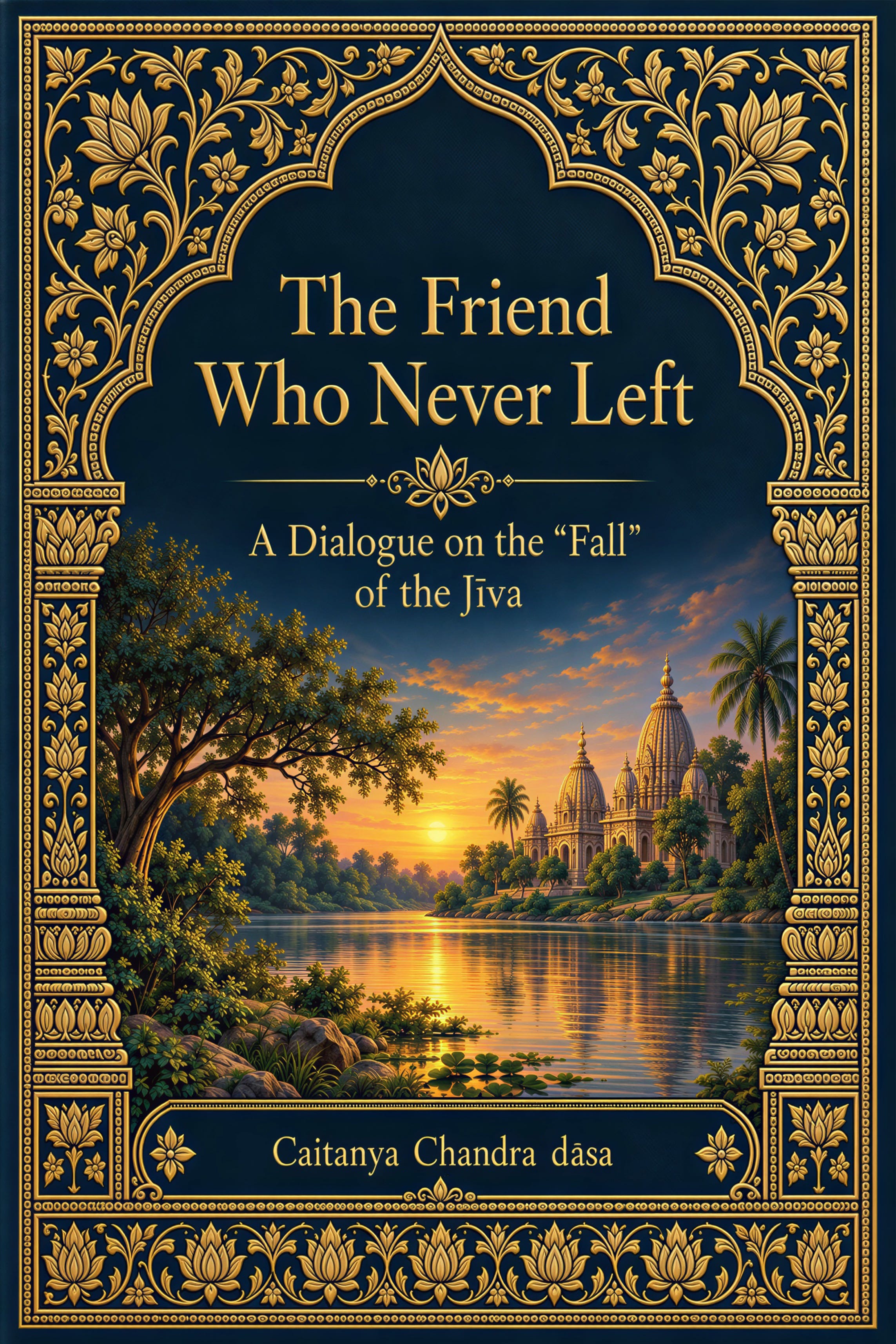
The Friend Who Never Left, A Dialog on the “Fall” of the Jīva
This is a publication for thoughtful readers who want to go deeper into Kṛṣṇa consciousness. I publish daily, trying to offer high-quality spiritual content, and all posts are available to free subscribers. If you wish, you can support this work with a monthly contribution. When you subscribe, you can choose between a free subscription and a monthly contribution, and you can switch from a free subscriber to a supporter at any time.
You can also receive updates on WhatsApp or Telegram.
If you would like to contribute further, you can find the donation links here.