

« The Song of God—Volume 1, chapters 1-6
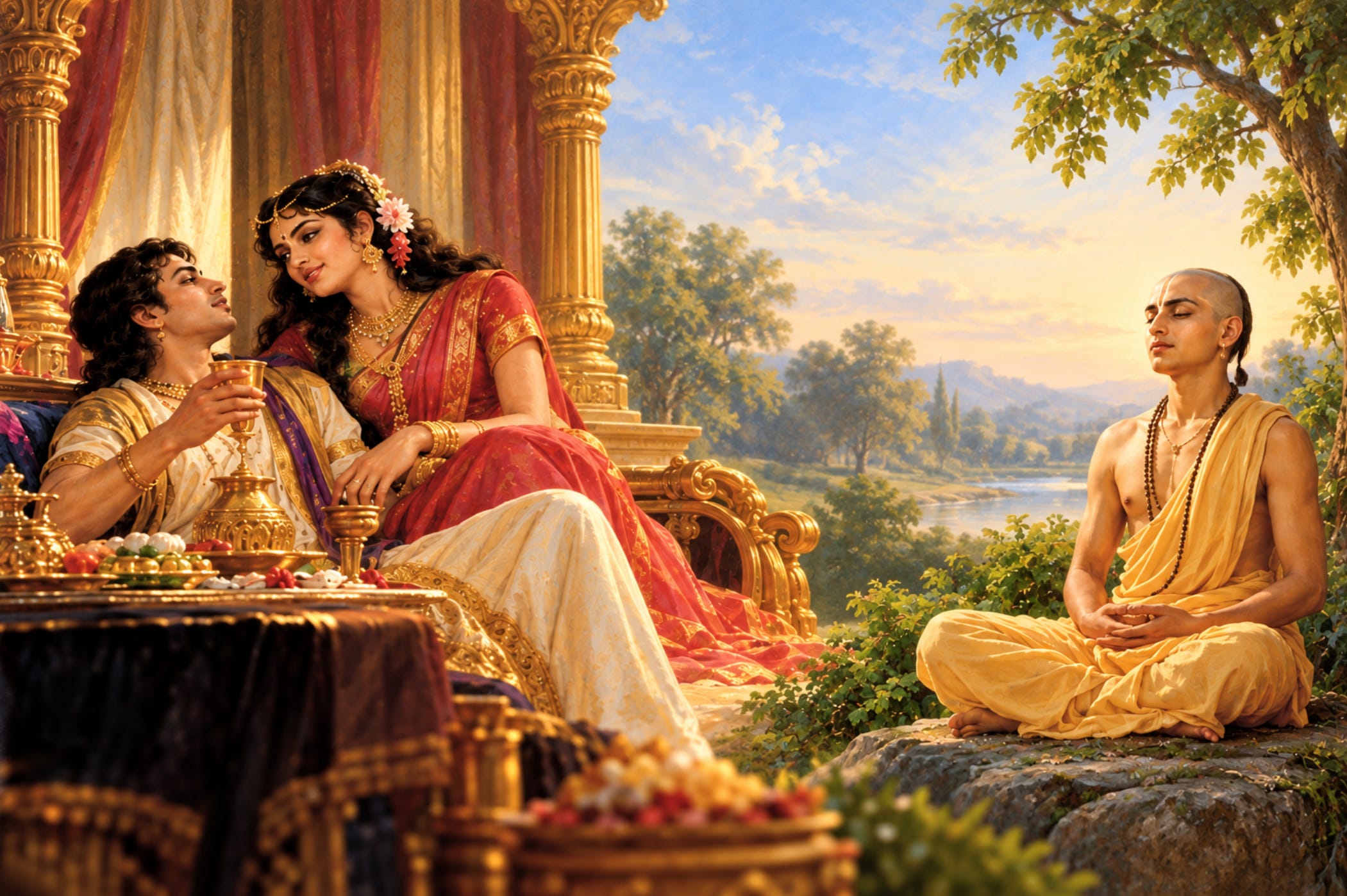
Resisting the urges of the senses and attaining liberation (Bg 5.22 to 5.26)
In the previous section, 5.17 to 5.21, Kṛṣṇa described the vision and realization of a self-realized person, who has fixed his intelligence, mind, faith, and shelter on Him. He sees the spiritual reality, and thus does not discriminate between different living beings based on the body. He has his intelligence fixed on the self, and is thus steady in both pleasure and distress. He is detached from external sense pleasure, fixed instead on inner spiritual happiness. Now, in 5.22 to 5.26, Kṛṣṇa elaborates on the practical results of this realization, or, in other words, the qualifications that such a transcendentalist develops.
Text 22: ye hi saṁsparśa-jā bhogā, duḥkha-yonaya eva te
ādy-antavantaḥ kaunteya, na teṣu ramate budhaḥ
An intelligent person does not take part in the sources of misery, which are due to contact with the material senses. O son of Kuntī, such pleasures have a beginning and an end, and so the wise man does not delight in them.
Text 23: śaknotīhaiva yaḥ soḍhuṁ, prāk śarīra-vimokṣaṇāt
kāma-krodhodbhavaṁ vegaṁ, sa yuktaḥ sa sukhī naraḥ
Before giving up this present body, if one is able to tolerate the urges of the material senses and check the force of desire and anger, he is well situated and is happy in this world.
Text 24: yo ’ntaḥ-sukho ’ntar-ārāmas, tathāntar-jyotir eva yaḥ
sa yogī brahma-nirvāṇaṁ, brahma-bhūto ’dhigacchati
One whose happiness is within, who is active and rejoices within, and whose aim is inward is actually the perfect mystic. He is liberated in the Supreme, and ultimately he attains the Supreme.
Text 25: labhante brahma-nirvāṇam, ṛṣayaḥ kṣīṇa-kalmaṣāḥ
chinna-dvaidhā yatātmānaḥ, sarva-bhūta-hite ratāḥ
Those who are beyond the dualities that arise from doubts, whose minds are engaged within, who are always busy working for the welfare of all living beings and who are free from all sins achieve liberation in the Supreme.
Text 26: kāma-krodha-vimuktānāṁ, yatīnāṁ yata-cetasām
abhito brahma-nirvāṇaṁ, vartate viditātmanām
Those who are free from anger and all material desires, who are self-realized, self-disciplined and constantly endeavoring for perfection, are assured of liberation in the Supreme in the very near future.
The three original characteristics of the soul are sat, cit, and ānanda: eternity, knowledge and spiritual bliss. These original characteristics are covered by contact with matter. This forces us to look for substitutes, seeking satisfaction in the material senses, looking for immortality in trying to somehow extend the longevity of the body, and so on. These material endeavors, however, ultimately result in misery. A self-realized person has superior knowledge; he understands perfectly that real happiness is found on the spiritual platform, and thus avoids material happiness, which obscures it.
Light and darkness can coexist to a certain extent during dawn, when the sun is still not fully visible. However, as the sun comes higher in the sky, there is no question of darkness remaining in any open space. Conversely, as the sun goes down, darkness gradually reappears.
Similarly, at a neophyte stage, one may try to balance material happiness and spiritual practice, but as we progress, we gradually come to the point that we need to choose one side. Spiritual realization means to gradually come to the platform of a sage, who rejects the false ego, and stops seeing himself as the actor and enjoyer, while material bondage means to become again immersed in the material ego and objects of the senses and forget about self-realization.
Kṛṣṇa defines material enjoyment as duḥkha-yonaya. This is a very strong statement. Yoni means “womb” in the sense of source, the place where something is nourished. Duḥkha means “distress” or “suffering.” In material life, we see material happiness as the solution for material suffering, but Kṛṣṇa explains that the material happiness itself is the source of future suffering. It is thus just like taking a loan to pay another loan. It may bring some momentary relief, but in the long term the debt only increases. Similarly, in the process of searching for material happiness, we accumulate so many attachments and karmic reactions that will bring even more suffering later.
Imagine, for example, a young man desiring to get married, with the idea of finding happiness. To attract a good wife, he has to accumulate many resources, like a house, a car, money, etc., forcing him to work hard. When he eventually finds his bride, he has to arrange the marriage and all other functions, which also demand work. The relationship, of course, establishes attachment that gradually grows, as they get their children, expand their circle of friends, grow in social position, etc. All of these come together with certain expectations that will not necessarily be fulfilled. We create many plans, but they do not necessarily work.
After all this effort and anxiety, one may feel happy for some time, but gradually things deteriorate. Things may not go well on the financial side, or there may be other problems; the children may not be obedient, there may be divorce, etc. Even if everything works perfectly, suffering will come later in life, as old age, disease, and eventually death set in. Apart from that, one has to work very hard to maintain his family, and not all these activities may be perfectly honest and religious. This also brings inevitable karmic reactions that he will have to suffer in his next life. We can thus see that a short period of material happiness can only be achieved with great effort, and even then, it inevitably leads to a long period of acute material suffering afterward.
Analyzing this process, we can easily understand the trap of materialistic life. Material suffering makes us look for material happiness, which forces us to work hard in this world to secure the resources we need for that. This inevitably forces us to accumulate so many karmic reactions. Material happiness in itself comes together with material attachment, and both karma and attachment come back in the form of loss and suffering. This acute suffering leads us to seek material happiness again, restarting the cycle. This can be connected with texts 2.62 and 2.63, where Kṛṣṇa describes the cycle of contemplation, attachment, lust, anger, bewilderment, and fall.
What is the solution, then? Kṛṣṇa explains that the intelligent, budhaḥ, does not delight in these temporary material pleasures (na teṣu ramate). As already explained, this does not mean he stops all kinds of activities, but he renounces the sense of proprietorship, acting only for Kṛṣṇa. With this, he gives up attachment, and instead performs actions out of duty, as an offering to Kṛṣṇa. This, in turn, frees him from karmic reactions. We can thus see that this process of detached work that Kṛṣṇa explains in chapters two, three, four, and five of the Gītā is the real solution for the problem of material suffering, and, at the same time, it brings us to real happiness with Kṛṣṇa on the transcendental platform.
The difficulty is that when we try to follow the spiritual path, the mind and senses push us back. Although there is plenty of spiritual engagement for the senses in spiritual practice, including chanting, dancing, and prasādam, we have to abstain from many gross sensory pleasures that are contradictory to our practice. What is the solution then? Kṛṣṇa gives us the path: some restriction is necessary. On the one hand, as we advance in spiritual life, the knowledge and spiritual realization make us less prone to sense enjoyment, but at the same time, voluntary restriction is also necessary, so our progress is not blocked. These are thus two tracks on the same railway.
Kṛṣṇa thus gives us the path to follow: “Before giving up this present body, if one is able to tolerate the urges of the material senses and check the force of desire and anger, he is well situated and is happy in this world.” This is also in line with what He mentions in text 2.64: one who is capable of controlling his senses through the regulative principles can obtain the mercy of the Lord.
The successful transcendentalist follows this path of sense control, and we should also follow it to attain the same result. This, however, should be taken in the context of the previous instructions. It is not about abandoning our duties or mere repression. To tolerate the urges of the senses means to patiently follow the whole spiritual process He describes, under the guidance of the bona fide spiritual master. Prabhupāda goes deeper in his purport:
“If one wants to make steady progress on the path of self-realization, he must try to control the forces of the material senses. There are the forces of talk, forces of anger, forces of mind, forces of the stomach, forces of the genitals, and forces of the tongue. One who is able to control the forces of all these different senses, and the mind, is called gosvāmī, or svāmī. Such gosvāmīs live strictly controlled lives and forgo altogether the forces of the senses. Material desires, when unsatiated, generate anger, and thus the mind, eyes and chest become agitated. Therefore, one must practice to control them before one gives up this material body. One who can do this is understood to be self-realized and is thus happy in the state of self-realization. It is the duty of the transcendentalist to try strenuously to control desire and anger.”
Kṛṣṇa then continues to describe the results of transcendental knowledge: “One whose happiness is within, who is active and rejoices within, and whose aim is inward is actually the perfect mystic. He is liberated in the Supreme, and ultimately he attains the Supreme.”
A self-realized devotee enjoys, but his happiness does not come from contact with the sense objects. It comes from within. Even if technically living in a material body, he is already liberated and, in due time, assumes a spiritual form to serve the Lord in the spiritual world.
In general, a materialist depends on many external objects to be happy. One depends on his house, his car, his family, and friends, hobbies, pets, etc. If such a person is separated from these at some point, he or she cannot feel happy. We can see that when people organize vacations, they have to bring many people and objects with them: their spouses and children, personal objects, close friends, often even their pets. Without these, one cannot enjoy the vacation. Their happiness is thus very unstable, because it depends on all these external objects. If the spouse decides to divorce, the children become rebellious, the best friend betrays them, or their financial position deteriorates, they immediately feel anxiety.
How is it possible for a self-realized person to feel happy anywhere, regardless of the material situation? The point is that the self-realized person bases his happiness on his relationship with Kṛṣṇa. As already discussed, the Absolute Truth is realized in three aspects. Full realization happens in the Bhagavān aspect, but even in Brahman or Paramātmā realization, one experiences a level of spiritual happiness that completely eclipses any form of material enjoyment. Because this happiness comes from within, the self-realized carries it everywhere, and therefore, his happiness does not depend on anything else. Because he carries Kṛṣṇa inside his heart, all he needs to be happy goes with him, and therefore he does not need anything else. This stage is called brahma-bhūta, the liberated stage. As mentioned in text 18.54, brahma-bhūta is the platform that precedes devotional perfection.
A self-realized soul can sit anywhere in silence, or he can travel anywhere with just a stick and a water pot, or, conversely, he may live in a palace, surrounded by fully surrendered disciples. In any situation, he is equipoised, because feeling happiness from within, he is not affected by the presence or absence of external material objects of the senses. All of these are simply engaged in Kṛṣṇa’s service. If a materialist receives a mansion, he or she will consider how to live there comfortably, while a pure devotee will look for ways to use it for Kṛṣṇa.
Kṛṣṇa then concludes His description of the qualifications of one who has attained the brahma-bhūta stage. Texts 25 and 26 may be taken together:
“Those who are beyond the dualities that arise from doubts, whose minds are engaged within, who are always busy working for the welfare of all living beings and who are free from all sins achieve liberation in the Supreme. Those who are free from anger and all material desires, who are self-realized, self-disciplined and constantly endeavoring for perfection, are assured of liberation in the Supreme in the very near future.”
Such a devotee is free from all sins (the result of giving up false ego and working only for Kṛṣṇa), is free from doubt, and is beyond the material dualities that come from it (the result of transcendental realization). His mind is engaged within (the result of fixing his mind on the transcendental platform), and he is busy, working for the welfare of all. He is also free from anger and material desires, self-realized, self-disciplined and constantly endeavoring for perfection.
Prabhupāda connects this welfare of all with the performance of devotional service. The central point is that a pure devotee understands that Kṛṣṇa is the source and support of everything, and works in this spirit, gradually trying to bring others to this same understanding. This means that the activities of a pure devotee are always directly or indirectly connected with expanding the mission of the Lord, bringing others to Kṛṣṇa consciousness. A pure devotee may thus maintain a temple, for a temple serves many purposes in benefiting the general people. Or, conversely, he may publish books and directly approach people to speak about Kṛṣṇa. He may distribute prasādam or give people spiritual education under the guise of welfare work, and so on.
As Prabhupāda mentions:
“When a person is actually in the knowledge that Kṛṣṇa is the fountainhead of everything, then when he acts in that spirit he acts for everyone. The sufferings of humanity are due to forgetfulness of Kṛṣṇa as the supreme enjoyer, the supreme proprietor and the supreme friend. Therefore, to act to revive this consciousness within the entire human society is the highest welfare work. One cannot be engaged in such first-class welfare work without being liberated in the Supreme. A Kṛṣṇa conscious person has no doubt about the supremacy of Kṛṣṇa. He has no doubt because he is completely freed from all sins. This is the state of divine love.”
On the other hand, a materialist will never be able to factually benefit others, because all his activities will be on the bodily platform. One may give food to the poor, but without being offered to Kṛṣṇa, this food will just further entangle them in karmic reactions. We can see that due to this lack of knowledge, the whole effort is ultimately wasted. The question is not that one should not do welfare work; the point is that one should connect it with Kṛṣṇa.
Ultimately, people do not suffer because of the lack of food or other material facilities; they suffer because they have forgotten Kṛṣṇa as the supreme enjoyer, the supreme proprietor, and the supreme friend. Only when we perform our activities in this consciousness can we truly benefit people.
Can other types of transcendentalists, like impersonalists and yogīs, attain the stage of brahma-bhūta? They can, but their advancement is much more difficult, and they always face the risk of falling due to the smallest agitation, even after practicing for a very long time.
Prabhupāda describes this point in his purport to text 5.26:
“In the conditioned soul the desire to enjoy the fruitive results of work is so deep-rooted that it is very difficult even for the great sages to control such desires, despite great endeavors. A devotee of the Lord, constantly engaged in devotional service in Kṛṣṇa consciousness, perfect in self-realization, very quickly attains liberation in the Supreme. Owing to his complete knowledge in self-realization, he always remains in trance.”
The root cause of conditioned life is the desire of the soul to enjoy independently from Kṛṣṇa. Devotional service uproots this desire because it gives a higher engagement and higher taste. A devotee may thus fall at an immature stage, but as soon as he becomes fixed, his position becomes secure.
Liberation is thus not about a physical location, but about attaining this state of consciousness where one becomes strongly connected with Kṛṣṇa. Even while living in the material world, a devotee can become connected with Kṛṣṇa and elevate himself to the spiritual world by constantly thinking of Him. This stage is called brahma-nirvāṇa, the absence of material miseries due to being constantly immersed in thoughts of Kṛṣṇa.
Main points in the purports of Śrīla Prabhupāda:
“An intelligent person does not take part in the sources of misery, which are due to contact with the material senses. O son of Kuntī, such pleasures have a beginning and an end, and so the wise man does not delight in them.”
a) The soul is eternal, but the body is temporary. Temporary happiness cannot satisfy the eternal soul. Thus, a liberated soul, situated in knowledge, is not interested in temporary sense gratification.
b) Material happiness is available even for animals, just as material suffering is. We should, therefore, not work hard for obtaining it. Instead, we should purify our existence and enjoy the transcendental platform. The more one is addicted to material pleasures, the more he or she is entrapped by material miseries. Therefore, those who are truly learned are not attracted by them.
“Before giving up this present body, if one is able to tolerate the urges of the material senses and check the force of desire and anger, he is well situated and is happy in this world.”
a) We need to learn to control our senses to make progress on the path of self-realization. One who can control the urges of the senses is called a gosvāmī. We need to learn this art while living in this body, so we may attain liberation at the end of this life.
b) Why is it so difficult to control the senses? We have to go to the root cause, and control desire. When desire is not satiated, it generates anger, which agitates the mind. A transcendentalist works hard to control desire and anger. One who can do that becomes happy in a state of self-realization.
“One whose happiness is within, who is active and rejoices within, and whose aim is inward is actually the perfect mystic. He is liberated in the Supreme, and ultimately he attains the Supreme.”
a) It is not possible to renounce material happiness unless one feels happiness from within. That’s the secret of a liberated person. He can be happy by just sitting anywhere and enjoying his internal spiritual activities. This level is called brahma-bhūta.
“Those who are beyond the dualities that arise from doubts, whose minds are engaged within, who are always busy working for the welfare of all living beings and who are free from all sins achieve liberation in the Supreme.”
a) Kṛṣṇa is the root of all existence. All suffering is due to forgetfulness of Him, and thus, real welfare means to reconnect people with their original Kṛṣṇa consciousness. A person who is situated in real knowledge, freed from all sins, can see this perfectly, and thus acts in this spirit. One cannot be engaged in such first-class welfare work without having attained a state of divine love, being liberated in the Supreme.
b) On the other hand, one working only on the level of mundane welfare cannot factually help anyone. He works only on the level of temporary relief of the body and mind, without addressing the real cause.
“Those who are free from anger and all material desires, who are self-realized, self-disciplined and constantly endeavoring for perfection, are assured of liberation in the Supreme in the very near future.”
a) Among all saintly persons who strive for liberation, the devotee is the best. No other process is as effective in controlling the senses as being engaged in devotional service.
b) The desire for material enjoyment is so deeply rooted in the conditioned soul that even great sages have difficulty in curbing it. A devotee constantly engaged in devotional service, however, has a positive engagement, and thus quickly attains liberation. He is situated in perfect knowledge and always remains in trance.
c) How is a devotee elevated to the spiritual world? By simply thinking of the Lord constantly, being engaged in Kṛṣṇa consciousness. In that state, even while living in this material world, the devotee already lives on the transcendental platform, without feeling material miseries.
Read the entire book:
« The Song of God—Volume 1, chapters 1-6

This is a publication for thoughtful readers who want to go deeper into Kṛṣṇa consciousness. I publish daily, trying to offer high-quality spiritual content, and all posts are available to free subscribers. If you wish, you can also choose a paid subscription to support this work.
You can also receive the updates on WhatsApp or Telegram.
If you would like to contribute further, you can find the donation links here.
Hare Krishna!
What a fantastic article and commentary. Essence of the essence. All glories to you👏👏