

« Making Sense of the Vedic Universe, a Higher-Dimensional Reality
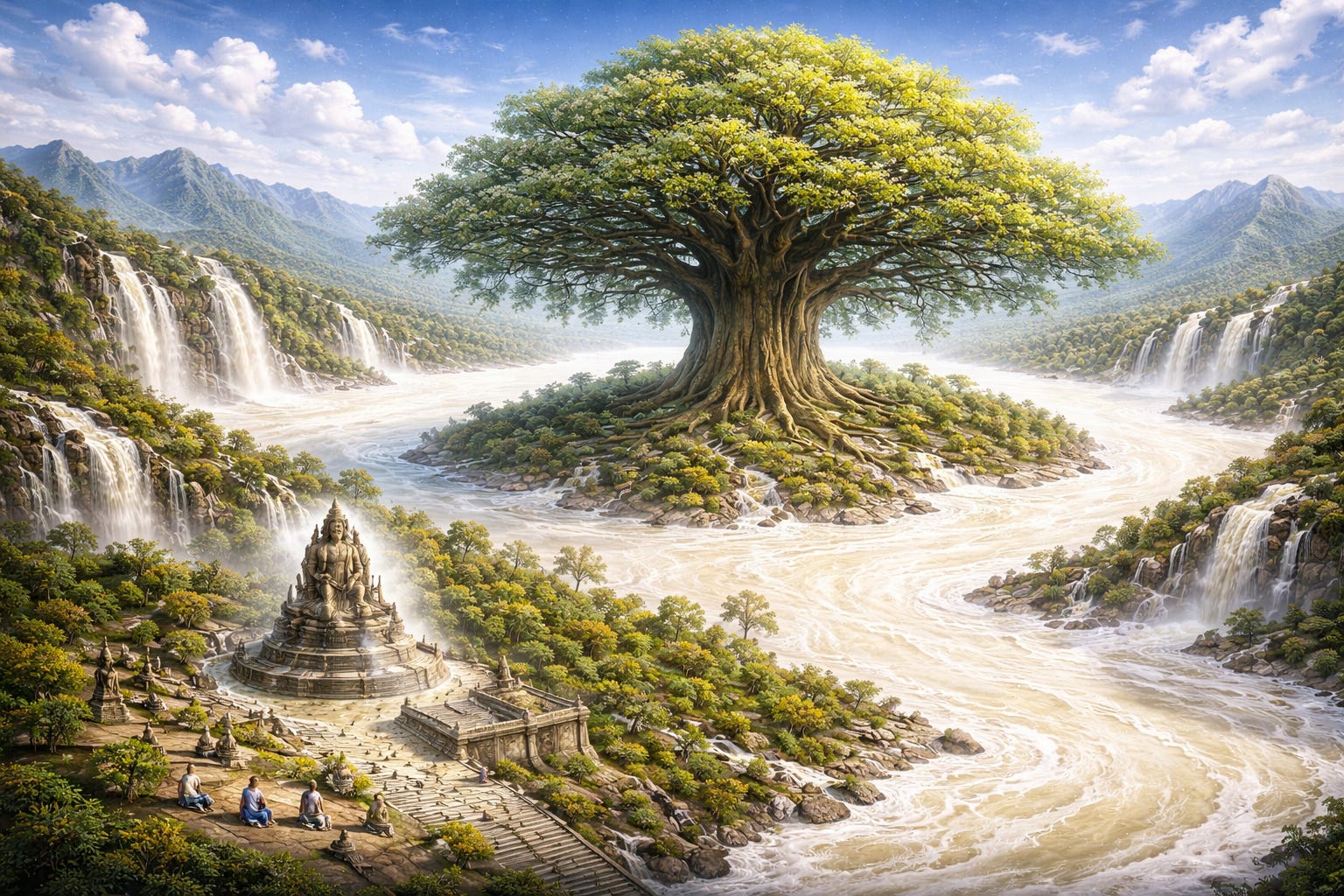
Śākadvīpa, the island of the great śāka tree
“Outside the Ocean of Milk is another island, Śākadvīpa, which has a width of 3,200,000 yojanas [25,600,000 miles]. As Krauñcadvīpa is surrounded by its own ocean of milk, Śākadvīpa is surrounded by an ocean of churned yogurt as broad as the island itself. In Śākadvīpa there is a big śāka tree, from which the island takes its name. This tree is very fragrant. Indeed, it lends its scent to the entire island.
The master of this island, also one of the sons of Priyavrata, was known as Medhātithi. He also divided his island into seven sections, named according to the names of his own sons, whom he made the kings of that island. The names of those sons are Purojava, Manojava, Pavamāna, Dhūmrānīka, Citrarepha, Bahurūpa and Viśvadhāra. After dividing the island and situating his sons as its rulers, Medhātithi personally retired, and to fix his mind completely upon the lotus feet of the Supreme Personality of Godhead, he entered a forest suitable for meditation.
For these lands also, there are seven boundary mountains and seven rivers. The mountains are Īśāna, Uruśṛṅga, Balabhadra, Śatakesara, Sahasrasrota, Devapāla and Mahānasa. The rivers are Anaghā, Āyurdā, Ubhayaspṛṣṭi, Aparājitā, Pañcapadī, Sahasra-śruti and Nijadhṛti.
The inhabitants of those islands are also divided into four castes — Ṛtavrata, Satyavrata, Dānavrata and Anuvrata — which exactly resemble brāhmaṇa, kṣatriya, vaiśya and śūdra. They practice prāṇāyāma and mystic yoga, and in trance they worship the Supreme Lord in the form of Vāyu.
[The inhabitants of Śākadvīpa worship the Supreme Personality of Godhead in the form of Vāyu in the following words.] O Supreme Person, situated as the Supersoul within the body, You direct the various actions of the different airs, such as prāṇa, and thus You maintain all living entities. O Lord, O Supersoul of everyone, O controller of the cosmic manifestation under whom everything exists, may You protect us from all dangers.” (SB 5.20.24-28)
The original ruler of Śākadvīpa was Medhātithi, another son of Priyavrata, who transmitted the rule of each tract of land to one of his sons, repeating the same pattern as in the previous islands.
The inhabitants of the island worship the Lord through Vāyu, the demigod of the wind. The names of the sons of the king are all directly connected with him: Purojava (the one who moves swiftly in front), Manojava (fast as the mind), Pavamāna (the purifying one), Dhūmrānīka (the one with a subtle form), Citrarepha (the one with wondrous qualities), Bahurūpa (the one who appears in many forms), and Viśvadhāra (the supporter of the universe).
Different from other islands, where the spiritual practice is more centered in the performance of sacrifices, the inhabitants of Śākadvīpa strive to achieve perfection through the process of prāṇāyāma, trying to focus their mind in samādhi. This meaning is indicated in the prayers of the inhabitants to Vāyu and reinforced by Prabhupāda in his purport: “Through the mystic yoga practice called prāṇāyāma, the yogī controls the airs within the body to maintain the body in a healthy condition. In this way, the yogī comes to the point of trance and tries to see the Supersoul within the core of his heart. Prāṇāyāma is the means to attain samādhi, trance, in order to fully absorb oneself in seeing the Supreme Lord as antaryāmī, the Supersoul within the core of the heart.”
The meaning of the names of the boundary mountains adds to this description, describing qualities they help the inhabitants to achieve. Īśāna is connected with inner rulership, or self-control; Uruśṛṅga with broad-mindedness; Balabhadra with disciplined strength; Śatakesara with richness in spiritual practice; Sahasrasrota indicates a regulated flow through the nāḍīs, the subtle energetic pathways of the body; Devapāla invokes divine protection; and Mahānasa indicates nourishment, both physical and spiritual.
Similarly, the names of the rivers are also connected with beneficial qualities: Anaghā is connected with purity, Āyurdā with longevity, Ubhayaspṛṣṭi with continuity, Aparājitā with mastery, Pañcapadī with discipline, Sahasra-śruti with contemplation, and Nijadhṛti with internal steadiness.
As in the other islands, the inhabitants follow a social structure based in four classes, with the names indicating that they understand the true purpose of the Varnāśrama system, performing their activities as an offering to the Lord. Ṛtavrata means “one whose vow is to follow the order of the Lord. Satyavrata, means “one who vowed to follow the path of truth”, Dānavrata means “the one who takes charity as his vow” and Anuvrata means “one whose vow is service to others.
The defining geographical mark of the island is a great śāka (teak) tree, which is very fragrant, scenting the whole island. This single tree exerting such influence over the whole island reinforces the unity in purpose of the inhabitants.
In the Gītā, Kṛṣṇa mentions that “Those who are on this path are resolute in purpose, and their aim is one. O beloved child of the Kurus, the intelligence of those who are irresolute is many-branched.” The presence of this great tree in Śākadvīpa, as well as the other great trees in the other islands, indicates how the inhabitants maintain this focus in the process of self-realization, cooperating in the direction of this ultimate goal. This also teaches us many important lessons on the ultimate purpose of the Varnāśrama system.
Puṣkaradvīpa, and the chariot of the sun
“Outside the ocean of yogurt is another island, known as Puṣkaradvīpa, which is 6,400,000 yojanas [51,200,000 miles] wide, twice as wide as the ocean of yogurt. It is surrounded by an ocean of very tasteful water as broad as the island itself. On Puṣkaradvīpa there is a great lotus flower with 100,000,000 pure golden petals, as effulgent as the flames of fire. That lotus flower is considered the sitting place of Lord Brahmā, who is the most powerful living being and who is therefore sometimes called bhagavān.
In the middle of that island is a great mountain named Mānasottara, which forms the boundary between the inner side and the outer side of the island. Its breadth and height are 10,000 yojanas [80,000 miles]. On that mountain, in the four directions, are the residential quarters of demigods such as Indra. In the chariot of the sun-god, the sun travels on the top of the mountain in an orbit called the Saṁvatsara, encircling Mount Meru. The sun’s path on the northern side is called Uttarāyaṇa, and its path on the southern side is called Dakṣiṇāyana. One side represents a day for the demigods, and the other represents their night.
The ruler of this island, the son of Mahārāja Priyavrata named Vītihotra, had two sons named Ramaṇaka and Dhātaki. He granted the two sides of the island to these two sons and then personally engaged himself in activities for the sake of the Supreme Personality of Godhead like his elder brother Medhātithi.
For the fulfillment of material desires, the inhabitants of this tract of land worship the Supreme Personality of Godhead as represented by Lord Brahmā. They offer prayers to the Lord as follows.
Lord Brahmā is known as karma-maya, the form of ritualistic ceremonies, because by performing ritualistic ceremonies one may attain his position and because the Vedic ritualistic hymns become manifest from him. He is devoted to the Supreme Personality of Godhead without deviation, and therefore in one sense he is not different from the Lord. Nevertheless, he should be worshiped not as the monists worship him, but in duality. One should always remain a servitor of the Supreme Lord, the supreme worshipable Deity. We therefore offer our respectful obeisances unto Lord Brahmā, the form of manifest Vedic knowledge.” (SB 5.20.29-33)
Different from the previous islands, Puṣkaradvīpa is not divided into seven, but just two. These two parts were given by Maharaja Vītihotra to his two sons. The defining characteristic of this island is a great lotus flower with 100 million golden, effulgent petals. This is not the same cosmic lotus flower from which Brahmā was born, but it is accepted as also one of his seating places. All the inhabitants of the island worship Brahmā as being non-different from the Supreme Lord, in the sense of being His great servitor
In the middle of the island there is a great circular mountain called Mānasottara, which divides the island into an inner and an outer region. This mountain serves as a support for the axle of the sun’s chariot. The other end of the axle is anchored on Mount Sumeru, with the sun itself positioned in the middle.
In the Purāṇas, the sun is described as the chariot of the sun-god, or his vehicle, through which he travels through the planetary system, distributing light. Following this analogy, it is described that one side of the axle of the chariot is fixed on one side on Sumeru mountain, and on the other side on Mānasottara mountain, fixing the sun in its proper orbit. When we hear such a description, we tend to impose the image of an earthen chariot, made from wood, but this is our own imposition, not what the verse says. The vehicles used by the demigods are not subjected to the same laws and limitations of vehicles of our planet, and thus don’t necessarily resemble them. Just as the vimānas used by them are not cramped boxes of metal like the space shuttles of our planet, their chariots are also very different in nature.
One example in this direction is that it is described that all the planets and stars are bound to Dhruvaloka by ropes. When we hear this description, we tend to think of physical ropes, made of cotton or silk, while in reality, these planetary ropes are described as being made from subtle wind, some form of attractional energy, possibly gravity-like, that is unknown to us.
Read the whole book:
« Making Sense of the Vedic Universe, a Higher-Dimensional Reality
This is a publication for thoughtful readers who want to go deeper into Kṛṣṇa consciousness. I publish daily, trying to offer high-quality spiritual content, and all posts are available to free subscribers. If you wish, you can also choose a paid subscription to support this work.
You can also receive the updates on WhatsApp or Telegram.
If you would like to contribute further, you can find the donation links here.