

« The Song of God—Volume 1, chapters 1-6
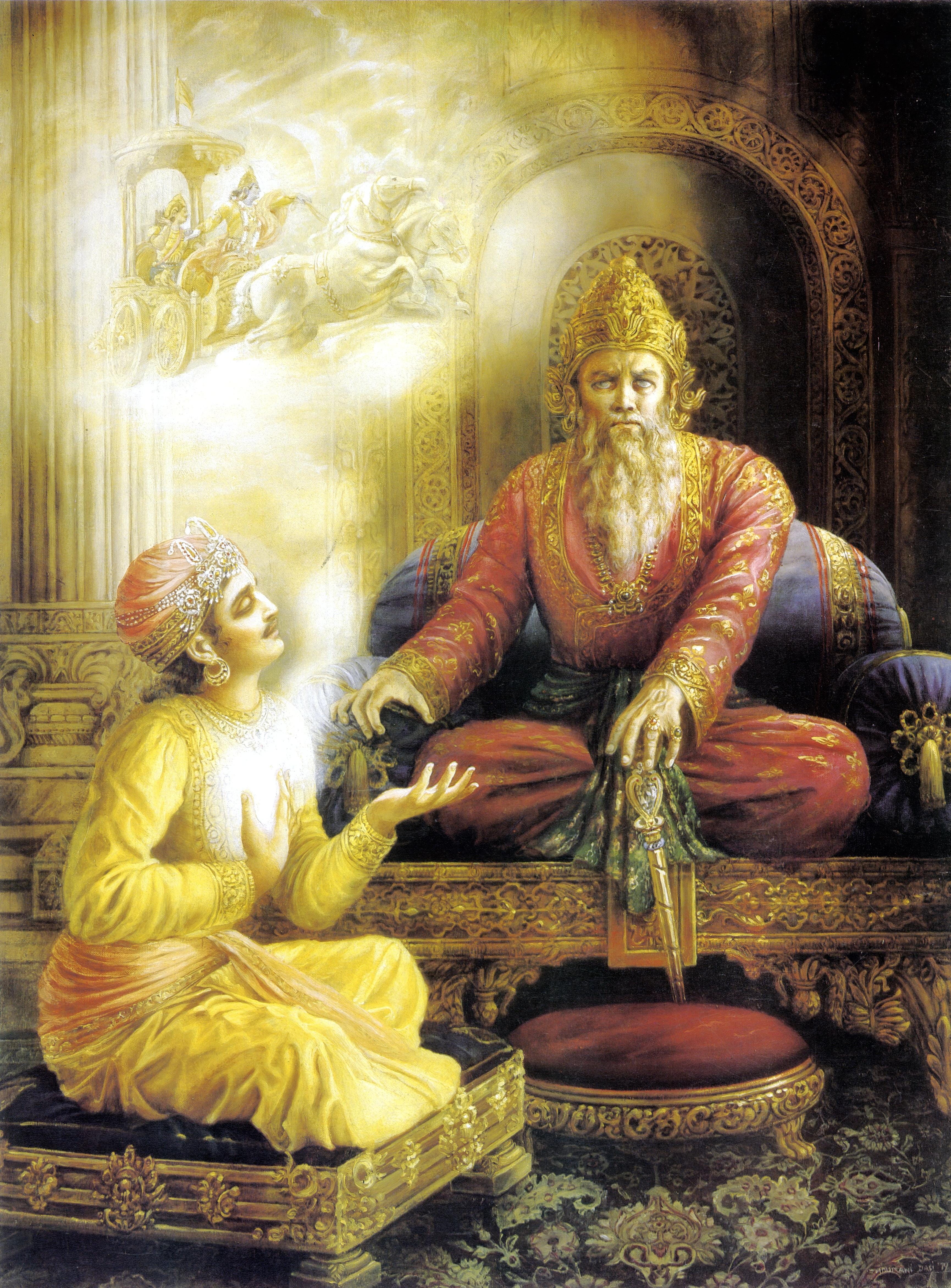
Setting the scene of the Gītā (Bg 1.1)
The Bhagavad-gītā starts not on the battlefield, but in the palace in Hastināpura. Dhṛtarāṣṭra inquires from Sañjaya about the events on the battlefield. The whole Bhagavad-gītā is spoken by Sañjaya in response to this question, but the direct answer is given in the last verse of the Gītā: “Wherever there is Kṛṣṇa, the master of all mystics, and wherever there is Arjuna, the supreme archer, there will also certainly be opulence, victory, extraordinary power, and morality. That is my opinion.” There will be no compromise; a great battle will happen and the Pāṇḍavas will be victorious.
Text 1: dhṛtarāṣṭra uvāca
dharma-kṣetre kuru-kṣetre, samavetā yuyutsavaḥ
māmakāḥ pāṇḍavāś caiva, kim akurvata sañjaya
Dhṛtarāṣṭra said: O Sañjaya, after my sons and the sons of Pāṇḍu assembled in the place of pilgrimage at Kurukṣetra, desiring to fight, what did they do?
One of the reasons for the advent of Kṛṣṇa was to free the planet (and the universe) from the weight of the millions of demoniac kṣatriyas who had taken birth at that time. Kṛṣṇa had previously killed many powerful demons, as well as exterminated millions of demoniac soldiers during the relentless attacks of Jarāsandha on Mathurā. In this way, the Lord reduced the burden of the world and, at the same time, showed His mercy by granting them liberation. Everything the Lord does is good, and everyone who comes to Him benefits. If even the demoniac kings who fought Him as enemies were granted liberation, we can only imagine the good fortune of devotees who approach Him with a loving attitude.
Now, the remaining kings and soldiers had gathered, and Kṛṣṇa organized a great pastime to liberate all of them. He spoke the Bhagavad-gītā to Arjuna in the middle of both armies, so that everyone present could hear the teachings. By remembering the transcendental instructions of Kṛṣṇa while fighting, seeing Him, and dying in His presence, all the soldiers on both sides achieved liberation. Arjuna and the other Pāṇḍavas were going to play an instrumental role in this plan, although the result of the battle had already been decided before it even began.
Vyāsadeva compiled the verses of the Bhagavad-gītā we have access to today as part of the Mahābhārata, which was composed as a presentation of Vedic knowledge for the people of our age, who are not very inclined to study complicated philosophical books such as the Upaniṣads and the Vedānta-sūtra. The Mahābhārata gives spiritual knowledge indirectly, by narrating the history of the Pāṇḍavas, but at the crucial moment, before the central battle is ready to start, the knowledge of the Bhagavad-gītā, which brings the conclusion of the Vedas, is presented.
Vyāsadeva presents the Bhagavad-gītā through Sañjaya’s report to Dhṛtarāṣṭra. Being blind, Dhṛtarāṣṭra did not join the battle and was thus dependent on his secretary to receive news of the events. Sañjaya was a disciple of Vyāsadeva, who had been blessed with the power of seeing events at a distance. Just as we can see what is happening in different parts of the world by watching the news, Sañjaya could directly see events in distant places from within the heart through this mystic power. Vyāsadeva had the same power; therefore, he could simultaneously see what was happening at Kurukṣetra and observe the conversation between Sañjaya and Dhṛtarāṣṭra.
The conversation starts with a peculiar question by Dhṛtarāṣṭra: “After my sons and the sons of Pāṇḍu assembled in the place of pilgrimage at Kurukṣetra, desiring to fight, what did they do?”
In his lecture from July 7, 1973, Prabhupāda calls our attention to the absurdity of this inquiry: “Just like if you are given food, if I ask somebody that “Such-and-such gentleman was served with nice dishes. Then what did he do?” this is a foolish question. He would eat. That’s all. [laughter] What is the question of “What did he do?” Similarly, when it is already settled up that they were to fight, there was no such question as kim akurvata, “What did they do?”
Dhṛtarāṣṭra asked this obvious question due to his nervousness and attachment. On the one hand, he was concerned about the possibility of his sons becoming affected by the pious environment of Kurukṣetra, a sacred place, and coming to some agreement with the Pāṇḍavas. Dhṛtarāṣṭra didn’t want peace; he wanted his sons to defeat the Pāṇḍavas and Duryodhana to become emperor. On the other hand, he was concerned about the outcome of the battle, since the battlefield could influence the battle in favor of the Pāṇḍavas, who were pious by nature, apart from the fact that Kṛṣṇa was personally on their side.
One could question why Kṛṣṇa took the side of the Pāṇḍavas. Is God not supposed to be impartial? Kṛṣṇa answers this later in the Gītā, in verse 9.29:
“I envy no one, nor am I partial to anyone. I am equal to all. But whoever renders service unto Me in devotion is a friend, is in Me, and I am also a friend to him.”
The Lord is indeed impartial, rewarding everyone according to their actions. However, at the same time, He becomes partial to His devotees due to natural affection arising from their profound relationship. A rich philanthropist may be charitable to all children, but he will always take special care of his own children, and no one can blame him for that.
Apart from that, Kṛṣṇa had given a choice to Arjuna and Duryodhana when both came to ask Him for support in the battle. He was not going to engage in battle, but one could have His personal guard (a sizable military force) join their side, and the other could have Him as an adviser and personal assistant. Arjuna, being a pure devotee, chose to have the company of the Lord, while Duryodhana, being an expert politician and tactician, preferred the army.
Yet another important meaning of this verse is to reinforce the historical authenticity of the Bhagavad-gītā, as mentioned. Many commentators insinuate that the Gītā is symbolic, with Kurukṣetra representing the body, the five Pāṇḍavas the senses, etc. However, the words “dharma-ksetre, kuru-ksetre” indicate that it is not so. The Bhagavad-gītā is not mythological: there is a place called Kurukṣetra, and a great battle happened there more than 5,000 years ago, where the Gītā was spoken.
Main points in the purport of Śrīla Prabhupāda:
“Dhṛtarāṣṭra said: O Sañjaya, after my sons and the sons of Pāṇḍu assembled in the place of pilgrimage at Kurukṣetra, desiring to fight, what did they do?”
a) We should try to understand the Bhagavad-gītā as it is, without personally motivated interpretations. Another prerequisite is that one should study from a devotee of the Lord who is part of the disciplic succession and can thus transmit the proper conclusions of the text. When these two prerequisites are satisfied, one can obtain knowledge that surpasses any other scripture in the world.
b) Dhṛtarāṣṭra was concerned about the result of the impending battle and thus questioned Sañjaya, his secretary: “What did they do?” Despite his concern, he didn’t want a compromise; he wanted the battle to happen.
c) Kurukṣetra is a holy place, a place of worship visited even by inhabitants of the heavenly planets. Dhṛtarāṣṭra was fearful that the atmosphere could influence the battle in favor of the Pāṇḍavas, who were virtuous.
d) Sañjaya was sitting at the palace with Dhṛtarāṣṭra, but he could see what was happening at a distance because of the mercy of his spiritual master, Vyāsadeva.
e) The Pāṇḍavas are the sons of Dhṛtarāṣṭra’s brother. They are his nephews and the cousins of Duryodhana and his other sons. Still, he usurped their kingdom and tried to kill them in many ways. The words dharma-kṣetre kuru-kṣetre in the verse thus also indicate that the influence of the holy place and the presence of Kṛṣṇa would make sure that Duryodhana and the other sons of Dhṛtarāṣṭra would be wiped out and the virtuous Yudhiṣṭhira would be established as the emperor.
Next: Duryodhana speaks to Droṇācārya (Bg 1.2 to 1.9)
Read the entire book:
« The Song of God—Volume 1, chapters 1-6

This is a publication for thoughtful readers who want to go deeper into Kṛṣṇa consciousness. I publish daily, trying to offer high-quality spiritual content, and all posts are available to free subscribers. If you wish, you can also choose a paid subscription to support this work.
You can also receive the updates on WhatsApp or Telegram.
If you would like to contribute further, you can find the donation links here.