

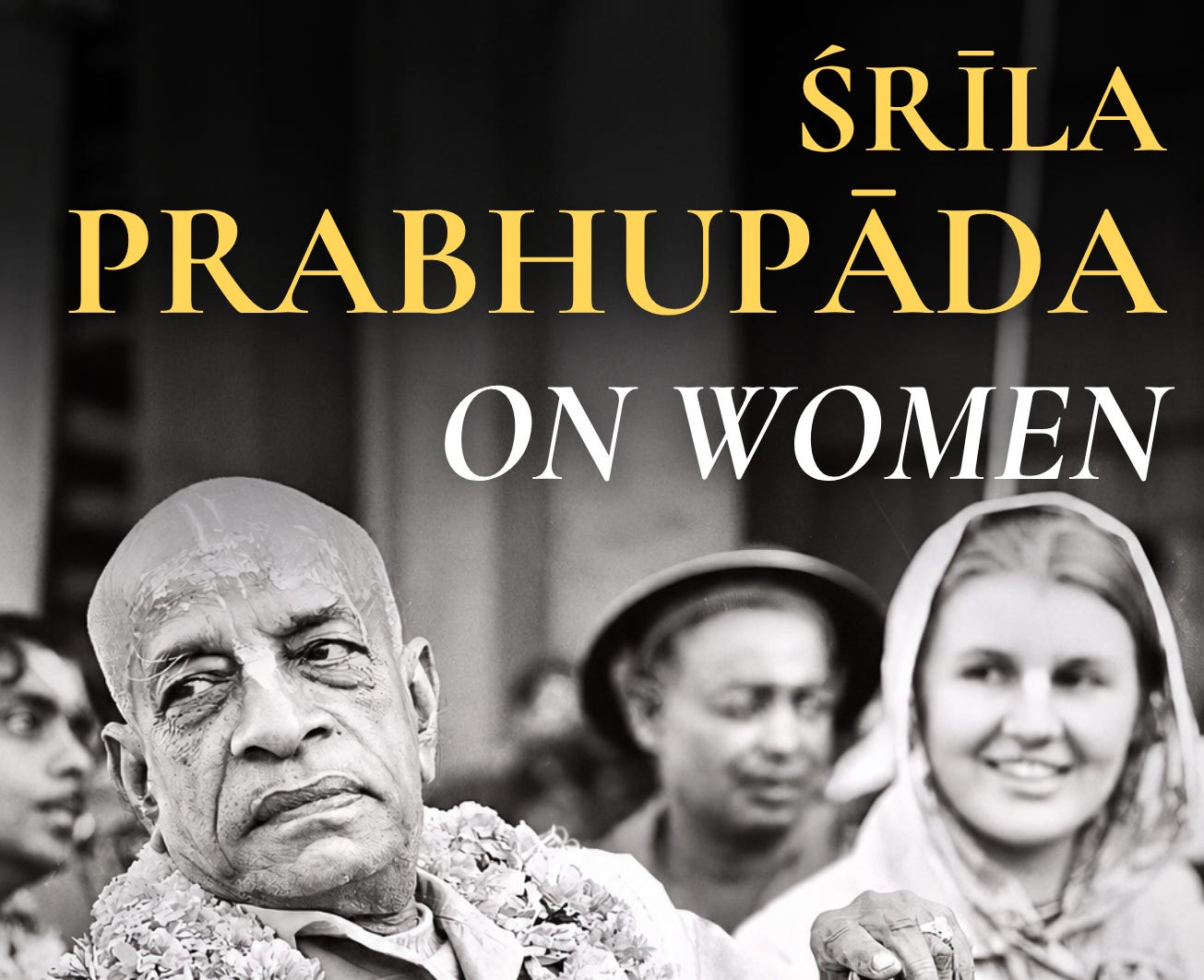
Why does Prabhupāda say that women should not be given independence at any stage?
There are a few passages in which Prabhupāda states that women should never be granted independence. Take, for example, this passage from his purport on SB 6.18.42:
“Women need to be protected by men. A woman should be cared for by her father in her childhood, by her husband in her youth and by her grown sons in her old age. This is the injunction of Manu, who says that a woman should not be given independence at any stage.”
The first important point to consider when we examine this passage is that in the Vedic concept, freedom comes not from being independent, but from giving up a false sense of material independence and using our free will to voluntarily follow higher authorities, culminating with Kṛṣṇa Himself. In the higher sense, no one can be independent, because the soul is always fully dependent on Kṛṣṇa for absolutely everything. Without the help of Kṛṣṇa, we can’t get up from bed in the morning; in fact, we can’t even breathe or open our eyes. All these functions are maintained by Him as Paramātmā, and when He says it’s time, we have no choice but to move with Him to a new body.
The Vedic idea is thus that no one should have independence at any stage, since independence is the very reason we end up in this lamentable condition in this material world, transmigrating from one temporary situation to another, from one body to another, without an end.
Every conditioned soul is subject to mistakes and imperfections: we have imperfect senses; the imperfect data we gather through them is processed by the emotional filters of the mind, and an imperfect intelligence clouds our judgment and makes us commit all kinds of mistakes. On top of that, because of lust and anger, we have a propensity to become illusioned and to cheat or betray others, which entangles us in karmic reactions. As long as we try to act independently, we rely on the imperfect mind and intelligence and cannot find the way out of this material world. Freedom and happiness come, ironically, from renouncing this tendency and following superior authorities, who in turn follow higher authorities, all the way to Kṛṣṇa himself.
Therefore, when it is said that a woman should not be independent, being under the care of the father and later the husband and grown-up children, we may at first think it suggests that a woman should be like a slave, without autonomy, but the scene changes when we understand that the father, husband, and son are also part of the system. A husband also renounces his independence by following scriptural injunctions, state laws, the king, and ultimately the spiritual master. Being part of this system, he is not free. He is supposed to conduct his life under a strict set of duties and laws that regulate his actions and make him a proper husband, father, citizen, disciple, and so on. The people above him, such as the king and the guru, are also not independent, as they are part of the same system. In this way, everyone is ultimately ruled by Kṛṣṇa through the medium of the scriptures and spiritual teachers, and this is what ultimately gives them freedom and eternal happiness outside the material clutches.
The whole Vedic idea is thus to be always dependent and subordinate to a higher authority. A child should be dependent on the parents, the parents on different levels of material and spiritual leaders, culminating in the spiritual master, and the spiritual master himself dependent on his own spiritual master, and ultimately on Kṛṣṇa. When we can fit into such a system of genuine authorities, we can advance easily, both materially and spiritually. Being under proper authorities makes one safe and successful.
Similarly, if a woman can find a man who is enlightened and reliable and can become dependent on him, this is the safest and most comfortable condition. That’s what everyone looks for, consciously or unconsciously. Being dependent means being cared for, and that’s the ideal situation for anyone, especially a woman. Therefore, when Prabhupāda says, “Women should not have independence at any stage,” he does not just refer to a dogmatic proposition but to an intrinsic need of every woman.
We can see, thus, that following superior authorities is necessary for every man or woman. Without following anyone, any imperfect person will be consumed by his or her own conditioned nature, drowning in selfishness and other inferior qualities, and losing the opportunity of human life. The problem is, of course, that such qualified authorities are not so common in the era we live in, and after a few bad experiences, people often come to the conclusion that it is better to just be independent and rely on oneself. In some cases, this may be necessary, but this is just a provisional strategy due to the circumstances and not the best in all cases. A child who has a violent father at home may be better off on the street, free from this immediate danger, but this does not mean every child should go to live on the street. A man may be cheated by a false guru, but this does not mean everyone should be without a guru. A corrupt president may squander the finances of the nation, but this does not mean we should abolish government and adopt anarchy.
This point becomes clear when we study the whole context of the passage:
“Women are self-interested by nature, and therefore they should be protected by all means so that their natural inclination to be too self-interested will not be manifested. Women need to be protected by men. A woman should be cared for by her father in her childhood, by her husband in her youth and by her grown sons in her old age. This is the injunction of Manu, who says that a woman should not be given independence at any stage. Women must be cared for so that they will not be free to manifest their natural tendency for gross selfishness. There have been many cases, even in the present day, in which women have killed their husbands to take advantage of their insurance policies. This is not a criticism of women but a practical study of their nature. Such natural instincts of a woman or a man are manifested only in the bodily conception of life. When either a man or a woman is advanced in spiritual consciousness, the bodily conception of life practically vanishes. We should see all women as spiritual units (ahaṁ brahmāsmi), whose only duty is to satisfy Kṛṣṇa. Then the influences of the different modes of material nature, which result from one’s possessing a material body, will not act.”
We come then to another point referred to in the passage, which is that women should be specifically taken care of by men. That’s an idea that many will cringe at, since it’s quite common for women to be mistreated by husbands, fathers, and other guardians, the very people who are supposed to protect them.
Here, it’s important to recognize two separate discussions. If they are not separated, the problem seems unsolvable, but when we understand that the problem is the consequence of two separate phenomena, the solution becomes straightforward.
The first issue is the discussion about whether women should accept a dependent position to a qualified guardian, be it a father, husband, teacher, etc. Here, the answer is quite natural: this is a beneficial position for any woman. Not many would argue that it is more beneficial for a girl to live under the protection of an affectionate father compared to not having a father, or for an adult woman to live under the care of a loving husband compared to not having a husband. Being cared for means renouncing freedom to a certain extent, but this is a trade-off that is hugely advantageous in this case. A child living on the streets is certainly freer than a child living with the parents, but no one would argue that the position of the abandoned child is better.
The trap in this case is that if a woman is convinced that the path of freedom is always better, she will reject any opportunities for being cared for, which will be against her own interests. Being intentionally independent can be a valid strategy in cases of abuse, when one has to learn to protect oneself, but it is not a good strategy in other situations. In most situations, independent means uncared for and alone, which is the deepest fear for most women. We can see that in this passage, Prabhupāda discusses this path, contesting the popular attitude of being proud and independent and discussing the result of such an attitude when applied indiscriminately.
A second point, however, is what a woman should do when the guardian is abusive. This side is explored by Prabhupāda in other purports, where he directly states that women should not blindly follow abusive or unqualified husbands. This is a point that comes from the scriptures themselves, which clearly state that a woman should follow a husband who is not fallen. When the husband becomes fallen, whether by failing to follow basic moral principles or by becoming abusive, the situation changes. In this case, a woman needs to protect herself, just like a child with an abusive father may need to seek help or run away from home. It’s important, thus, to separate the provisional strategy in dealing with abuse from the general, beneficial attitude of following authorities and being under care.
If one is attacked by an armed robber or other violent person, one may do whatever is necessary to defend oneself, including even killing the attacker, but this does not mean people should start killing indiscriminately. This separation between general rules and provisional strategy is essential in any kind of discussion and must always be taken into account.
We can see thus that a woman depends on the existence of a good husband to play the role of a good wife, and similarly, a man needs a good wife to be stable in the role of a good husband. The two are thus interdependent. When we take just one purport out of context, it may appear that Prabhupāda is emphasizing only the side of the woman, but when we study his teachings as a unit, we can see that he was emphasizing the side of the man more frequently. He was teaching his male disciples to be ideal men who would be worth being followed. The fact that not all men can understand or apply the teachings does not diminish Prabhupāda’s value as a teacher.
These points are made even clearer when we study the second part of the same purport on SB 6.18.42:
“The Kṛṣṇa consciousness movement is so beneficial that it can very easily counteract the contamination of material nature, which results from one’s possessing a material body. Bhagavad-gītā therefore teaches, in the very beginning, that whether one is a man or a woman, one must know that he or she is not the body but a spiritual soul. Everyone should be interested in the activities of the spirit soul, not the body. As long as one is activated by the bodily conception of life, there is always the danger of being misled, whether one is a man or a woman. The soul is sometimes described as puruṣa because whether one is dressed as a man or a woman, one is inclined to enjoy this material world. One who has this spirit of enjoyment is described as puruṣa. Whether one is a man or a woman, he is not interested in serving others; everyone is interested in satisfying his or her own senses. Kṛṣṇa consciousness, however, provides first-class training for a man or a woman. A man should be trained to be a first-class devotee of Lord Kṛṣṇa, and a woman should be trained to be a very chaste follower of her husband. That will make the lives of both of them happy.”
All of us, both men and women, have the same difficulty, which is identifying with the needs of the body and the desires of the mind, which keep us bound to this material world. By nature, men have a nature to take the lead, while women are by nature more risk-averse and more comfortable in being cared for, especially after the children come. Women can assume the position of providers when necessary, but this would not be what most ladies would choose, especially with a child.
Being cared for, in the case of a woman, does not mean just getting food and shelter, but receiving love and attention. For a lady, these needs are as important as basic material needs. These needs, in turn, can only be satisfied by having an affectionate relationship with a man. A lady may get food and a roof living in a homeless shelter or even in a prison, but not many ladies will feel happy in such a situation. Having an affectionate relationship with a man and receiving care from him means accepting a dependent position. A lady is free to refuse the deal, but this brings us back to the situation of being alone and neglected, which is not only painful but also not very conducive to one’s spiritual development. Bitterness does not lead one to love of Godhead but to impersonalism, which is the precise opposite.
A woman who sees herself as a soul may be able to avoid all these needs by directly cultivating a relationship with Kṛṣṇa, acting on the spiritual platform. This is the platform of great ascetic women in the Vaiṣnava tradition, like Gaṅgāmātā Gosvāminī. This is, however, a path that can be followed only by very rare women who are factually on a similar platform. It is very different from ordinary feminism. It is also different from a temporary position for the purpose of spiritual training, like a young brahmacāriṇī living in a temple.
There are also many cases of ladies who are forced into a position of renunciation due to life circumstances, as in the case of widows in India, but this is yet another provisional circumstance. Ideally, these women would reach old age being cared for by grown-up children, but due to circumstances, they are forced to fend for themselves.
Therefore, the Vedic idea, propagated by Prabhupāda, is that men and women cooperate, with men accepting a subordinate position to the guru, laws, and so on, and taking the role of caregivers and providers for the family, and women accepting a dependent position in relation to the husband and caring for the children and others who are under their care. Both are thus dependent, just in different ways. This not only offers a path in which the needs of both can be satisfied but also creates a situation where children can be properly cared for, which is another important discussion.
Let’s then examine another passage where Prabhupāda discusses the same topic from a slightly different angle:
“According to Manu, women, the fair sex, should not have independence at any stage of life. In childhood a woman must be under the protection of her parents, in youth she must be under the protection of the husband, and in old age, she must be under the protection of grown-up children. Devahūti demonstrated all these statements of the Manu-saṁhitā in her life: as a child, she was dependent on her father, later she was dependent on her husband, in spite of her opulence, and she was later dependent on her son, Kapiladeva.” (SB 3.33.19)
The relationship of a young girl with a father, an adult woman with a husband, and an elderly lady with her adult son may seem very different at first, but they have something in common: they are all based on the principle of being cared for by a male with whom a woman has an emotional connection. This is the type of relationship that satisfies both the material and emotional needs that we already discussed. Prabhupāda mentions that a woman should be cared for by at least one of the three at any stage of her life. Not many will disagree that this is desirable as a general principle.
The difficulty is, of course, that men are not always up to the standard, and thus we need to also discuss the other side of the question and all the implications for our spiritual society.
Unqualified men are usually more interested in sex than in building relationships, while women are frequently the opposite, hankering for deeper relationships where they feel protected. Because hankering for a relationship is such an intrinsic part of the female psyche, women who don’t have it become vulnerable to being exploited by men who learn how to seduce vulnerable ladies for sex or other purposes. After a woman is repeatedly cheated in this way, her heart becomes hard, and this can have many negative consequences.
By nature, women have a tendency to love and trust. We can easily notice this tendency in small girls who have loving parents. When properly cultivated, this tendency leads a woman to become a good wife and mother, qualities that, combined with good spiritual guidance, can easily give birth to love for Kṛṣṇa. Love for Kṛṣṇa is actually not so difficult to develop, but it requires a soft heart.
This sequence is, however, only possible when women are properly treated. When a lady is repeatedly cheated, her propensity for loving and trusting is lost, and she is deprived of the opportunity. Some men can make great spiritual progress by following the path of asceticism and renunciation, but these paths are very difficult for women and often lead to the opposite result. A woman whose heart becomes hard due to repeated betrayals by men may lose her best chance of going back to Godhead in this life.
How can this be avoided?
That’s what Prabhupāda explains in this passage. If a woman is protected by a loving father during her youth, then by a loving husband in her adult age, and later by her grown-up sons in old age, her propensity for loving and trusting will be nourished and expanded. She will not only become a valuable asset to society but will also have the best chance of becoming a pure devotee of Kṛṣṇa.
Loving wives and mothers are the backbone of any civilized society. It’s not by chance that the Manu Saṃhitā mentions that a place where women are mistreated is permanently abandoned by the goddess of fortune. When ladies are neglected and mistreated, they can, understandably, become selfish and bitter. This is an understandable response to the situation, and this is precisely what makes it tragic. Women who become bitter due to abuse can lead to all kinds of problems and conflicts that destroy a community from the inside. We can observe that communities in our movement where women were mistreated in the past mostly failed.
When Prabhupāda says that women should not be given independence, he implies that a lady should be protected at every stage of her life. We should always take into consideration that Kṛṣṇa consciousness automatically implies treating everyone with the utmost respect. When such care and consideration are not present, it quickly degrades into a demoniac, exploitative culture, which we had the misfortune of observing in many episodes in our movement.
When one is being exploited, independence sounds like a good idea, but when one is being properly taken care of, independence sounds foolish. Because in most modern societies, men are not properly trained to protect their daughters, wives, and mothers, women have to resort to being independent to protect themselves from exploitation, but when there is the opportunity to be protected, this is a much better deal.
One of the difficulties is that when men read such passages, they often think that they are already perfect and that the problem is with the women, who are not willing to surrender to them. When a man has good qualities, is proper in his behavior, and is capable of properly protecting a wife in the material, psychological, and spiritual spheres, it is not very difficult to find ladies who will voluntarily want to accept his leadership. He will then just have to be a little intelligent in his choice. The problem is that it is not so common to find such men nowadays.
Much of the modern desire for independence arises as a reaction to failed protection: modern men often fail to act as responsible fathers, husbands, sons, and spiritual leaders. When men fail, women naturally seek independence as a means of self-protection. However, when men are properly trained, self-controlled, affectionate, and responsible, the Vedic model starts to make sense. This is the system that can bring a balance: not domination by men, nor rebellion by women, but cooperation under the principle of dharma.
This brings us to the point of generating good children and properly educating them, which Śrīla Prabhupāda also repeatedly mentions in his writings. Proper men don’t grow on trees; they have to be trained from the beginning. All solutions for social problems start with good education, and this is no different. When we take this into consideration, we can see the form of Kṛṣṇa’s plan that Prabhupāda tries to translate into modern language: dutiful and affectionate husbands cooperating with affectionate wives produce good, balanced children, who transmit these same values to the next generations, creating a virtuous cycle that is beneficial for everyone involved. Feminism and chauvinism break this cycle of cooperation, taking us away from this spiritual system.
Read the whole book:
« Śrīla Prabhupāda on Women
This is a publication for thoughtful readers who want to go deeper into Kṛṣṇa consciousness. I publish daily, trying to offer high-quality spiritual content, and all posts are available to free subscribers. If you wish, you can also choose a paid subscription to support this work.
You can also receive the updates on WhatsApp or Telegram.
If you would like to contribute further, you can find the donation links here.
"We come then to another point referred to in the passage, which is that women should be specifically taken care of by men. That’s an idea that many will cringe at, since it’s quite common for women to be mistreated by husbands, fathers, and other guardians, the very people who are supposed to protect them."
Is it?
Or is it more common that they are structurally unable to protect them because of this narrative?
Ie: the narrative is that they are commonly mistreated, and effective of that narrative is that men are disempowered in protecting them, and they are unprotected and mistreated as a result?