

« The Song of God—Volume 1, chapters 1-6
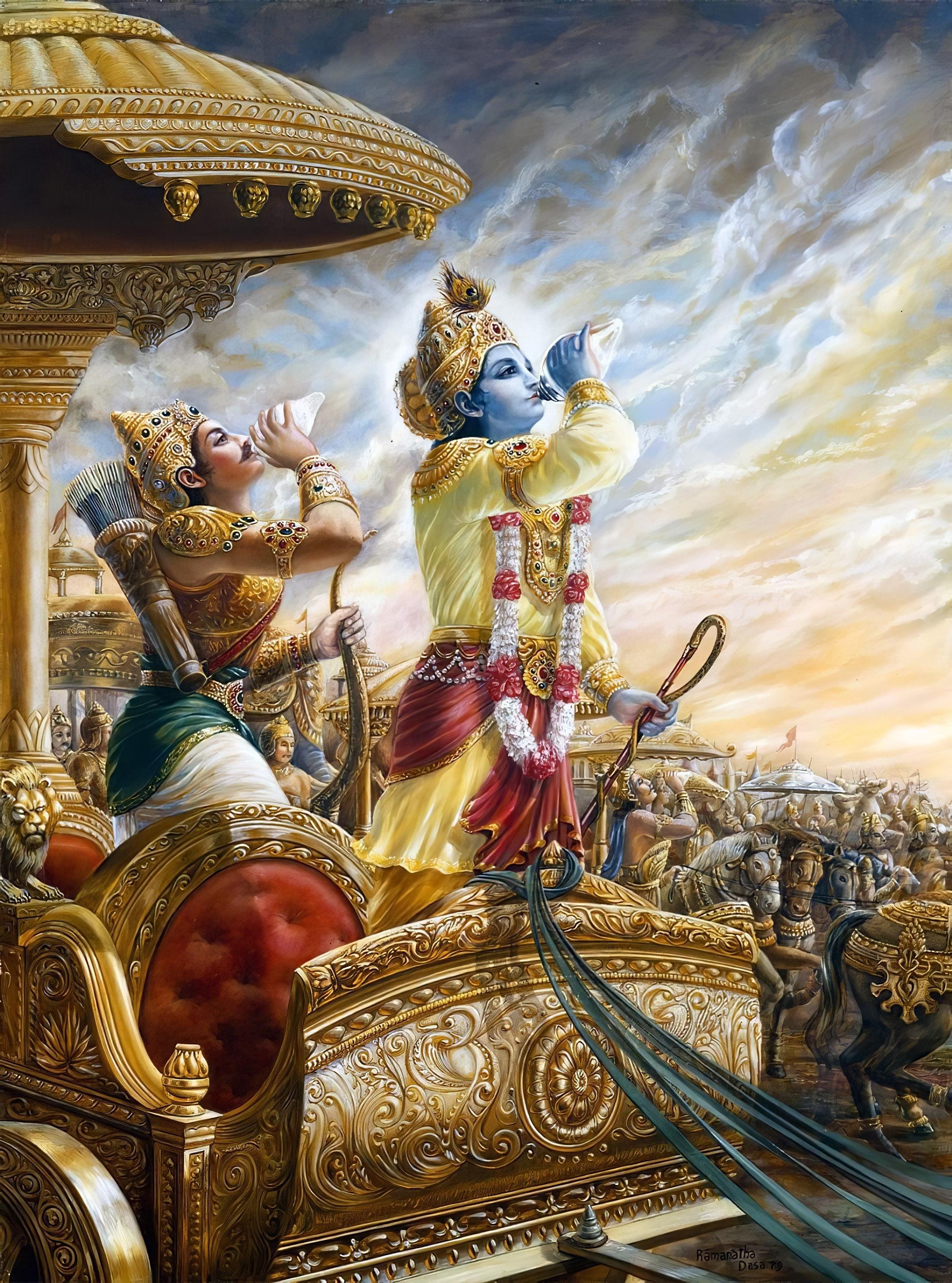
Signs of victory: the sounding of the conchshells (Bg 1.12 to 1.19)
Bhīṣma can clearly see Duryodhana’s attempt to politically manage his generals. However, seeing Duryodhana as his nephew, he doesn’t respond negatively. Instead, he tries to encourage him by blowing his conchshell, and is followed by the whole Kaurava army. Externally, this appears to display their strength, but the real situation becomes clear when Kṛṣṇa and Arjuna answer, followed by the other Pāndavas and their whole army. Their vibration reveals the reality Duryodhana’s diplomacy could not change: victory belongs to the side protected by Kṛṣṇa.
Text 12: tasya sañjanayan harṣam, kuru-vṛddhaḥ pitāmahaḥ
simha-nādam vinadyoccaiḥ, śankham dadhmau pratāpavān
Then Bhīṣma, the great valiant grandsire of the Kuru dynasty, the grandfather of the fighters, blew his conchshell very loudly, making a sound like the roar of a lion, giving Duryodhana joy.
Text 13: tataḥ śankhāś ca bheryaś, ca paṇavānaka-gomukhāḥ
sahasaivābhyahanyanta sa, śabdas tumulo ’bhavat
After that, the conchshells, drums, bugles, trumpets and horns were all suddenly sounded, and the combined sound was tumultuous.
Text 14: tataḥ śvetair hayair yukte, mahati syandane sthitau
mādhavaḥ pāṇḍavaś caiva, divyau śankhau pradadhmatuḥ
On the other side, both Lord Kṛṣṇa and Arjuna, stationed on a great chariot drawn by white horses, sounded their transcendental conchshells.
Text 15: pāñcajanyam hṛṣīkeśo, devadattam dhanañ-jayaḥ
pauṇḍram dadhmau mahā-śankham, bhīma-karmā vṛkodaraḥ
Lord Kṛṣṇa blew His conchshell, called Pāñcajanya; Arjuna blew his, the Devadatta; and Bhīma, the voracious eater and performer of herculean tasks, blew his terrific conchshell, called Pauṇḍra.
Texts 16-18: anantavijayam rājā, kuntī-putro yudhiṣṭhiraḥ
nakulaḥ sahadevaś ca, sughoṣa-maṇipuṣpakau
kāśyaś ca parameṣv-āsaḥ, śikhaṇḍī ca mahā-rathaḥ
dhṛṣṭadyumno virāṭaś ca, sātyakiś cāparājitaḥ
drupado draupadeyāś ca, sarvaśaḥ pṛthivī-pate
saubhadraś ca mahā-bāhuḥ, śankhān dadhmuḥ pṛthak pṛthak
King Yudhiṣṭhira, the son of Kuntī, blew his conchshell, the Ananta-vijaya, and Nakula and Sahadeva blew the Sughoṣa and Maṇipuṣpaka. That great archer the King of Kāśī, the great fighter Śikhaṇḍī, Dhṛṣṭadyumna, Virāṭa, the unconquerable Sātyaki, Drupada, the sons of Draupadī, and others, O King, such as the mighty-armed son of Subhadrā, all blew their respective conchshells.
Text 19: sa ghoṣo dhārtarāṣṭrāṇām, hṛdayāni vyadārayat
nabhaś ca pṛthivīm caiva, tumulo ’bhyanunādayan
The blowing of these different conchshells became uproarious. Vibrating both in the sky and on the earth, it shattered the hearts of the sons of Dhṛtarāṣṭra.
Bhīṣmadeva was one of the twelve mahājanas, the great authorities in religious principles of the universe. Despite his qualifications, he remained on the side of Duryodhana ultimately due to the will of the Lord, who wanted to show that even the greatest warrior can’t win if fighting against His devotees. Bhīṣma also had a chivalrous relationship with the Lord and desired to be on the opposite side to see Him engaged in battle, a desire that was also satisfied. The Lord can fulfill many purposes simultaneously with His arrangements, and that’s an example.
The relationship of Kṛṣṇa and Bhīṣmadeva is explained in more detail by Śrīla Prabhupāda in his purport to SB 1.9.38:
“The dealings of Lord Kṛṣṇa and Bhīṣmadeva on the Battlefield of Kurukṣetra are interesting because the activities of Lord Śrī Kṛṣṇa appeared to be partial to Arjuna and at enmity with Bhīṣmadeva; but factually all this was especially meant to show special favor to Bhīṣmadeva, a great devotee of the Lord. The astounding feature of such dealings is that a devotee can please the Lord by playing the part of an enemy. The Lord, being absolute, can accept service from His pure devotee even in the garb of an enemy. The Supreme Lord cannot have any enemy, nor can a so-called enemy harm Him because He is ajita, or unconquerable. But still He takes pleasure when His pure devotee beats Him like an enemy or rebukes Him from a superior position, although no one can be superior to the Lord. These are some of the transcendental reciprocatory dealings of the devotee with the Lord. And those who have no information of pure devotional service cannot penetrate into the mystery of such dealings. Bhīṣmadeva played the part of a valiant warrior, and he purposely pierced the body of the Lord so that to the common eyes it appeared that the Lord was wounded, but factually all this was to bewilder the nondevotees.”
Being such a great devotee, Bhīṣmadeva understood perfectly the plan of the Lord for the battle and knew that the Kauravas would be defeated. His sounding of the conchshell served two purposes: cheering his grandson Duryodhana, who was distressed in mind, and informing him that although he would fulfill his duty as a kṣatriya in fighting in the battle, there was no hope of victory because the Supreme Lord was on the other side.
Following Bhīṣma, all the other Kauravas sounded their conchshells and other musical instruments, but despite the tumultuous sound, they were incapable of affecting the soldiers on the side of the Pāṇḍavas, due to their unflinching faith in the protection of the Lord. However, when Kṛṣṇa and Arjuna sounded their transcendental conchshells, followed by all the others in the Pāṇḍava army, the hearts of all the Kauravas were shattered.
Main points in the purports of Śrīla Prabhupāda:
“Then Bhīṣma, the great valiant grandsire of the Kuru dynasty, the grandfather of the fighters, blew his conchshell very loudly, making a sound like the roar of a lion, giving Duryodhana joy.”
a) Duryodhana was the grandson of Bhīṣma, and thus, out of compassion, he tried to cheer him up. Indirectly, however, the blowing of the conchshell indicated that although he was going to fulfill his duty and fight, there was no chance of victory, because Kṛṣṇa was on the other side.
“After that, the conchshells, drums, bugles, trumpets and horns were all suddenly sounded, and the combined sound was tumultuous. On the other side, both Lord Kṛṣṇa and Arjuna, stationed on a great chariot drawn by white horses, sounded their transcendental conchshells.”
a) The sounding of the conchshells of Kṛṣṇa and Arjuna was of a different quality. They indicated that there was no hope of victory for the other side due to the presence of Kṛṣṇa. The Goddess of Fortune is always accompanying the Lord; therefore, both victory and fortune awaited Arjuna.
b) The chariot of Arjuna was donated by Agni and was blessed to conquer any place of the three worlds where it was drawn. That was another sign of victory.
“Lord Kṛṣṇa blew His conchshell, called Pāñcajanya; Arjuna blew his, the Devadatta; and Bhīma, the voracious eater and performer of herculean tasks, blew his terrific conchshell, called Pauṇḍra.”
a) The Lord is described as Hṛṣīkeśa because He directly controls the senses of Arjuna, His pure devotee, and gives him direction on the battlefield of Kurukṣetra. The Lord is present in the hearts of all, and thus He directs everyone’s senses, but He does so according to their level of surrender.
b) The Lord receives names according to His activities and His relationships with His devotees, such as Madhusūdana, Govinda, Vāsudeva, Devakī-nandana, Yaśodā-nandana, Pārtha-sārathi, etc.
c) Apart from Kṛṣṇa and Arjuna, the blowing of the conchshells of the other commanders on the side of the Pandavas was very encouraging to the soldiers. On the other side, there were no such credits.
“King Yudhiṣṭhira, the son of Kuntī, blew his conchshell, the Ananta-vijaya, and Nakula and Sahadeva blew the Sughoṣa and Maṇipuṣpaka. That great archer the King of Kāśī, the great fighter Śikhaṇḍī, Dhṛṣṭadyumna, Virāṭa, the unconquerable Sātyaki, Drupada, the sons of Draupadī, and others, O King, such as the mighty-armed son of Subhadrā, all blew their respective conchshells.”
a) The signs indicated that the whole Kuru dynasty would be destroyed in the battle, together with their allies. All the great kings were present, and they were all doomed. Sañjaya tactfully informed Dhṛtarāṣṭra that it was all his fault for encouraging the irreligious acts of his sons.
“The blowing of these different conchshells became uproarious. Vibrating both in the sky and on the earth, it shattered the hearts of the sons of Dhṛtarāṣṭra.”
a) There was no heartbreak on the part of the Pāṇḍavas when Bhīṣma and others sounded their conchshells. This was due to their confidence in Kṛṣṇa. However, when the Pāndavas and their allies sounded their conches, the hearts of the soldiers on the side of Duryodhana were shattered.
Next: Arjuna orders Kṛṣṇa (Bg 1.20 to 1.23)
Read the entire book:
« The Song of God—Volume 1, chapters 1-6

This is a publication for thoughtful readers who want to go deeper into Kṛṣṇa consciousness. I publish daily, trying to offer high-quality spiritual content, and all posts are available to free subscribers. If you wish, you can also choose a paid subscription to support this work.
You can also receive the updates on WhatsApp or Telegram.
If you would like to contribute further, you can find the donation links here.