

« Making Sense of the Vedic Universe, a Higher-Dimensional Reality
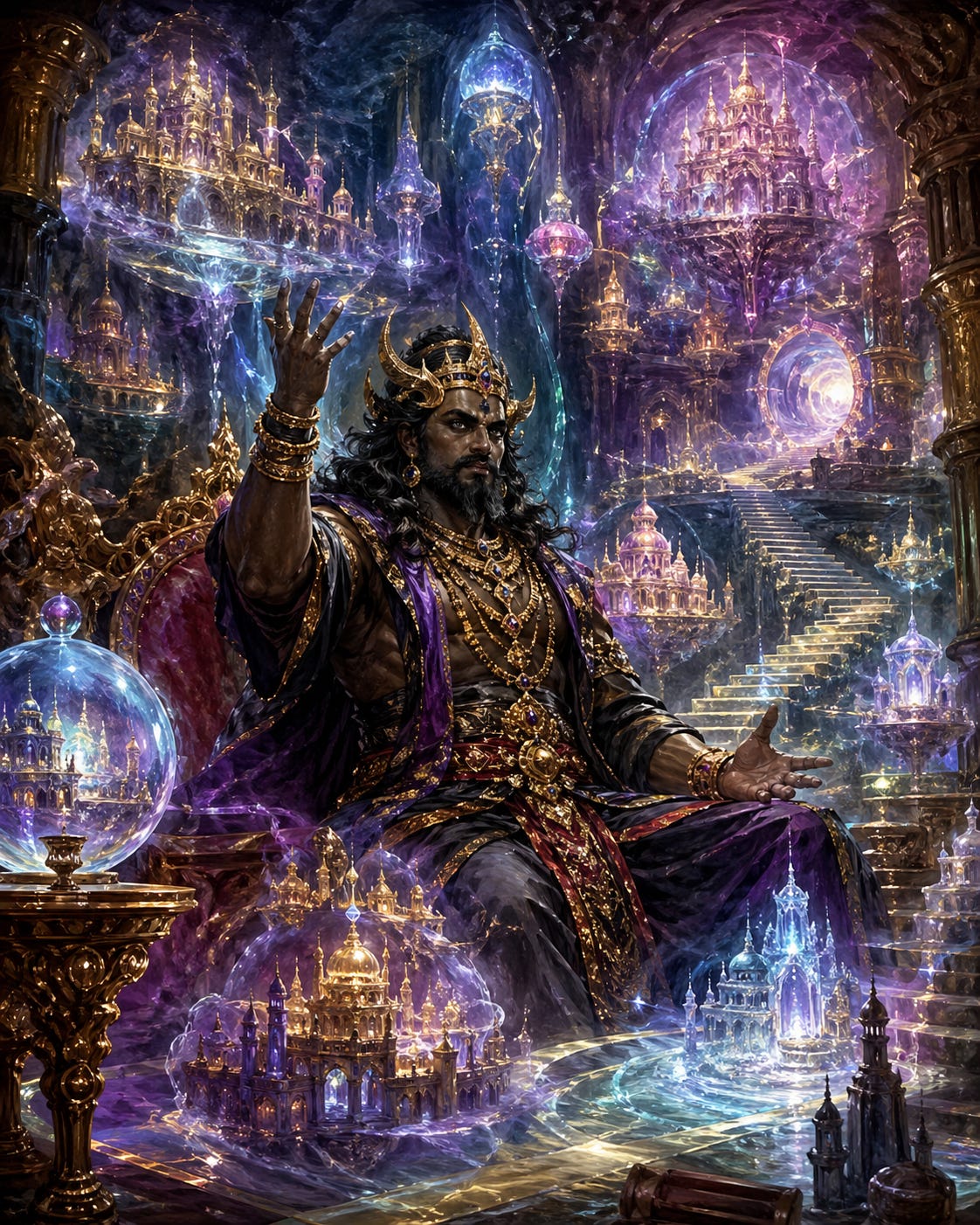
Talātala, the abode of Maya Dānava
“Beneath the planet known as Sutala is another planet, called Talātala, which is ruled by the Dānava demon named Maya. Maya is known as the ācārya [master] of all the māyāvīs, who can invoke the powers of sorcery. For the benefit of the three worlds, Lord Śiva, who is known as Tripurāri, once set fire to the three kingdoms of Maya, but later, being pleased with him, he returned his kingdom. Since that time, Maya Dānava has been protected by Lord Śiva, and therefore he falsely thinks that he need not fear the Sudarśana cakra of the Supreme Personality of Godhead.” (SB 5.24.28)
Maya Dānava was previously mentioned in the context of being the architect of the lower planetary systems. Apart from this function, he rules the planetary system of Talātala. Maya is not just an architect; he is a powerful sorcerer, with many followers, called māyāvīs. He combines, thus, technical and mystical knowledge.
In the Seventh Canto, for example, it is described how once the demons, after being defeated by the demigods, took shelter of Maya, who constructed three powerful flying cities, imbued with many illusory powers, including invisibility. Boarding these cities, the demons started destroying the three worlds until Lord Śiva joined the battle and killed many of them. Maya, however, was able to counteract this by resurrecting the slain demons using a well of nectar he had created. Only after Lord Viṣnu interfered, coming together with Brahmā in the form of a cow and a calf to drink the nectar, was Lord Śiva able to defeat them.
Later, however, Maya surrendered to Lord Śiva, who returned his kingdom and offered him protection. Due to that, Maya lives under the false hope that the protection of Lord Śiva will protect him from death.
Another similar incident is described in SB 2.7.37. In a past Kali-yuga, human beings were able to contact Maya, who constructed invisible aerial fortresses which allowed them to attack other planets. The massacre was then stopped by another appearance of Buddha, who appeared in an attractive form to teach them non-violence.
Maya is also the transmitter of the Surya-siddhanta, the classical astronomical treatise used to calculate celestial motions, eclipses, calendars, and so on. It is described that Maya performed great austerities, causing the sun-god to appear to him and describe this science, which he later transmitted to sages of our planet. Different from the Śrīmad-Bhāgavatam, which contains descriptions focused on spiritual development, the Surya-siddhanta focuses on practical calculations of the structure and positions of the planets. In some parts, it appears to contradict the Śrīmad-Bhāgavatam (in the descriptions of the moon, for example), but this is because it describes our gross dimension, while the Bhāgavatam describes the subtle dimension of the demigods. It is also an important book, but for different reasons. This also shows the difference in mentality of the asuras. Maya is interested in understanding the physical universe we live in, while Parīkṣit and the sages in Naimiṣāraṇya are interested in becoming free from it.
In this way, Maya illustrates the difference between knowledge and wisdom. He is extraordinarily talented in terms of technical knowledge, simultaneously mastering the sciences of architecture and engineering, weapons, illusion, urban design, astronomy, and so on. He is, however, blind in terms of spiritual knowledge. He can manipulate the material energy, but he is still under illusion and fear of death. In this sense, he is very similar to modern scientists and all sorts of materialists, who become absorbed in material knowledge, forgetting that death is coming near, or sometimes get caught in the illusory hope that progress in material knowledge can somehow save them from death.
On the bright side, Maya constructed the assembly house of Maharaja Yudhiṣṭhira in Indraprastha due to his debt of gratitude to Arjuna for saving his life. This shows that sometimes the technical knowledge of the asuras can be used in the service of Kṛṣṇa and His pure devotees. In general, a pure life in contact with cows and nature is the best option for developing spiritually, but if one is going to live in a city, using the material facilities created by the demons to serve Kṛṣṇa is the second best option.
Read the whole book:
« Making Sense of the Vedic Universe, a Higher-Dimensional Reality
This is a publication for thoughtful readers who want to go deeper into Kṛṣṇa consciousness. I publish daily, trying to offer high-quality spiritual content, and all posts are available to free subscribers. If you wish, you can also choose a paid subscription to support this work.
You can also receive the updates on WhatsApp or Telegram.
If you would like to contribute further, you can find the donation links here.