

« Making Sense of the Vedic Universe, a Higher-Dimensional Reality
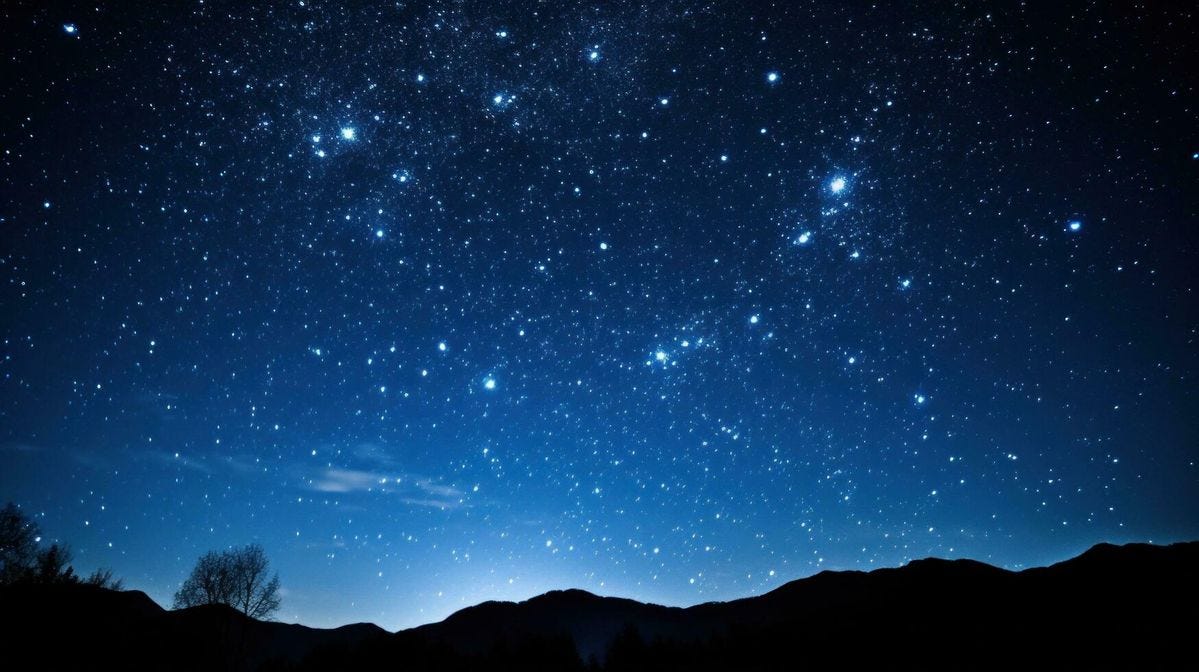
The 28 nakṣatras
“There are many stars located 200,000 yojanas [1,600,000 miles] above the moon. By the supreme will of the Supreme Personality of Godhead, they are fixed to the wheel of time, and thus they rotate with Mount Sumeru on their right, their motion being different from that of the sun. There are twenty-eight important stars, headed by Abhijit.” (SB 5.22.11)
Further than the moon is a region with many stars. Among these stars there are 28 which are prominent (led by Abhijit), and each of these 28 stars is assigned a sector of the sky. These are the 28 nakṣatras studied in Vedic astrology.
In the vertical dimension, they are 200,000 yojanas higher than the moon. Unlike the sun and moon, these nakṣatras don’t have an independent counterclockwise movement, but they still move daily following the movement of the whole sky. The sun, moon, and other planets move against this background, and their movements are studied in Vedic astrology. Just as the sun and the moon, the nakṣatras are channels for the manifestation of the potency of the Lord, regulating karma, destiny, and other influences according to our time and place of birth.
It’s important to note that the positions of these stars don’t match anything in the modern cosmological model. According to the modern interpretation, these stars are all many light-years away. In the multidimensional model of the Bhāgavatam, however, they appear relatively close to us, lower than visible planets like Venus and Mars.
The description of the Bhāgavatam can be loosely connected with the modern cosmological model if we take Dhruvaloka as being Polaris, the many stars described in this verse as being other stars closer to us, Śiśumāra as the path of the Milky Way we see in the sky, and Svargaloka as the many stars that comprise it. Beyond it are the planetary systems of Maharloka, Janaloka, Tapoloka, and Satyaloka, as well as the rest of the structures of our galaxy, as well as the other galaxies and other cosmic structures beyond it. Even the distances can be harmonized to a certain extent if we accept the concept of yojana corresponding to the concept of distance of the inhabitants of each level, and thus the distances growing exponentially from our perspective. This can be useful to harmonize the description of the Bhāgavatam with our observable universe, and sustain the validity of the explanation, not just from a mystical standpoint, but even on the practical level. There are limits for these similarities, however, since the Bhāgavatam describes structures and levels of existence that are beyond what we can observe using our senses.
It is important, thus, to keep in mind that the Bhāgavatam describes not only our physical universe but also higher spheres of existence that match different levels of spiritual development. Our goal is not just to accumulate information and speculate about it, but to understand this map of the vertical dimension given in the scripture and see the blue hand behind it all. By understanding the different levels of the material universe, we can gradually lose interest in it, and fix our consciousness on what is beyond, back home, back to Godhead.
On this path, becoming fixed in modern cosmological models based on what our eyes can see is a trap, because it keeps us chained to the gross realm of our physical senses.
Context is also important. Śukadeva Goswami is not describing the universe in these verses as a mere intellectual exercise. He is answering the question Maharaja Parīkṣit posed on SB 5.16.3: “When the mind is fixed upon the Supreme Personality of Godhead in His external feature made of the material modes of nature — the gross universal form — it is brought to the platform of pure goodness. In that transcendental position, one can understand the Supreme Personality of Godhead, Vāsudeva, who in His subtler form is self-effulgent and beyond the modes of nature. O my lord, please describe vividly how that form, which covers the entire universe, is perceived.”
Kṛṣṇa pervades the entire cosmic manifestation, and this is visualized as the universal form. By fixing our mind in this description, we can be brought to the platform of pure goodness, and when this is achieved, we can finally understand the Supreme Lord in His spiritual form.
The orbits of the planets
From text 5.22.12 to 5.22.17, Śukadeva Gosvāmi completes the description of the visible planets and their influence on us. This description helps us to see the planets as not just cosmic bodies, but as mediums for the distribution of karmic results and the manifestation of the potencies of the Lord.
The orbits of Venus, Mercury, Mars, Jupiter, and Saturn are described from the point of view of someone observing from earth. When we look up at night, the sky looks like a vast dome, where the stars appear fixed in position in relation to each other. In the midst of this mass of stars we have the path of the zodiac, which serves as a planetary highway for the sun, the moon, and all the planets. They all stay within it.
Different from the stars and the sun, which trace a predictable path in the sky, the planets wander around, constantly shifting their position. Sometimes they move to the east, sometimes to the west, sometimes they pause and then move in the opposite direction, and so on.
In Vedic cosmology, the planets (as well as the sun and the moon) are called grahas. The word graha comes from the root graḥ, which means to seize, grasp, hold, or influence. They are cosmic agents that influence us, acting as instruments of our karma.
In the Vedic model, the planets are situated between the stars that form the nakṣatras, but below Dhruvaloka. They are all described as celestial planets. It’s also probable that the gross planets we see in the sky may be just gross representations of these celestial bodies (just as in the case of the moon), since they are described in the Bhāgavatam as very distant from us, further away than certain stars.
In any case, no one should expect that one traveling to Mars or Venus in a space probe would find Apsarās there. Even if such a trip were to become technically possible, one would find only rocks, just as in the case of the moon.
“Some 1,600,000 miles above this group of stars is the planet Venus, which moves at almost exactly the same pace as the sun according to swift, slow and moderate movements. Sometimes Venus moves behind the sun, sometimes in front of the sun and sometimes along with it. Venus nullifies the influence of planets that are obstacles to rainfall. Consequently its presence causes rainfall, and it is therefore considered very favorable for all living beings within this universe. This has been accepted by learned scholars.
Mercury is described to be similar to Venus, in that it moves sometimes behind the sun, sometimes in front of the sun and sometimes along with it. It is 1,600,000 miles above Venus, or 7,200,000 miles above earth. Mercury, which is the son of the moon, is almost always very auspicious for the inhabitants of the universe, but when it does not move along with the sun, it forbodes cyclones, dust, irregular rainfall, and waterless clouds. In this way it creates fearful conditions due to inadequate or excessive rainfall.” (SB 5.22.12-13)
In the modern concept of the solar system, the sun is at the center, with Mercury and Venus orbiting it, followed by the earth. The Bhāgavatam, however, describes their orbits from a geocentric perspective. When we look at the sky at night, we can see the movements of Venus and Mercury exactly as described here. They never appear very far from the sun, but sometimes appear in front of it, sometimes behind, sometimes alongside it, and so on.
“Situated 1,600,000 miles above Mercury, or 8,800,000 miles above earth, is the planet Mars. If this planet does not travel in a crooked way, it crosses through each sign of the zodiac in three fortnights and in this way travels through all twelve, one after another. It almost always creates unfavorable conditions in respect to rainfall and other influences.
Situated 1,600,000 miles above Mars, or 10,400,000 miles above earth, is the planet Jupiter, which travels through one sign of the zodiac within the period of a Parivatsara. If its movement is not curved, the planet Jupiter is very favorable to the brāhmaṇas of the universe.
Situated 1,600,000 miles above Jupiter, or 12,000,000 miles above earth, is the planet Saturn, which passes through one sign of the zodiac in thirty months and covers the entire zodiac circle in thirty Anuvatsaras. This planet is always very inauspicious for the universal situation.” (SB 5.22.13-16)
All these planets influence us in different ways, and their influence can be seen as auspicious or inauspicious in different circumstances. Venus, for example, is favorable in the sense of creating the conditions for material life and sense enjoyment, while Jupiter is often feared by materialists for bringing fulfillment of our karma, but is seen as very auspicious by brāhmaṇas and transcendentalists.
After the planets, there is a very special group of stars, the Saptarṣi constellation (Ursa Major), which is the abode of the seven sages. These are sages who are perfect knowers of the Vedas and are chosen to disseminate the principles of dharma over the universe in each universal cycle. At the beginning of each manvantara, a new group of seven sages takes charge, following the change of the Manus and demigods:
“Situated 8,800,000 miles above Saturn, or 20,800,000 miles above earth, are the seven saintly sages, who are always thinking of the well-being of the inhabitants of the universe. They circumambulate the supreme abode of Lord Viṣṇu, known as Dhruvaloka, the polestar.” (SB 5.22.17)
Just as all the other stars and constellations, the Saptarṣi honor Dhruvaloka by circumambulating it daily, following the movement of the whole sky.
The Bhāgavatam thus offers a list of some of the prominent stars, but it is important to understand these are not the only ones. The path to Dhruvaloka includes millions of other stars. All these stars form the siśumāra, the divine dolphin, another divine form of the Lord visible in the material universe.
Read the whole book:
« Making Sense of the Vedic Universe, a Higher-Dimensional Reality
This is a publication for thoughtful readers who want to go deeper into Kṛṣṇa consciousness. I publish daily, trying to offer high-quality spiritual content, and all posts are available to free subscribers. If you wish, you can also choose a paid subscription to support this work.
You can also receive the updates on WhatsApp or Telegram.
If you would like to contribute further, you can find the donation links here.