

Subscribe to receive new articles by e-mail. It’s free, but if you like, you can pledge a donation:
🔉 Audio of the lesson »
🎙Podcast (Search for “Mysteries of the Vedas” on Spotify, iTunes, etc. to hear all the lessons
Check this post if you would like to join the live lessons. This course is maintained with your donations. Click here to donate.
💬 Text of the lesson
The Activities of Mahārāja Āgnīdhra (chapter 5.2)
Priyavrata transmitted the rule of Bhu-Mandala to his seven sons, led by Āgnīdhra. Each son became the king of one of the islands, with Āgnīdhra ruling over Jambūdvīpa, the principal amongst the islands, and being accepted as the chief ruler by his brothers.
Āgnīdhra was a pious king who ruled based on religious principles and treated all citizens like his own sons. His protection was not just based on giving food, shelter, and security; he maintained the principles of varṇāśrama-dharma, training the citizens to live a progressive life, according to the principles of the Vedas, based on service to the Supreme Lord. Prabhupāda contrasts it with modern rulers, who just collect taxes without giving any real benefit to the citizens.
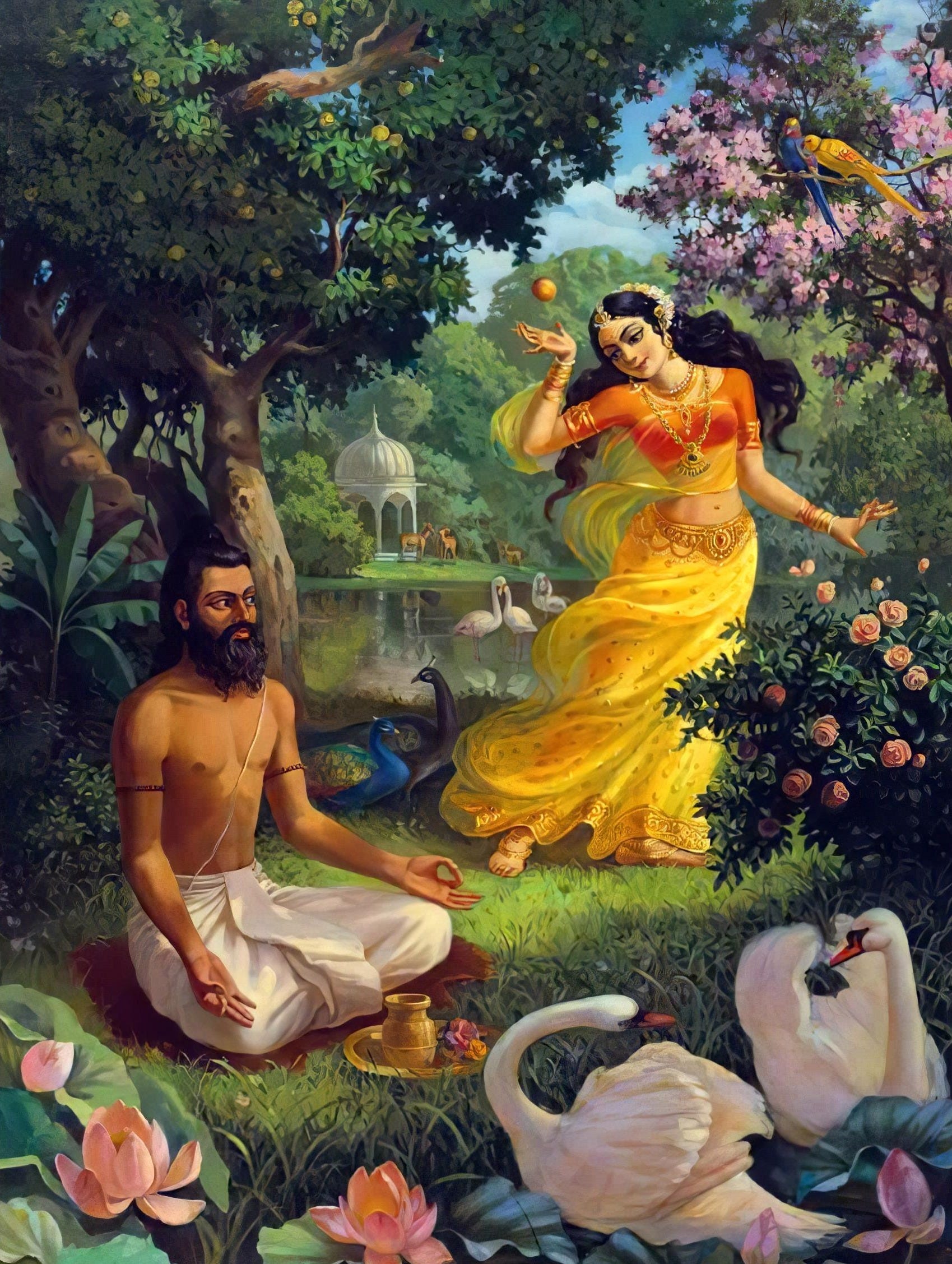
Āgnīdhra, however, was not so serious about self-realization as his father. He was more attracted to the idea of being elevated to Pitṛloka, and for that end he worshiped Lord Brahmā in a valley of Mandara Hill, one of the great mountains of Jambūdvīpa (5.16.11), that was later used by the demigods and demons to churn the ocean of milk.
The reason for his choice of this particular mountain appears to be that it’s a place apsarās regularly visit. It seems that, from the beginning, his idea was that, by the grace of Brahmā, he could meet one of these celestial ladies and beget a perfect son who would perform all religious duties after his departure and thus secure his position in Pitṛloka.
As Prabhupāda explains in his purport to 5.2.2:
“The King became pitṛloka-kāma, or desirous of being transferred to the planet named Pitṛloka. Pitṛloka is mentioned in Bhagavad-gītā (yānti deva-vratā devān pitṝn yānti pitṛ-vratāḥ). To go to this planet, one needs very good sons who can make offerings to Lord Viṣṇu and then offer the remnants to their forefathers. The purpose of the śrāddha ceremony is to please the Supreme Personality of Godhead, Lord Viṣṇu, so that after pleasing Him one may offer prasāda to one’s forefathers and in this way make them happy. The inhabitants of Pitṛloka are generally men of the karma-kāṇḍīya, or fruitive activities category, who have been transferred there because of their pious activities. They can stay there as long as their descendants offer them viṣṇu-prasāda. Everyone in heavenly planets, such as Pitṛloka, however, must return to earth after exhausting the effects of their pious acts. As confirmed in Bhagavad-gītā (9.21), kṣīṇe puṇye martya-lokaṁ viśanti: persons who perform pious acts are transferred to higher planets, but when the effects of their pious acts are over, they are again transferred to earth.”
How is it possible that a pure devotee like Priyavrata could beget a child who was interested in marrying an apsarā and being elevated to the celestial planets? Prabhupāda explains that Priyavrata begot Āgnīdhra while involved in material activities, and thus he inherited this mood. He calls our attention to the process of garbhādhāna-saṁskāra, which can mold the mentality of the father and mother in such a way that an exalted Vaiṣnava can be born.
Generally, couples beget children shortly after marriage, when they are young and still infatuated with material desires. As a result, children inherit the same mentality. Everyone can be trained as a perfect Vaiṣnava, but in this case, the children start their lives from this point and have to be elevated from there. There are, however, a few examples of exalted couples mentioned in the scriptures that take time for practicing austerities and developing their Krsna Consciousness before begetting children, like Kardama Muni and Devahūti, Sutapā and Pṛśni, etc. Prabhupāda also insists on the performance of garbhādhāna-saṁskāra, so a couple can raise their consciousness at least temporarily before begetting a child. The original process is complicated; therefore, Prabhupāda simplified the Vedic process of garbhādhāna-saṁskāra, taking the principle that any deficiency can be covered by sincerely chanting the holy names. He prescribed that couples should chant 50 rounds on the days chosen to try to beget a child, not just as a ritual, but as a sincere prayer to the Lord. If this is done sincerely, there is a chance of begetting an exalted Vaiṣnava, regardless of any other circumstances.
He also explains this point on the same purport: “sons are begotten with different mentalities according to the time of their conception. According to the Vedic system, therefore, before a child is conceived, the garbhādhāna-saṁskāra is performed. This ceremony molds the mentality of the father in such a way that when he plants his seed in the womb of his wife, he will beget a child whose mind will be completely saturated with a devotional attitude.”
What about Pitṛloka? Why is begetting a child so important for persons interested in being promoted there? The point is that Pitṛloka is available for persons who practice the path of fruitive activities. Just as pure devotees are elevated to the spiritual planets, great sages to Brahmaloka, Tapoloka, and Janaloka, etc. Pitṛloka is accessible only to pious persons who rigidly practice the regulations of the karma-kanda section of the Vedas and are capable of leaving behind a son who will offer piṇḍa (the prasāda from Lord Viṣṇu, offered to the ancestors once a year during the śrāddha ceremony). Once elevated to Pitṛloka, one can remain there for as long as the practice is maintained in the family, generation after generation. When the family eventually degrades, and the practice stops, one falls togueter with all the other ancestors, and continues on the path of saṃsāra.
As Prabhupāda explains, “To have a good son, Mahārāja Āgnīdhra wanted a wife from a family of demigods. Therefore, he went to Mandara Hill, where the women of the demigods generally come, to worship Lord Brahmā.”
Each of the demigods is put in charge of a number of apsarās, which are devoted to them. These apsarās are often sent on missions to meet exalted earthly kings and beget good children with them. Because these are very handsome men, the apsarās have no objection to doing it.
Following this system, Brahmā selected Pūrvacitti amongst the ladies in his court and sent her to meet the king and give him a child. The rest of the chapter describes the meeting and how Āgnīdhra courted the lady very expertly and made her eager to associate with him.
In her womb, he begot nine sons: Nābhi, Kiṁpuruṣa, Harivarṣa, Ilāvṛta, Ramyaka, Hiraṇmaya, Kuru, Bhadrāśva, and Ketumāla. These nice sons were put in charge of one of the subdivisions of the island of Jambūdvīpa (the central island of Bhu-Mandala), which will be explained in detail later on. All these nine tracts of land received their names.
Originally, the nine islands were called Ilāvṛta–varṣa, Bhadrāśva–varṣa, Ketumāla–varṣa, Kimpuruṣa–varṣa, Hari–varṣa, Ramyaka–varṣa, Hiraṇmaya–varṣa, Kuru–varṣa, and Nābhi–varṣa. Later, Nābhi–varṣa was renamed to Bhārata-varṣa. A small detail is that because Ilāvṛta–varṣa is the central tract, sometimes the whole set is called Ilāvṛta–varṣa, and therefore it is sometimes said that Bhārata-varṣa was previously called Ilāvṛta–varṣa. This is just a matter of nomenclature.
What happened to Āgnīdhra and Pūrvacitti after begetting their children? Apsarās have the habit of returning to the celestial planets as soon as the children are sufficiently grown-up, abandoning their earthly husbands. She was originally from Pitṛloka, and thus, after her mission was complete, she returned there to continue her worship of Lord Brahmā, leaving Āgnīdhra behind.
As in the case of other kings who get involved with apsarās, Āgnīdhra missed her very much. Always thinking of her, he took his next birth in Pitṛloka, the same planet as her. As mentioned in text 5.2.22:
“After Pūrvacitti’s departure, King Āgnīdhra, his lusty desires not at all satisfied, always thought of her. Therefore, in accordance with the Vedic injunctions, the King, after his death, was promoted to the same planet as his celestial wife. That planet, which is called Pitṛloka, is where the pitās, the forefathers, live in great delight.”
His life was, however, not wasted, because his first son, Nābhi, was a great devotee, and from him the Lord personally appeared as Ṛṣabhadeva, opening the next section of the Fifth Canto.
The deep meaning hidden in Āgnīdhra’s flattery
Āgnīdhra spoke to Pūrvacitti in a flattering way in order to seduce her. His words are described in verses 5.2.7 to 16. At first, this description seems to diverge from the main description of Śrīmad Bhāgavatam, describing the features of a woman and the words of an infatuated king, but when we go deep into the meaning, it is a very significant passage that describes the sexual attraction that binds us to this world and gives us some hints on how to become free from it. Here are the main points:
5.2.7: Āgnīdhra was instantly attracted to Pūrvacitti, but having been so long engaged in austerities, and with his intelligence bewildered due to her beauty, he was confused, and at first he thought she was the son of a saintly person from the forest, and thus addressed her as muni-varya (O best of munis). However, because she was so attractive, he questioned whether she was the personification of the illusory potency of the Lord. He then started studying her features, not believing she could be a boy. The first thing he noted was her eyebrows, which he compared to bows without strings. Following this analogy, he questioned whether she had the intention of hunting animals in the forest.
Śrīla Viśvanātha Cakravartī Ṭhākura describes that in this situation, Āgnīdhra was the animal Pūrvacitti was hunting. Prabhupāda adds that “This material world is like a great forest, and its inhabitants are like forest animals such as deer and tigers meant to be killed. The killers are the eyebrows of beautiful women. Captivated by the beauty of the fair sex, all the men of the world are killed by bows without strings, but cannot see how they are killed by māyā.”
A man moved by lustful desires approaches and courts a beautiful woman, seeing himself as an enjoyer of this world, but in reality, he is just like an animal, victimized by the arrows shot by the powerful bows of a materialistic woman, who plans to use him to satisfy her own purposes. In the name of material enjoyment, he misses the chance of attaining self-realization, and is killed at the end by the material energy, just like an animal, and sent to an uncertain future in another material body.
Religious marriages are centered on the idea of cooperating in spiritual advancement. A man accepts a wife to assist him in his spiritual practice, and promises to protect her and keep her engaged in devotional service in all circumstances. Similarly, the woman accepts a man whom she admires as a husband, promising to follow and serve him for her whole life, putting aside all selfish considerations. When these spiritual goals are put aside, men and women just exploit each other in the most outrageous ways. One may think he or she is enjoying, but in reality, materialistic life means simply being killed by Māyā.
At the end of his purport, Prabhupāda summarizes the whole question: “Karmīs who act very seriously for sense gratification are always referred to in the śāstras by such terms as pramatta, vimukha and vimūḍha. They are killed by māyā. However, one who is apramatta, a sane, sober person, a dhīra, knows very well that a human being’s primary duty is to render service to the Supreme Person. Māyā is always ready to kill those who are pramatta with her invisible bows and arrows.”
5.2.8: The arrows shot by the two bows are her eyes, compared to two sharp arrows with feathers like the petals of a lotus flower. They are thus both beautiful and dangerous. The eyes of a beautiful woman are thus compared to a weapon that can be used to subjugate a man, whether for good or bad. Having looked at her eyes, Āgnīdhra was already victimized, just as a defenseless animal pierced by sharp arrows, completely at the mercy of the hunter. He thus prayed to Pūrvacitti that her glance was favorable (that she would become his wife), because it would be impossible for him to remain without her.
Prabhupāda mentions that Āgnīdhra was afraid of the glance of Pūrvacitti. This exemplifies another passage, in which he mentioned that we should have a healthy respect for the power of Māyā. The glance of an attractive woman or man is very powerful, just like a weapon. Just as we are careful around an armed person, understanding he can kill us in an instant, we should be careful with these glances if we don’t want to be victimized by the illusory energy. Such situations have no good outcome, because getting involved with an attractive person because of lust means illusion, since material lust can’t ever be satisfied, and being rejected after becoming attracted can result in even greater bewilderment.
5.2.9-14: In his purports, Prabhupāda goes for a few verses with the understanding that Āgnīdhra was bewildered and could not understand if Pūrvacitti was a boy or a girl, while Śrīla Viśvanātha Cakravartī Thākura suggests he was feigning surprise to show his expertise at seduction. This apparent disagreement should be interpreted simply as revealing two valid interpretations that expand the meaning of the verses.
Taking that Āgnīdhra was confused, the verses describe the pathetic condition of a man bewildered by a beautiful woman, incapable of speaking coherently, as Prabhupāda explains in his purports. His leads to the hopeless condition of Āgnīdhra, becoming an obedient servant of his wife, and becoming almost mad when she left, reduced to aspiring to take his next birth on the same planet as her in the hope of maybe seeing her again.
Taking that Āgnīdhra was aware that Pūrvacitti was an apsarā sent by Brahmā, we get the meaning that he continued to address her as a Brāhmana boy in text nine onward as a tactic of seduction, showing his capacity to play with words. In this mood, he glorified her mouth, the pleasing sound of her ankle bells, her well-formed hips, her waist, and her style of dress that revealed her beautiful forms. He was already seeing her naked under her dress.
Prabhupāda describes that “When a man looks upon a woman with such lusty desires, he is captivated by her face, her breasts and her waist, for a woman first attracts a man to fulfill his sexual desires by the beautiful features of her face, by the beautiful slope of her breasts and also by her waist. Pūrvacitti was dressed in fine yellow silk, and therefore her hips looked like kadamba flowers. Because of her belt, her waist seemed to be encircled by burning cinders. She was fully dressed, but Āgnīdhra had become so lusty that he asked, “Why have you come naked?”
Āgnīdhra had become very lusty after her, and he showed that in his words. This approach of glorifying the beauty of a lady and showing interest is universally used by men as a strategy of seduction, because for a woman, beauty equals power. When a lady is very beautiful, she can obtain anything she wants and enjoy life to the fullest. Because of this, women universally desire to be beautiful, and this is exploited by lusty men. When a lady feels beautiful, she unconsciously sees it as an opportunity to enjoy life; this acts like a trigger for all kinds of repressed material desires. After making her feel beautiful and triggering these desires, a man directs them to himself, making her see him as an opportunity to satisfy all these desires. This push can be almost irresistible to a woman, putting her at the mercy of a materialistic man. In this case, she becomes the hunted one.
Āgnīdhra praised the thin waist of Pūrvacitti and compared her breasts to two horns, meaning that they were round, full, raised, and pointy.
Some compositions in Sanskrit may sound clumsy to us, but they are very attractive in the context of the original culture, like a woman being compared to an elephant. This is a comparison that would not be very welcomed by a modern lady, but in the original context, it compares a woman’s gait with the graceful movements of an elephant while walking, and indicates that her hips are broad, full, and attractive.
Next, Āgnīdhra inquired about her abode. Certainly, the people there must be very pious to possess such beautiful bodily features. Furthermore, because she has such a pleasing aroma emanating from her mouth, he concludes she must always eat the prasāda of Lord Viṣṇu. With these words, he praises Pūrvacitti as an inhabitant of the celestial planets.
He then continues to glorify her other features and movements, addressing her as suhṛttama (the best friend), which brings in a mood of intimacy.
5.2.15-16: Āgnīdhra concludes that being so qualified, she must have been sent by Brahmā to become his wife, in response to his desire to beget a perfect son. Being completely infatuated by her beauty, he concludes: “I do not want to give up your company, for my mind and eyes are fixed upon you and cannot be drawn away. O woman with beautiful raised breasts, I am your follower. You may take me wherever you like, and your friends may also follow me.”
Prabhupāda summarizes the mood in his purport: “Now Āgnīdhra frankly admits his weakness. He was attracted to Pūrvacitti, and therefore before she could say “But I have no business with you,” he expressed his desire to be united with her. He was so attracted that he was ready to go anywhere, hell or heaven, in her company. When one is absorbed in lust and the influence of sex, one surrenders to the feet of a woman without reservations.”
Human life offers us the possibility of attaining self-realization, and a relationship with a wife or husband can assist us on that if properly conducted. When we become infatuated by the desire to enjoy our senses, however, we become involved out of lust, which can have very negative results. Forgetting about the higher goals of life, we waste our human life.
Mahārāja Nābhi desires a perfect son (chapter 5.3)
Priyavrata practiced great austerities, both in his life as a brahmacārī and at the end of life for achieving perfection. Āgnīdhra also performed great austerities, but his purpose was quite different. As Krsna explains in the Gītā, whatever is our state of consciousness at the time of death, that’s the situation we attain. Āgnīdhra desired to be promoted to Pitṛloka, and his attachment to Pūrvacitti just increased that. Instead of becoming attached to the beautiful form of the Lord, he became attached to a form of this material world, and thus assumed a new material body to continue pursuing his material desires.
No one can live in this material world without performing some kind of austerity. We may perform voluntary austerity, according to the prescription of the scriptures, or we may practice forced austerity, in the form of disease and different forms of material difficulties but austerity will always be present, even in the life of the wealthiest materialist. The difference, of course, is that by performing voluntary austerity we advance, while forced austerity just brings senseless suffering.
Voluntary austerity can be performed with or without material desire. Austerity performed with material desire can bring us the material results we desire, while austerity performed for the satisfaction of the Lord brings us perfection in devotional service.
Āgnīdhra desired a celestial wife and promotion to Pitṛloka, but still, his desire was not completely outside the realm of devotional service, because he desired to have a perfect son, and he performed all his activities following the precepts of the scriptures. Although he was not situated in a platform of pure devotion like his father, Āgnīdhra was a greatly pious king, and as a result, his eldest son, Nābhi, was a great devotee.
It’s interesting to note that all the injunctions present in the Vedas are the orders of the Supreme Lord, and therefore, a person who performs fruitive activities following the scriptures indirectly worships the Lord, and thus, indirectly practices devotional service. Our ācāryas frequently criticize demigod worship in their commentaries to make it clear that devotional service is the highest perfection, but demigod worship can still serve as a stepping stone for ordinary people who are not capable of directly worshiping the Lord.
Because of his piety, Āgnīdhra was blessed with a son who was a great Vaiṣnava, Nābhi, and through this son, the Lord worked out his transcendental plan of appearing as an incarnation in the bloodline of Priyavrata.
“Śukadeva Gosvāmī continued to speak: Mahārāja Nābhi, the son of Āgnīdhra, wished to have sons, and therefore he attentively began to offer prayers and worship the Supreme Personality of Godhead, Lord Viṣṇu, the master and enjoyer of all sacrifices. Mahārāja Nābhi’s wife, Merudevī, who had not given birth to any children at that time, also worshiped Lord Viṣṇu along with her husband.” (SB 5.3.1)
As in the case of other great exalted couples, Mahārāja Nābhi and his wife practiced austerities and worshiped the Lord for a long time before trying to conceive a son. This is the process for begetting a pure devotee or an incarnation of the Lord, a Ray of Viṣṇu, as described by Śrīla Bhaktivinoda Thākura.
Nābhi performed sacrifices in the pravargya line, which is a line of ritual devotional sacrifices. Rituals have no power for attracting the supreme Lord, but they can serve as conduits for a devotee’s devotion, like in the case of Nābhi. This point was already explained by Lord Kapila in the third canto. Just as a yogi uses āsanas and prāṇāyāma to focus his mind, or a brāhmana focuses his attention by doing elaborate sacrifices, a devotee can use these and other activities performed using his body and mind to express his devotion to the Supreme Lord. The activity or ritual in itself is not important; the devotion is, but if the ritual is used to express one’s devotion, it also becomes perfect.
This is explained in the second verse:
“In the performance of a sacrifice, there are seven transcendental means to obtain the mercy of the Supreme Personality of Godhead: (1) by sacrificing valuable things or eatables, (2) by acting in terms of place, (3) by acting in terms of time, (4) by offering hymns, (5) by going through the priest, (6) by offering gifts to the priests and (7) by observing the regulative principles. However, one cannot always obtain the Supreme Lord through this paraphernalia. Nonetheless, the Lord is affectionate to His devotee; therefore when Mahārāja Nābhi, who was a devotee, worshiped and offered prayers to the Lord with great faith and devotion and with a pure uncontaminated mind, superficially performing some yajña in the line of pravargya, the kind Supreme Personality of Godhead, due to His affection for His devotees, appeared before King Nābhi in His unconquerable and captivating form with four hands. In this way, to fulfill the desire of His devotee, the Supreme Personality of Godhead manifested Himself in His beautiful body before His devotee. This body pleases the mind and eyes of the devotees.” (SB 5.3.2)
What was the result? The Lord personally appeared to Nābhi in His Viṣṇu form, displaying all His opulences:
“Lord Viṣṇu appeared before King Nābhi with four arms. He was very bright, and He appeared to be the best of all personalities. Around the lower portion of His body, He wore a yellow silken garment. On His chest was the mark of Śrīvatsa, which always displays beauty. He carried a conchshell, lotus flower, disc and club, and He wore a garland of forest flowers and the Kaustubha gem. He was beautifully decorated with a helmet, earrings, bangles, belt, pearl necklace, armlets, ankle bells and other bodily ornaments bedecked with radiant jewels. Seeing the Lord present before them, King Nābhi and his priests and associates felt just like poor people who have suddenly attained great riches. They received the Lord and respectfully bent their heads and offered Him things in worship.” (SB 5.3.3)
Many verses in the Śrīmad Bhāgavatam describe the form of the Supreme Lord. We should not take these different verses as being repetitive, but rather as an opportunity to remember the Lord and gradually imprint His transcendental form within our minds. The ultimate goal of life is to always remember Krsna and never forget Him. Meditation on the Lord requires us to remember His form, and by such repeated descriptions, Śrīmad Bhāgavatam teaches us how to achieve that.
King Nābhi had the idea of obtaining a son just like the Supreme Lord. For this purpose, he engaged a number of priests in performing the sacrifice. These were no ordinary Brāhmanas, but great devotees who were qualified on the same level as demigods. There is no one like the Supreme Lord; He is the One without a second. He thus used the desire of the king as an excuse to appear as an incarnation, as He Himself desired. Thus he answered:
“O great sages, I am certainly very pleased with your prayers. You are all truthful. You have prayed for the benediction of a son like Me for King Nābhi, but this is very difficult to obtain. Since I am the Supreme Person without a second and since no one is equal to Me, another personality like Me is not possible to find. In any case, because you are all qualified brāhmaṇas, your vibrations should not prove untrue. I consider the brāhmaṇas who are well qualified with brāhminical qualities to be as good as My own mouth.
Since I cannot find anyone equal to Me, I shall personally expand Myself into a plenary portion and thus advent Myself in the womb of Merudevī, the wife of Mahārāja Nābhi, the son of Āgnīdhra.” (SB 5.3.17-18)
Queen Merudevī was seated right beside her husband in the sacrificial arena. According to the regulations, one should perform Vedic sacrifices always in the company of his wife. Even in Maharloka, where sages are greatly pure, they perform sacrifices together with their consorts. This gave Merudevī the opportunity to also see the transcendental form of the Lord, and understand that He was going to soon appear from her womb.
It is described that the Lord appeared as Ṛṣabhadeva, the son of Merudevī, in His original spiritual form. This means Ṛṣabhadeva is a direct incarnation of the Lord, with a completely transcendental body. He is not a jīva who was empowered.
The devotee priests pray to the Supreme Lord
The priests began to offer prayers to the Lord, saying: O most worshipable one, we are simply Your servants. Although You are full in Yourself, please, out of Your causeless mercy, accept a little service from us, Your eternal servants. We are not actually aware of Your transcendental form, but we can simply offer our respectful obeisances again and again, as instructed by the Vedic literatures and authorized ācāryas. Materialistic living entities are very much attracted to the modes of material nature, and therefore they are never perfect, but You are above the jurisdiction of all material conceptions. Your name, form and qualities are all transcendental and beyond the conception of experimental knowledge. Indeed, who can conceive of You? In the material world we can perceive only material names and qualities. We have no other power than to offer our respectful obeisances and prayers unto You, the transcendental person. The chanting of Your auspicious transcendental qualities will wipe out the sins of all mankind. That is the most auspicious activity for us, and we can thus partially understand Your supernatural position. (SB 5.3.4-5)
Seeing the form of the Lord, the priests confess their incapacity in understanding or categorizing him according to their limited understanding. The Lord is full of apparently contradictory qualities. He is the greatest, but at the same time can enter even inside the atom. He is unlimited, but at the same time has a personal form. Everything exists inside the Lord (since everything is a manifestation of His energy), but at the same time, when He appears in front of us, we appear to be outside. The Lord is one, but He appears in unlimited forms and expansions. He appears inside the material universe, while at the same time remaining outside, transcendental to matter. All these different contradictions are beyond the comprehension of the human mind, but still, they are all somehow reconciled in the transcendental form of the Lord.
Māyāvādis are incapable of understanding the transcendental form of the Lord, and thus they conclude that the Lord has no form, no potencies, and no activities. This is the result of trying to understand the transcendental with one’s limited brain. Contradictory as it may seem, the more one speculates about the form of the Lord, the more one becomes propense to conclude He has no form, because the existence of a transcendental form that reconciles all contradictory attributes will never fit one’s limited intellect. Even when the Lord appears in front of us, our eyes are not a reliable way of understanding His glories. Brahmā could see Krsna with His eyes, but he saw a mere cowherd boy and decided to play a trick. Indra saw Him as an enemy and attacked Vṛndāvana for seven days, while Duryodhana tried to arrest Krsna even after seeing His universal form, thinking He was an ordinary magician.
The brāhmanas thus guide us to the proper process of understanding the form of the Lord by accepting the description given in the Vedic literature.
The process for approaching the Supreme Lord
“O Supreme Lord, You are full in every respect. You are certainly very satisfied when Your devotees offer You prayers with faltering voices and in ecstasy bring You tulasī leaves, water, twigs bearing new leaves, and newly grown grass. This surely makes You satisfied.
We have engaged in Your worship with many things and have offered sacrifices unto You, but we think that there is no need for so many arrangements to please Your Lordship.” (SB 5.3.6-7)
After understanding the greatness of the Supreme Lord, one might conclude that He is unapproachable, but the Brāhmanas dispel this misunderstanding, stating that although the Lord is so great, He can be satisfied with a small offering of tulasī leaves and water, or even leaves, twigs, and newly grown grass. The point is not the size of the offering, but the devotion. The offering serves as a vehicle that the devotee uses to express his devotion.
In text seven, the Brāhmanas refer to their own efforts in offering the sacrifice, concluding that there is no need to offer such elaborate rituals. Prabhupāda expands this point in his purport: “Śrīla Rūpa Gosvāmī says that if one is offered varied foods but has no appetite, the offering has no value. In a big sacrificial ceremony there may be many things accumulated to satisfy the Supreme Personality of Godhead, but if there is no devotion, attachment or love for the Lord, the arrangement is useless. The Lord is complete in Himself, and He does not need anything from us. However, if we offer Him a little water, a flower and a tulasi leaf, He will accept them. Bhakti, devotional service, is the main way to satisfy the Supreme Personality of Godhead. It is not a question of arranging huge sacrifices.”
Neophytes often have great faith in rituals, thinking that such rituals have the power of evoking the Lord or securing His blessings, but this is dismissed by the Brahmanas, who, in their humility, thought that they were not on the path of devotional service and that their sacrifice was not pleasing to the Lord.
There is another side, however, that is bought by Prabhupāda on text 6: “If one is fully absorbed in love and ecstasy, he need offer only a flower and a little water. As stated in Bhagavad-gītā, patraṁ puṣpaṁ phalaṁ toyaṁ yo me bhaktyā prayacchati: “If one offers Me with love and devotion a leaf, a flower, fruit or water, I will accept it.”
Even though the Lord is satisfied by devotion, we should not be negligent, since negligence is precisely a sign of a lack of devotion. If one is situated on a platform of love of Godhead, there is no need to make complicated offerings; just a few tulasi leaves and water will be perfectly satisfying to the Lord. However, if one is not situated in devotion, one can gradually develop it by offering whatever one has best, according to the rules and regulations. A rich man shouldn’t be a miser, thinking that since the Lord asks for just a few leaves and water in the Gītā, he should offer just that, and use all the rest of his wealth for his personal gratification. Similarly, if one is worshiping the deity, one should not be negligent.
It is said that one who is on a platform of spontaneous devotion has no need to follow rules and regulations, but this is because on such a platform, one has no material desires and automatically uses all his time to serve the Lord. When we are not situated in this platform, however, it is the opposite: unless we make a conscious effort, our time is automatically wasted in sleep and activities for sense gratification. Therefore, as long as we are not in a platform of pure and spontaneous devotion, we should keep ourselves busy, serving and performing worship according to the rules and regulations. We should not discard the rules prematurely, judging ourselves perfect; otherwise, we risk becoming sahajiyās.
You can also donate using Buy Me a Coffee, PayPal, Wise, Revolut, or bank transfers. There is a separate page with all the links. This helps me enormously to have time to write instead of doing other things to make a living. Thanks!