


You can receive new articles directly in your inbox. Subscription is free; donations are welcome.
We learn that the bhakti process is composed of two stages: vaidhī-bhakti and rāgānugā-bhakti. We hear a lot about vaidhī-bhakti, the path of devotional service according to the rules and regulations, and we often wonder about rāgānugā-bhakti, which is taken as a higher platform. Most of what we practice is connected with the path of vaidhī-bhakti, and we may wonder if we are not missing something by not knowing more about the path of rāgānugā-bhakti.
The problem is that when we start asking about rāgānugā-bhakti, we often come in contact with all kinds of sahajiyās with all types of misunderstandings about the whole thing. We come then into imaginary forms of siddha-praṇālī, imaginary forms of meditation in a so-called spiritual form, and so on. There is, however, a legitimate path of rāgānugā-bhakti that is taught by Śrīla Jīva Gosvāmi in his bhakti-sandarbha, and is also mentioned by Śrīla Prabhupāda in his books. These are the passages we should try to understand when we think we are ready to graduate from just doing sādhana.
The first point to understand is that the process taught by Jīva Gosvāmi is not a replacement for sādhana but a deepening of it. Externally, the devotee should continue to follow the same disciplined process. What changes is that instead of simply doing things mechanically, a devotee develops a very intense meditation on Kṛṣṇa. Only when this process of meditation is perfected, a devotee may give up the external practices and sit in a secluded place to practice nirjana-bhajana, serving Kṛṣṇa within his mind. At this perfected stage, one can literally join His eternal pastimes.
This article will be a little long, because there are many references to cover, but if one is genuinely interested in the topic, this may be perceived as a positive instead of a negative. Here I’m using the translation of the Bhakti-sandarbha of Kuśakratha Prabhu.
In his Bhakti-sandarbha (312), Jīva Gosvāmi mentions that those who have not yet progressed to at least the stage of ruci (genuine spontaneous taste) should continue to practice the regulated activities of vaidhī-bhakti while developing their meditation on the Lord. Most of us are generally in the stage of anartha-nivṛtti, where we are still battling bad habits and general material attachments. After we complete this stage, there is the stage of niṣthā, where one becomes steady in the spiritual practice, without being disturbed by changing material conditions, and ruci comes still further. This gives us an idea of proportion. This process of meditation he describes can begin to be practiced even in the lower stages of devotional service (under proper guidance). The point is that until one develops true attachment, they must be practiced together with the rules and regulations of devotional service. The reason advanced devotees may later discard these rules and regulations is that, at this stage, they have no propensity to do anything sinful and a genuine attraction for the Lord; therefore, the purpose of the regulations is attained automatically, without the need of them having to consciously follow them.
When vaidhī-bhakti and rāgānugā-bhakti are discussed in the context of one being inferior and the other superior, the words are taken in the sense of a devotee simply following rules and regulations mechanically compared with a devotee who has attained deep absorption. In practice, the two mix. A few advanced devotees go completely in the direction of complete absorption, while others practice this devotional meditation together with their regulated practice. Even great ācāryas follow rules and regulations to give an example to others.
In text 18 of the same section, Jīva Gosvāmi warns us of the danger of disregarding the rules and regulations before attaining genuine absorption:
“The state of being an unalloyed (ekanti) devotee of the Lord is attained by having faith in devotional service. When one is attracted (ruci) to the Lord, one naturally respects the rules and regulations described in the scriptures. Attraction to the Lord is very rare. If a person has no respect for the rules and regulations of the scriptures and thinks himself an unalloyed devotee, he is merely a proud hypocrite. This is confirmed by the following words of the Brahma-yamala:
“Devotional service to the Lord that ignores the authorised Vedic literatures like the Upanisads, Puranas, Narada-pancaratra, etc., is simply an unnecessary disturbance in society.”
Prabhupāda also uses the same quote in different situations to sustain the same point. We can see it comes directly from Jīva Gosvāmi.
Another point made by Jīva Gosvāmi is that to develop this intense internal meditation, a devotee must live in a holy place. This means either directly living in Mayapur, Vṛndāvana, etc., or living there mentally by fixing our mind in the practice of devotional service. This is essential because this process of fixed meditation demands that the mind be very stable, unagitated. This is probably the greatest impediment for us nowadays. As long as the mind remains agitated due to the demands of modern life, there is no question of deep meditation. In this case, practical services can be more effective, as we are often instructed to do.
Where exactly does Jīva Gosvāmi approach this subject? He starts by laying all the philosophical basis in the Tattva-sandarbha, Bhagavat-sandarbha, and Paramatma-sandarbha, and then goes deeper into the philosophical understanding of the transcendental and supreme nature of Kṛṣṇa’s pastimes, as well as our eternal relationship with Him in the Kṛṣṇa-sandarbha. We get a very good foundation on these topics by studying Śrīla Prabhupāda’s books. This solid philosophical basis is also essential, because without the right understanding, the process of meditation will not be correct. If one thinks that Kṛṣṇa pastimes are performed under the material modes, as Māyāvādīs tend to understand, for example, or if one tries to enter into them with an attitude of enjoyment instead of service, as Sahajiyās often do, then there is no question of proper meditation.
The foundations for the process of rāgānugā meditation are then developed in the Bhakti-sandarbha, especially in sections 272 to 312.
Sections 272 to 277 establish hearing and chanting as the foundation of the whole process. That’s the point all our spiritual masters emphasize. Without this foundation, there is no question of going further. Everything else serves to deepen this process, not to replace it.
Here are the five sections:
Anuccheda 272:
1 The glory of kirtana is described in these words (Srimad Bhagavatam 11.5.37):
“Indeed, there is no higher possible gain for embodied souls forced to wander throughout the material world than the Supreme Lord’s sankirtana movement, by which one can attain the supreme peace and free oneself from the cycle of repeated birth and death.”
2 Here the words “atah” and “yatah” both mean “than kirtana”. “Paramam santim” means there is no peace better than what is obtained by performing kirtana. This is confirmed by the following words of Srimad Bhagavatam (11.19.36): “The word “sama” (peacefulness) or santa-rasa indicates that one is attached to the lotus feet of Krsna.”
3 These words of the Lord affirm that by performance of kirtana one attains faith in the Lord far greater than the faith attained by meditation or any other spiritual practice. By kirtana the cycle of repeated birth and death is brought to an end. By meditation performed in the Satya-yuga one does not attain this same deep faith in the Supreme Lord.
4 In the Skanda Purana it is said: “In Kali-yuga the great devotees worship the Lord by performing kirtana.”
5 These words of the Skanda Purana glorify the performance of kirtana, which brings great faith in the Supreme Lord. The Lord, who is very merciful to the fallen souls, does not reveal any spiritual path better than kirtana. If someone says that simply by moving the lips in kirtana one does not attain the same result obtained by meditation or other spiritual practices, he should not be believed.
Anuccheda 273:
1 Hearing that the people who live in Kali-yuga have great faith in the Supreme Lord, the great souls pray that they may also take birth in Kali-yuga. This is described in the following words (Srimad Bhagavatam 11.5.38):
2 “My dear King, the inhabitants of Satya-yuga and other ages eagerly desire to take birth in this age of Kali, since in this age there will be many devotees of the Supreme Lord, Narayana.”
3 In this way the people of Kali-yuga will have great devotion and love for the Lord, as was described in Srimad Bhagavatam 11.5.37 (quoted in anuccheda 272, text 1).
4 Great devotion to the Lord is also described in these words (Srimad Bhagavatam 6.14.5): “O great sage, among many millions who are liberated and perfect in knowledge of liberation, one may be a devotee of Lord Narayana or Krsna. Such devotees, who are fully peaceful are extremely rare.”
5 It is not possible to adequately describe the virtues of performing kirtana in Kali-yuga. To chant the holy name of the Lord only devotion is needed. There are no restrictions according to time and place. This is described in the Visnu-dharma Purana, in the story of the ksatra-bandhu, where it is said:
6 “O hunter, in chanting the holy names of Lord Krsna there are no restrictions of time, place or accepting remnants.”
7 In the Skanda Purana, Padma Purana-Vaisakha-mahatmya, and Visnu-dharma Purana it is said:
“One should chant the holy names of Lord Krsna, who holds the cakra, always and everywhere.”
8 In the Skanda Purana it is said:
“The holy name of Lord Krsna fulfils all desires. It is independent. It does not depend on the restrictions of time, place, situated, or purification.”
9 In the Visnu-dharma Purana it is said:
“For one who has Lord Krsna in his heart, the Kali-yuga becomes Satya-yuga. For one who does not have Lord Krsna in his heart, the Satya-yuga becomes Kali-yuga.”
10 One should not think, “It is because in the Kali-yuga it is not possible to attain success by any other means, that a little endeavour in kirtana brings a great result.”
11 In Sri Visnu Purana (6.8.55) it is said:
“One who fixes his mind on the Supreme Lord never goes to hell. When one meditates on the Lord even Svargaloka seems an obstacle. When one’s heart goes to the Lord even Brahmaloka seems small and pathetic. Staying in His devotee’s pure heart, the eternal Lord gives the gift of liberation. Why should anyone be surprised, then, that sins at once perish when the infallible Supreme Lord is glorified?”
12 These words of Sri Visnu Purana show that the glorification of the Lord is much more important than meditation, which leads in stages to samadhi. This is also confirmed by the following words of Srimad Bhagavatam (2.1.11):
“O King, constant chanting of the holy name of the Lord after the ways of the great authorities is the doubtless and fearless way of success for all, including those who are free from all material desires, those who are desirous of all material enjoyment, and also those who are self-satisfied by dint of transcendental knowledge.”*
13 In the Vaisnava-cintamani it is said:
“By merely moving one’s lips to glorify Lord Visnu, one attains a result better than what is attained by long and difficult meditations.”
14 It is also said in the scriptures:
“One on whose mouth the holy names of Lord Krsna always stay must already have worshipped the Lord for hundreds of births.”
15 However, in the Namaparadha-bhanjana-stotra it is said:
“One who commits all kinds of offenses may become delivered by taking shelter of Lord Hari. One who commits offenses to Lord Hari is an animal, even though he may stand on two feet.”
16 In every yuga kirtana (glorification of the Lord) is equally powerful. However, by the mercy of the Supreme Personality of Godhead, it is especially to be performed in Kali-yuga. Therefore in Kali-yuga it is praised as being most important. In Kali-yuga the other activities of devotional service should be performed in connection with kirtana.
17 The importance of kirtana in Kali-yuga is described by these words (Srimad Bhagavatam 11.5.32):
“In the age of Kali, intelligent persons perform congregational chanting to worship the incarnation of Godhead, who constantly sings the names of Krsna. Although His complexion is not blackish He is Krsna Himself. He is accompanied by His associates, servants, weapons and confidential companions.”
18 That the chanting of the holy name of the Lord is supremely independent and important is confirmed by the following words (Sri Narada Purana 3.126):
“In this age of quarrel and hypocrisy, the only means of deliverance is the chanting of the holy names of the Lord. There is no other way. There is no other way. There is no other way.”
19 This truth is also eloquently explained in Srimad Bhagavatam 11.5.36-38. The verse quoted in the beginning of this anuccheda was spoken by Sri Karabhajana to Maharaja Nimi.
Anuccheda 274:
1 Thus it is shown that in Kali-yuga by the chanting the holy names of the Lord one attains great devotion to Him. However, they who commit offenses to the holy name remain outside of the sphere of devotional service. This is described in these words of Srimad Bhagavatam (12.3.43-44):
“O King, in the age of Kali people’s intelligence will be diverted by atheism, and they will almost never offer sacrifice to the Supreme Personality of Godhead, who is the supreme spiritual master of the universe. Although the great personalities who control the three worlds all bow down to the lotus feet of the Supreme Lord, the petty and miserable human beings of this age will not do so.
3 “Terrified, about to die, a man collapses on his bed. Although his voice is faltering and he is hardly conscious of what he is saying, if he utters the holy name of the Supreme Lord he can be freed from the reaction of his fruitive work and achieve the supreme destination. But still people in the age of Kali will not worship the Supreme Lord.
4 The meaning of this verse is clear. This verse was spoken by Srila Sukadeva Gosvami.
Anuccheda 275:
1 In this way kirtana is explained. To be included within kirtana are humble prayers and appeals to one’s worshipable Deity. The Srimad Bhagavatam’s description of the glorification of the Lord’s holy names and other features are most substantial and significant than those found in other puranas. In Kali-yuga the Srimad Bhagavatam is especially praised. This is explained in the following words (Srimad Bhagavatam 1.3.43):
2 “This Bhagavata Purana is as brilliant as the sun, and it has arisen just after the departure of Lord Krsna to His own abode, accompanied by religion, knowledge, etc. Persons who have lost their vision due to the dense darkness of ignorance in the age of kali shall get light from this Purana.”
3 If a person has a pure heart, engages in the devotional activities that begin with surrender, and does not abandoning the process of chanting the Lord’s holy name, a process described in Srimad Bhagavatam 2.1.11), he will find himself engaged in smaranam (meditation) which his mind is fixed on the Supreme Lord. Meditation has many forms, beginning with meditation of the Lord’s holy names. Meditation is described in a general way by the Supreme Lord Himself in the following words (Srimad Bhagavatam 11.13.14):
4 “The actual yoga system as taught by My devotees, headed by Sanaka-kumara, is simply this: Having withdrawn the mind from all other objects, one should directly and appropriately absorb it in Me.”
5 Here the word “yatha” means “properly”. This verse means “One should absorb the mind in me.” In the Skanda Purana, Lord Brahma declares:
“By scrutinisingly reviewing all the revealed scriptures and judging them again and again, it is now concluded that Lord Narayana is the Supreme Absolute Truth, and thus He alone should be worshipped.”
Anuccheda 276:
1 Meditation on the holy name is described in the following words of the Jabali-samhita: “One who desires liberation should always chant, sing, glorify and remember the holy name of Lord Hari.”
2 A pure heart is needed in order to successfully meditate on the holy name. Meditation on the holy name is not as powerful and effective as chanting the holy name. This is so, although it is not expressly stated in this quote. Meditation on the Lord’s form is described in these words of Srimad Bhagavatam (12.12.55):
3 Remembrance of Lord Krsna’s lotus feet destroys everything inauspicious and awards the greatest good fortune. It purifies the heart and bestows devotion for the Supreme Soul, along with knowledge enriched with realisation and renunciation.”
4 Here the word “paramatmani” means “Sri Krsna” and “bhaktim” means “loving devotional service”. Love for the Supreme Personality of Godhead is the primary result obtained by devotional service. The other results accompany that primary result. This verse was spoken by Srila Suta Gosvami.
Anuccheda 277:
1 It is also said (Srimad Bhagavatam 10.80.11):
“The Lord of the bhojas, Vrsnis and Andhakas is not at Dvaraka. He gives Himself away to anyone who simply remembers His lotus feet. What doubt is there then that He, the spiritual master of the universe, is willing to bestow prosperity and enjoyment upon a devotee who engages in worshipping Him, even though these material benefits are not very desirable?”
2 Here the word “smaratah” means “of one who meditates”. The supreme Personality of Godhead directly appears before a devotee who meditates on Him. He becomes submissive to such a devotee. That is the meaning. “Artha-kaman” is in the plural because it includes liberation and the other goals of life. Here the parable of “linga-samavaya-nyaya” is appropriate. Meditation on the Lord’s form is also glorified in these words of the Garuda Purana:
3 “When even a moment passes without remembrance of the Supreme Personality of Godhead, one should bitterly lament as if his precious wealth had suddenly been stolen by a band of thieves.”
4 The verse quoted in the beginning of this anuccheda was spoken to Sridama Vipra by His wife.
We can see that these passages are based on what we study in the Śrīmad-Bhāgavatam. In fact, the whole Sat-sandarbhas are a set of theses that clarify the conclusions of the Śrīmad-Bhāgavatam organized in terms of sambandha, abhidheya, and prayojana. Most of these conclusions are given by Prabhupāda in his purports; therefore, these works should not be considered separate. They explain the same Vaiṣnava philosophy, just treating different topics at different levels of detail.
Prabhupāda explains the Bhāgavatam verse by verse, including practical instructions, while Jīva Gosvāmī organizes the conclusions of the Śrīmad-Bhāgavatam into philosophical arguments. On some topics, Prabhupāda offers more detail; on others, Jīva Gosvāmi offers more detail. Therefore, the two are complementary.
Back to the discussion on rāgānugā-bhakti, what may sound genuinely new is the process he describes in section 278:
Anuccheda 278:
1 Now the different stages of meditation (as described before) on the Lord’s qualities, associates, service, and pastimes will now be considered. Meditation proceeds in five stages. The first stage is smarana, where the mind is sometimes attracted to the Lord. The next stage is dharana, where the mind is more completely attracted to the Lord. The next stage is dhyana, where one specifically meditates on the form of the Lord. The next stage is dhruvanusmrti, where one’s meditation on the Lord becomes like a flood of nectar. The final stage of meditation is samadhi, where the Lord alone is present in one’s thoughts.
2 Smarana is described in these words of the Narada Purana:
“Eternal Lord Narayana is pleased with even a sinner who somehow or other remembers Him. Of this there is no doubt.”
3 Dharana is described by the Supreme Personality of Godhead in these words (Srimad Bhagavatam 11.14.27):
“The mind of one meditating upon the objects of sense gratification is certainly entangles in such objects, but if one constantly remembers Me, then the mind is absorbed in Me.”
4 Dhyana is described in these words of the Nrsimha Purana and other scriptures:
“Even a sinner who engages in undivided meditation on the lotus feet of the Supreme Personality of Godhead finds that all his troubles become transformed into blessings.
5 Here the word “nirdvandvam” means “ignoring the troubles caused by heat, cold, and other dualities”, and “iritam” means “spoken by the scriptures”. Even a sinner engaged in such meditation finds that all this troubles become transformed into blessings. That is the meaning here.
6 Dhruvanusmrti is described in these words of Srimad Bhagavatam (3.29.11-12):
“The manifestation of unadulterated devotional service is exhibited when one’s mind is at once attracted to hearing the transcendental name and qualities of the Supreme Personality of Godhead, who is residing in everyone’s heart. Just as the water of the Ganges flows naturally down towards the ocean, such devotional ecstasy, uninterrupted by any material condition, flows towards the Supreme Lord.”
7 Dhruvanusmrti is also described in these words (Srimad Bhagavatam 11.2.53):
“The lotus feet of the Supreme Personality of Godhead are sought even by the greatest of demigods, such as Brahma and Siva, who have all accepted the Supreme Personality of Godhead as their life and soul. A pure devotee of the Lord can never forget those lotus feet in any circumstance. He will not give up his shelter at the lotus feet of the Lord for a single moment, indeed, not for half a moment, even in exchange for the benediction of ruling and enjoying the opulence of the entire universe. Such a devotee of the Lord is to be considered the best of the Vaisnavas.”
8 Srila Ramanuja Acarya has also discussed this topic in his commentary on the first sutra of Vedanta-sutra.
9 Samadhi is described in these words (Srimad Bhagavatam 12.10.9):
“Because Markandeya’s material mind had stopped functioning, the sage failed to notice that Lord Siva and his wife, the controllers of the universe, had personally come to see him. Markandeya was so absorbed in meditation that he was unaware of either himself or the external world.”
10 Here the word “tayoh” means “of Lord Siva and his wife”. Because they are both potencies and amsas of the Lord they are here called “jagad-atmanoh”, which means “the creators of the universe”. The word “ruddha-dhi-vrttih” means “rapt in meditation on the Supreme Personality of Godhead.”
Before this verse it was said (Srimad Bhagavatam 12.10.6):
“Surely this saintly brahmana does not desire any benediction, not even liberation itself, for he has attained pure devotional service unto the inexhaustible Personality of Godhead.”*
In this way it is shown that the samadhi described here is different from the samadhi of the impersonalists, which is called asamprajnata-samadhi.
This verse was spoken by Srila Suta Gosvami.
Here, Jīva Gosvāmi describes five stages of progressive absorption:
Smaraṇa — Remembrance.
Dhāraṇā — Concentration.
Dhyāna — Meditation.
Dhruvānusmṛti — Uninterrupted absorption.
Samādhi — Complete absorption.
The important part to understand is that these five stages describe the development of deep meditation on Kṛṣṇa inside the practice of devotional service and not a separate system that replaces it. The practice includes chanting songs from the previous ācāryas and meditating on their meaning, meditating on specific pastimes according to the time and circumstances, and so on. Only later, as the mind becomes stable, may they progress into a direct process of solitary meditation.
This context becomes clear when we study Prabhupāda’s purport to SB 7.5.23-24. This is a very long purport, but it details the whole process of spiritual practice in a nutshell. The most relevant passage for this discussion is the beginning of the purport, discussing the processes of śravaṇam, kīrtanam, and smaraṇam:
Śrīla Bhaktisiddhānta Sarasvatī Ṭhākura gives the following explanation in his Tathya. The word śravaṇa refers to giving aural reception to the holy name and descriptions of the Lord’s form, qualities, entourage and pastimes as explained in Śrīmad-Bhāgavatam, Bhagavad-gītā and similar authorized scriptures. After aurally receiving such messages, one should memorize these vibrations and repeat them (kīrtanam). Smaraṇam means trying to understand more and more about the Supreme Lord, and pāda-sevanam means engaging oneself in serving the lotus feet of the Lord according to the time and circumstances. Arcanam means worshiping Lord Viṣṇu as one does in the temple, and vandanam means offering respectful obeisances. Man-manā bhava mad-bhakto mad-yājī māṁ namaskuru. Vandanam means namaskuru — offering obeisances or offering prayers. Thinking oneself to be nitya-kṛṣṇa-dāsa, everlastingly a servant of Kṛṣṇa, is called dāsyam, and sakhyam means being a well-wisher of Kṛṣṇa. Kṛṣṇa wants everyone to surrender unto Him because everyone is constitutionally His servant. Therefore, as a sincere friend of Kṛṣṇa, one should preach this philosophy, requesting everyone to surrender unto Kṛṣṇa. Ātma-nivedanam means offering Kṛṣṇa everything, including one’s body, mind, intelligence and whatever one may possess.
One’s sincere endeavor to perform these nine processes of devotional service is technically called bhakti. The word addhā means “directly.” One should not be like the karmīs, who perform pious activities and then formally offer the results to Kṛṣṇa. That is karma-kāṇḍa. One should not aspire for the results of his pious activities, but should dedicate oneself fully and then act piously. In other words, one should act for the satisfaction of Lord Viṣṇu, not for the satisfaction of his own senses. That is the meaning of the word addhā, “directly.”
anyābhilāṣitā-śūnya
ṁjñāna-karmādy-anāvṛtam
ānukūlyena kṛṣṇānu-
śīlanaṁ bhaktir uttamā“One should render transcendental loving service to the Supreme Lord Kṛṣṇa favorably and without desire for material profit or gain through fruitive activities or philosophical speculation. That is called pure devotional service.” One should simply satisfy Kṛṣṇa, without being influenced by fruitive knowledge or fruitive activity.
The Gopāla-tāpanī Upaniṣad says that the word bhakti means engagement in the devotional service of the Supreme Personality of Godhead, not of anyone else. This Upaniṣad describes that bhakti is the offering of devotional service unto the Supreme Personality of Godhead. To perform devotional service, one should be relieved of the bodily conception of life and aspirations to be happy through elevation to the higher planetary systems. In other words, work performed simply for the satisfaction of the Supreme Lord, without any desire for material benefits, is called bhakti. Bhakti is also called niṣkarma, or freedom from the results of fruitive activity. Bhakti and niṣkarma are on the same platform, although devotional service and fruitive activity appear almost the same.
The nine different processes enunciated by Prahlāda Mahārāja, who learned them from Nārada Muni, may not all be required for the execution of devotional service; if a devotee performs only one of these nine without deviation, he can attain the mercy of the Supreme Personality of Godhead. Sometimes it is found that when one performs one of the processes, other processes are mixed with it. That is not improper for a devotee. When a devotee executes any one of the nine processes (nava-lakṣaṇā), this is sufficient; the other eight processes are included. Now let us discuss these nine different processes.
(1) Śravaṇam. Hearing of the holy name of the Lord (śravaṇam) is the beginning of devotional service. Although any one of the nine processes is sufficient, in chronological order the hearing of the holy name of the Lord is the beginning. Indeed, it is essential. As enunciated by Lord Śrī Caitanya Mahāprabhu, ceto-darpaṇa-mārjanam: by chanting the holy name of the Lord, one is cleansed of the material conception of life, which is due to the dirty modes of material nature. When the dirt is cleansed from the core of one’s heart, one can realize the form of the Supreme Personality of Godhead — īśvaraḥ paramaḥ kṛṣṇaḥ sac-cid-ānanda-vigrahaḥ. Thus by hearing the holy name of the Lord, one comes to the platform of understanding the personal form of the Lord. After realizing the Lord’s form, one can realize the transcendental qualities of the Lord, and when one can understand His transcendental qualities one can understand the Lord’s associates. In this way a devotee advances further and further toward complete understanding of the Lord as he awakens in realization of the Lord’s holy name, transcendental form and qualities, His paraphernalia, and everything pertaining to Him. Therefore the chronological process is śravaṇaṁ kīrtanaṁ viṣṇoḥ. This same process of chronological understanding holds true in chanting and remembering. When the chanting of the holy name, form, qualities and paraphernalia is heard from the mouth of a pure devotee, his hearing and chanting are very pleasing. Śrīla Sanātana Gosvāmī has forbidden us to hear the chanting of an artificial devotee or nondevotee.
Hearing from the text of Śrīmad-Bhāgavatam is considered the most important process of hearing. Śrīmad-Bhāgavatam is full of transcendental chanting of the holy name, and therefore the chanting and hearing of Śrīmad-Bhāgavatam are transcendentally full of mellows. The transcendental holy name of the Lord may be heard and chanted accordingly to the attraction of the devotee. One may chant the holy name of Lord Kṛṣṇa, or one may chant the holy name of Lord Rāma or Nṛsiṁhadeva (rāmādi-mūrtiṣu kalā-niyamena tiṣṭhan). The Lord has innumerable forms and names, and devotees may meditate upon a particular form and chant the holy name according to his attraction. The best course is to hear of the holy name, form and so on from a pure devotee of the same standard as oneself. In other words, one who is attached to Kṛṣṇa should chant and hear from other pure devotees who are also attached to Lord Kṛṣṇa. The same principle applies for devotees attracted by Lord Rāma, Lord Nṛsiṁha and other forms of the Lord. Because Kṛṣṇa is the ultimate form of the Lord (kṛṣṇas tu bhagavān svayam), it is best to hear about Lord Kṛṣṇa’s name, form and pastimes from a realized devotee who is particularly attracted by the form of Lord Kṛṣṇa. In Śrīmad-Bhāgavatam, great devotees like Śukadeva Gosvāmī have specifically described Lord Kṛṣṇa’s holy name, form and qualities. Unless one hears about the holy name, form and qualities of the Lord, one cannot clearly understand the other processes of devotional service. Therefore Śrī Caitanya Mahāprabhu recommends that one chant the holy name of Kṛṣṇa. Paraṁ vijayate śrī-kṛṣṇa-saṅkīrtanam. If one is fortunate enough to hear from the mouth of realized devotees, he is very easily successful on the path of devotional service. Therefore hearing of the holy name, form and qualities of the Lord is essential.
In Śrīmad-Bhāgavatam (1.5.11) there is this verse:
tad-vāg-visargo janatāgha-viplavo
yasmin prati-ślokam abaddhavaty api
nāmāny anantasya yaśo-’ṅkitāni yat
śṛṇvanti gāyanti gṛṇanti sādhavaḥ“Verses describing the name, form and qualities of Anantadeva, the unlimited Supreme Lord, are able to vanquish all the sinful reactions of the entire world. Therefore even if such verses are improperly composed, devotees hear them, describe them and accept them as bona fide and authorized.” In this connection, Śrīdhara Svāmī has remarked that a pure devotee takes advantage of another pure devotee by trying to hear from him about the holy name, form and qualities of the Lord. If there is no such opportunity, he alone chants and hears the Lord’s holy name.
(2) Kīrtanam. The hearing of the holy name has been described above. Now let us try to understand the chanting of the holy name, which is the second item in the consecutive order. It is recommended that such chanting be performed very loudly. In Śrīmad-Bhāgavatam, Nārada Muni says that without shame he began traveling all over the world, chanting the holy name of the Lord. Similarly, Śrī Caitanya Mahāprabhu has advised:
tṛṇād api sunīcena
taror api sahiṣṇunā
amāninā mānadena
kīrtanīyaḥ sadā hariḥA devotee can very peacefully chant the holy name of the Lord by behaving more humbly than the grass, being tolerant like a tree and offering respects to everyone, without expecting honor from anyone else. Such qualifications make it easier to chant the holy name of the Lord. The process of transcendental chanting can be easily performed by anyone. Even if one is physically unfit, classified lower than others, devoid of material qualifications or not at all elevated in terms of pious activities, the chanting of the holy name is beneficial. An aristocratic birth, an advanced education, beautiful bodily features, wealth and similar results of pious activities are all unnecessary for advancement in spiritual life, for one can very easily advance simply by chanting the holy name. It is understood from the authoritative source of Vedic literature that especially in this age, Kali-yuga, people are generally short-living, extremely bad in their habits, and inclined to accept methods of devotional service that are not bona fide. Moreover, they are always disturbed by material conditions, and they are mostly unfortunate. Under the circumstances, the performance of other processes, such as yajña, dāna, tapaḥ and kriyā — sacrifices, charity and so on — are not at all possible. Therefore it is recommended:
harer nāma harer nāma
harer nāmaiva kevalam
kalau nāsty eva nāsty eva
nāsty eva gatir anyathā“In this age of quarrel and hypocrisy the only means of deliverance is chanting of the holy name of the Lord. There is no other way. There is no other way. There is no other way.” Simply by chanting the holy name of the Lord, one advances perfectly in spiritual life. This is the best process for success in life. In other ages, the chanting of the holy name is equally powerful, but especially in this age, Kali-yuga, it is most powerful. Kīrtanād eva kṛṣṇasya mukta-saṅgaḥ paraṁ vrajet: simply by chanting the holy name of Kṛṣṇa, one is liberated and returns home, back to Godhead. Therefore, even if one is able to perform other processes of devotional service, one must adopt the chanting of the holy name as the principal method of advancing in spiritual life. Yajñaiḥ saṅkīrtana-prāyair yajanti hi sumedhasaḥ: those who are very sharp in their intelligence should adopt this process of chanting the holy names of the Lord. One should not, however, manufacture different types of chanting. One should adhere seriously to the chanting of the holy name as recommended in the scriptures: Hare Kṛṣṇa, Hare Kṛṣṇa, Kṛṣṇa Kṛṣṇa, Hare Hare/ Hare Rāma, Hare Rāma, Rāma Rāma, Hare Hare.
While chanting the holy name of the Lord, one should be careful to avoid ten offenses. From Sanat-kumāra it is understood that even if a person is a severe offender in many ways, he is freed from offensive life if he takes shelter of the Lord’s holy name. Indeed, even if a human being is no better than a two-legged animal, he will be liberated if he takes shelter of the holy name of the Lord. One should therefore be very careful not to commit offenses at the lotus feet of the Lord’s holy name. The offenses are described as follows: (a) to blaspheme a devotee, especially a devotee engaged in broadcasting the glories of the holy name, (b) to consider the name of Lord Śiva or any other demigod to be equally as powerful as the holy name of the Supreme Personality of Godhead (no one is equal to the Supreme Personality of Godhead, nor is anyone superior to Him), (c) to disobey the instructions of the spiritual master, (d) to blaspheme the Vedic literatures and literatures compiled in pursuance of the Vedic literatures, (e) to comment that the glories of the holy name of the Lord are exaggerated, (f) to interpret the holy name in a deviant way, (g) to commit sinful activities on the strength of chanting the holy name, (h) to compare the chanting of the holy name to pious activities, (i) to instruct the glories of the holy name to a person who has no understanding of the chanting of the holy name, (j) not to awaken in transcendental attachment for the chanting of the holy name, even after hearing all these scriptural injunctions.
There is no way to atone for any of these offenses. It is therefore recommended that an offender at the feet of the holy name continue to chant the holy name twenty-four hours a day. Constant chanting of the holy name will make one free of offenses, and then he will gradually be elevated to the transcendental platform on which he can chant the pure holy name and thus become a lover of the Supreme Personality of Godhead.
It is recommended that even if one commits offenses, one should continue chanting the holy name. In other words, the chanting of the holy name makes one offenseless. In the book Nāma-kaumudī it is recommended that if one is an offender at the lotus feet of a Vaiṣṇava, he should submit to that Vaiṣṇava and be excused; similarly, if one is an offender in chanting the holy name, he should submit to the holy name and thus be freed from his offenses. In this connection there is the following statement, spoken by Dakṣa to Lord Śiva: “I did not know the glories of your personality, and therefore I committed an offense at your lotus feet in the open assembly. You are so kind, however, that you did not accept my offense. Instead, when I was falling down because of accusing you, you saved me by your merciful glance. You are most great. Kindly excuse me and be satisfied with your own exalted qualities.”
One should be very humble and meek to offer one’s desires and chant prayers composed in glorification of the holy name, such as ayi mukta-kulair upāsya mānam and nivṛtta-tarṣair upagīyamānād. One should chant such prayers to become free from offenses at the lotus feet of the holy name.
(3) Smaraṇam. After one regularly performs the processes of hearing and chanting and after the core of one’s heart is cleansed, smaraṇam, remembering, is recommended. In Śrīmad-Bhāgavatam (2.1.11) Śukadeva Gosvāmī tells King Parīkṣit:
etan nirvidyamānānām
icchatām akuto-bhayam
yogināṁ nṛpa nirṇītaṁ
harer nāmānukīrtanam“O King, for great yogīs who have completely renounced all material connections, for those who desire all material enjoyment and for those who are self-satisfied by dint of transcendental knowledge, constant chanting of the holy name of the Lord is recommended.” According to different relationships with the Supreme Personality of Godhead, there are varieties of nāmānukīrtanam, chanting of the holy name, and thus according to different relationships and mellows there are five kinds of remembering. These are as follows: (a) conducting research into the worship of a particular form of the Lord, (b) concentrating the mind on one subject and withdrawing the mind’s activities of thinking, feeling and willing from all other subjects, (c) concentrating upon a particular form of the Lord (this is called meditation), (d) concentrating one’s mind continuously on the form of the Lord (this is called dhruvānusmṛti, or perfect meditation), and (e) awakening a likening for concentration upon a particular form (this is called samādhi, or trance). Mental concentration upon particular pastimes of the Lord in particular circumstances is also called remembrance. Therefore samādhi, trance, can be possible in five different ways in terms of one’s relationship. Specifically, the trance of devotees on the stage of neutrality is called mental concentration.
We can see that śravaṇam and kīrtanam follow the initial explanation of Jīvā Gosvāmi in sections 272 to 277, while Prabhupada’s description of the process of smaraṇam is based on his description of the five processes of progressive absorption. From there, one gradually progresses into the other six processes of devotional service, directly serving the Lord. They may be practiced directly, by worshipping the deity, or mentally. The main point is the absorption. To just perform the same services mechanically will not have the same effect.
This fits the entire system into the performance of nine processes of devotional service. The idea is that hearing and chanting are the foundation. As we become purified by this process, we gradually increase our absorption in Kṛṣṇa and His pastimes, gradually developing an affinity for a particular associate of the Lord, and follow his or her footsteps.
This process is described in CC Madhya 22.158:
“ ‘The advanced devotee who is inclined to spontaneous loving service should follow the activities of a particular associate of Kṛṣṇa’s in Vṛndāvana. He should execute service externally as a regulative devotee as well as internally from his self-realized position. Thus he should perform devotional service both externally and internally.’
There is no purport for the verse, but Prabhupāda comments on it in the Nectar of Devotion, chapter 16:
ELIGIBILITY FOR SPONTANEOUS DEVOTIONAL SERVICE
Persons desiring to follow in the footsteps of such eternal devotees of the Lord as the Vṛṣṇis and Vṛndāvana denizens are called rāgānugā devotees, which means that they are trying to attain to the perfection of those devotees. These rāgānugā devotees do not follow the regulative principles of devotional service very strictly, but by spontaneous nature they become attracted to some of the eternal devotees such as Nanda or Yaśodā, and they try to follow in their footsteps spontaneously. There is a gradual development of the ambition to become like a particular devotee, and this activity is called rāgānugā.
We must always remember, however, that such eagerness to follow in the footsteps of the denizens of Vraja (Vṛndāvana) is not possible unless one is freed from material contamination. In following the regulative principles of devotional service, there is a stage called anartha-nivṛtti, which means the disappearance of all material contamination. Sometimes someone is found imitating such devotional love, but factually he is not freed from anarthas, or unwanted habits. It has been seen that a so-called devotee proclaims himself a follower of Nanda, Yaśodā or the gopīs, while at the same time his abominable attraction for mundane sex life is visible. Such a manifestation of divine love is mere imitation and has no value. When one is actually spontaneously attracted to the loving principles of the gopīs, there will be found no trace of any mundane contamination in his character.
Therefore, in the beginning, everyone should strictly follow the regulative principles of devotional service according to the injunctions of the scriptures and the spiritual master. Only after the stage of liberation from material contamination can one actually aspire to follow in the footsteps of the devotees in Vṛndāvana.
It is said by Śrī Rūpa Gosvāmī, “When one is actually liberated from material contamination, he can always remember an eternal devotee in Vṛndāvana in order to love Kṛṣṇa in the same capacity. And developing such an aptitude, one will always live in Vṛndāvana, even within his mind.” The purport is that if it is possible one should go and physically be present at Vraja-bhūmi, Vṛndāvana, and be engaged always in the service of the Lord, following the devotees in Vraja-dhāma, the spiritual realm of Vraja. If it is not possible, however, to be physically present at Vṛndāvana, one can meditate anywhere on living in that situation. Wherever he may be, one must always think about life in Vraja-dhāma and about following in the footsteps of a particular devotee in the service of the Lord.
A devotee who is actually advanced in Kṛṣṇa consciousness, who is constantly engaged in devotional service, should not manifest himself, even though he has attained perfection. The idea is that he should always continue to act as a neophyte devotee as long as his material body is there. Activities in devotional service under regulative principles must be followed even by the pure devotee. But when he realizes his actual position in relationship with the Lord, he can, along with the discharging of regulative service, think within himself of the Lord under the guidance of a particular associate of the Lord, and develop his transcendental sentiments in following that associate.
In this connection, we should be careful about the so-called siddha-praṇālī. The siddha-praṇālī process is followed by a class of men who are not very authorized and who have manufactured their own way of devotional service. They imagine that they have become associates of the Lord simply by thinking of themselves like that. This external behavior is not at all according to the regulative principles. The so-called siddha-praṇālī process is followed by the prākṛta-sahajiyā, a pseudosect of so-called Vaiṣṇavas. In the opinion of Rūpa Gosvāmī, such activities are simply disturbances to the standard way of devotional service.
Śrī Rūpa Gosvāmī says that learned ācāryas recommend that we follow the regulative principles even after the development of spontaneous love for Kṛṣṇa. According to the regulative principles, there are nine departmental activities, as described above, and one should specifically engage himself in the type of devotional service for which he has a natural aptitude. For example, one person may have a particular interest in hearing, another may have a particular interest in chanting, and another may have a particular interest in serving in the temple. So these, or any of the other six different types of devotional service (remembering, serving, praying, engaging in some particular service, being in a friendly relationship or offering everything in one’s possession), should be executed in full earnestness. In this way, everyone should act according to his particular taste.
We can see that he makes a similar point as Jīvā Gosvāmi: this stage of absorption starts far past the level of anartha-nivṛtti. After one becomes free from all material contamination.
It should not be confused with the so-called process of siddha-praṇālī practiced by sahajiyās, which is just a cheap imitation. Here Prabhupāda refers to the true process described by Jīva Gosvāmi.
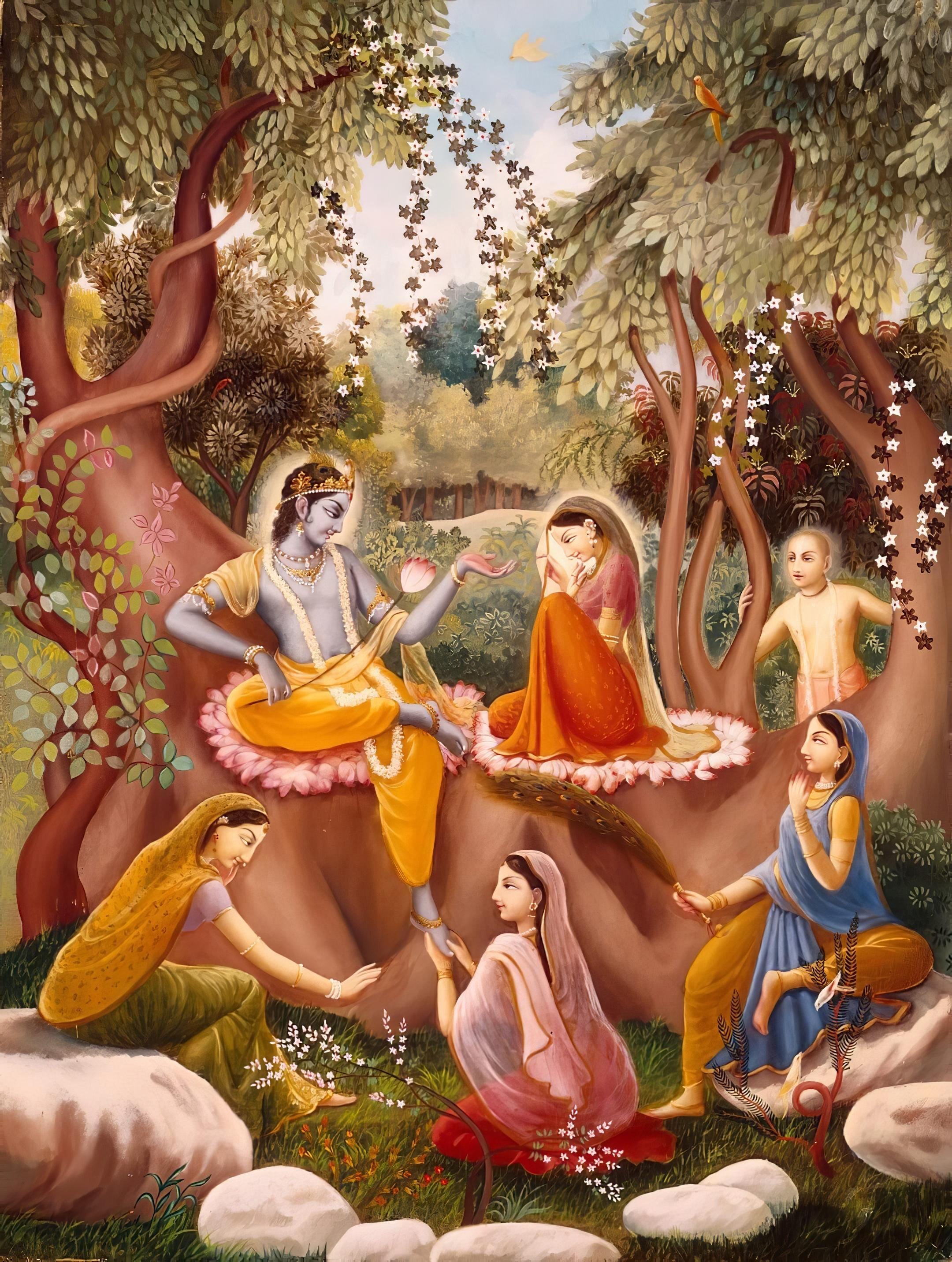
This is also where we can see a clear division between the process of smarana described by Jīva Gosvāmi and rāgānugā-bhakti. First, we become deeply absorbed in Kṛṣṇa’s pastimes. This can bring us up to the stage of śānta-rasa, love of Godhead without a direct attitude of service. From this stage, by hearing about Kṛṣṇa’s associates from the scriptures and the works of our previous ācāryas, a devotee may become attracted to a particular type of service to Kṛṣṇa performed by a particular associate and become more and more absorbed in his or her service and activities. This meditation can gradually progress into the stage of dāsya-rasa, sakhya-rasa, vātsalya-rasa, or mādhurya-rasa, according to a devotee's natural propensity.
Here, it is important to note that this absorption does not include creating an imaginary spiritual form (which is a sahajiya practice), nor imagining that one may merge into that associate, which is Māyāvādā. One meditates in serving a particular devotee in the same rasa, not in having a particular form, much less in merging or becoming someone. One’s eternal spiritual form is revealed later, as in the case of Gopa Kumara in the Brhad-bhagavatamṛta, who aspired to serve the lord in friendship since close to the beginning, but had his eternal spiritual form revealed when he joined the lila.
There is also a bona fide process of siddha-pranali that is discussed by Śrīla Bhaktivinoda Thākura in the Jaiva Dharma, but it is possible only when both the guru and the disciple are already on the spiritual platform. It is very different from the sahajiya version.
This point about following the footsteps of an eternal associate is confirmed by Prabhupāda in CC Madhya 22.149:
Translation
“The original inhabitants of Vṛndāvana are attached to Kṛṣṇa spontaneously in devotional service. Nothing can compare to such spontaneous devotional service, which is called rāgātmikā bhakti. When a devotee follows in the footsteps of the devotees of Vṛndāvana, his devotional service is called rāgānugā bhakti.
Purport
In his Bhakti-sandarbha, Jīva Gosvāmī states:
tad evaṁ tat-tad-abhimāna-lakṣaṇa-bhāva-viśeṣeṇa svābhāvika-rāgasya vaiśiṣṭye sati tat-tad-rāga-prayuktā śravaṇa-kīrtana-smaraṇa-pāda-sevana-vandanātma-nivedana-prāyā bhaktis teṣāṁ rāgātmikā bhaktir ity ucyate. . . . tatas tadīyaṁ rāgaṁ rucyānugacchantī sā rāgānugā.
When a pure devotee follows the footsteps of a devotee in Vṛndāvana, he develops rāgānugā bhakti.
There is more in the next verses (CC Madhya 22.150-158)
“ ‘When one becomes attached to the Supreme Personality of Godhead according to one’s natural inclination to love Him and is fully absorbed in thoughts of the Lord, that state is called transcendental attachment, and devotional service according to that attachment is called rāgātmikā, or spontaneous devotional service.’
“The primary characteristic of spontaneous love is deep attachment for the Supreme Personality of Godhead. Absorption in thought of Him is a marginal characteristic.
“Thus devotional service which consists of rāga [deep attachment] is called rāgātmikā, spontaneous loving service. If a devotee covets such a position, he is considered to be most fortunate.
“If one follows in the footsteps of the inhabitants of Vṛndāvana out of such transcendental covetousness, he does not care for the injunctions or reasonings of śāstra. That is the way of spontaneous love.
“ ‘Devotional service in spontaneous love is vividly expressed and manifested by the inhabitants of Vṛndāvana. Devotional service that accords with their devotional service is called rāgānugā bhakti, or devotional service following in the wake of spontaneous loving service.’
“ ‘When an advanced, realized devotee hears about the affairs of the devotees of Vṛndāvana — in the mellows of śānta, dāsya, sakhya, vātsalya and mādhurya — he becomes inclined in one of these ways, and his intelligence becomes attracted. Indeed, he begins to covet that particular type of devotion. When such covetousness is awakened, one’s intelligence no longer depends on the instructions of śāstra [revealed scripture] or on logic and argument.’
“There are two processes by which one may execute this rāgānugā bhakti — external and internal. When self-realized, the advanced devotee externally remains like a neophyte and executes all the śāstric injunctions, especially those concerning hearing and chanting. But within his mind, in his original, purified, self-realized position, he serves Kṛṣṇa in Vṛndāvana in his particular way. He serves Kṛṣṇa twenty-four hours a day, all day and night.
“ ‘The advanced devotee who is inclined to spontaneous loving service should follow the activities of a particular associate of Kṛṣṇa’s in Vṛndāvana. He should execute service externally as a regulative devotee as well as internally from his self-realized position. Thus he should perform devotional service both externally and internally.’
Śrīla Prabhupāda then gives us another important purport for text 153:
Śrīla Bhaktisiddhānta Sarasvatī Ṭhākura says that a devotee is attracted by the service of the inhabitants of Vṛndāvana — namely the cowherd men, Mahārāja Nanda, mother Yaśodā, Rādhārāṇī, the gopīs and the cows and calves. An advanced devotee is attracted by the service rendered by an eternal servitor of the Lord. This attraction is called spontaneous attraction. Technically it is called svarūpa-upalabdhi. This stage is not achieved in the beginning. In the beginning one has to render service strictly according to the regulative principles set forth by the revealed scriptures and the spiritual master. By continuously rendering service through the process of vaidhī bhakti, one’s natural inclination is gradually awakened. That is called spontaneous attraction, or rāgānugā bhakti.
An advanced devotee situated on the platform of spontaneity is already very expert in śāstric instruction, logic and argument. When he comes to the point of eternal love for Kṛṣṇa, no one can deviate him from that position, neither by argument nor by śāstric evidence. An advanced devotee has realized his eternal relationship with the Lord, and consequently he does not accept the logic and arguments of others. Such an advanced devotee has nothing to do with the sahajiyās, who manufacture their own way and commit sins by indulging in illicit sex, intoxication and gambling, if not meat-eating. Sometimes the sahajiyās imitate advanced devotees and live in their own whimsical way, avoiding the principles set down in the revealed scriptures. Unless one follows the six Gosvāmīs — Śrī Rūpa, Sanātana, Raghunātha Bhaṭṭa, Śrī Jīva, Gopāla Bhaṭṭa and Raghunātha dāsa — one cannot be a bona fide spontaneous lover of Kṛṣṇa. In this connection, Śrīla Narottama dāsa Ṭhākura says, rūpa-raghunātha-pade haibe ākuti kabe hāma bujhaba se yugala pirīti. The sahajiyās’ understanding of the love affairs between Rādhā and Kṛṣṇa is not bona fide because they do not follow the principles laid down by the six Gosvāmīs. Their illicit connection and their imitation of the dress of Rūpa Gosvāmī, as well as their avoidance of the prescribed methods of revealed scriptures, will lead them to the lowest regions of hell. These imitative sahajiyās are cheated and unfortunate. They are not equal to advanced devotees (paramahaṁsas). Debauchees and paramahaṁsas are not on the same level.
We find additional details in the Nectar of Instruction, verse 8:
Translation
The essence of all advice is that one should utilize one’s full time – twenty-four hours a day – in nicely chanting and remembering the Lord’s divine name, transcendental form, qualities and eternal pastimes, thereby gradually engaging one’s tongue and mind. In this way one should reside in Vraja [Goloka Vṛndāvana-dhāma] and serve Kṛṣṇa under the guidance of devotees. One should follow in the footsteps of the Lord’s beloved devotees, who are deeply attached to His devotional service.
Purport
Since the mind may be one’s enemy or one’s friend, one has to train the mind to become his friend. The Kṛṣṇa consciousness movement is especially meant for training the mind to be always engaged in Kṛṣṇa’s business. The mind contains hundreds and thousands of impressions, not only of this life but also of many, many lives of the past. These impressions sometimes come in contact with one another and produce contradictory pictures. In this way the mind’s function can become dangerous for a conditioned soul. Students of psychology are aware of the mind’s various psychological changes. In Bhagavad-gītā (8.6) it is said:
yaṁ yaṁ vāpi smaran bhāvaṁ
tyajaty ante kalevaram
taṁ taṁ evaiti kaunteya
sadā tad-bhāva-bhāvitaḥ“Whatever state of being one remembers when he quits his body, that state he will attain without fail.”
At the time of death, the mind and intelligence of a living entity create the subtle form of a certain type of body for the next life. If the mind suddenly thinks of something not very congenial, one has to take a corresponding birth in the next life. On the other hand, if one can think of Kṛṣṇa at the time of death, he can be transferred to the spiritual world, Goloka Vṛndāvana. This process of transmigration is very subtle; therefore Śrīla Rūpa Gosvāmī advises devotees to train their minds in order that they will be unable to remember anything other than Kṛṣṇa. Similarly, the tongue should be trained to speak only of Kṛṣṇa and to taste only kṛṣṇa-prasāda. Śrīla Rūpa Gosvāmī further advises, tiṣṭhan vraje: one should live in Vṛndāvana or any part of Vrajabhūmi. Vrajabhūmi, or the land of Vṛndāvana, is supposed to be eighty-four krośas in area. One krośa equals two square miles. When one makes Vṛndāvana his residence, he should take shelter of an advanced devotee there. In this way one should always think of Kṛṣṇa and His pastimes. This is further elucidated by Śrīla Rūpa Gosvāmī in his Bhakti-rasāmṛta-sindhu (1.2.294):
kṛṣṇaṁ smaran janaṁ cāsya
preṣṭhaṁ nija-samīhitam
tat-tat-kathā-rataś cāsau
kuryād vāsaṁ vraje sadā“A devotee should always reside in the transcendental realm of Vraja and always engage in kṛṣṇaṁ smaran janaṁ cāsya preṣṭham, the remembrance of Śrī Kṛṣṇa and His beloved associates. By following in the footsteps of such associates and by entering under their eternal guidance, one can acquire an intense desire to serve the Supreme Personality of Godhead.”
Again Śrīla Rūpa Gosvāmī states in Bhakti-rasāmṛta-sindhu (1.2.295):
sevā sādhaka-rūpeṇa
siddha-rūpeṇa cātra hi
tad-bhāva-lipsunā kāryā
vraja-lokānusārataḥ“In the transcendental realm of Vraja [Vraja-dhāma] one should serve the Supreme Lord, Śrī Kṛṣṇa, with a feeling similar to that of His associates, and one should place himself under the direct guidance of a particular associate of Kṛṣṇa and should follow in his footsteps. This method is applicable both in the stage of sādhana [spiritual practices executed while in the stage of bondage] and in the stage of sādhya [God realization], when one is a siddha-puruṣa, or a spiritually perfect soul.”
Śrīla Bhaktisiddhānta Sarasvatī Ṭhākura has commented as follows upon this verse: “One who has not yet developed interest in Kṛṣṇa consciousness should give up all material motives and train his mind by following the progressive regulative principles, namely chanting and remembering Kṛṣṇa and His name, form, quality, pastimes and so forth. In this way, after developing a taste for such things, one should try to live in Vṛndāvana and pass his time constantly remembering Kṛṣṇa’s name, fame, pastimes and qualities under the direction and protection of an expert devotee. This is the sum and substance of all instruction regarding the cultivation of devotional service.
“In the neophyte stage one should always engage in hearing kṛṣṇa-kathā. This is called śravaṇa-daśā, the stage of hearing. By constantly hearing the transcendental holy name of Kṛṣṇa and hearing of His transcendental form, qualities and pastimes, one can attain to the stage of acceptance called varaṇa-daśā. When one attains this stage, he becomes attached to the hearing of kṛṣṇa-kathā. When one is able to chant in ecstasy, he attains the stage of smaraṇāvasthā, the stage of remembering. Recollection, absorption, meditation, constant remembrance and trance are the five items of progressive kṛṣṇa-smaraṇa. At first, remembrance of Kṛṣṇa may be interrupted at intervals, but later remembrance proceeds uninterrupted. When remembrance is uninterrupted, it becomes concentrated and is called meditation. When meditation expands and becomes constant, it is called anusmṛti. By uninterrupted and unceasing anusmṛti one enters the stage of samādhi, or spiritual trance. After smaraṇa-daśā or samādhi has fully developed, the soul comes to understand his original constitutional position. At that time he can perfectly and clearly understand his eternal relationship with Kṛṣṇa. That is called sampatti-daśā, the perfection of life.
“Caitanya-caritāmṛta advises those who are neophytes to give up all kinds of motivated desires and simply engage in the regulative devotional service of the Lord according to the directions of scripture. In this way a neophyte can gradually develop attachment for Kṛṣṇa’s name, fame, form, qualities and so forth. When one has developed such attachment, he can spontaneously serve the lotus feet of Kṛṣṇa even without following the regulative principles. This stage is called rāga-bhakti, or devotional service in spontaneous love. At that stage the devotee can follow in the footsteps of one of the eternal associates of Kṛṣṇa in Vṛndāvana. This is called rāgānuga-bhakti. Rāgānuga-bhakti, or spontaneous devotional service, can be executed in the śānta-rasa when one aspires to be like Kṛṣṇa’s cows or the stick or flute in the hand of Kṛṣṇa, or the flowers around Kṛṣṇa’s neck. In the dāsya-rasa one follows in the footsteps of servants like Citraka, Patraka or Raktaka. In the friendly sakhya-rasa one can become a friend like Baladeva, Śrīdāmā or Sudāmā. In the vātsalya-rasa, characterized by parental affection, one can become like Nanda Mahārāja and Yaśodā, and in the mādhurya-rasa, characterized by conjugal love, one can become like Śrīmatī Rādhārāṇī or Her lady friends such as Lalitā and Her serving maids (mañjarīs) like Rūpa and Rati. This is the essence of all instruction in the matter of devotional service.”
As we can see, the whole process is a natural progression of the process of hearing and chanting and becomes accessible as we advance and become free from material contamination. Receiving instructions from a devotee who understands the process can help, but only if we have already developed the right foundation.
We can see that in his purport to CC Madhya 22.153, Prabhupāda explains that “An advanced devotee situated on the platform of spontaneity is already very expert in śāstric instruction, logic and argument. When he comes to the point of eternal love for Kṛṣṇa, no one can deviate him from that position, neither by argument nor by śāstric evidence.” This clarifies that this stage is developed at the uttama-adhikārī level, where a devotee combines firm material detachment with firm knowledge of the scriptures and absorption in devotional service. This is generally achieved through a lifetime of service, progressing through the neophite stage by hearing, chanting, and following the basic rules and regulations, then gradually surpassing the intermediate stage by practically applying this knowledge of Kṛṣṇa consciousness and accepting sacrifices to spread Kṛṣṇa consciousness to others.
The mistake of the sahajiyas is to try to impose this platform artificially on kaniṣṭha-adhikārīs who are still materially engrossed and propense to materialism and sense gratification. This leads to all the gross deviations that have plagued Vaiṣnava communities for centuries. This is also another alert about trying to reach this platform too early, before clearing all the necessary stages.
Guidance in this case can help to protect and direct the natural attraction of a devotee when it is already manifesting. It cannot artificially create a relationship before a devotee has cleared the necessary steps.
This also explains why Prabhupāda has not given as much attention to describing the process of raganuga-bhakti in his books as he gave to the process of hearing, chanting, and following regulated devotional service. He gave extensive instructions on this topic in the Śrī Caitanya-caritāmṛta and other books, and they become clear as devotees attain the necessary stages. The main difficulty for most of us is exactly to be patient enough to reach this stage. Many of us struggle even with very basic principles, such as not eating food cooked by non-devotees, fasting on Ekadasi, and so on. This shows we still have some homework to do.
Read more:


This is a publication for thoughtful readers who want to go deeper into Kṛṣṇa consciousness. I publish daily, trying to offer high-quality spiritual content, and all posts are available to free subscribers. If you wish, you can support this work with a monthly contribution. When you subscribe, you can choose between a free subscription and a monthly contribution, and you can switch from a free subscriber to a supporter at any time.
You can also receive updates on WhatsApp or Telegram.
If you would like to contribute further, you can find the donation links here.