

« Making Sense of the Vedic Universe, a Higher-Dimensional Reality
The concept of predominating deities
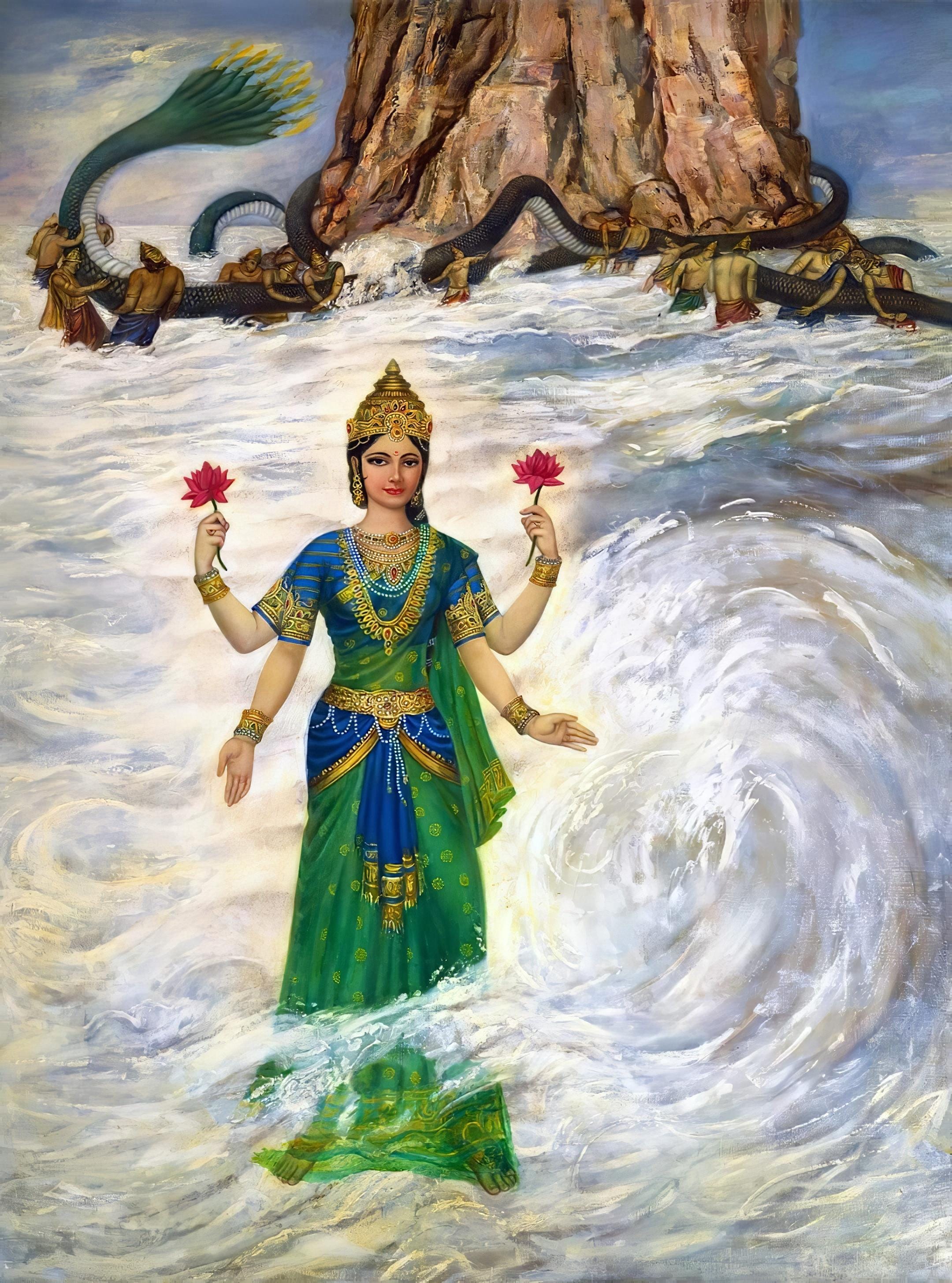
After the description of the creation of the material elements, we have a mysterious passage, where the controlling deities of the elements offer their prayers to the Supreme Lord, asking Him to enter the elements and make the cosmic manifestation possible through His energy.
“The controlling deities of all the above-mentioned physical elements are empowered expansions of Lord Viṣnu. They are embodied by eternal time under the external energy, and they are His parts and parcels. Because they were entrusted with different functions of universal duties and were unable to perform them, they offered fascinating prayers to the Lord as follows.” (SB 3.5.38)
How can material elements offer prayers? The Śrīmad-Bhāgavatam explains that everything in the Lord’s creation is personal. Just like the material energy itself is personified in the form of Pārvatī, the consort of Lord Śiva, all the material elements and different material energies of the Supreme Lord have their predominating deities. We thus have a distinction between the gross material elements and the spiritual potencies that control them, just as the difference between body and soul.
At this point, the material elements were already manifested, including the mahat-tattva, false ego, ether, air, fire, water, and earth, as well as the functions of sound, touch, form, taste, and smell, together with their respective deities, but because the material creation was not yet active, they were unable to perform their functions. They thus started offering prayers to the Lord.
It happens that the material elements and even their predominating deities have no power to create for themselves, just like factory workers have no ability to produce a new car alone. Unless there is a project, a factory, tools, parts, and a manager to guide them, nothing will be done. Similarly, the predominating deities of the material elements can only offer their work in manipulating the building blocks of the material manifestation. For the cosmos to manifest, a project is necessary, as well as competent managers who can oversee the construction. Both have to be provided by the Lord.
In his purport to text 3.5.51, Śrila Prabhupāda draws a parallel with our own situation, explaining that we need empowerment to be able to serve the Lord (or, in fact, to perform any kind of activities), and this empowerment is obtained by sincerely trying to serve the Lord under the guidance of a qualified spiritual master. In other words, everything is possible, and everything starts from our desire. From desire comes the reciprocation of the Lord, and when the Lord reciprocates, everything becomes possible.
The next chapter, 3.6, describes how the Lord reacted to these prayers by entering the material elements and manifesting the universal form, leading to the subsequent stages of material creation:
“The Lord thus heard about the suspension of the progressive creative functions of the universe due to the noncombination of His potencies, such as the mahat-tattva.
The Supreme Powerful Lord then simultaneously entered into the twenty-three elements with the goddess Kālī, His external energy, who alone amalgamates all the different elements. Thus when the Personality of Godhead entered into the elements by His energy, all the living entities were enlivened into different activities, just as one is engaged in his work after awakening from sleep.
When the twenty-three principal elements were set in action by the will of the Supreme, the gigantic universal form, or the viśvarūpa body of the Lord, came into existence. As the Lord, in His plenary portion, entered into the elements of the universal creation, they transformed into the gigantic form in which all the planetary systems and all movable and immovable creations rest.” (SB 3.6.1-5)
The description of the Bhāgavatam mentions the existence of 23 elements. We studied the creation of five, plus the mind and false ego. What are these 23? This is just a different way to count it. The list of the 23 elements includes the mahat-tattva, false ego, mind, the properties of the five elements, and the different senses. All of these were created in the previous process. They are 1) the total material energy, 2) false ego, 3) sound, 4) touch, 5) form, 6) taste, 7) smell, 8) earth, 9) water, 10) fire, 11) air, 12) sky, 13) eye, 14) ear, 15) nose, 16) tongue, 17) skin, 18) hand, 19) leg, 20) evacuating organ, 21) genitals, 22) speech, and 23) mind.
Later in the third canto, Lord Kapila describes 25 elements, counted as:
a) The five material elements (earth, water, fire, air, and ether).
b) The qualities of these elements (odor, taste, form, touch, and sound).
c) The five senses for acquiring knowledge (sight, hearing, smell, taste, and touch).
d) The five senses of action (the tongue, hands, legs, genital, and excretory system).
e) The four internal senses (mind, intelligence, material ego, and material consciousness).
f) Time, which is counted as the 25th element.
Kṛṣṇa Himself, in the 11th canto, explains that there are different valid ways to count the material elements. The main point is that the simple existence of the elements doesn’t make the cosmic creation viable, just like a mere pile of bricks is not sufficient for a house to be built. The Lord enters into the elements as Paramātma, bringing with Him His energy, and that’s what makes the creation possible.
Read the whole book:
« Making Sense of the Vedic Universe, a Higher-Dimensional Reality
This is a publication for thoughtful readers who want to go deeper into Kṛṣṇa consciousness. I publish daily, trying to offer high-quality spiritual content, and all posts are available to free subscribers. If you wish, you can also choose a paid subscription to support this work.
You can also receive the updates on WhatsApp or Telegram.
If you would like to contribute further, you can find the donation links here.