

« The Song of God—Volume 1, chapters 1-6
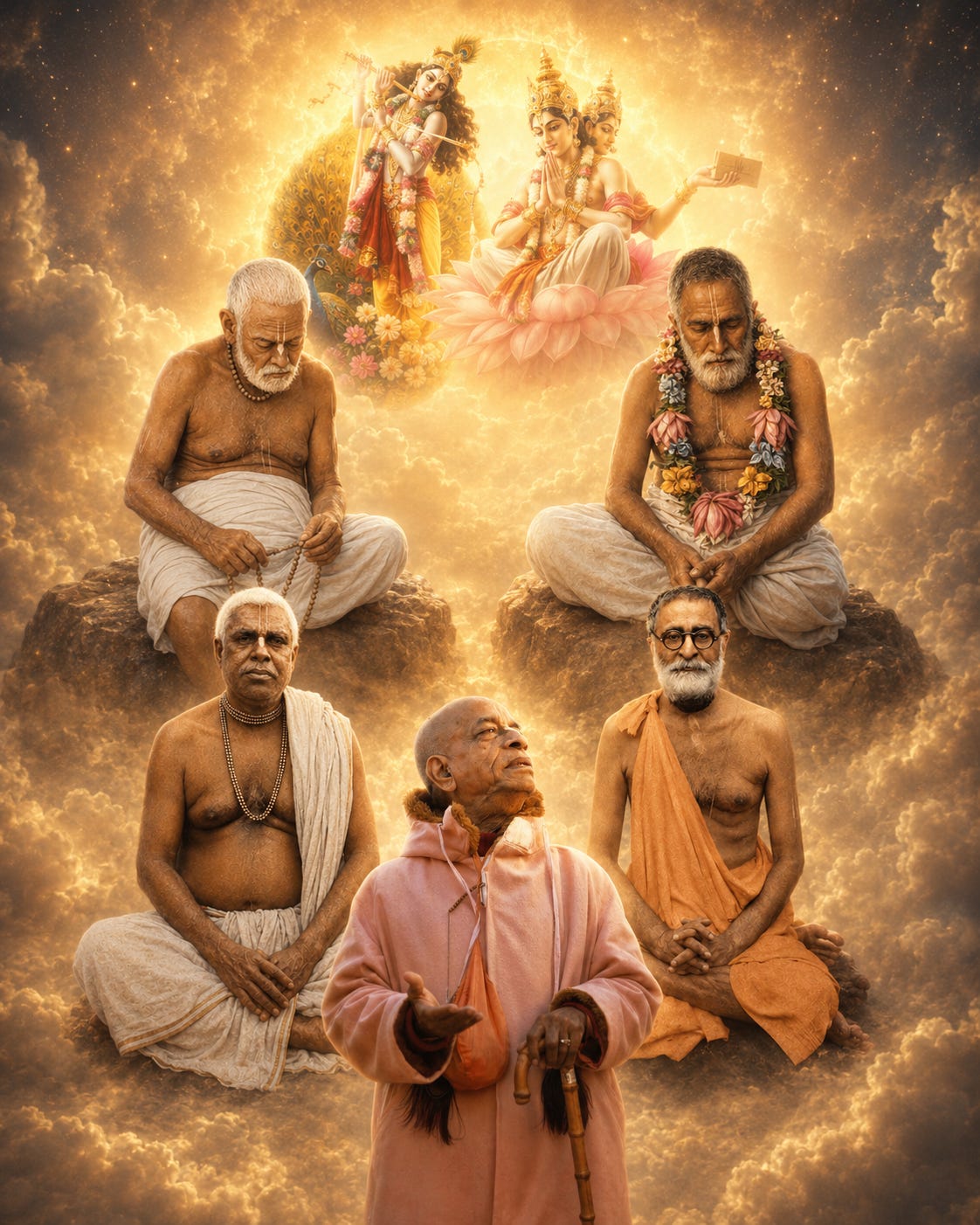
The disciplic succession: the key to understanding the scriptures
All conditioned souls share the same four defects. We are prone to committing mistakes, becoming illusioned, and cheating others, and the very senses we use to obtain knowledge are imperfect. Due to these intrinsic defects, perfect knowledge can’t be produced inside this material world. We may create theories, and occasionally we may get certain things right, but our knowledge will never be complete or perfect. Perfect knowledge has to be imported; it has to come from outside this dark universe.
In the fourth chapter of the Gītā, Kṛṣṇa reveals how in the past He had explained this transcendental science to Vivasvān, the demigod who presides over the sun, and that He was again transmitting the same transcendental knowledge to Arjuna. When Arjuna questions how He could have spoken to Vivasvān millions of years ago, Kṛṣṇa reveals that He comes regularly to reveal the transcendental science whenever this transcendental knowledge becomes lost. As He mentions, “Whenever and wherever there is a decline in religious practice, O descendant of Bharata, and a predominant rise of irreligion – at that time I descend Myself.” (Bg. 4.7)
Just as Kṛṣṇa comes personally, He also regularly sends His pure devotees to reveal the same spiritual knowledge. Pure devotees share the same pure and transcendental nature as Kṛṣṇa, and therefore, they can reveal the same perfect knowledge. In this way, sometimes Kṛṣṇa comes personally, and sometimes He sends His perfect representatives from the transcendental realm to deliver us perfect knowledge.
Once revealed inside the universe, the knowledge is carefully transmitted through a disciplic succession that maintains the conclusions of the text. One who is now a disciple has the duty of properly learning this knowledge and later transmitting it to his or her students without adulteration. The form may change, as the knowledge is explained according to the mentality of different audiences, but the essence must be maintained. Because the original knowledge is already perfect, there is no room for improvement. Any change just degrades the message, just like one will never make any improvement in a supercar by hitting it with a hammer.
As long as one remains faithful to the conclusions of the previous links of the chain, the knowledge is preserved. But as soon as there is change, the knowledge is lost, and the branch withers. Kṛṣṇa always makes sure that at least some of the branches of the tree remain, generation after generation. If at a certain point all branches are lost, He comes again or sends His representative to make a new revelation. In this way, this knowledge remains available generation after generation to sincere seekers.
As Śrīla Prabhupāda explains in his introduction, “Vedic knowledge is not a question of research. Our research work is imperfect because we are researching things with imperfect senses. We have to accept perfect knowledge which comes down, as is stated in Bhagavad-gītā, by the paramparā (disciplic succession). We have to receive knowledge from the proper source in disciplic succession beginning with the supreme spiritual master, the Lord Himself, and handed down to a succession of spiritual masters. Arjuna, the student who took lessons from Lord Śrī Kṛṣṇa, accepts everything that He says without contradicting Him. One is not allowed to accept one portion of Bhagavad-gītā and not another. No. We must accept Bhagavad-gītā without interpretation, without deletion and without our own whimsical participation in the matter. The Gītā should be taken as the most perfect presentation of Vedic knowledge. Vedic knowledge is received from transcendental sources, and the first words were spoken by the Lord Himself.”
The Vedic knowledge was originally transmitted from Kṛṣṇa to Brahmā, the creator of our universe. At the beginning of the current cycle of creation, Brahmā meditated for a thousand years of the demigods, and as a result, he had the opportunity to personally meet the Lord, who revealed the Vedic knowledge to him and granted him a vision of His eternal abode. Brahmā, in turn, transmitted this knowledge to his son, Nārada Muni, who in turn transmitted it to Vyāsadeva, the compiler of the Vedas. Vyāsadeva also became one of the links in the disciplic succession of the Bhagavad-gītā and the compiler of the book. The text that we have access to now consists of the words of Vyāsadeva, who narrates the conversation between Sañjaya and Dhṛtarāṣṭra.
Vyāsadeva in turn transmitted this knowledge to Madhvācārya, who transmitted it to Padmanābha, starting a succession that continues up to this day. At the end of his introduction, Śrīla Prabhupāda gives the complete paramparā, starting from Kṛṣṇa all the way to himself. Śrīla Prabhupāda, in turn, continued the disciplic succession by teaching his disciples, and they, in turn, are teaching their own disciples and grand-disciples. Śrīla Prabhupāda thus became a large branch of the tree, connecting us to it in the form of branches and leaves.
This transcendental knowledge was originally secret, transmitted by a spiritual master to his trusted disciples, but Śrīla Prabhupāda, and before him his spiritual master, Śrīla Bhaktisiddhānta Sarasvatī Thākura, and his father, Śrīla Bhaktivinoda Thākura, opened it up to a wider audience by writing and publishing numerous books.
Śrīla Prabhupāda called his commentary on the Gītā “The Bhagavad-gītā As It Is” because this is a commentary that reveals the original meanings of the text, as received from the disciplic succession, different from other commentaries where the authors give their personal conclusions. In this way, he gave the worldwide audience the possibility of learning the proper conclusions of the Bhagavad-gītā, as explained by Kṛṣṇa Himself to Arjuna.
Anyone who studies the Bhagavad-gītā by accepting the conclusions Prabhupāda gives in his commentary becomes unofficially connected to the paramparā, although for better results one should study it under the guidance of one of his disciples, grand-disciples, or grand-grand-disciples, who can help him to perfectly understand this perfect transcendental knowledge.
Next: CHAPTER ONE: Observing the armies on the battlefield of Kurukṣetra (Arjuna-viṣāda yoga)
Read the entire book:
« The Song of God—Volume 1, chapters 1-6

This is a publication for thoughtful readers who want to go deeper into Kṛṣṇa consciousness. I publish daily, trying to offer high-quality spiritual content, and all posts are available to free subscribers. If you wish, you can also choose a paid subscription to support this work.
You can also receive the updates on WhatsApp or Telegram.
If you would like to contribute further, you can find the donation links here.