

« Making Sense of the Vedic Universe, a Higher-Dimensional Reality
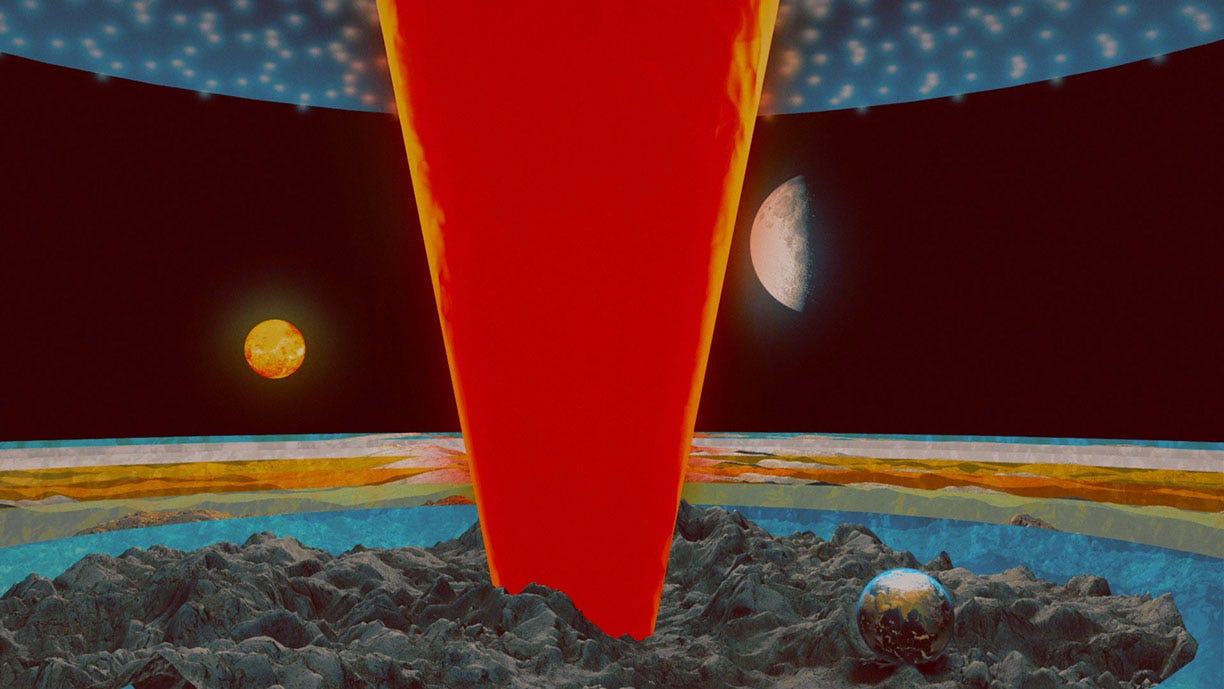
The earth and the extended earth
The Śrīmad-Bhāgavatam describes the intermediate planetary system as a series of concentric islands called Bhū-mandala, which has a diameter of 500 million yojanas. At the center, there is the island of Jambūdvīpa, which is 100,000 yojanas (800,000 miles) in diameter. In the southern part of Jambūdvīpa, there is Bhārata-varṣa, which is the tract of land where human beings live. This is the tract of land the Pāṇḍavas and other great kings mentioned in the Śrīmad-Bhāgavatam ruled.
Our planet, the way we experience it in Kali-yuga, is also called Bhārata-varṣa, but it may not be exactly the same Bhārata-varṣa where the Pāṇḍavas lived. The place where human beings of previous ages were living appears to be a higher-dimensional space, to which we currently don’t have direct access. Our planet appears to be some kind of projection of Bhārata-varṣa in the gross dimension we currently live in.
This can explain why the geographical features described in the Mahābhārata are different from those of our world. It’s mentioned in the Mahābhārata that the Bhārata-varṣa where the Pāṇḍavas lived is 72,000 miles (9,000 yojanas) from north to south, 640,000 miles (80,000 yojanas) from west to east, and is surrounded on the north by a version of the Himalayas with mountains 80,000 miles high, which is many times larger than our planet.
More details about this higher-dimensional Bhārata-varṣa are given in the Skanda Purāṇa (7.1.11.6-14) in a conversation between Lord Śiva and Pārvatī Devi:
“What is remembered as Jambūdvīpa is exactly at the center of the earth. It is divided into nine regions, O beautiful woman, known as the different varṣas. The first is called Bhārata-varṣa and is also divided into nine parts. From south to north it measures 9,000 yojanas (72,000 miles). The distance from east to west is 80,000 yojanas (640,000 miles). It has the Himalayas to the north and the salty ocean to the south, west, and east. O goddess, Bhārata, the excellent kṣetra, is in between. It is affected by four yugas: Satya, Treta, Dvāpara, and Kali. The division of yugas exists only here, as well as the classification of the people into four varnas. This Bhārata-varṣa is the seed of everything, O lady of a beautiful face. It is Karma-bhūmi [the place where karma is created]. The consequences of incurring merit and sins are not obtained elsewhere.”
As we can see, Bhārata-varṣa is described as many times larger than our planet. These dimensions explain the gigantic armies and populations described in the Mahābhārata. Jarāsandha, for example, attacked Mathurā 17 times, each with an army composed of 23 akṣauhiṇīs. That’s more than 80 million soldiers in total, all of them professional kṣatriyas (not just conscripted soldiers, as in modern wars). This means that the total population, just in the kingdom of Jarāsandha, must have been in the tens of billions.
One could argue that these descriptions are exaggerated. However, if we adopt this approach, the reliability of the text as a historical and cosmological source becomes difficult to sustain.
Epics such as the Mahabhārata describe advanced civilizations where people would travel regularly from one side of Bhārata-varsa to another. It is difficult to suppose that such a culture would remain ignorant of the basic dimensions of its own world. The measurement of the earth’s circumference does not require advanced technology; Eratosthenes famously calculated it in the 3rd century BCE using simple observational methods. The Sūrya-siddhānta likewise presents precise astronomical and geographical calculations, confirming that they were well-known.
The most consistent reading, therefore, is that these descriptions indeed describe the world they experienced. The question is just how to explain it in the context of our present reality.
It appears that human beings of the previous ages, up to Dvāpara-yuga, lived in the higher-dimensional space of Bhū-mandala and had access to the other tracts of land that compose Jambūdvīpa, as described in many passages. In Kali-yuga, however, we live in a gross dimension and don’t have access to these higher realms. According to Śrīdhara Swami, the original commentator of the Śrīmad-Bhāgavatam, even time for us is different from the rest of Bhū-mandala. What is one year in Bhū-mandala is two years for us.
Somehow, our planet is the only part of Bhū-mandala that is visible in our gross dimension. Just like the moon we see in the sky appears to be a projection of the celestial moon in our gross dimension, our planet appears to be a projection of Bhārata-varṣa in our gross dimension. Certain places, like Badarīkāśrama, Kurukṣetra, Naimiṣāraṇya, and so on, exist simultaneously in both the higher-dimensional Bhārata-varṣa and our planet, but only people with the necessary qualifications can gain access to the higher-dimensional space.
The same applies to all holy places. Vṛndāvana, for example, exists both in the spiritual sky and here on our planet. Pure devotees have access to the spiritual Vṛndāvana, while others see Vṛndāvana as just a city that is part of our planet and have no access to the spiritual reality that exists there. The same applies to Mayapur, Jagannatha Pūri, and so on.
At first, this idea of planets and places appearing in different forms in different dimensional levels may sound ludicrous, but it is quite natural. We do this all the time when we take a photo or draw a map, for example. A photo is nothing more than a two-dimensional representation of a three-dimensional object. Superficially, it looks the same, but it is very different in nature. Similarly, our three-dimensional reality can be represented on a two-dimensional piece of paper in the form of a map. In a map, a building can be represented in the form of a square, and a bridge in the form of a line that goes over another line that represents a road. The building is not a square, nor a cube, but when we represent it in a two-dimensional map, it is represented like that. Similarly, a bridge is a three-dimensional structure: there is something under the bridge and there is something over it, but when we put it into a map, it looks just like a flat line. Similarly, when the gigantic structure of Bhu-mandala described in the Vedas is represented in our plane, it appears as our earthly globe, while the celestial moon, which is described as larger than the sun and the abode of an extraordinarily opulent civilization, is represented as the rocky moon we have access to. Because most beings in the universe live in higher dimensions to which we do not have access, the universe appears to be uninhabited to us.
Our universe is divided into 14 planetary systems. Each planetary system is composed of innumerable planets. We live somewhere in Bhū-mandala, the 7th planetary system from top to bottom. However, because we live in Kali-yuga, the last of the sequence of four ages, we have access to only part of it, in the form of the gross dimension we live in. The Vedas explain that in the past, human beings had access to other parts of Bhū-mandala, and some could even visit the higher planetary systems of Bhuvarloka, Svargaloka, Maharloka, and even Brahmāloka, which is currently impossible for us.
Because our planet is the only visible part of Bhū-mandala in our gross dimension, the word “mahīm” is used in the Śrīmad-Bhāgavatam both in the sense of the whole Bhū-mandala (the extended earth) and in the sense of “the earth” or the “earth globe”, meaning our planet. There are thus two concepts of “earth”: one in the sense of our planet, as it exists in our gross dimension, and “earth” as the extended earth, or Bhū-mandala, as it exists in a higher-dimensional space. Both exist simultaneously, and human beings have access to one or the other according to their level of spiritual realization.
Vyāsadeva and the other sages living in Badarīkāśrama, for example, live in the higher-dimensional space. Although Badarīkāśrama is a place that can be accessed from our planet, through the Himalayas, it is part of the higher-dimensional space of Bhū-mandala and thus is inaccessible to ordinary people. Only a few very advanced souls may be able to access it in the current age, as was the case with Madhvācārya, who was able to reach Badarīkāśrama through the Himalayas and receive personal instructions from Vyāsadeva. That is why Madhvācārya appears in the Paramparā as a disciple of Vyāsadeva, even though he lived only about 800 years ago.
Read the whole book:
« Making Sense of the Vedic Universe, a Higher-Dimensional Reality
This is a publication for thoughtful readers who want to go deeper into Kṛṣṇa consciousness. I publish daily, trying to offer high-quality spiritual content, and all posts are available to free subscribers. If you wish, you can also choose a paid subscription to support this work.
You can also receive the updates on WhatsApp or Telegram.
If you would like to contribute further, you can find the donation links here.