

« The Song of God—Volume 1, chapters 1-6
Introduction:
The conclusions of the Bhagavad-gītā
Śrīla Prabhupāda composed a masterful introduction to the Bhagavad-gītā As It Is, which he recorded on a donated dictaphone as two lectures on February 19 and 20, 1966, in the first place he rented in New York, room 307 at 100 West 72nd Street.
The depth of the text, combined with the fact that it was recorded in just two takes in the form of a lecture, spoken entirely from memory, highlights Prabhupāda’s extraordinary scholarship and profound spiritual insight. In this introduction, he delivers a powerful set of conclusions from the Vedic literature, conclusions that are clear in the original texts to those who know what to look for, but that have baffled scholars for centuries. The text of his introduction may look simple when we first read it, but the deeper we dive, the more details we can find. Here, we delve into the main points he presents.
It may sound strange to start a book with the conclusions, but this is actually the process for studying spiritual literature. To truly grasp its meaning, we need to be armed with the right conclusions, which serve as keys for understanding the text. This is precisely what Śrīla Prabhupāda provides in his introduction.
The essential qualification to understand the Gītā
In the case of the Bhagavad-gītā, especially, starting with the conclusions, is extremely useful. Different from an ordinary novel, the verses of the Gītā bring us a very intricate philosophy and can’t be understood without the right qualifications.
Sanskrit verses can be translated, and difficult philosophical passages can be explained, but there is one crucial qualification for understanding the Bhagavad-gītā that can’t be taught. This crucial qualification is the result of a personal choice, and that’s a decision no one else can make for us.
This essential qualification is revealed by Kṛṣṇa in the ninth chapter, where He says to Arjuna:
idam tu te guhya-tamam, pravakṣyāmy anasūyave
jñānam vijñāna-sahitam, yaj jñātvā mokṣyase ’śubhāt
“My dear Arjuna, because you are never envious of Me, I shall impart to you this most confidential knowledge and realization, knowing which you shall be relieved of the miseries of material existence.”
The mystery of the Bhagavad-gītā cannot be understood by someone envious of Kṛṣṇa. Often in this world, we envy and belittle powerful people, and frequently not without reason, since powerful people such as politicians often misuse their influence and cause harm to others. The Bhagavad-gītā, however, explains that Kṛṣṇa is not a despotic ruler. He is the source of everything that exists and the most intimate friend. He is all-powerful and prepared to help us in every aspect, but at the same time, He respects our free will and remains hidden from our vision until we desire to find Him.
As Prabhupāda explains in his introduction, every living being has an eternal, personal relationship with the Lord, called svarūpa. In the language of the Bhagavad-gītā, “eternal” means something that is always existing, without a beginning and an end. Certainly, nothing in this material world can be called eternal in this sense, since everything here has a beginning and an end. Eternal things can exist only on the spiritual platform, where there is no past and future, but just a blissful, eternal present.
This svarūpa is thus our true self, outside the temporality of this material world. Somehow it was forgotten, and the process of bhakti, devotional service, or Kṛṣṇa consciousness is the process that can revive this transcendental svarūpa. This ultimate stage of perfection is called svarūpa-siddhi, the perfection of our constitutional position.
There are five main relationships with Kṛṣṇa, which ramify into unlimited varieties. One can relate to Kṛṣṇa in a passive state, aware of His greatness but without a propensity to directly interact with Him; one can serve Him from a subordinate position; one can relate to Him as a friend, from an equal position; one can relate to Him as a parent; or one can relate to Him as a conjugal lover, as in the case of the gopīs, the ultimate example of pure love.
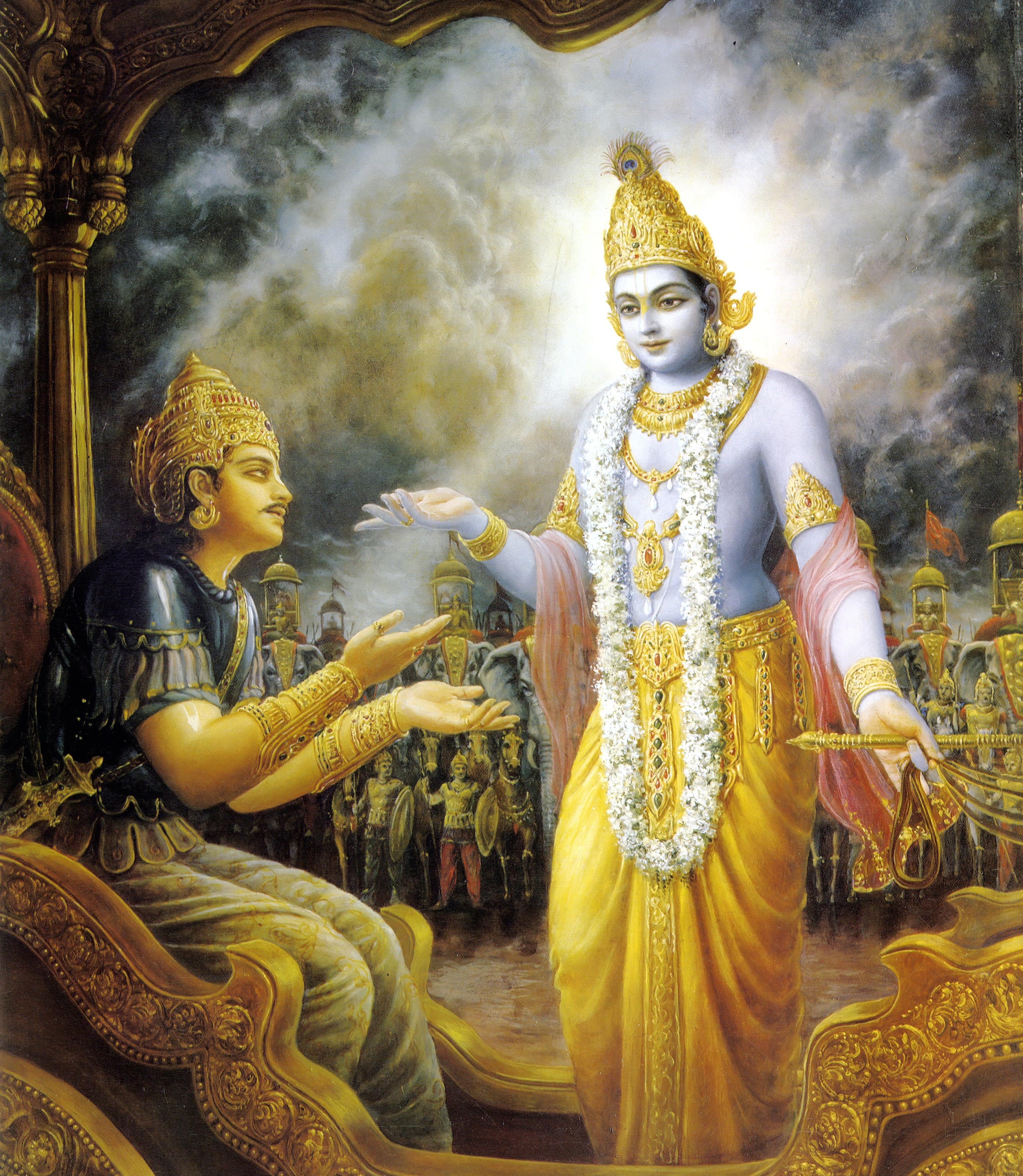
Arjuna, for example, is the eternal friend of Kṛṣṇa. At the beginning of the Bhagavad-gītā, he became confused due to the difficult situation he was in, but by approaching Kṛṣṇa and receiving instructions from Him, he was able to surpass this lamentation and become situated in perfect knowledge. We are in the same position Arjuna was put in at the beginning of the Bhagavad-gītā: immersed in lamentation and confused about what to do and what not to do, and just like Kṛṣṇa dissipated the illusion of Arjuna by explaining to him the Bhagavad-gītā, He is ready to do the same for us. The same knowledge revealed to Arjuna five thousand years ago is available to all of us, and Kṛṣṇa is personally present in our hearts, ready to guide us, just as He guided Arjuna in the treacherous and unforgiving battlefield of Kurukṣetra.
This transcendental knowledge offered in the Bhagavad-gītā is compared to a sword that can cut the knots of ignorance and illusion that bind us to this temporary world and elevate us to the transcendental platform, bringing us freedom.
Kṛṣṇa offers equal chances for everyone to live happily and gradually reconnect with their original spiritual nature, achieving ultimate happiness. Not only does He try to guide us through books such as the Bhagavad-gītā, but He is also present in the heart of everyone as the Supersoul. He is thus the closest and most intimate friend, and He is always with us, although we may not notice His presence due to our fixation on the external world.
The root of the word “yoga” is the Sanskrit “yuj,” which means to join or to unite. Yoga means the union between us, the individual self, and Kṛṣṇa, the Supreme Self. According to Śrīla Madhvācārya, there are three types of union: 1) to become one in opinion or mentality, 2) to achieve similarity, and 3) to be in the same locality. When we say, “As human beings, we are one,” it doesn’t mean we are literally the same person, but that we are similar, or that we have a common identity. Similarly, achieving yoga, or unity with the Supreme, does not mean merging into Him and losing our individuality but to become one in nature.
What is the nature of Kṛṣṇa? He is described as sat-cit-ānanda, full of eternity, knowledge, and bliss. In our current situation, we are more or less the opposite. Instead of sat, cit, and ānanda, we are asat (mortal), acit (lacking in terms of knowledge), and nirānanda (susceptible to misery and lamentation). The Bhagavad-gītā, however, reveals that this is not our real nature. Originally, we are eternal souls who are full of knowledge and spiritual bliss, just like Kṛṣṇa. However, due to our identification with the material body, we identify with the qualities of the body, and this leads us to an abnormal condition where we have to face loss, death, bewilderment, lamentation, and misery. In the Bhagavad-gītā, Kṛṣṇa guides us back to our original condition as blissful souls. To accept this guidance, however, we need to trust His instructions, and this is not possible if we are envious of Him.
As Śrīla Prabhupāda explains in his introduction, “Therefore Bhagavad-gītā should be taken up in a spirit of devotion. One should not think that he is equal to Kṛṣṇa, nor should he think that Kṛṣṇa is an ordinary personality or even a very great personality. Lord Śrī Kṛṣṇa is the Supreme Personality of Godhead. So according to the statements of Bhagavad-gītā or the statements of Arjuna, the person who is trying to understand the Bhagavad-gītā, we should at least theoretically accept Śrī Kṛṣṇa as the Supreme Personality of Godhead, and with that submissive spirit, we can understand the Bhagavad-gītā. Unless one reads the Bhagavad-gītā in a submissive spirit, it is very difficult to understand the Bhagavad-gītā, because it is a great mystery.”
Here, I try to systematize the main conclusions of the text, organized in a series of points and individually explained with the addition of information given later in the book. My idea in this introduction is to help you go deeper into the text and better understand the depth of Prabhupāda’s presentation. If after studying these points you try to read the introduction of Śrīla Prabhupāda again, you will probably notice many points you missed the first time.
Next: Understanding the Absolute Truth
Read the entire book:
« The Song of God—Volume 1, chapters 1-6

This is a publication for thoughtful readers who want to go deeper into Kṛṣṇa consciousness. I publish daily, trying to offer high-quality spiritual content, and all posts are available to free subscribers. If you wish, you can also choose a paid subscription to support this work.
You can also receive the updates on WhatsApp or Telegram.
If you would like to contribute further, you can find the donation links here.
Hare Krishna. Pamho. Thank you for this Interesting explanation. My question is - is it correct that Bhakti Yogis aspire to become one in opinion with the Supreme Self?
When I become one in opinion with Krishna my svaroop will be revealed to me?
I would want to replace my desires with Krishna's desires but I feel I have some desires about which I am not sure if they are pleasing to Krishna or not. Should I simply ignore such desires?
Master your emotions.... become stateless