

« The Song of God—Volume 1, chapters 1-6
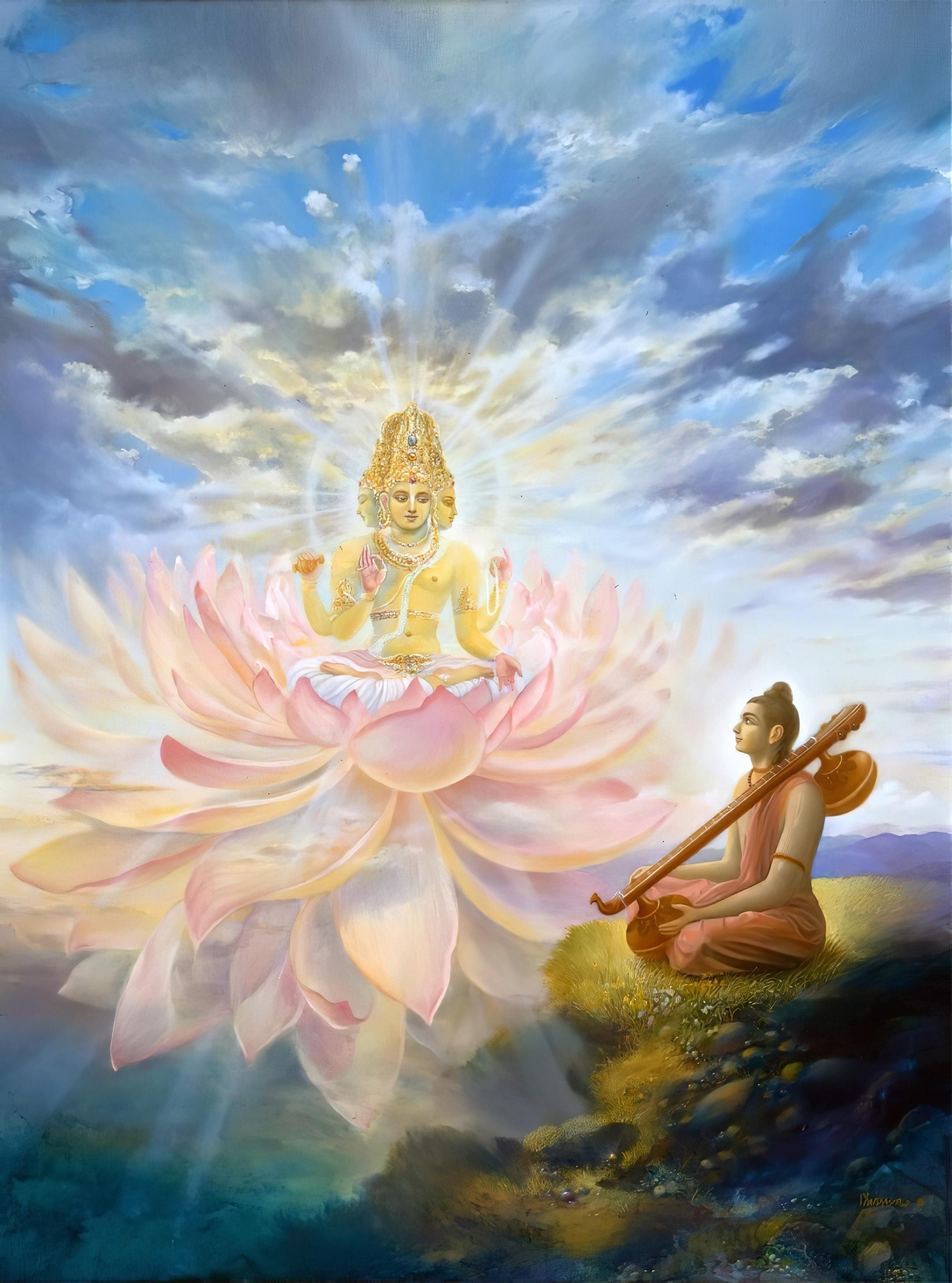
The fate of the unsuccessful yogī (Bg 6.37 to 6.45)
In the previous section, Arjuna raised his objection: the process of mystic yoga is not suitable for modern people, who are full of anxieties and are not serious about self-realization. Arjuna himself admitted his incapacity to perfectly follow this system. The central problem is to control the agitated mind.
Kṛṣṇa agrees that the mind is indeed difficult to control, but insists that it can be subdued through suitable practice and detachment. The higher meaning is that one can control the mind through the process of Kṛṣṇa consciousness, which Kṛṣṇa will explain in detail starting from chapter seven.
Arjuna then asks a very intelligent question: what happens to a person who commits to the spiritual process, but falls later? Does he still benefit somehow, or does one just end up losing both the chance of self-realization and material happiness?
Text 37: arjuna uvāca
ayatiḥ śraddhayopeto, yogāc calita-mānasaḥ
aprāpya yoga-saṁsiddhiṁ, kāṁ gatiṁ kṛṣṇa gacchati
Arjuna said: O Kṛṣṇa, what is the destination of the unsuccessful transcendentalist, who in the beginning takes to the process of self-realization with faith but who later desists due to worldly-mindedness and thus does not attain perfection in mysticism?
Text 38: kaccin nobhaya-vibhraṣṭaś, chinnābhram iva naśyati
apratiṣṭho mahā-bāho, vimūḍho brahmaṇaḥ pathi
O mighty-armed Kṛṣṇa, does not such a man, who is bewildered from the path of transcendence, fall away from both spiritual and material success and perish like a riven cloud, with no position in any sphere?
Text 39: etan me saṁśayaṁ kṛṣṇa, chettum arhasy aśeṣataḥ
tvad-anyaḥ saṁśayasyāsya, chettā na hy upapadyate
This is my doubt, O Kṛṣṇa, and I ask You to dispel it completely. But for You, no one is to be found who can destroy this doubt.
Text 40: śrī-bhagavān uvāca
pārtha naiveha nāmutra, vināśas tasya vidyate
na hi kalyāṇa-kṛt kaścid, durgatiṁ tāta gacchati
The Supreme Personality of Godhead said: Son of Pṛthā, a transcendentalist engaged in auspicious activities does not meet with destruction either in this world or in the spiritual world; one who does good, My friend, is never overcome by evil.
Text 41: prāpya puṇya-kṛtāṁ lokān, uṣitvā śāśvatīḥ samāḥ
śucīnāṁ śrīmatāṁ gehe, yoga-bhraṣṭo ’bhijāyate
The unsuccessful yogī, after many, many years of enjoyment on the planets of the pious living entities, is born into a family of righteous people, or into a family of rich aristocracy.
Text 42: atha vā yoginām eva, kule bhavati dhīmatām
etad dhi durlabha-taraṁ, loke janma yad īdṛśam
Or [if unsuccessful after long practice of yoga] he takes his birth in a family of transcendentalists who are surely great in wisdom. Certainly, such a birth is rare in this world.
Text 43: tatra taṁ buddhi-saṁyogaṁ, labhate paurva-dehikam
yatate ca tato bhūyaḥ, saṁsiddhau kuru-nandana
On taking such a birth, he revives the divine consciousness of his previous life, and he again tries to make further progress in order to achieve complete success, O son of Kuru.
Text 44: pūrvābhyāsena tenaiva, hriyate hy avaśo ’pi saḥ
jijñāsur api yogasya, śabda-brahmātivartate
By virtue of the divine consciousness of his previous life, he automatically becomes attracted to the yogic principles – even without seeking them. Such an inquisitive transcendentalist stands always above the ritualistic principles of the scriptures.
Text 45: prayatnād yatamānas tu, yogī saṁśuddha-kilbiṣaḥ
aneka-janma-saṁsiddhas, tato yāti parāṁ gatim
And when the yogī engages himself with sincere endeavor in making further progress, being washed of all contaminations, then ultimately, achieving perfection after many, many births of practice, he attains the supreme goal.
Previously, in text 4.40, Kṛṣṇa already spoke about the destination of the unfaithful: “But ignorant and faithless persons who doubt the revealed scriptures do not attain God consciousness; they fall down. For the doubting soul there is happiness neither in this world nor in the next.” A person who has no faith in Kṛṣṇa’s words cannot advance in the spiritual path. Even if one goes up to a certain point, without faith it is not possible to reach the goal. One thus eventually falls back into materialistic life, and on this path, there is no happiness, either in this life, or in the next.
Kṛṣṇa also condemned the position of the hypocrite, who externally pretends to be spiritual, but internally remains attached to enjoyment in text 3.6: One who restrains the senses of action but whose mind dwells on sense objects certainly deludes himself and is called a pretender.
Here, however, Arjuna asks about a different category: the faithful person, who sincerely tries to follow the spiritual path, but is not capable of controlling the unstable mind, and thus fails to reach perfection in this life. What is his position? Kṛṣṇa had already answered this question in text 2.40, where He mentioned that, “in this endeavor there is no loss or diminution, and a little advancement on this path can protect one from the most dangerous type of fear.” Arjuna, however, wants Kṛṣṇa to confirm it and address a specific point:
In traditional Vedic culture, people would perform fruitive activities with the goal of improving their material position, just as in modern life people study and work. A transcendentalist, however, abandons this pursuit to dedicate himself to the spiritual path. It seems thus that if one is unsuccessful, one loses in both ways, achieving neither material nor spiritual success. Does one end up like a riven cloud, that separates from a smaller cloud but fails to join a bigger one, and thus ends up being just blown by the wind and destroyed?
Kṛṣṇa answers emphatically that “a transcendentalist engaged in auspicious activities does not meet with destruction either in this world or in the spiritual world; one who does good, My friend, is never overcome by evil.”
The synonyms given by Prabhupāda give us additional detail. The word iha means “in this life” or “in this world,” while amutra means “in the next life” or “in the next world.” Vināśaḥ means “destruction” and durgatim “to degradation.”
Together, these words result in a very broad meaning, indicating the extent of the protection of the Lord. A devotee, even if unsuccessful, faces no destruction or degradation, in this life, the next life, or any other life. This leads to Prabhupāda translating amutra as “in the spiritual world” in the main translation. The devotee is thus protected while still in the material world, and, once attaining liberation, is also protected from spiritual annihilation by merging into the impersonal brahmajyoti. A devotee who serves Kṛṣṇa is thus guaranteed to eventually attain the service of the Lord in one of the spiritual planets.
How is it that a devotee is protected against degradation? We can see many examples of devotees who, after some time, stop their practice and fall again into worldly life. There are two verses that can help us to understand:
“Even if one commits the most abominable action, if he is engaged in devotional service he is to be considered saintly because he is properly situated in his determination.” (Bg 9.30)
“My dear Vyāsa, even though a devotee of Lord Kṛṣṇa sometimes falls down somehow or other, he certainly does not undergo material existence like others [fruitive workers, etc.] because a person who has once relished the taste of the lotus feet of the Lord can do nothing but remember that ecstasy again and again.” (SB 1.5.19)
These two verses make clear that the situation of a devotee who sincerely serves Kṛṣṇa for some time, but later falls, is not the same as that of a materialist. Prabhupāda explains this point in his purport:
“There are certainly many instances where devotees of the Lord have fallen down due to uncongenial association, just like fruitive workers, who are always prone to degradation. But even though he falls down, a devotee is never to be considered the same as a fallen karmī. A karmī suffers the result of his own fruitive reactions, whereas a devotee is reformed by chastisement directed by the Lord Himself. The sufferings of an orphan and the sufferings of a beloved child of a king are not one and the same. An orphan is really poor because he has no one to take care of him, but a beloved son of a rich man, although he appears to be on the same level as the orphan, is always under the vigilance of his capable father.”
A materialist is alone, suffering the reactions of his previous activities, while a devotee, even in his fallen position, remains under the protection of the Lord, who continues to make plans to save him. The son of a wealthy man who ran away from home may meet an orphan in the street, but their situation is not the same.
We can find another example in the Sixth Canto of Śrīmad-Bhāgavatam, in the story of Ajāmila. Even though he fell with a prostitute, he was later saved by the transcendental arrangement of the Lord, and returned home, back to Godhead, at the end of his life.
Prabhupāda reinforces this same point in his purport by quoting SB 1.5.17: “If someone gives up all material prospects and takes complete shelter of the Supreme Personality of Godhead, there is no loss or degradation in any way. On the other hand a nondevotee may fully engage in his occupational duties and yet not gain anything.”
In this way, Prabhupāda translates na hi kalyāṇa-kṛt kaścid durgatiṁ tāta gacchati as “one who does good, My friend, is never overcome by evil.” A devotee may lose a few battles, like in the case of Ajāmila, but ultimately these are temporary difficulties. Once one comes to the service of Kṛṣṇa, there is no possibility of being unsuccessful. Any defeat is only temporary.
Another significant word used in the verse is kalyāṇa-kṛt (one who is engaged in auspicious activities). This is how Kṛṣṇa defines the devotee or transcendentalist who is protected from destruction or degradation. Kalyāṇa-kṛt means “one who is engaged in auspicious activities,” but, as Prabhupāda explains in the last paragraph of his purport, this doesn’t apply to worshippers of demigods and performers of other Vedic auspicious activities. “Auspicious” in this context means spiritual activities that bring us to Kṛṣṇa, or devotional service. “Transcendentalist” in the context of the verse, thus, means “devotee.” A devotee may be directly serving Kṛṣṇa, or may be meditating on Him while following the path of mystic yoga. In both cases, he or she is protected, regardless of which specific process one is following.
“Activity in Kṛṣṇa consciousness is the only auspicious activity, and anyone who voluntarily accepts all bodily discomforts for the sake of making progress on the path of Kṛṣṇa consciousness can be called a perfect transcendentalist under severe austerity. And because the eightfold yoga system is directed toward the ultimate realization of Kṛṣṇa consciousness, such practice is also auspicious, and no one who is trying his best in this matter need fear degradation.”
In this way, the literal meaning of text 6.40 is “Son of Pṛthā, a devotee does not meet with destruction either in this life, or in the next life. One who is engaged in devotional service never faces degradation.”
Prabhupāda gives the higher meaning in his translation, adding also the point that a devotee does not face the risk of impersonal liberation, and that any defeat in the process is temporary: “The Supreme Personality of Godhead said: Son of Pṛthā, a transcendentalist engaged in auspicious activities does not meet with destruction either in this world or in the spiritual world; one who does good, My friend, is never overcome by evil.”
After giving the conclusion, Kṛṣṇa elaborates on it in texts 6.41 to 6.45:
“The unsuccessful yogī, after many, many years of enjoyment on the planets of the pious living entities, is born into a family of righteous people, or into a family of rich aristocracy. Or [if unsuccessful after long practice of yoga] he takes his birth in a family of transcendentalists who are surely great in wisdom. Certainly, such a birth is rare in this world. On taking such a birth, he revives the divine consciousness of his previous life, and he again tries to make further progress in order to achieve complete success, O son of Kuru.
By virtue of the divine consciousness of his previous life, he automatically becomes attracted to the yogic principles – even without seeking them. Such an inquisitive transcendentalist stands always above the ritualistic principles of the scriptures. And when the yogī engages himself with sincere endeavor in making further progress, being washed of all contaminations, then ultimately, achieving perfection after many, many births of practice, he attains the supreme goal.”
The yoga-bhraṣṭāḥ, unsuccessful devotees, are divided into two groups. The first group consists of devotees who fall after a short time of practice, and the second consists of devotees who fall after practicing for a long time, already closer to perfection.
Devotees who fall after a short time usually do so because of strong latent material desires. Kṛṣṇa thus grants them a long life in the celestial planets, so they can satisfy these desires. The atmosphere in the celestial planets is much more pious and pure than here, and there one has the opportunity to associate with exalted souls, and enjoy in ways that don’t lead to degradation. After this period, Kṛṣṇa arranges for them to take birth in well-to-do families (śrīmatāṁ) or in pious, religious families (śucīnāṁ). Simultaneously, from inside the heart, Kṛṣṇa reminds one of his previous practice, giving thus all the conditions for further advancement.
We often hear that money and social status are not positive for spiritual advancement, so why is it that the unsuccessful devotee is born in a rich family? Would it not be more favorable to be born in a poor family?
In this case, no. Devotees who are advanced may be born in families of pure devotees who are poor by material standards, as described in text 6.42, but a birth in an ordinary poor, uneducated family is not considered favorable. Birth in a well-to-do family offers a devotee the opportunity of receiving a proper material education, and other assets that are necessary for his development. One is also not pressed into fighting hard for survival, and thus, when later one comes again in contact with devotees, the conditions are right for one to understand what he hears and take again the spiritual path. Having seen the shortcomings of life in a wealthy or middle-class family, one has no illusions about material progress. This path is thus not free of risk, but it offers many advantages.
Another possibility is śucīnāṁ: one can take birth in a pious family, like in the house of a brāhmana, or a religious, righteous family. This includes families of devotees who are still struggling in the process, ordinary brāhmanas, and other religious, righteous people. In this way, one learns to be clean and follow the laws of God, learning from some scripture. It is also not free from risks, but it also gives a good foundation for later adopting again the path of devotional service.
We can practically see that many devotees who are serious in practicing in this life were born in middle-class or relatively wealthy families, and had the opportunity of receiving a good material education, while others were born in materially cultured or religious families. There are also many second-generation devotees, who may have been born of devotee parents who were not exactly perfect in their practice, but taught them about Kṛṣṇa.
There is, however, a special type of birth reserved for devotees who practice for a long time but somehow are not able to attain perfection in just one life. Their case is different from the previous group, because their failure is not because of latent material desires. They simply run out of time. In their case, there is no need for a birth in the celestial planets. They are reborn immediately in the house of dhī-matām, those who are endowed with great wisdom. The word “wisdom” in this case is used in the sense of realized spiritual knowledge, and not in the sense of mere erudition. In other words, they are born in the house of advanced devotees and trained from birth in Kṛṣṇa consciousness. As Kṛṣṇa mentions, this type of birth is very rare. Pure devotees do not grow on trees, and many of them go directly to renounced life, never entering into family life and begetting children.
This path is also often taken by nitya-siddhas, perfect devotees from the spiritual world who come to this planet to spread the message of the Lord. Śrīla Bhaktisiddhānta Sarasvatī Thākura was born to Śrīla Bhaktivinoda Thākura, and Śrīla Prabhupāda was born to Gour Mohan De, a pure devotee. Prabhupāda gives more details in his purport to SB 1.12.30:
“Śrīla Jīva Gosvāmī remarks in this connection that every child, if given an impression of the Lord from his very childhood, certainly becomes a great devotee of the Lord like Mahārāja Parīkṣit. One may not be as fortunate as Mahārāja Parīkṣit to have the opportunity to see the Lord in the womb of his mother, but even if he is not so fortunate, he can be made so if the parents of the child desire him to be so. There is a practical example in my personal life in this connection. My father was a pure devotee of the Lord, and when I was only four or five years old, my father gave me a couple of forms of Rādhā and Kṛṣṇa. In a playful manner, I used to worship these Deities along with my sister, and I used to imitate the performances of a neighboring temple of Rādhā-Govinda. By constantly visiting this neighboring temple and copying the ceremonies in connection with my own Deities of play, I developed a natural affinity for the Lord. My father used to observe all the ceremonies befitting my position. Later on, these activities were suspended due to my association in the schools and colleges, and I became completely out of practice. But in my youthful days, when I met my spiritual master, Śrī Śrīmad Bhaktisiddhānta Sarasvatī Gosvāmī Mahārāja, again I revived my old habit, and the same playful Deities became my worshipful Deities in proper regulation. This was followed up until I left the family connection, and I am pleased that my generous father gave the first impression which was developed later into regulative devotional service by His Divine Grace.”
In either case, a devotee has the opportunity of reviving his devotional practice and advancing further on the path. Devotional service is never lost; it can only be temporarily covered. Therefore, even in a new body, as soon as we start again our spiritual practice, we quickly progress up to the stage we stopped in the previous life, and from there we gradually advance further. As Prabhupāda mentions, by the grace of the Lord, the transcendentalist gets repeated opportunities for attaining perfection in Kṛṣṇa consciousness. Kṛṣṇa assures us of success in text 6.45, mentioning that by continued practice, life after life, a devotee becomes washed of all material contaminations and ultimately achieves perfection, joining Him in the spiritual world (yogī saṁśuddha-kilbiṣaḥ aneka-janma-saṁsiddhas tato yāti parāṁ gatim).
There is also another point raised by Kṛṣṇa in text 6.44. Ordinary people are attracted to ordinary material piety and auspicious rituals prescribed in the scriptures, because they see it as a way to attain the satisfaction of their material desires. This is good at this stage, but they also distract us from the ultimate goal. A devotee who already came to Kṛṣṇa in his previous life is usually not attracted to these ritualistic functions. Instead, he goes directly back to the practice of devotional service. In this way, life after life, a devotee avoids being distracted by ordinary, mundane piety and instead remains engaged in the worship of the Lord.
A perfect example of this is the life of Bharata Mahārāja. Because of his excessive attachment to a deer, he was born as a deer in his next life, but still, he didn’t forget his previous practice, and even as a deer he engaged in remembering the Lord. Then, in the next life, he was born in the house of a pious brāhmana, who wanted to teach him ordinary religious principles, but being already fixed in direct meditation on the Lord, he was not very interested. Later he revealed the extent of his spiritual realization in his talks with King Rahūgaṇa, as described in the Fifth Canto of Śrīmad-Bhāgavatam.
Main points in the purports of Śrīla Prabhupāda:
“Arjuna said: O Kṛṣṇa, what is the destination of the unsuccessful transcendentalist, who in the beginning takes to the process of self-realization with faith but who later desists due to worldly-mindedness and thus does not attain perfection in mysticism?”
a) The basic principle of self-realization is knowledge of our eternal nature of happiness in eternal life, bliss, and knowledge, transcendental to the body and mind. Realizing this eternal constitutional position is the basis of both aṣṭāṅga-yoga and bhakti-yoga. However, the process of bhakti is direct and is thus more suitable to our age.
b) The goals of both are to understand our spiritual nature, our eternal relationship with Kṛṣṇa, and the activities to reestablish this lost connection. By following these three items in either bhakti or aṣṭāṅga, we are sure to reach the goal sooner or later. Kṛṣṇa already mentioned this in the second chapter, but Arjuna wants to confirm and make it clear for all.
c) Self-realization is difficult in our age, and even one who is sincere can fall from the process. When a soul tries to escape the material energy, she presents many obstacles. Even if one is practicing, there is the possibility of being attracted again. In this case, what is his destination?
“O mighty-armed Kṛṣṇa, does not such a man, who is bewildered from the path of transcendence, fall away from both spiritual and material success and perish like a riven cloud, with no position in any sphere?”
a) One may choose to progress materially or spiritually. Spiritual progress leads to liberation and passes through ceasing material activities and sacrificing illusory material happiness. However, if one gives up the material path and also fails in the spiritual path, it seems he loses in both ways, achieving neither liberation nor material happiness, like a riven cloud. This is a question many candidate devotees may have, and Arjuna wants to clarify it.
b) The verse mentions the word brahmaṇaḥ pathi, the spiritual path. Kṛṣṇa has three aspects: Brahman, Paramātmā, and Bhagavān. The yogī tries to achieve the first two aspects through an indirect process that can take many lives. The devotee, however, takes the direct path to understand Kṛṣṇa as the Supreme Person, Bhagavān.
“This is my doubt, O Kṛṣṇa, and I ask You to dispel it completely. But for You, no one is to be found who can destroy this doubt.”
a) Kṛṣṇa is the supreme knower of the past, present, and future, and therefore His conclusion is final and complete. In the previous chapters, Kṛṣṇa already explained the future of the living entities, explaining that they are eternally individuals, even after liberation. Now, Arjuna wants to know the future of the unsuccessful transcendentalist.
“The Supreme Personality of Godhead said: Son of Pṛthā, a transcendentalist engaged in auspicious activities does not meet with destruction either in this world or in the spiritual world; one who does good, My friend, is never overcome by evil.”
a) A devotee practicing Kṛṣṇa consciousness can attain the highest perfection, but one could argue that if a devotee gives up his material duties and activities and still fails to complete it, he loses both spiritually and materially, losing the opportunity of material progress and becoming entangled in reactions for not performing his duties.
b) This is, however, proved false. The Śrīmad-Bhāgavatam assures that progress in Kṛṣṇa consciousness is permanent, and a devotee continues to practice in the next life. On the other hand, without Kṛṣṇa consciousness, a materialist may not attain the auspicious results he is expecting.
c) Human beings can be divided into two groups. The first is the nonregulated people who live mainly for sense gratification, without knowledge of the next life. Whatever their state is, their activities are not auspicious. The second is the regulated, who follow the principles of the scriptures. They perform auspicious activities and gradually rise to the platform of Kṛṣṇa consciousness. This is progress in life.
d) This group performing auspicious activities is further divided into three groups: 1) materialistic followers of the Vedas, 2) transcendentalists trying to achieve liberation, and 3) the devotees. The first group can be further divided into a) karmīs who are attached to the results of their activities (they may achieve material results, but these results are temporary and thus not truly auspicious), and b) the ones who are acting on a detached platform, out of duty, and are gradually progressing to the platform of Kṛṣṇa consciousness.
e) What about the other two groups? Ultimately, the only auspicious activities are activities that lead to liberation. True liberation means reconnecting with the original nature of the soul as an eternal servant of Kṛṣṇa. Therefore, in conclusion, only activities in Kṛṣṇa consciousness are truly auspicious, and therefore devotees who sacrifice and accept discomforts to progress on the path are the perfect transcendentalists, and should not fear degradation. What about yogīs? In its true form, the process of aṣṭāṅga-yoga brings one to the platform of Kṛṣṇa consciousness and is thus also auspicious.
“The unsuccessful yogī, after many, many years of enjoyment on the planets of the pious living entities, is born into a family of righteous people, or into a family of rich aristocracy.”
a) The yogī or devotee who falls after a short period goes to the celestial planets for a long life of sense gratification. One has thus the opportunity to exhaust his material propensities, and afterward take birth in a righteous or aristocratic family to continue his practice and continue to progress in the direction of the ultimate goal.
“Or [if unsuccessful after long practice of yoga] he takes his birth in a family of transcendentalists who are surely great in wisdom. Certainly, such a birth is rare in this world.”
a) The ones who fall after a long time of practice take their next birth in families of great yogīs or devotees, and are trained in spiritual principles since the beginning of their lives. Traditionally, there were many ācārya families in India, which were very learned and devoted by tradition and training. Over time, however, most degenerated due to insufficient education and training. By the grace of Kṛṣṇa, however, there are still a few such families that foster transcendentalists generation after generation.
b) Prabhupāda makes the point that both he and his spiritual master were born in families of pure devotees, and were trained in devotional life since the beginning of their lives. This makes the point of how fortunate a birth in such families is.
“On taking such a birth, he revives the divine consciousness of his previous life, and he again tries to make further progress in order to achieve complete success, O son of Kuru.”
a) King Bharata is a good example of a transcendentalist reviving his previous practice after taking birth in auspicious conditions. He was the emperor of the whole world, who retired to try to achieve spiritual perfection, but was unsuccessful. In his next life, he was born in the family of a pious brāhmana and became the greatest transcendentalist. His life shows how spiritual progress is never in vain, and a devotee receives repeated opportunities to achieve perfection.
“By virtue of the divine consciousness of his previous life, he automatically becomes attracted to the yogic principles – even without seeking them. Such an inquisitive transcendentalist stands always above the ritualistic principles of the scriptures.”
a) Ordinary people are attracted to the fruitive rituals recommended in the Vedas, but advanced yogīs and devotees who are reborn have no attraction for them. Instead, they are automatically attracted to yoga principles, especially the chanting of the holy names, which elevate them to perfect Kṛṣṇa consciousness. In this way, they automatically seek the goal of the scriptures instead of being lost in the lower stages like common people.
b) One example is Ṭhākura Haridāsa, who followed a rigid spiritual routine of chanting 300,000 holy names daily. Because he chanted constantly, it is understood that in his previous life he exhausted all the Vedic rituals and was elevated to the platform of Kṛṣṇa consciousness, which he perfected in his life as a follower of Lord Caitanya.
“And when the yogī engages himself with sincere endeavor in making further progress, being washed of all contaminations, then ultimately, achieving perfection after many, many births of practice, he attains the supreme goal.”
a) Reborn in a righteous, aristocratic, or saintly family, one continues his previous practice. Complete Kṛṣṇa consciousness, the supreme perfection, is generally attained after many births of performing pious activities, when one finally becomes free from all contaminations and fully engaged in the transcendental service of the Lord.
Read the entire book:
« The Song of God—Volume 1, chapters 1-6

This is a publication for thoughtful readers who want to go deeper into Kṛṣṇa consciousness. I publish daily, trying to offer high-quality spiritual content, and all posts are available to free subscribers. If you wish, you can also choose a paid subscription to support this work.
You can also receive the updates on WhatsApp or Telegram.
If you would like to contribute further, you can find the donation links here.