


You can receive new articles directly in your inbox. Subscription is free; donations are welcome.
Any introspective person can come to the conclusion that this material world is a place of hardships and, realizing that he is a soul, come to the point of desiring liberation. However, the material energy is very difficult to overcome. Many philosophers and yogīs try to become free from this material world, but they rarely succeed.
In the Gītā, Kṛṣṇa gives us an easy process: we just need to surrender to Him. The soul is constitutionally an eternal loving servant of the Lord, and as soon as we give up our false sense of material identity, we naturally return to this original position.
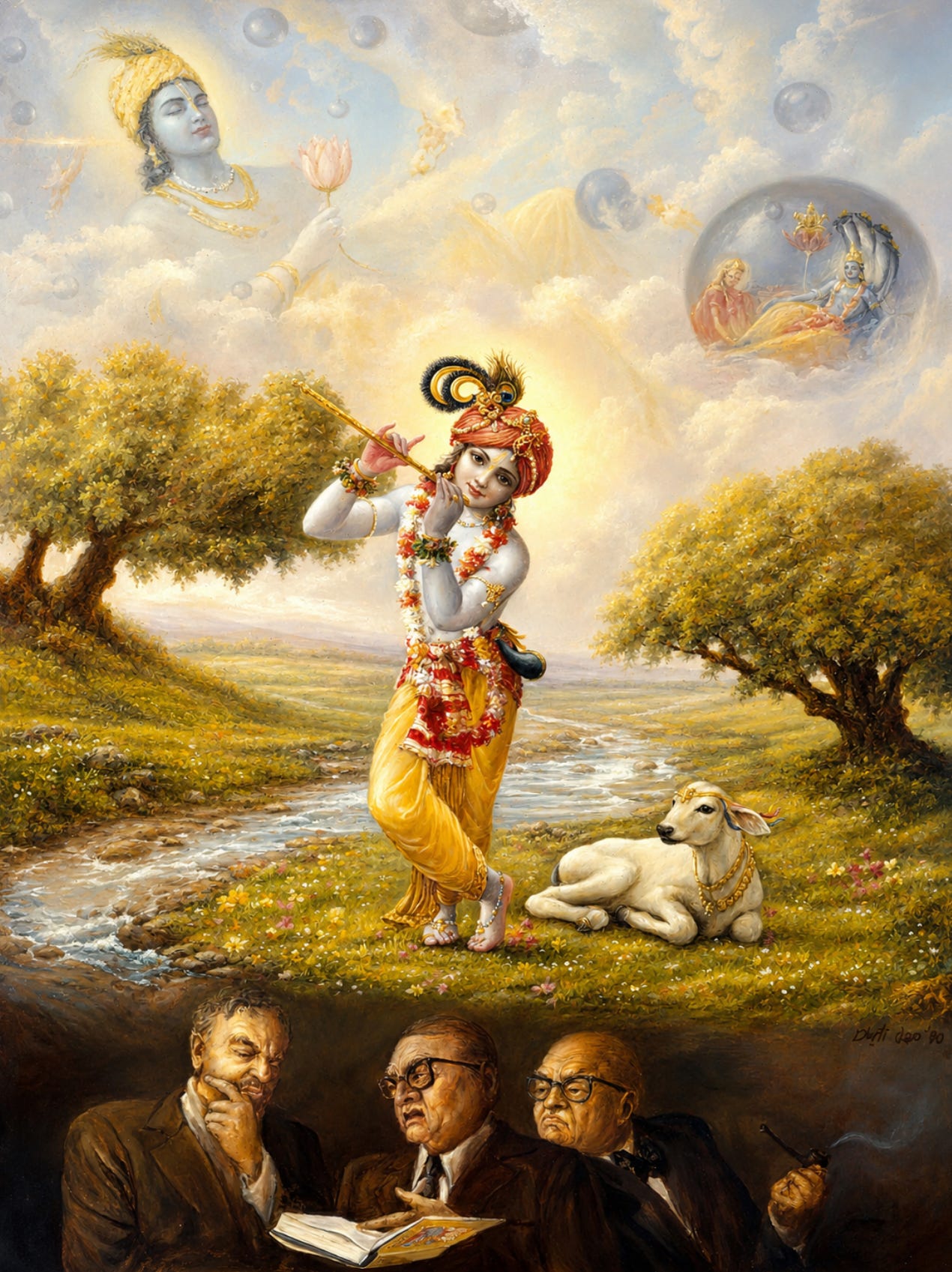
So, why do people still refuse? Why is it that even people well-qualified by material standards, like scholars and intellectuals, who may even come to study the Bhagavad-gītā, refuse to accept this simple process?
Ultimately, it is because of material illusion. Material illusion covers our original knowledge and makes us see everything in a distorted way. Suddenly, we are the body; the universe appeared by chance, life serves no ultimate purpose, and there is no God.
There is also another point. Truly qualified personalities mentioned in the scriptures do surrender to Kṛṣṇa, and as a result become great devotees. We have many examples in history: Brahmā, the patriarch of our universe, meditated for 1,000 years of the demigods and received the personal darśana of Kṛṣṇa, who revealed the whole Vedic knowledge to him and ordered him to create the universe. Lord Śiva lives on Mount Kailāsa, constantly absorbed in meditation on the Supreme Lord. The Four Kumāras, the exponents of the jñāna school and teachers of countless students, are pure devotees of Viṣnu, having become attracted to His service simply by smelling the aroma of Tulasi leaves offered to Him. Similarly, Vyāsadeva, the compiler of the Vedas, Manu, the father of mankind, and so many other greatly exalted personalities are pure devotees of the Lord.
According to Prabhupāda, the reason intellectuals, philosophers, political leaders, and other prominent leaders of contemporaneous societies refuse is that they are not true intellectuals, philosophers, or leaders. Rather, they are ordinary people who occupy these positions for material gain. This is a heavy claim, but Kṛṣṇa Himself supports it in Bg 7.15 by calling them duṣkṛtinaḥ: miscreants, or atheistic planmakers.
The root kṛtī indicates ability, merit, and action, but the prefix duṣ- indicates that the action is misdirected. The duṣkṛtinas are often materially qualified and work very hard, but because they act under material illusion, their efforts fail in producing anything truly beneficial for themselves or others. This shows that without Kṛṣṇa consciousness, material qualifications not only fail to bring real benefit, but often become harmful. Kṛṣṇa divides the duṣkṛtina class into four groups:
1) The mūḍha is the gross materialist who works very hard for little gain. They are compared with asses and other beasts of burden. Kṛṣṇa gives us the process of advancing by working for Him, but the mūḍhas prefer to work for materialistic masters and use whatever little they gain to try to satisfy their senses.
2) The second class is the narādhama, the lowest of mankind. These are materialists who are educated by material standards but follow no religious principles. In other words, due to some previous piety, they receive the opportunity of a human birth, with good education and other facilities, assets that they could immediately use to understand the Absolute Truth, but they deliberately reject the process. As Prabhupāda mentions, the majority of the current population falls into this category.
3) The māyayāpahṛta-jñānāḥ (those whose knowledge has been stolen by illusion) are intellectuals and philosophers who excel in terms of material knowledge. They possess substantial education and material intelligence, but illusion diverts this material intelligence, forcing them to work in the wrong direction. Instead of using their intelligence to understand Kṛṣṇa and surrender unto Him, they simply produce atheistic philosophies and scientific theories that misguide themselves and others. This category includes many classes of materialistic philosophers, such as the followers of the atheistic Sāṅkhya system, which is discussed in detail in the Govinda-bhāṣya. Śrīla Bhaktivinoda Thākura also includes persons who worship demigods without understanding Kṛṣṇa’s supreme position in this category. Prabhupāda includes all kinds of intellectual circles, like philosophers, poets, literati, scientists, etc.
4) The last class is the āsuraṁ bhāvam āśritāḥ, the ones who share the atheistic nature of the demons. This is the class that offers the deepest resistance. They are deeply averse to God and averse to His supremacy. Just as demons such as Kaṁsa tried to kill Kṛṣṇa with weapons, such persons try to kill Him with atheistic theories that deny His existence or transcendental position. Some say that there is no God; others say that Kṛṣṇa has a material form, or that He is subordinate to the impersonal aspect. They are even ready to worship common men as incarnations, anything but accept the path that Kṛṣṇa offers in the Bhagavad-gītā. Just as Kaṁsa, they usually maintain their enmity up to the very end, and just as Kaṁsa, they are eventually killed by Kṛṣṇa, who appears to them in the form of death. Unlike the great historical demons who were personally killed by Kṛṣṇa, however, ordinary atheists don’t attain liberation, but simply receive the results of their activities in the cycle of birth and death. Later (16.19-20), Kṛṣṇa adds that He casts them into various demoniac species of life, where they cannot approach Him. In other words, they continue descending, taking births in demoniac families that reinforce the same consciousness and progressively close the opportunity for approaching Kṛṣṇa. Gradually, they sink to the most abominable type of existence, eventually taking birth in the animal species. Their mentality puts them into a self-reinforcing cycle, from which it is very difficult to escape. Practically speaking, their only chance is to somehow receive the mercy of a pure devotee.
Prabhupāda explains the four categories in more detail in his purport to Bg 7.15. There are many classes of impious people and atheists, but they can all be fit into these four basic classes. Another important point is that these classes come from material contamination. Even the greatest narādhama is still a pure soul, constitutionally bound to love and serve Kṛṣṇa. The problem is that for the time being, this pure soul identifies with a nefarious material identity. There is always the possibility that an atheist may meet devotees and have a change of heart, but if this doesn’t happen, the tendency is that one continues acting impiously, accumulating sinful reactions that eventually lead to hellish conditions and life in the animal species. By the time one receives the opportunity of a human birth again, his consciousness may have been changed.
Read more:

This is a publication for thoughtful readers who want to go deeper into Kṛṣṇa consciousness. I publish daily, trying to offer high-quality spiritual content, and all posts are available to free subscribers. If you wish, you can also choose a paid subscription to support this work.
You can also receive updates on WhatsApp or Telegram.
If you would like to contribute further, you can find the donation links here.