


« The Friend Who Never Left: A Dialog on the “Fall” of the Jīva
You can receive new articles directly in your inbox. Subscription is free; donations are welcome.
Chapter Eight: King Purañjana and his mysterious friend
The next morning, Mādhava again returned to Gaurāṅga’s house. He spent most of the night reading about King Purañjana; time passed fast. The first time he read it, he could barely follow the narrative. In the end, he just remembered a few disconnected details. Now, after the discussion of Kapila’s teachings, he could understand it better.
Gaurāṅga Dāsa was sitting on the veranda, reading. He put the book aside as Mādhava approached.
Gaurāṅga Dāsa: So, what did you find about Purañjana and his mysterious friend?
Mādhava Dāsa: Purañjana is the conditioned soul, and the friend is Paramātmā. But I have several questions about what He says. Some of His statements seem to directly contradict the arguments in the other book.
Gaurāṅga Dāsa: We will come to that. First, let’s examine the story itself. Why was Nārada Muni narrating it?
Mādhava Dāsa: He was instructing King Prācīnabarhi, who was performing many fruitive sacrifices and unnecessarily killing many animals in the process. Nārada showed him the animals he had killed, waiting at the entrance of hell to take revenge on him after death.
Gaurāṅga Dāsa: Yes, very good. Prācīnabarhi was misguided. He was following religious rituals, but because his goal was material enjoyment, he became absorbed in fruitive activities, without caring for properly following the regulative principles, and without understanding the real purpose of religious life. Nārada told him the story of Purañjana to help him understand his mistake.
He told the king’s own history in the form of an allegory. In reality, this is the story of every conditioned soul. I’m Purañjana, and you are also Purañjana. We can read our own history in the pages of Śrīmad-Bhāgavatam.
How does the allegory begin?
Mādhava Dāsa: He was traveling everywhere, searching for a place to live, but he could not find a place that would satisfy him. He wanted to enjoy, but no place could satisfy all his desires.
Gaurāṅga Dāsa: Knowledge can be obtained, and liberation can be achieved. Love for Kṛṣṇa is also an attainable goal when we come to the proper process. Purañjana, however, was not searching for those. He wanted material enjoyment. His desires were thus unlimited, and no place could satisfy him. Even after traveling for a long time, he was still dissatisfied.
Mādhava Dāsa: The point I noticed is that when Nārada introduces Purañjana, he is already searching for material enjoyment. There is no explanation of how he developed these desires.
Gaurāṅga Dāsa: And what can we conclude from that?
Mādhava Dāsa: That the story doesn’t describe the beginning of his conditioning. It begins with Purañjana already conditioned.
Gaurāṅga Dāsa: Yes. Anādi, just as we described. When we study it from the material side, there is no identifiable beginning. Purañjana is traveling since time immemorial. We already discussed this point.
Nārada Muni does not try to put a date on something whose beginning cannot be traced. Instead, he focuses on the lesson we can learn from it.
Then, the next point. Did he find a place he liked?
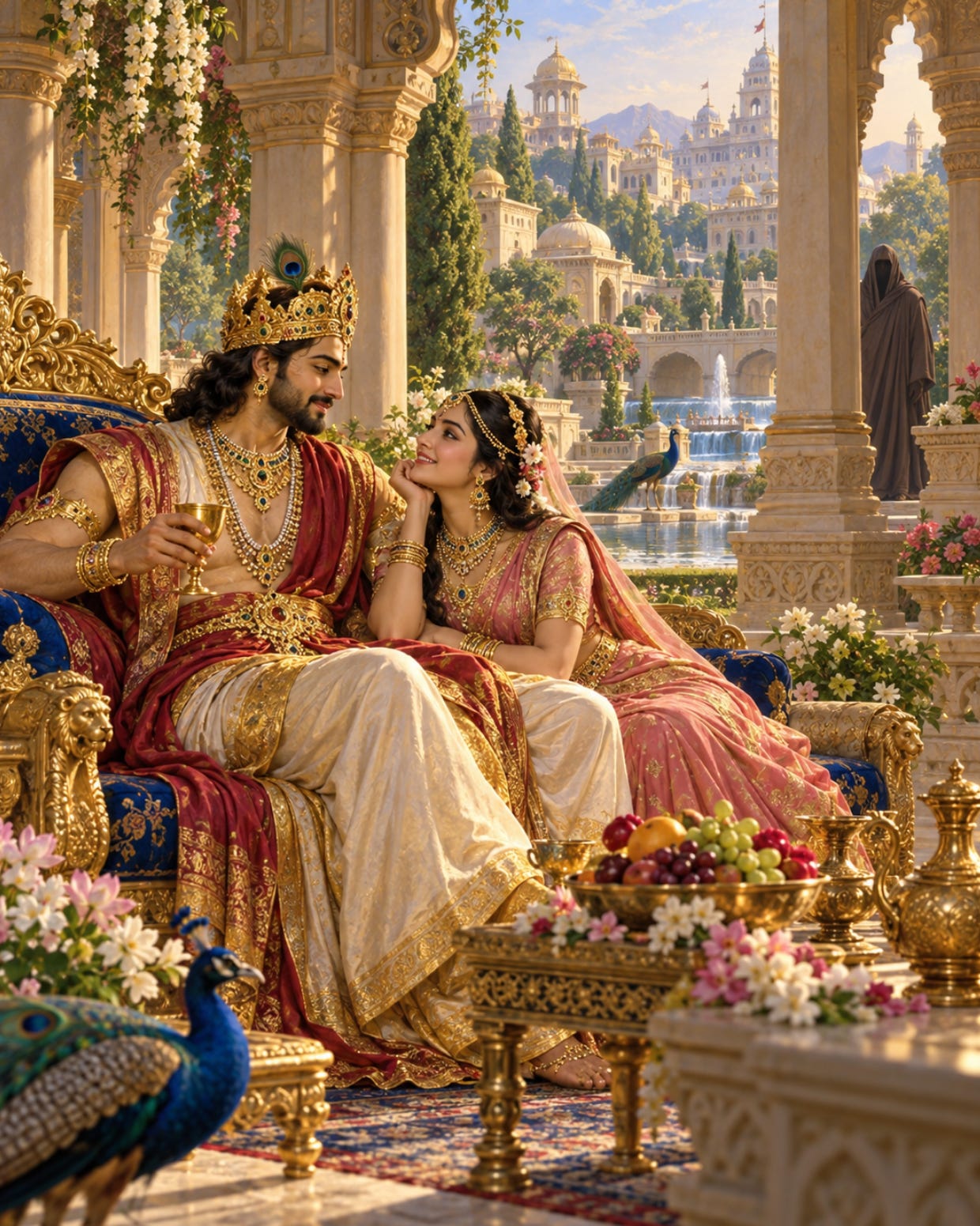
Mādhava Dāsa: He discovered a beautiful city in Bhārata-varṣa, with nine gates, surrounded by gardens and lakes. Inside the city, he met with a beautiful woman, surrounded by many servants and protected by a five-headed serpent.
Gaurāṅga Dāsa: Yes, the city is the human body. The nine gates are the openings of the body. The soul is like a king who rules over the city and uses its facilities for his own purposes. And what about the woman?
Mādhava Dāsa: She represents material intelligence. Her ten servants represent the senses, and the snake represents the vital airs that maintain the body.
Gaurāṅga Dāsa: The material intelligence appears very attractive to the conditioned soul, because it gives us the ability to manipulate the material world and fulfill our desires. This includes both manipulating physical objects and manipulating different ideas and arguments. In both cases, intelligence brings power.
Intelligence can also be used to understand Kṛṣṇa and become engaged in His service. This is its proper use. In this case, we use this material intelligence to revive our original spiritual intelligence. But that’s not what Purañjana did.
Mādhava Dāsa: Yes, Purañjana sees the woman and immediately desires her. He wants to enjoy the body with the help of material intelligence.
But she reveals herself to be very limited. She doesn’t know where she came from or who created her. She knows about the city and her companions.
Gaurāṅga Dāsa: And what does that tell us?
Mādhava Dāsa: That material intelligence can understand many things about the material world, but it cannot understand its own origin.
Gaurāṅga Dāsa: Precisely. That’s the first lesson we can learn here. Material intelligence is part of the material energy. Its manifestation has a beginning and end, and still, material intelligence cannot help us find this beginning. How then can we expect it to reveal the origin of the soul, which transcends the material environment and material time itself? That’s why speculating on this topic always brings us to the wrong conclusions. The only way to understand it, and even then only to a certain point, is to carefully study the scriptures under the guidance of the ācārya. Without this, we fall into the same mistake as the material scientists.
In any case, Purañjana is delighted with this arrangement. He becomes the king of the city, taking the woman as his wife and her servants as his assistants and associates. This illustrates the soul becoming absorbed in the material body.
Mādhava Dāsa: Eventually, he becomes completely controlled by her. He follows her just like an image in the mirror. When she eats, he eats. When she drinks, he drinks. When she laughs, he laughs. When she cries, he cries.
Gaurāṅga Dāsa: That’s one of the most vivid images of the allegory. The constitutional position of the soul is to serve. We are always servants. If we don’t want to serve Kṛṣṇa, we end up serving our material senses, mind, and intelligence. We do everything they want, but the results are ours alone to suffer or enjoy, according to the laws of karma.
This point also connects directly with what we studied in the teachings of Lord Kapila. Because we identify with the mind, intelligence, body, and senses, we accept their activities as our own, accepting the plans of the intelligence as our plans and the desires of the mind as our desires. We thus become so absorbed in this material identity that we forget our original spiritual nature.
Now, what happens after he spends many years enjoying his kingdom?
Mādhava Dāsa: Time passes, and his city is attacked by Caṇḍavega, who represents time. The five-headed serpent representing the vital airs fights to defend it but becomes weaker as time passes. Gradually the walls start to crumble, and the city is breached, but Purañjana is so absorbed in his enjoyment that he doesn’t notice the end is near.
Eventually Kālakanyā comes, representing old age, and the Yavana king arrives with his soldiers.
Gaurāṅga Dāsa: The body deteriorates, the senses become dull, even the intelligence betrays him. The city that once offered so many beautiful lakes and other facilities for sense enjoyment falls apart.
But what is Purañjana thinking while this all happens?
Mādhava Dāsa: He remains attached to his family and possessions, even as death approaches.
Gaurāṅga Dāsa: That’s the tragedy. He has spent his whole life building a mistaken, temporary identity, and now everything is being taken away. He cannot accept that his position as king is temporary.
At the end, the Yavana soldiers enter the city, Prajvāra sets it on fire, and Purañjana is forcibly dragged away. What happens to his city?
Mādhava Dāsa: It is destroyed. He loses everything.
Gaurāṅga Dāsa: Without Kṛṣṇa consciousness, that’s our situation at death. Our body, our possessions, our family, and even our own material identity are taken away. The question is that Purañjana himself does not cease to exist. He accepts a new temporary identity, becoming a woman in his next life, princess Vaidarbhī.
He does not remember being Purañjana, fully embracing the new identity. The previous personality has disappeared, but the soul remains the same.
This is the same principle we studied in Kapila’s teachings. The material reflection changes, but the soul remains unchanged.
Mādhava Dāsa: And there is something else. After being mentioned in the very beginning, the mysterious friend is not mentioned again.
Gaurāṅga Dāsa: Yes, this illustrates a forgetful attitude. Kṛṣṇa is with us the whole time as Paramātma, following us from one body to the other. The unknown friend, Avijñāta, is there the entire time, but at no point in the story does Purañjana notice Him. Even while he was being dragged from the body, all he could remember were his material possessions.
Mādhava Dāsa: This is exactly the point Śrīla Prabhupāda makes in the Crow and Tal-Fruit article. Even though we forget Kṛṣṇa, He never forgets us.
Gaurāṅga Dāsa: And what happens to Vaidarbhī?
Mādhava Dāsa: She marries King Malayadhvaja, and they have children. Later, the king retires to the forest to practice spiritual life, and Vaidarbhī follows him.
Gaurāṅga Dāsa: In this life, she got married to a great devotee, and by following him, she automatically advanced in devotional service. Malayadhvaja became her guru, who introduced her to the process of devotional service. When he left for the forest, she followed him, and she was serving him in his last days. This illustrates the position of the dedicated disciple, who serves the spiritual master either by remaining with him in his last days or by serving his mission.
When Malayadhvaja finally passes away, she sees herself completely alone in the forest. She prepares a funeral pyre and is about to enter the fire with her husband’s body. What happens then?
Mādhava Dāsa: A mysterious brāhmana appears. Nārada says he was an old friend of King Purañjana.
Gaurāṅga Dāsa: Exactly! Notice that Nārada mentions he is a friend of Purañjana, not of Vaidarbhī. The material identity changed, but the soul is the same. Paramātmā is the friend of the soul, not the friend of the material identity.
And what does he say?
Mādhava Dāsa: This is the part that interested me most. He asks Vaidarbhī if she remembers him and presents himself as her eternal friend. He says she had consulted Him many times in the past. Here is the exact passage:
“The brāhmaṇa continued: My dear friend, even though you cannot immediately recognize Me, can’t you remember that in the past you had a very intimate friend? Unfortunately, you gave up My company and accepted a position as enjoyer of this material world.”
Gaurāṅga Dāsa: Yes. And what do you understand from this statement?
Mādhava Dāsa: They were together previously, but Purañjana forgot their relationship when he became focused on material enjoyment.
It goes further than what we established studying the Caitanya Caritāmṛta.
Mahāprabhu explains that love for Kṛṣṇa is eternally established in the heart, but someone could argue that this eternal love had never previously been manifested. Here, however, the Lord Himself as Paramātmā speaks of an intimate friendship. And He directly says that Purañjana gave up His company. This implies that Purañjana left, and the Lord has been following him since.
This makes a very strong point against the idea that we were never with Kṛṣṇa. How could someone give up someone’s company if he had never been with that person?
Gaurāṅga Dāsa: And there is more immediately afterward. Read texts 54 and 55.
Mādhava Dāsa: “My dear gentle friend, both you and I are exactly like two swans. We live together in the same heart, which is just like the Mānasa Lake. Although we have been living together for many thousands of years, we are still far away from our original home.
My dear friend, you are now My very same friend. Since you left Me, you have become more and more materialistic, and not seeing Me, you have been traveling in different forms throughout this material world, which was created by some woman.”
Gaurāṅga Dāsa: And what is this original home?
Mādhava Dāsa: Prabhupāda mentions that it is the spiritual world.
“The original home of the living entity and the Supreme Personality of Godhead is the spiritual world. In the spiritual world both the Lord and the living entities live together very peacefully. Since the living entity remains engaged in the service of the Lord, they both share a blissful life in the spiritual world. However, when the living entity wants to enjoy himself, he falls down into the material world. Even while he is in that position, the Lord remains with him as the Supersoul, his intimate friend. Because of his forgetfulness, the living entity does not know that the Supreme Lord is accompanying him as the Supersoul. In this way the living entity remains conditioned in each and every millennium. Although the Lord follows him as a friend, the living entity, because of forgetful material existence, does not recognize Him.”
Gaurāṅga Dāsa: There is also something else to consider. The Lord says that Purañjana gave up His company, but at the same time we can see that they were never separated. The Lord remained with him the whole time. So how could Purañjana leave if he was never separated from the Lord?
And what exactly does it mean that he left? Does it mean he physically departed from a certain geographical place? And what exactly is the original home mentioned in text fifty-four?
These are questions we should examine carefully.
Nārada gives us his own explanation of the story in chapter 29. We should take his explanation into consideration.
Mādhava Dāsa: Then that’s the homework for today?
Gaurāṅga Dāsa: Yes. Read Nārada’s explanations, and then return to the conversation between the brāhmana and Vaidarbhī in chapter 28, especially texts 51 to 54. Pay attention to Prabhupāda’s purports.
I want you to think about these two remaining questions: What does it mean that Purañjana left the Lord’s company? And what is the original home they are speaking about?
Mādhava Dāsa: Yes, sir!
Next: The friend who never left »
Read the entire book:
The Friend Who Never Left, A Dialog on the “Fall” of the Jīva

This is a publication for thoughtful readers who want to go deeper into Kṛṣṇa consciousness. I publish daily, trying to offer high-quality spiritual content, and all posts are available to free subscribers. If you wish, you can support this work with a monthly contribution. When you subscribe, you can choose between a free subscription and a monthly contribution, and you can switch from a free subscriber to a supporter at any time.
You can also receive updates on WhatsApp or Telegram.
If you would like to contribute further, you can find the donation links here.