

« The Song of God—Volume 1, chapters 1-6
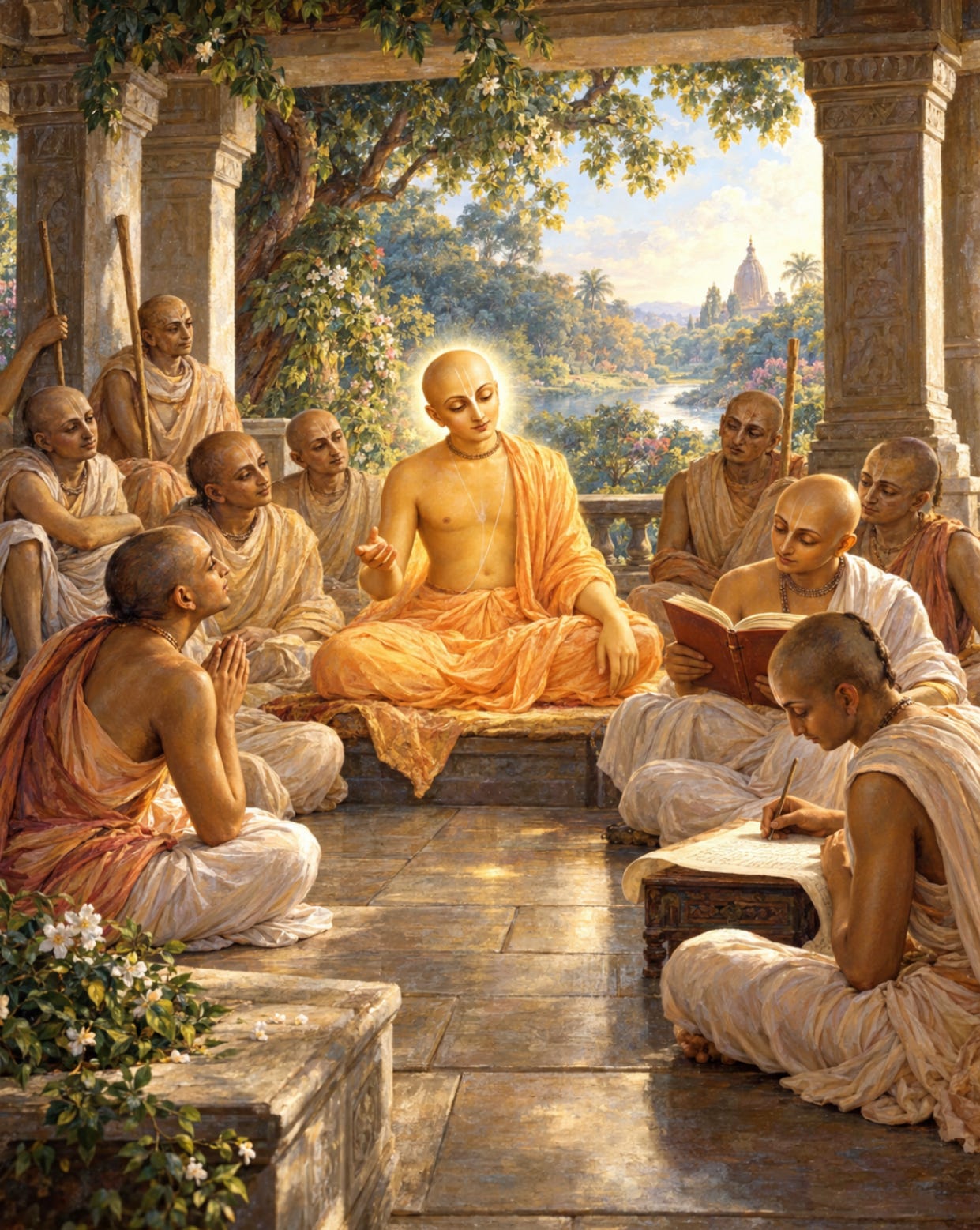
The glories of transcendental knowledge (Bg 4.33 to 4.38)
After describing the different processes of sacrifice, Kṛṣṇa now explains their ultimate purpose. Sacrifice is ultimately meant to bring us to transcendental realization. This perfect knowledge, however, does not come automatically, nor can it be obtained by mental speculation. One has to approach a self-realized spiritual master with submission, asking relevant questions and offering service. Without this vital connection, these different processes fail to produce their ultimate result, for they are performed without proper understanding. On the other hand, under the care of the spiritual master, the disciple learns how to perform sacrifice in knowledge and gradually realizes the instructions he has received. This realized knowledge destroys all misgivings and brings him to the platform of pure Kṛṣṇa consciousness.
Text 33: śreyān dravya-mayād yajñāj, jñāna-yajñaḥ paran-tapa
sarvaṁ karmākhilaṁ pārtha, jñāne parisamāpyate
O chastiser of the enemy, the sacrifice performed in knowledge is better than the mere sacrifice of material possessions. After all, O son of Pṛthā, all sacrifices of work culminate in transcendental knowledge.
Text 34: tad viddhi praṇipātena, paripraśnena sevayā
upadekṣyanti te jñānaṁ, jñāninas tattva-darśinaḥ
Just try to learn the truth by approaching a spiritual master. Inquire from him submissively and render service unto him. The self-realized souls can impart knowledge unto you because they have seen the truth.
Text 35: yaj jñātvā na punar moham, evaṁ yāsyasi pāṇḍava
yena bhūtāny aśeṣāṇi, drakṣyasy ātmany atho mayi
Having obtained real knowledge from a self-realized soul, you will never fall again into such illusion, for by this knowledge you will see that all living beings are but part of the Supreme, or, in other words, that they are Mine.
Text 36: api ced asi pāpebhyaḥ, sarvebhyaḥ pāpa-kṛt-tamaḥ
sarvaṁ jñāna-plavenaiva, vṛjinaṁ santariṣyasi
Even if you are considered to be the most sinful of all sinners, when you are situated in the boat of transcendental knowledge you will be able to cross over the ocean of miseries.
Text 37: yathaidhāṁsi samiddho ’gnir, bhasma-sāt kurute ’rjuna
jñānāgniḥ sarva-karmāṇi, bhasma-sāt kurute tathā
As a blazing fire turns firewood to ashes, O Arjuna, so does the fire of knowledge burn to ashes all reactions to material activities.
Text 38: na hi jñānena sadṛśaṁ, pavitram iha vidyate
tat svayaṁ yoga-saṁsiddhaḥ, kālenātmani vindati
In this world, there is nothing so sublime and pure as transcendental knowledge. Such knowledge is the mature fruit of all mysticism. And one who has become accomplished in the practice of devotional service enjoys this knowledge within himself in due course of time.
In the previous section, the importance of the process of sacrifice was established. Sacrifice, however, is not supposed to be merely an external ritual. It should lead to purification, and purification should lead to transcendental knowledge. Sacrifices prescribed according to the recommendations of the scriptures are always beneficial, but without transcendental knowledge, they remain on the material platform, and result in no spiritual benefit. Śrīla Bhaktivinoda Thākura explained the spiritual process on three levels: sambandha, abhidheya, and prayojana. Transcendental knowledge enters directly at the first level, sambandha. Without the proper understanding, the spiritual practice (abhidheya) will not be proper, and one will not attain the ultimate goal (prayojana). Kṛṣṇa thus establishes in text 4.33 that all forms of sacrifice described in the previous verses should not be performed as mere rituals. Their ultimate purpose is to bring one to transcendental knowledge, understanding one’s position as a transcendental soul, eternally connected with Him.
This, however, leads us to an apparent contradiction: sacrifice is supposed to bring us to a platform of knowledge, but at the same time, sacrifice should be performed in knowledge to be effective. How can a person who is not in knowledge even start? The point is that there is a process by which help comes from the outside, making the change of heart possible.
Knowledge should be received from a self-realized spiritual master. To properly understand, we should practice praṇipāta and paripraśna: we should surrender to the spiritual master and inquire submissively. To receive spiritual knowledge means to submit ourselves to the authority of Kṛṣṇa, accepting to learn and follow His instructions. We receive these instructions through an experienced devotee who acts as His representative. Just as a policeman represents the authority of the state, the spiritual master is the representative of Kṛṣṇa. We submit to Kṛṣṇa by submitting to the spiritual master. We can test the spiritual master before formally accepting his guidance, but once we are convinced he is a bona fide representative, we should pose our questions in a humble spirit. A challenging attitude blocks the change of heart necessary for progressing in spiritual life.
The third component is sevā; we should offer some service. This is not just a formality: service is what gives us the purification to understand this knowledge. We learn from some spiritual teacher; therefore, we can offer some help or some donation. We are learning from Śrīla Prabhupāda through his books; therefore, we can serve his mission, and so on. Without some form of service, the knowledge we receive may remain superficial. That’s an invisible process.
The processes of praṇipāta and paripraśna allow us to avoid the two main traps in inquiring from a spiritual master, which are arrogance and blind following. Both are dangerous. We need to be selective enough to find a genuine spiritual master, and once we find one, we should be able to curb our arrogance, listen submissively, and offer service. As Prabhupāda explains in his purport:
“In this verse, both blind following and absurd inquiries are condemned. Not only should one hear submissively from the spiritual master, but one must also get a clear understanding from him, in submission and service and inquiries. A bona fide spiritual master is by nature very kind toward the disciple. Therefore when the student is submissive and is always ready to render service, the reciprocation of knowledge and inquiries becomes perfect.”
The necessity of learning from a teacher is accepted as universal even in terms of material knowledge. We can learn many things by watching videos, but any serious professional has to pass through a university to be accepted. No one would accept undergoing heart surgery by a self-taught surgeon. As Prabhupāda explains in his purport:
“No one can be spiritually realized by manufacturing his own process, as is the fashion of the foolish pretenders. The Bhāgavatam (6.3.19) says, dharmaṁ tu sākṣād bhagavat-praṇītam: the path of religion is directly enunciated by the Lord. Therefore, mental speculation or dry arguments cannot help lead one to the right path. Nor by independent study of books of knowledge can one progress in spiritual life. One has to approach a bona fide spiritual master to receive the knowledge.”
How can this be applied to the study of Prabhupāda’s books? We can imagine that Prabhupāda’s books are like reference books. We can study books by ourselves, but to apply them properly, we need the guidance of a self-realized devotee who lives according to them, just as a serious student benefits from university teachers who can explain the practical application of the textbooks. Without this step, our progress will be slower, and there will always be the possibility of misunderstanding.
We can see that Prabhupāda himself emphasizes the acceptance of a spiritual master in his books, following what Kṛṣṇa Himself declares. When Śrīla Prabhupāda was present, he was personally accepting disciples. After he entered samādhi, the responsibility of preserving and transmitting his teachings continued through faithful disciples and grand-disciples who represent him without changing his conclusions.
What is the result of obtaining transcendental knowledge? Kṛṣṇa answers in text 4.35: “Having obtained real knowledge from a self-realized soul, you will never fall again into such illusion.”
Material illusion is based on the false identification with the body, mind, and ego. As souls, we are different from the body, but we observe the workings of the body and mind, and under the spell of the false ego, imagine an identity and purpose separate from Kṛṣṇa.
Identification with the body makes us fall into the urges of the senses, while identification with the mind makes us prey to the different material desires stored there. Identification with the ego makes us want to grow socially, build a great nation, and so on. All of this makes us work tirelessly in this world for no ultimate gain. Transcendental knowledge puts us on the opposite path. It makes us understand we are the eternal soul, who is eternally connected with Kṛṣṇa. As we start seeing with the eyes of knowledge, the material illusion starts to dissipate, and once we come to the spiritual platform, the same knowledge makes us never want to go back.
As Prabhupāda explains in his purport to text 4.35:
“For want of sufficient knowledge in the absolute science, we are now covered with illusion, and therefore we think that we are separate from Kṛṣṇa. Although we are separated parts of Kṛṣṇa, we are nevertheless not different from Him. The bodily difference of the living entities is māyā, or not actual fact. We are all meant to satisfy Kṛṣṇa. By māyā alone Arjuna thought that the temporary bodily relationship with his kinsmen was more important than his eternal spiritual relationship with Kṛṣṇa. The whole teaching of the Gītā is targeted toward this end: that a living being, as Kṛṣṇa’s eternal servitor, cannot be separated from Kṛṣṇa, and his sense of being an identity apart from Kṛṣṇa is called māyā. The living entities, as separate parts and parcels of the Supreme, have a purpose to fulfill. Having forgotten that purpose since time immemorial, they are situated in different bodies, as men, animals, demigods, etc. Such bodily differences arise from forgetfulness of the transcendental service of the Lord. But when one is engaged in transcendental service through Kṛṣṇa consciousness, one becomes at once liberated from this illusion. One can acquire such pure knowledge only from the bona fide spiritual master and thereby avoid the delusion that the living entity is equal to Kṛṣṇa.”
In text 4.36, Kṛṣṇa uses the construction “api ced” (even if) to glorify transcendental knowledge. The reason we remain bound to this material world for so many lives is that we fall into a vicious cycle:
1) We act sinfully.
2) Our heart becomes contaminated.
3) This contamination prevents us from understanding transcendental knowledge.
4) Without knowledge, we remain bound, and continue to act sinfully.
Once we fall into this cycle, it is very difficult to escape.
Kṛṣṇa, however, explained the process for obtaining transcendental knowledge. This process breaks this cycle, allowing even the most sinful to find his way out.
Śrīla Viśvanātha Cakravartī Thākura mentions three apparent contradictions in the idea of a sinful person manifesting transcendental knowledge.
If someone is sinful, how can his heart become purified?
Without purification, how can he develop knowledge?
If he has developed knowledge, how can he still act sinfully?
The solution for the first is that transcendental knowledge does not come from one’s own strength; it comes directly from Kṛṣṇa through the medium of the spiritual master. A sinful person cannot normally manifest transcendental knowledge, but it becomes possible once we accept the process described by Kṛṣṇa in text 4.34.
The second logical problem is that, if knowledge requires purity, and purity requires knowledge, how can a sinful person even begin? The answer is again in the process of service and submission Kṛṣṇa describes. A sinful person hears transcendental knowledge and, through some preliminary faith, starts the process of service. From this combination of hearing and serving, the knowledge starts purifying the heart, and as the heart becomes purified, transcendental knowledge deepens, up to the point one becomes self-realized. Again, the point is that purification comes due to an external source. One cannot complete this process alone.
The third point indicates a practical situation. A person situated in transcendental knowledge often acts in ways that are disapproved by others. This directly applies to the case of Arjuna, who was preparing to fight his relatives out of service to Kṛṣṇa. To an external observer, this may be considered condemnable, but Kṛṣṇa assures that even if the whole material society may condemn the actions of a devotee, their opinion is not relevant. The parents and relatives of a devotee may become upset because he or she is serving Kṛṣṇa, and make many accusations, but what really matters is one’s relationship with Kṛṣṇa, not the expectations of kinsmen.
Another meaning of this third point is that even if a devotee is found performing real sins, breaking regulative principles due to illusion or weakness, this knowledge of our eternal relationship with Kṛṣṇa is so powerful that it can save us from this degraded position and bring us back to proper spiritual practice in due time. A powerful example in this connection is the history of Ajāmila described in the Śrīmad-Bhāgavatam. He was serving Kṛṣṇa in his youth, fell into a life of degradation, but was still saved at the end due to his sincere chanting of the holy names because of his previous service.
In any of these conditions, the expression “api ced” takes away any doubt about the power and efficacy of the process, and makes the point that there is nothing better. As Prabhupāda explains in his purport, “Proper understanding of one’s constitutional position in relationship to Kṛṣṇa is so nice that it can at once lift one from the struggle for existence which goes on in the ocean of nescience.”
To destroy any remaining doubt, Kṛṣṇa gives, in texts 4.36 and 4.37, two powerful images that describe the power of transcendental knowledge: the first is as a boat, that carries us across the material ocean, and the second is as fire that burns to ashes the results of all sinful reactions.
The image of the boat shows that we cannot cross the material ocean by our own strength. Although the soul is part of Kṛṣṇa’s internal potency, and thus superior to matter, because the material energy is a potency of Kṛṣṇa, it can easily overpower us. To be saved, we need the boat of Kṛṣṇa consciousness, received through the bona fide spiritual master.
The analogy of the fire illustrates how transcendental knowledge destroys the reactions of karma, another powerful force that binds us to this world. The results of both pious and impious actions should be given up, because pious reactions also force us to take birth again to receive the rewards. Transcendental knowledge destroys both, closing both karmic accounts and bringing us back to our original position of service to Kṛṣṇa.
Kṛṣṇa confirms these previous points in text 4.38 with the words na hi jñānena sadṛśaṁ, pavitram iha vidyate: “In this world, there is nothing so sublime and pure as transcendental knowledge.”
This is not just theoretical knowledge; it is, in fact, the fruit of the practice of devotional service, and, as explained in 4.34, can be obtained only when philosophical inquiry is combined with an attitude of service. Once we become situated in this transcendental knowledge, we find real peace and happiness in connection with Kṛṣṇa, who is situated inside our own hearts. Real peace and happiness come from understanding our eternal relationship with Kṛṣṇa and acting in this relationship. Materialists look for happiness in the contact with matter, but they ultimately find only misery. Impersonalists try to extinguish this misery by stopping all activity, but only the devotee can find real happiness on the spiritual platform. Transcendental knowledge, thus, cannot be separated from devotional service. It matures through the practice of devotional service and manifests its final perfection in full Kṛṣṇa consciousness.
Kṛṣṇa uses the word kālena (in course of time) to warn about two points: the first is that the result can take time to appear; therefore, we should not be discouraged. We have been in this material world for so long that the beginning cannot even be traced back. Depending on where we are on the path, it can take some time, but Kṛṣṇa assures us that the result is guaranteed. We should not feel discouraged. As we practice devotional service, starting with the detached work prescribed by Kṛṣṇa in these first chapters, transcendental knowledge is gradually revealed inside the heart. The second point is again an alert about the danger of artificial renunciation. Artificial renunciation is just another manifestation of ignorance; it will not magically fix us in transcendental knowledge; on the contrary, it will make us fall, as already explained.
Main points in the purports of Śrīla Prabhupāda:
“O chastiser of the enemy, the sacrifice performed in knowledge is better than the mere sacrifice of material possessions. After all, O son of Pṛthā, all sacrifices of work culminate in transcendental knowledge.”
a) The purpose of performing sacrifices is to first attain full knowledge, then liberation, and, finally, to come to the platform of Kṛṣṇa consciousness. Sacrifices may take different forms according to the faith of the performer, and sacrifices performed in knowledge are distinguished from sacrifices under material concepts. Without knowledge, sacrifices remain material and give no spiritual benefit.
b) What is this knowledge? Real knowledge brings us to the platform of Kṛṣṇa consciousness. When sacrifices are performed on this platform of transcendental knowledge, they bring us to the spiritual platform. There is karma-kāṇḍa and jñāna-kāṇḍa, but the goal of both is Kṛṣṇa consciousness.
“Just try to learn the truth by approaching a spiritual master. Inquire from him submissively and render service unto him. The self-realized souls can impart knowledge unto you because they have seen the truth.”
a) Once conditioned, it’s very difficult for a soul to become free again. For this, we need help, and this help comes in the form of the bona fide spiritual master connected to the disciplic succession. Because the chain comes from the Lord Himself, the spiritual master can give transcendental knowledge to the disciple.
b) The path of religion is directly given by the Lord. No one can become self-realized by creating his own process. Mental speculation and dry arguments can’t help. Even independent study of the Vedas cannot bring real progress. One has to learn the correct conclusions from a self-realized spiritual master.
c) One should inquire with an attitude of submission and service. Without this combination, the transmission of knowledge will not be effective. Seeing the sincerity of the disciple, the spiritual master will bless him or her with genuine understanding. Questions should be relevant; absurd inquiries are condemned, just as blind following is.
d) A self-realized spiritual master is by nature kind to the disciple. The main barrier is the attitude of the disciple. When the student is submissive and active in his attitude of service, the reciprocation becomes perfect.
“Having obtained real knowledge from a self-realized soul, you will never fall again into such illusion, for by this knowledge you will see that all living beings are but part of the Supreme, or, in other words, that they are Mine.”
a) What is the result of receiving true spiritual knowledge? One understands everyone is part and parcel of Kṛṣṇa. The idea of an existence separated from Him is called māyā, illusion. In reality, there is nothing separate from Him.
b) Kṛṣṇa is the origin of everything, the cause of all causes. The impersonal Brahman, powerful as it is, is just the effulgence of His transcendental body. Even the different forms of Viṣṇu and different incarnations are just His expansions, just as all souls are. Māyāvādīs fail to understand what the transcendental platform is, and thus, lacking proper knowledge, they think that Kṛṣṇa divides Himself when He appears in different expansions, just as a material object.
c) We may think we are now separated from Kṛṣṇa, but this is due to ignorance. Because of this ignorance, we forget our eternal identity and are covered by the bodily conception. Bodily differences come from our forgetfulness of the transcendental service of the Lord. But when we are engaged in devotional service, we become free from this illusion.
d) Perfect knowledge is that Kṛṣṇa is the supreme shelter for all living entities. Giving up this shelter, we become covered by māyā, and imagine we have a separate identity. Under this illusory identity, we become forgetful of Kṛṣṇa. Real liberation means to be situated in our constitutional position as eternal servitors of Kṛṣṇa. This is what we call Kṛṣṇa consciousness.
“Even if you are considered to be the most sinful of all sinners, when you are situated in the boat of transcendental knowledge you will be able to cross over the ocean of miseries.”
a) The material struggle is compared with an ocean of nescience. Even if one is a strong swimmer, the struggle is severe. Transcendental knowledge is compared to a boat that can save us from this ocean. It is very simple, but at the same time the most sublime.
“As a blazing fire turns firewood to ashes, O Arjuna, so does the fire of knowledge burn to ashes all reactions to material activities.”
a) Perfect knowledge is also compared to a fire that burns all reactions to previous activities, pious or impious, closing our karmic account. There are different stages of reaction: reactions that are germinating, that are giving fruits, already experienced, and stocked for the future. Transcendental knowledge of our eternal relationship with Kṛṣṇa destroys all of them.
“In this world, there is nothing so sublime and pure as transcendental knowledge. Such knowledge is the mature fruit of all mysticism. And one who has become accomplished in the practice of devotional service enjoys this knowledge within himself in due course of time.”
a) Ignorance is the cause of bondage, and knowledge is the cause of liberation. Transcendental knowledge ultimately means spiritual realization. This spiritual realization comes as the mature fruit of devotional service. Kṛṣṇa consciousness is the culmination of both peace and knowledge. Once one attains it, there is nothing else to attain.
Read the entire book:
« The Song of God—Volume 1, chapters 1-6

This is a publication for thoughtful readers who want to go deeper into Kṛṣṇa consciousness. I publish daily, trying to offer high-quality spiritual content, and all posts are available to free subscribers. If you wish, you can also choose a paid subscription to support this work.
You can also receive the updates on WhatsApp or Telegram.
If you would like to contribute further, you can find the donation links here.