

« Making Sense of the Vedic Universe, a Higher-Dimensional Reality
The journey of a soul through the universe
This last topic is dedicated to describing the journey of a conditioned soul through the material universe. This is our story: how we came to the place we are now, and where we can go from here.
The model of the universe from the Śrīmad-Bhāgavatam describes the different planetary systems that compose the universe, giving us a map of the different realms of the cosmos and the standard of consciousness one has to develop to access each of them. Although described as disks stacked on top of each other, these different planetary systems are more like different levels of consciousness. The thoughts and activities we cultivate during our lives elevate or degrade our consciousness, and the final result will produce a new body in one of these 14 planetary systems.
In other words, the scriptures give us a map that helps us to understand where we are, and what is the path to reach the desired destination. The material universe is incredibly large and complex, and a soul can follow innumerable different paths, transmigrating from one body to the next in the wheel of saṃsāra. By understanding this process, we can chalk a brighter path for ourselves, and help others to also achieve the goal of life. The secret to understanding this explanation is to not try to match these different locations with different stars and galaxies, but to try to understand the different levels of consciousness of the inhabitants there.
We understand that we are not the body, nor the mind, but a spirit soul, a spiritual particle of pure consciousness, who is independent of the body. Just as one may change his clothes, abandoning clothes that are old or damaged, a soul changes to another body when it becomes too old or diseased. When we abandon a particular body, we call it “death,” and when we accept a new one, we call it “birth.” This is a cycle that has been going on for a very long time.
The scriptures explain that there are 8,400,000 forms of life in this universe, among which there are 400,000 species of intelligent life, spread through different planets. Different from the modern scientific definition, which classifies species according to their capacity to generate viable offspring, the species described in the Vedas describe different levels of consciousness. Souls transmigrate through these different species of life according to their actions and desires in the cycle of saṃsāra.
It’s explained that every soul has an eternal relationship with Kṛṣṇa, a spiritual identity that is eternal and unbreakable. This identity is the true ego or the real identity of the soul. How the soul can go from this position of eternal bliss to the perpetual struggle in the material world is a mystery. However, when this happens, the journey of the soul inside the material realm starts in the Causal Ocean, a border between the two worlds, a borderline position between the spiritual and the material.
In the Causal Ocean, the soul is still in a pure state and enjoys a degree of spiritual bliss. However, desiring variety, the soul enters the material creation and assumes the covering of the false ego, which brings us to material designations. False ego means to accept an identity different from our original spiritual identity as an eternal servant of Kṛṣṇa. Under the influence of the false ego, we accept the identity of a human being, demigod, animal, or anything else. The false ego leads to the other coverings of the soul: intelligence and mind (that form the subtle body), the senses, and finally the gross body.
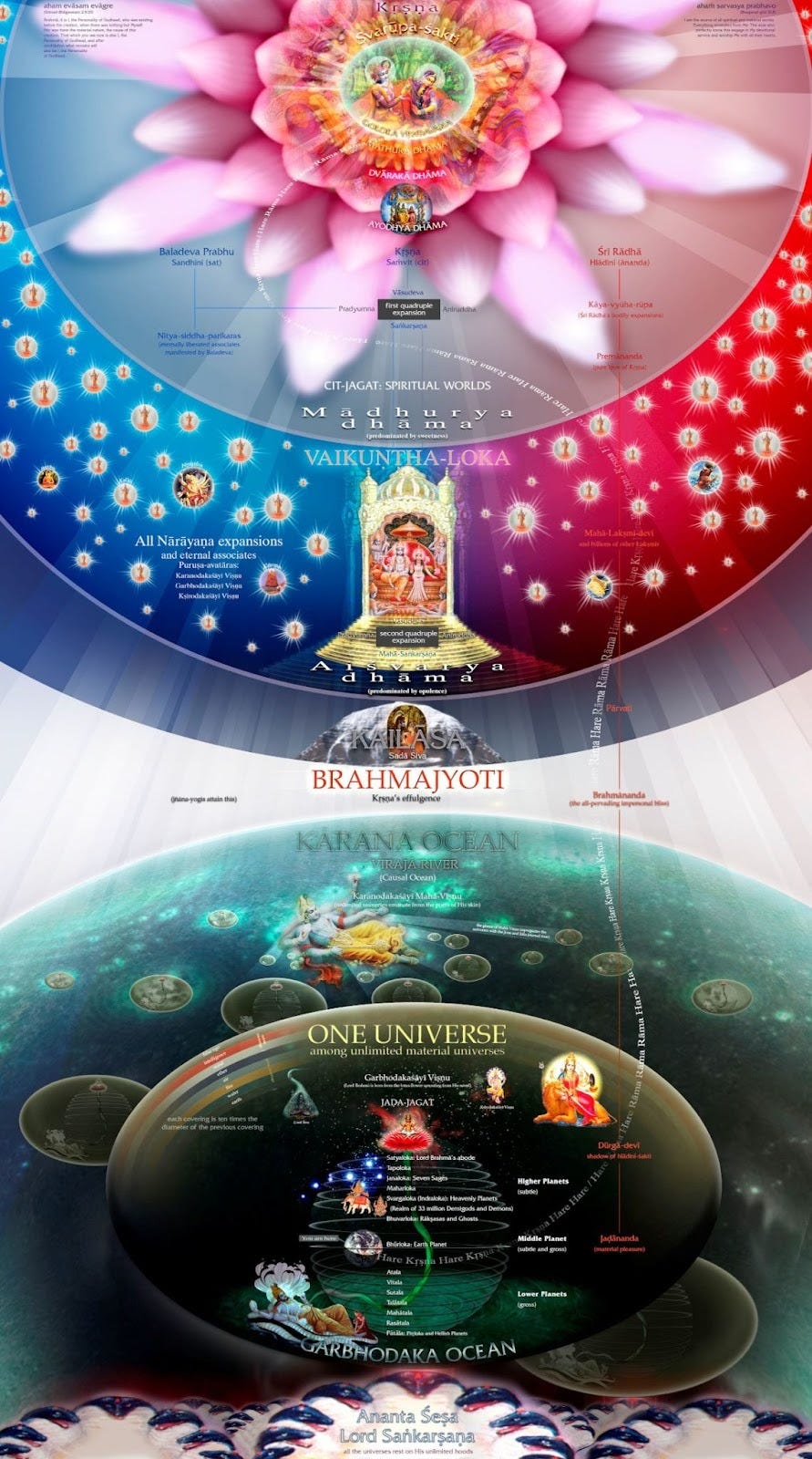
Goloka chart
The Causal Ocean is a place where one is free from material duality but doesn’t have access to the varieties of the spiritual kingdom, similar in this sense to the impersonal Brahmājyoti. Souls can stay for a long time there, but the desire for variety makes them eventually fall into the material universes.
The spiritual planets are thus places of service, for souls who are situated in their original nature. The Brahmājyoti and the Causal Ocean are borderline places, where one’s eternal propensity for service remains dormant. From this position, a soul can fall into the material manifestation, and that’s where we are now.
As Prabhupāda mentions in SB 9.24.58, when a soul first enters the material creation, one starts from the highest position. From there, one can return back to Godhead, or go down to other planetary systems. Souls who go on this path take birth next in one of the upper planetary systems situated directly below Satyaloka: Tapoloka, Janaloka, or Maharloka. These are subtle planetary systems where highly pious souls live. The ones that are very pure and attracted to meditation live in the first, while the ones that are attracted to discipline and pious deeds live in the second and third.
Again, the soul has the choice of going up or down. The ones who are serious about self-realization may attain liberation and go back to the spiritual planets, or even take another birth in Satyaloka, but others that become yet more entangled with matter go down, taking birth in Svargaloka, the celestial planets.
Pious souls live on these planets in great delight, having the opportunity to satisfy their sensual desires. The problem with Svargaloka is that because of the practically unlimited opportunity for sense gratification, most use their time there to simply enjoy heavenly delights instead of pursuing the path of self-realization. Therefore, after a long life there, they fall again.
The ones who have a little bit of pious credit left, take a last birth in heavenly conditions in one of the earthly heavens of Bhū-mandala. Having finally exhausted his pious credits, they come down to earth. This is the place we are now.
Our planet is described in the Vedas as karma-kṣetra, a place where souls who exhaust their past karma go to execute different activities and thus create a new baggage of karma, which will determine their next destination. In other words, this planet is a kind of cosmic crossroads, and the decisions we make here are going to have long-lasting implications.
Being a place where we have a difficult life, and where we need to work very hard for any small amount of material success, this planet is considered an ideal place to cultivate spiritual knowledge and follow the path of self-realization. Everywhere there is some possibility of engaging in self-realization, but earth is the place where there is little to gain in terms of material enjoyment and a lot to gain in terms of spiritual advancement, especially in the age we live in, during the ascending phase of the Saṅkīrtana movement of Mahāprabhu.
However, this opportunity comes with a great danger: if we misuse it by following the path of materialism, we continue downward, going to the lower planets, where people are just after material comforts and there is little opportunity for self-realization. This part of the universe is described in the Śrīmad-Bhāgavatam as a dark hole because once one enters there, it’s difficult to come out. In general, souls remain in the lower planets until whatever pious credits they have are exhausted, and from there they go to animal life.
Finally, there are the hellish planets, places where people who commit serious crimes go specifically to pay for the violence they committed against other living beings. Souls who arrive there listen while their wrongdoings are described by Chandragupta, the secretary of Yamarāja, and are sentenced to different levels of punishment according to the severity of their crimes.
The hellish planets are at the bottom of the universe. From there, there is no further way down. A soul who reaches this level has, after paying for his crimes, the opportunity to again take birth on this earth or another intermediary planet, usually as a plant or animal, and from there slowly progress in the karmic evolutive process until he again can take birth as a human being, a position where he again has the choice of going up or going down.
To take birth as a human being on earth is considered very fortunate, because here one has the chance of meeting devotees who propagate transcendental knowledge, and thus start in the process of devotional service. Although one can obtain many material blessings by serving Kṛṣṇa, the real blessing is that devotional service brings us to a position where we can perform more devotional service. As soon as we start, we get caught on Kṛṣṇa’s hook, and the tendency is that we continue to perform devotional service life after life, and eventually attain perfection. We may think that someone chanting the Mahā-mantra or taking a sweet ball is something trivial, but this can be a turning point in one’s existence. Instead of continuing to go up and down on the material path, one begins the journey back home, back to Godhead.
Since life in this material world is not our original position, everyone is ultimately supposed to go back home, back to Godhead. However, if we are not careful, we can remain here for a very long time, even after starting the process of devotional service. We can study the case of the demigods, for example. Although they are all devotees, they have to remain in their posts for millions of years until the end of the manvantara, to only then have the opportunity to be elevated to Maharloka, then to Janaloka, and so on. Even if everything goes well, they have to remain in this material world for trillions of years until finally having the opportunity of going back to Godhead together with Brahmā at the end of the universe.
Even though we have a great opportunity in this life, we have free will, which brings up the possibility of making the wrong choice. If we surrender to our material desires, we can easily miss the opportunity and create a path that may not be so pleasant. That’s the beauty, and the danger, of human life.
In the Bhagavad-gītā, Kṛṣṇa mentions that “That which in the beginning may be just like poison but at the end is just like nectar and which awakens one to self-realization is said to be happiness in the mode of goodness.” The material path may be pleasurable in the beginning, but it is painful in the long run. The devotional path, on the other hand, involves discipline and restraint. One who is studying to pass a test and enter a good university has to renounce many things he would otherwise want to do, and instead spend days and nights immersed in studies, but this allows him to achieve a much better position in the future. Similarly, the path of self-realization involves working on our bad habits, vices, and lower qualities; therefore, it is a path that may present us with many challenges in the beginning. However, it brings us to the most sublime results in the end.
In summary, the soul is originally pure, but as we go downwards inside the material universe, we become progressively more involved with lower qualities, like lust, anger, and greed. This degrades our consciousness and makes us go progressively deep in the sequence of different planetary systems. This continues to a certain point, where we again come in contact with spiritual knowledge, and decide to start our way back. That’s where we are now. Our next destination will be determined by what we do next.
Read the whole book:
« Making Sense of the Vedic Universe, a Higher-Dimensional Reality
This is a publication for thoughtful readers who want to go deeper into Kṛṣṇa consciousness. I publish daily, trying to offer high-quality spiritual content, and all posts are available to free subscribers. If you wish, you can also choose a paid subscription to support this work.
You can also receive the updates on WhatsApp or Telegram.
If you would like to contribute further, you can find the donation links here.
Hare Krishna.Even though I know a bit of it that human birth is like an emergency,we have to grow our spiritual consciousness and go back to Godhead but living in material world keeps us postponing our bhakti or keeping it secondary.Reading this was an eye opener and a imp reminder that ,my material life, I am living today doesnt really matter to my soul,all matters is my spiritual consciousness and how I develop it by the end of this lifetime.
If I'm not wrong the secretary of Yamaraj is Chitragupta and not Chandragupta. Hare Krishna.