

« Making Sense of the Vedic Universe, a Higher-Dimensional Reality
The keys to understanding the Vedic model of the universe
The Vedic cosmological model of the Purāṇas is centered on the description of Bhū-mandala, a gigantic series of concentric islands and oceans, organized like a lotus flower and situated close to the vertical center of the universe. The difficulty with that model is that it doesn’t reflect what we see when we look at the sky. If our planet is part of a gigantic structure composed of massive islands surrounded by oceans, why can’t we detect it? Why do all the means we have to collect information about our cosmic surroundings show only a lonely planet, surrounded by the vastness of space?
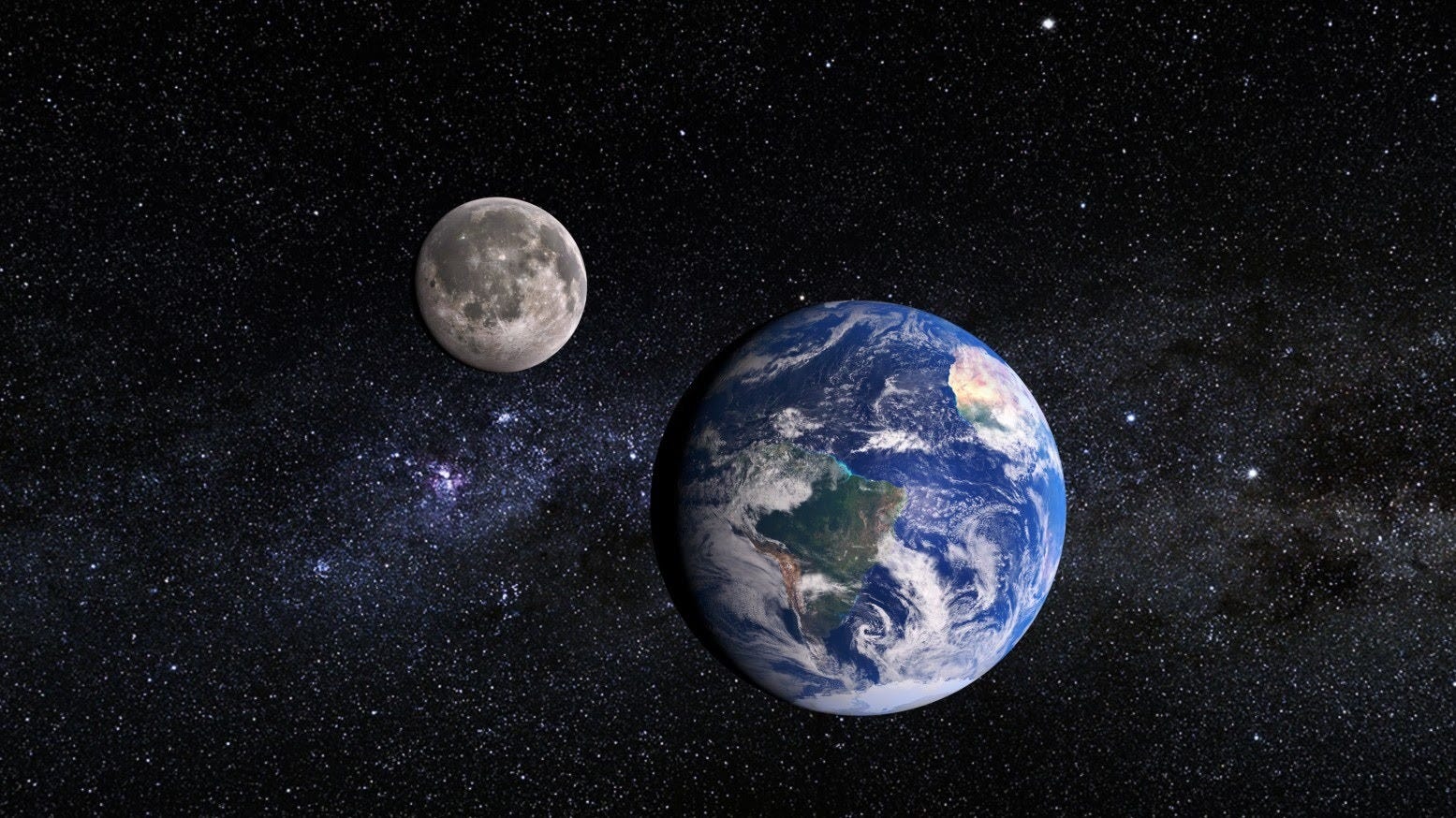
The first point to understand about the structure of Bhū-mandala is that it is the way demigods see the universe. Different beings, with different sets of senses, see reality in different ways. The concept of reality of an ant and that of a human being are radically different. Similarly, demigods can see reality on a much higher level than we do.
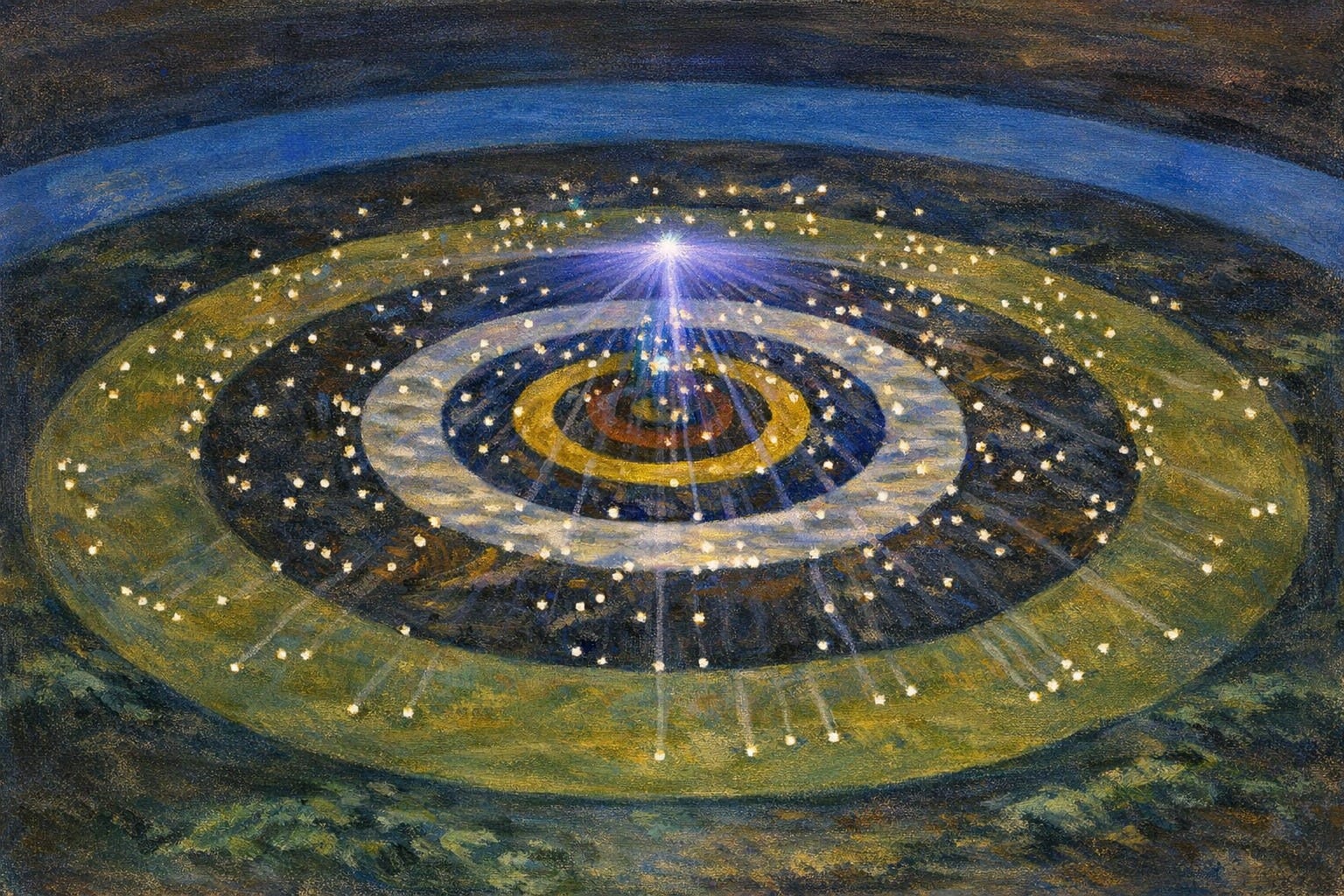
A second point is that the universe described in the Vedas is multidimensional. Our perception of reality depends on our level of consciousness. Just as demigods can’t perceive great sages like the four Kumāras unless they become visible to them, we can’t perceive the demigods or their abodes unless they become visible to us. Even the asuras are normally not visible to us, since they also possess subtle bodies, similar to the demigods in nature.
What do I mean by subtle? The words “gross” and “subtle” may not precisely convey the idea, but I use them here due to the absence of better terms. For the demigods and asuras, the type of “subtle” matter they have around them looks as solid as the matter we have on our planet looks for us. However, the type of matter that constitutes their worlds is fundamentally different from the type of matter that makes up our planet. Just like water is subtler than earth, in the sense that it’s liquid and transparent, and air is subtler than water in the sense that it is much lighter and more compressible, the type of matter that constitutes the abodes of the devas and asuras is subtle in the sense that we can’t detect it using our earthly instruments, or interact with it using our senses. It is similar in principle to the idea of dark matter present in modern physics. One meaning of the word “subtle” is something that is mysterious and not easily understood; another is something refined, whereas “gross” applies to something lower, which lacks such refinement. I use it here in that sense.
Bhū-mandala corresponds to the intermediate planetary system. Below, in the subtle vertical dimension, are the subterranean realms of the asuras, and above are the abodes of the demigods, followed by the planetary systems inhabited by great sages. Somehow, the demigods see Bhū-mandala as a continuous structure and have access to the different tracts of land that compose it, but in our gross reality, the different abodes that compose Bhū-mandala appear as different planets, to which we don’t have access. We can’t even directly understand how these different planets appear in our gross reality, since in our age we have access to only our own planet, which is part of the southern section of Jambūdvīpa, the central island.
In our gross reality, the universe appears to be almost empty, and everything is extremely far away. From the higher-dimensional perspective of the demigods, however, the different planets that compose the intermediate planetary system form a cosmic lotus, with the higher planetary systems orbiting around it like a giant chandelier that has its pivot in Dhruvaloka. If we start from the assumption that the universe appeared by chance and is governed by mechanical physical laws, it does not make much sense, but from the perspective of an all-powerful God with an artistic sense, it’s perfectly plausible. The question is just to understand it.
At the time Śrīla Prabhupāda was commenting on the Fifth Canto, the meaning of the description of Bhū-mandala was a mystery. Prabhupāda asked his disciples to try to find Indian astronomers who could help him explain and build a model of the structure for a Vedic planetarium, but none of the Vedic astrologers of the time were able to give any practical help.
Later on, Prabhupāda gave the keys for understanding the description in a letter containing his final conclusions on the structure of the Vedic Universe and practical instructions to build a visual model of the Vedic universe for the Temple of the Vedic Planetarium in Mayapur (Svarūpa Dāmodara, April 27, 1976):
“My final decision is that the universe is just like a tree, with root upwards. Just as a tree has branches and leaves so the universe is also composed of planets which are fixed up in the tree like the leaves, flowers, fruits, etc. of the tree. The pivot is the pole star, and the whole tree is rotating on this pivot. Mount Sumeru is the center, trunk, and is like a steep hill, like the alps mountains which also have very high peaks. I have seen in Switzerland one mountain peak which was so high that is penetrated through the clouds. The tree is turning and therefore, all the branches and leaves turn with the tree. The planets have their fixed orbits, but still they are turning with the turning of the great tree. There are pathways leading from one planet to another made of gold, copper, etc., and these are like the branches. Distances are also described in the 5th Canto just how far one planet is from another.
We can see that at night, how the whole planetary system is turning around, the pole star being the pivot. Each planet has its orbit fixed but the sun is moving up and down, north and south. It is not that we shall accept the theory that the sun is fixed up and the others are all going around the sun. That is not correct. Even the 7th star is rotating once around the pole star in each 24 hours. The whole universe is just like a big tree, that is a fact. I do not think that the modern astronomers have any such idea that the whole universe is like a big tree. The planets which are full of living entities are one after another, one above the other. The relative positions of the planets is fixed up but the whole thing is turning. The sun is going north and south, it has its own orbit below the moon. So now you all Ph.D.’s must carefully study the details of the 5th Canto and make a working model of the universe. If we can explain the passing seasons, eclipses, phases of the moon, passing of day and night, etc. then it will be very powerful propaganda.”
Here, Prabhupāda gives the keys for understanding the whole cosmological model of the Śrīmad-Bhāgavatam, finding the answers to the questions that baffled Indian astronomers for centuries. The conclusions given by Prabhupāda in this letter can be summarized as follows:
a) The universe has the form of an inverted tree, just as Kṛṣṇa describes in the Bhagavad-gītā. The real form of the three is the spiritual creation, and the material cosmos appears as an inverted reflection of it. Satyaloka, the planet of Brahmā, is situated at the root, and the other planetary systems are below it, forming the trunk, branches, twigs, leaves, etc. of this universal tree. This describes the basic organization of the planetary systems, forming a tree-like structure. Dhruvaloka is central in this model, serving as the central pivot to the universal chandelier of stars and planets.
b) This analogy of the universe as a tree, or as a chandelier, helps us to understand another important feature of the Vedic universe: the whole structure of stars, planets, and other visible objects rotates around the central axis of Dhruvaloka once every 24 hours. This rotation is what explains the passage of days and nights in the model. This detail, indicated by Prabhupāda, is what makes the model functional.
From the perspective of modern cosmology, the idea that the whole universe rotates may appear absurd, but that’s exactly what we see when we look at the night sky. If we make a time-lapse, we see that all the stars revolve around a central pivot every 24 hours. That’s precisely what the Vedic model describes.
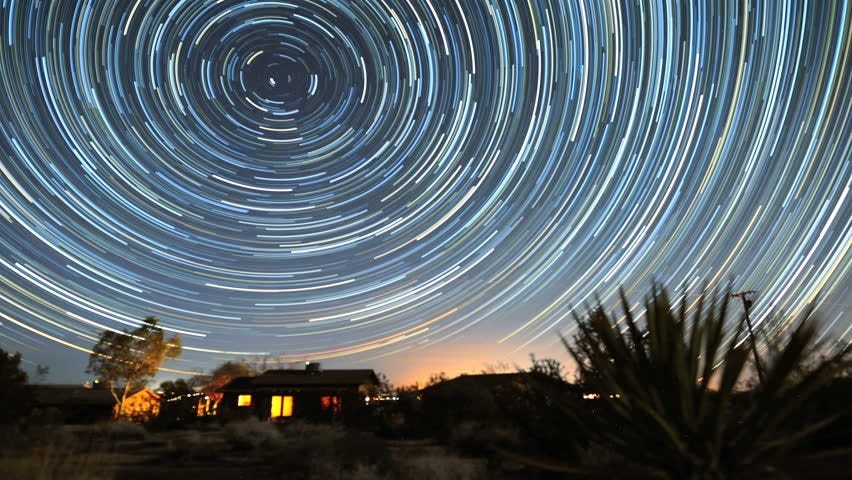
c) In the Vedic model, the days, as well as the passage of the seasons, are explained in terms of the movements of the sun in relation to Bhū-mandala, a much larger, higher-dimensional structure of which our planet is part. In our gross plane, Bhū-mandala is not visible, but the model still describes our practical experience, describing the movements of the sun, planets and stars we observe when we look into the sky.
d) The rotation of the sun around Bhū-mandala results in the passage of the seasons, while the daily rotation of the whole structure around Dhruvaloka explains the passage of the days and nights. Śukadeva Goswami describes this model in chapter 5.21 of the Śrīmad-Bhāgavatam, but the explanation is very difficult to follow. Maharaja Parīkṣit himself asks for clarification in SB 5.22.1. We will discuss this model in more detail later in the book.
e) Mount Sumeru, situated at the center of Bhū-mandala, stands at the very center of the tree, aligned with the pivot of Dhruvaloka. It is surrounded by many other mountains described in chapter 5.16, as well as other structures of Bhū-mandala. In the model, our planet lies to the south of the structure, as part of Bhārata-varṣa.
f) Prabhupāda mentions that “The tree is turning and therefore, all the branches and leaves turn with the tree. The planets have their fixed orbits, but still they are turning with the turning of the great tree.” What does it mean?
This is a very delicate part of the model. In SB 5.21.8-9, Śukadeva Goswami mentions that “Although the sun moves counterclockwise, facing the constellations, with Sumeru Mountain on its left, it also moves clockwise and appears to have the mountain on its right because it is influenced by the dakṣiṇāvarta wind.”
How can the sun move in two directions at the same time, moving simultaneously clockwise and counterclockwise? This is exactly the point that confuses Maharaja Parīkṣit and leads him to inquire in SB 5.22.1. What at first sounds absurd, is precisely the passage that reveals the delicate point made by Prabhupāda: the sun moves simultaneously in two directions, creating both the transitions of day and night and the cycles of the seasons.
In the annual orbit around Mount Sumeru, the sun moves counterclockwise, with Sumeru Mountain on its left. This movement is perceived on our planet as the sun moving up and down in the sky with the passage of the seasons. In the other movement, the sun moves clockwise, together with the rest of the universal tree around Dhruvaloka, with Mount Sumeru on its right. This movement is much faster, taking just 24 hours to be completed, and is perceived on our planet as the passage of days and nights.
The same dual movement is found in the movement of the visible planets, such as Mars and Jupiter. They have their independent orbits in relation to each other, but at the same time, they all move together once per day around Dhruvaloka, following the movement of the whole sky. Prabhupāda reinforces this by saying that “We can see that at night, how the whole planetary system is turning around, the pole star being the pivot. Each planet has its orbit fixed, but the sun is moving up and down, north and south.”
g) All parts of the universe, and even Bhū-mandala itself, are composed of different planets. However, these planets are connected by interplanetary pathways that allow inhabitants who are sufficiently advanced to go from one planet to the other, giving the idea of the structure forming a continuous area as described in the Fifth Canto. In the analogy of the tree, these pathways are like the branches connecting the different leaves and fruits of the tree. This is how this structure is being represented in the exposition in the ToVP:
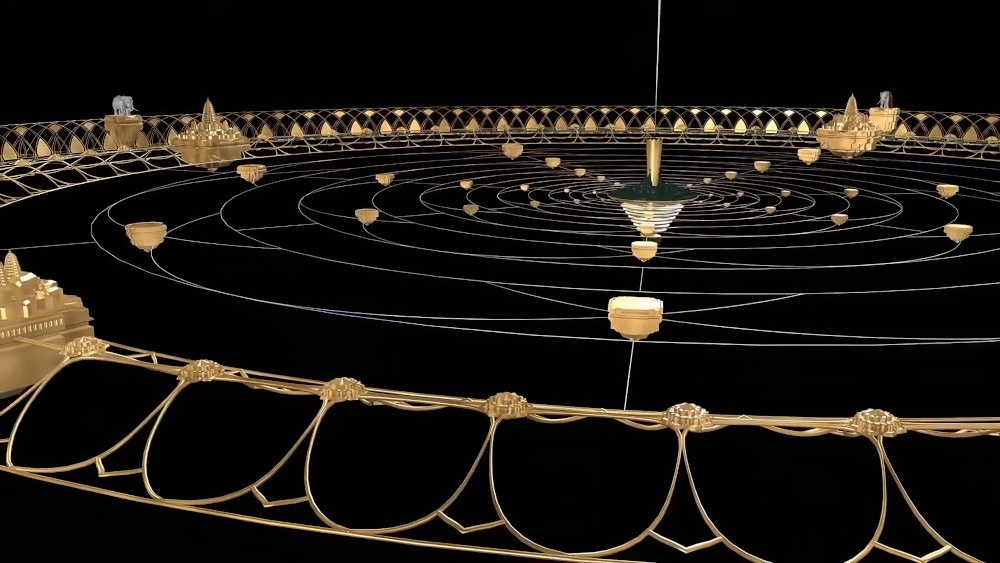
Bhū-mandala is compared to a lotus, where the different varṣas correspond to different petals of the flower. Prabhupāda concludes that these are different planets, but they are connected to each other through interplanetary pathways. Other inhabitants of Bhū-mandala, as well as advanced human beings from previous ages, used to be able to move freely from one varṣa to another of Bhū-mandala, and sometimes even to other planetary systems, but because we lack the qualification and the appropriate set of body and senses, we can’t even perceive these other abodes. We end up thus with the impression we are alone in the universe, as believed by many, since we can’t see or contact anyone else.
h) Different from what is believed in modern astronomy, in the Vedic model all planets are inhabited. Even the other planets of our solar system, including the sun and the moon (also counted as planets in the Vedic model), are celestial abodes, inhabited by advanced civilizations. However, even if we go there, we see only rocks and dust, since we lack the qualification to see and experience their refined reality. This is the point behind the failure of the space programs of different countries in detecting life outside our planet. They are based on the wrong process, relying on sensors and machines, instead of the elevation of their consciousness. Without following the proper process, even if we somehow break free of the gravity of our planet and reach other planets and stars, we continue being imprisoned in our gross reality and can’t see anything apart from dust and rocks.
Prabhupāda gives another concise explanation of the workings of the material universe in his purport to the Śrī Īśopaniṣad, mantra 14. This is another passage that helps us to understand the material manifestation and our role in it.
“From the Viṣṇu Purāṇa (6.7.61) we receive the following information: viṣṇu-saktih para prokta, ksetrajñakhya tatha para, avidya-karma-samjñanya, trtiya saktir isyate
Lord Viṣnu, the Personality of Godhead, possesses different energies, known as para (superior) and apara (inferior). The living entities belong to the superior energy. The material energy, in which we are presently entangled, is the inferior energy. The material creation is made possible by this energy, which covers the living entities with ignorance (avidya) and induces them to perform fruitive activities. Yet there is another part of the Lord’s superior energy that is different from both this material, inferior energy and the living entities. That superior energy constitutes the eternal, deathless abode of the Lord. This is confirmed in the Bhagavad-gītā (8.20): paras tasmat tu bhavo ’nyo, ’vyakto ’vyaktat sanatanah, yah sa sarvesu bhutesu, nasyatsu na vinasyati
All the material planets – upper, lower and intermediate, including the sun, moon and Venus – are scattered throughout the universe. These planets exist only during the lifetime of Brahmā. Some lower planets, however, are vanquished after the end of one day of Brahmā and are again created during the next day of Brahmā. On the upper planets, time is calculated differently. One of our years is equal to only twenty-four hours, or one day and night, on many of the upper planets. The four ages of earth (Satya, Treta, Dvapara and Kali) last only twelve thousand years according to the time scale of the upper planets. Such a length of time multiplied by one thousand constitutes one day of Brahmā, and one night of Brahmā is the same. Such days and nights accumulate into months and years, and Brahmā lives for one hundred such years. At the end of Brahmā’s life, the complete universal manifestation is vanquished.
Those living beings who reside on higher planets like the sun and the moon, as well as those on Martyaloka, this earth planet, and also those who live on lower planets – all are merged into the waters of devastation during the night of Brahmā. During this time no living beings or species remain manifest, although spiritually they continue to exist. This unmanifested stage is called avyakta. Again, when the entire universe is vanquished at the end of Brahmā’s lifetime, there is another avyakta state. But beyond these two unmanifested states is another unmanifested state, the spiritual atmosphere, or nature. There are a great number of spiritual planets in this atmosphere, and these planets exist eternally, even when all the planets within this material universe are vanquished at the end of Brahmā’s life. There are many material universes, each under the jurisdiction of a Brahmā, and this cosmic manifestation within the jurisdiction of the various Brahmās is but a display of one fourth of the energy of the Lord (ekapad-vibhuti). This is the inferior energy. Beyond the jurisdiction of Brahmā is the spiritual nature, which is called tripad-vibhuti, three fourths of the Lord’s energy. This is the superior energy, or para-prakrti.”
Let’s break it down into simple ideas:
1) Kṛṣṇa possesses two energies: The superior energy (para) and the inferior energy (apara). The souls are part of the superior energy, and material nature is part of the inferior energy.
2) Material energy covers the souls with ignorance (avidya), and this ignorance makes us acquire material bodies and perform different material activities, forgetting our original spiritual nature.
3) Apart from the souls, there is another part of Kṛṣṇa’s superior energy, which constitutes the spiritual planets. Kṛṣṇa’s energy has thus three main components: The spiritual creation, the material creation, and the souls, who can choose between being part of the spiritual or material creation.
4) The material universes are repeatedly created and destroyed, but the spiritual creation is eternal. In the material universes there is repeated birth and death, but in the spiritual creation there is eternity.
5) There are many planets scattered throughout the universe. These planets exist only during the lifetime of Brahmā. When Brahmā dies, all the planets of the universe are destroyed.
6) At the end of each day of Brahmā, lower planets are destroyed (up to Svargaloka), and only the higher planets (Maharloka and higher) remain. The planets that are destroyed are created again on the next day of Brahmā.
7) Time on the upper planets is calculated differently from our planet. One year for us is equal to just twenty-four hours (one day and night), in Svargaloka. Similarly, a whole cycle of four ages on earth (Satya, Treta, Dvāpara, and Kali) lasts only twelve thousand years according to the time scale of the celestial planetary system.
8) One day of Brahmā (12 hours) corresponds to 1,000 sequences of Satya, Treta, Dvāpara, and Kali-yugas. There is also the night of Brahmā (the other 12 hours of his day) that lasts for the same period. Such days and nights accumulate into months and years, and Brahmā lives for one hundred such years. At the end of Brahmā’s life, the complete universal manifestation is vanquished.
9) During the night of Brahmā, all the living beings from the destroyed planetary systems of Bhūrloka, Bhuvarloka and Swargaloka, as well as the lower planets, are merged into the waters of devastation, remaining inactive under the protection of Garbhodakaśāyī Viṣṇu.
10) During this period, these living entities remain materially unmanifest, although spiritually they continue to exist. This unmanifested stage is called avyakta and lasts for the period of the night of Brahmā.
11) When Brahmā finally reaches the end of his life, there is another avyakta state, when all the living beings who did not achieve liberation are merged into the body of Mahā-Viṣnu and have to wait for a very long period until a new cycle of creation begins.
12) Both the materially unmanifested state that occurs at the end of the day of Brahmā, as well as at the end of his life are called avyakta. There is another avyakta, which is the spiritual world. There, all beings are also materially unmanifested, but there they are spiritually active. What we call liberation is a state of material immanifestation, where we become free from the gross and subtle material bodies. It leads to life in the Brahmajyoti, or the Causal Ocean, where the soul remains in a dormant state. The stage of spiritual manifestation is beyond that. It comes from reestablishing our original spiritual nature and becoming active in the spiritual planets.
13) In the spiritual world (the spiritual atmosphere, or nature), there is a great number of spiritual planets that exist eternally. These planets are the abode of many eternally liberated souls.
14) All the planets in the spiritual sphere continue to exist even at the end of Brahmā’s life. They are not affected by the cycles of creation and destruction of the material universes.
15) There are many material universes, each one under the jurisdiction of a particular Brahmā. The combination of all the different material universes constitutes just one-quarter of the energy of the Lord (ekapad-vibhuti). This is the inferior energy.
16) Beyond this inferior material energy there is the spiritual nature, which is called tripad-vibhuti, three-quarters of the Lord’s energy. This is the superior energy, or para-prakrti, that composes the spiritual planets and everything that exists there.
Let’s now study this model in detail, going through the relevant chapters of the Fifth Canto, verse by verse.
Read the whole book:
« Making Sense of the Vedic Universe, a Higher-Dimensional Reality
This is a publication for thoughtful readers who want to go deeper into Kṛṣṇa consciousness. I publish daily, trying to offer high-quality spiritual content, and all posts are available to free subscribers. If you wish, you can also choose a paid subscription to support this work.
You can also receive the updates on WhatsApp or Telegram.
If you would like to contribute further, you can find the donation links here.