

« The Song of God—Volume 1, chapters 1-6
The learned guide others without disturbing them (Bg 3.25 to 3.29)
In the previous section, Kṛṣṇa emphasized the role of saintly persons in guiding others by their example. Now, He explains how they guide with their words. The self-realized devotee understands well the difference between work performed in Kṛṣṇa consciousness and material, fruitive work performed under the material modes. However, he also understands that it is not possible for an ordinary person to be immediately elevated to a completely detached platform. Therefore, instead of telling them to stop their material work, he teaches them to spiritualize their activities, so they can be gradually elevated to the platform of work in Kṛṣṇa consciousness.
Text 25: saktāḥ karmaṇy avidvāṁso, yathā kurvanti bhārata
kuryād vidvāṁs tathāsaktaś, cikīrṣur loka-saṅgraham
As the ignorant perform their duties with attachment to results, the learned may similarly act, but without attachment, for the sake of leading people on the right path.
Text 26: na buddhi-bhedaṁ janayed, ajñānāṁ karma-saṅginām
joṣayet sarva-karmāṇi, vidvān yuktaḥ samācaran
So as not to disrupt the minds of ignorant men attached to the fruitive results of prescribed duties, a learned person should not induce them to stop work. Rather, by working in the spirit of devotion, he should engage them in all sorts of activities [for the gradual development of Kṛṣṇa consciousness].
Text 27: prakṛteḥ kriyamāṇāni, guṇaiḥ karmāṇi sarvaśaḥ
ahaṅkāra-vimūḍhātmā, kartāham iti manyate
The spirit soul bewildered by the influence of false ego thinks himself the doer of activities that are in actuality carried out by the three modes of material nature.
Text 28: tattva-vit tu mahā-bāho, guṇa-karma-vibhāgayoḥ
guṇā guṇeṣu vartanta, iti matvā na sajjate
One who is in knowledge of the Absolute Truth, O mighty-armed, does not engage himself in the senses and sense gratification, knowing well the differences between work in devotion and work for fruitive results.
Text 29: prakṛter guṇa-sammūḍhāḥ, sajjante guṇa-karmasu
tān akṛtsna-vido mandān, kṛtsna-vin na vicālayet
Bewildered by the modes of material nature, the ignorant fully engage themselves in material activities and become attached. But the wise should not unsettle them, although these duties are inferior due to the performers’ lack of knowledge.
In the previous section, we studied how a person in knowledge should act. Even though a pure devotee is free from material attachment, he should give the proper example to others. Now, Kṛṣṇa deepens this instruction, explaining how he should instruct ordinary persons, who are still attached to enjoying their senses and acting in this world. We may think this section may not apply to us, because we are not liberated souls, but it is not so. All of us have some realization to share, and we have a duty to share what we know about Kṛṣṇa consciousness with others. This passage contains important instructions on how to do so.
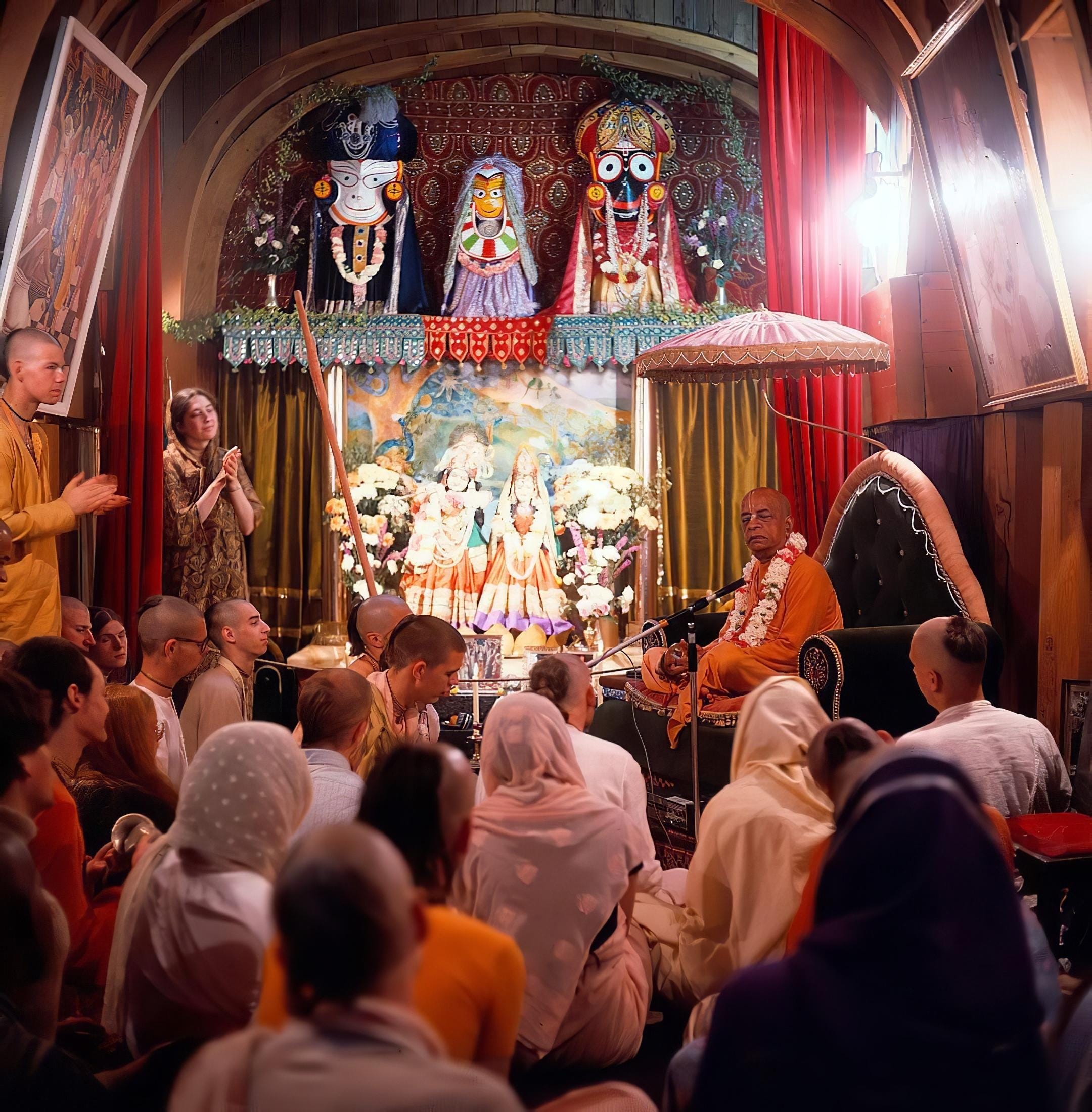
Both a materialist and a self-realized soul perform some kind of work. The difference is that the materialist works to satisfy his senses, while the devotee works for the satisfaction of Kṛṣṇa. Superficially, a pure devotee and a materialist may appear to perform similar activities, but there will be a crucial difference in their consciousness. When Śrīla Prabhupāda was living in Vṛndāvana, before coming to the West, he was personally printing and selling his books. Many pseudo-Vaiṣṇavas were criticizing him, confusing this with ordinary business. In their stereotyped idea, a Vaiṣṇava should simply sit, chant, and pretend to be humble. Prabhupāda, however, could understand and apply the essence of the Gītā, performing activities in devotional service and accepting all sorts of inconveniences to spread the teachings of Kṛṣṇa and the previous ācāryas.
Another misconception is that karma-yoga is merely a platform for neophytes that is later replaced by devotional service. This is similar to believing that the foundation is different from the building. Technically speaking, there is a division, but they are so intimately connected that the separation remains merely technical. A teacher may emphasize the technical difference in order to help the student to understand the structure, but one errs if he thinks the foundation is separated from, or less important than the rest of the building and can thus be neglected. Noticing this tendency in his students, another teacher may do the opposite, emphasizing that the foundation is an essential and inseparable part of the building that cannot be skipped.
Similarly, if we study the commentary of Śrīla Viśvanātha Cakravartī Ṭhākura, for example, we can notice that he emphasizes the distinctions to help us understand the structure and hierarchy of the different yoga processes explained in the Gītā. Prabhupāda, on the other hand, speaking to a modern audience prone to inactivity, impersonalism, and false renunciation, often emphasizes the common ground, teaching us that karma-yoga and bhakti-yoga should be seen as different steps of the same ladder. We can see that in the Gītā, Śrīla Prabhupāda usually translates karma-yoga, and other processes performed in Kṛṣṇa consciousness directly as “devotional service,” emphasizing the substance instead of the details.
Both emphases are valid, but Prabhupāda emphasizes the points that are more essential to us. He carefully studied the commentaries made by previous ācāryas and presented their conclusions in a way that makes the practical application unmistakable.
When work is connected with Kṛṣṇa, it is already devotional service in progressive form, regardless of the faults of the practitioner. The natural progression is to gradually transition from sakāma-karma-yoga to niṣkāma-karma-yoga, and from this platform, gradually come to the platform of pure love of Godhead, without necessarily ceasing to work. As we can see practically, even the greatest Vaiṣṇavas continue to work for Kṛṣṇa, often until their last breath, but they do so from a platform of pure love.
In this way, the activities of a pure devotee are completely spiritual, even while printing and selling books, building temples, or managing a spiritual institution. The question is, how can a devotee bring a materialist to the platform of Kṛṣṇa consciousness? Should he instruct him to stop working, leave his family, and go to chant solitarily in the forest?
Kṛṣṇa answers this question in text 3.26: “So as not to disrupt the minds of ignorant men attached to the fruitive results of prescribed duties, a learned person should not induce them to stop work. Rather, by working in the spirit of devotion, he should engage them in all sorts of activities.”
A person who is still full of material desires can’t stop performing actions. This is simply not possible. Even if one tries to renounce and go to chant in the forest, the mind will continue dwelling on the objects of sense gratification. One will then either fall back into his previous lifestyle, or become one of the pretenders already condemned in the previous sections.
Instead, a materialistic person should be engaged in activities connected with Kṛṣṇa consciousness. By associating with pure devotees, one can get the taste, and learn that serving Kṛṣṇa and following the spiritual process is much more blissful than simply serving his senses. Studying different biographies of Śrīla Prabhupāda, we can see how he was practically applying this strategy in the beginning of our movement, creating temples that were always buzzing with activity.
Another dimension of this verse appears when we speak to materially pious people, who follow the path of the Vedas to some extent, performing some worship to demigods or family traditions. Should we tell them to stop everything? In his purport, Prabhupāda speaks of two paths: in general, we should teach them to continue whatever beneficial activities they are performing, but connect them with the service of Kṛṣṇa, especially with our own example. In other words, we should help them transition from karma-kānda to karma-yoga, by establishing Kṛṣṇa as the goal. By starting the process of dedicating the fruits of one’s work to Kṛṣṇa, one can gradually advance further.
This is explained by Prabhupāda in this passage:
“All rituals, all performances of sacrifices, and everything that is put into the Vedas, including all direction for material activities, are meant for understanding Kṛṣṇa, who is the ultimate goal of life. But because the conditioned souls do not know anything beyond sense gratification, they study the Vedas to that end. But through fruitive activities and sense gratification regulated by the Vedic rituals one is gradually elevated to Kṛṣṇa consciousness. Therefore a realized soul in Kṛṣṇa consciousness should not disturb others in their activities or understanding, but he should act by showing how the results of all work can be dedicated to the service of Kṛṣṇa. The learned Kṛṣṇa conscious person may act in such a way that the ignorant person working for sense gratification may learn how to act and how to behave.”
If, however, one is already slightly developed in Kṛṣṇa consciousness, he or she may be directly engaged in the service of the Lord, ascending directly to the platform of niṣkāma-karma-yoga. In this case, there is no need to perform Vedic rituals and other pious activities because the practice of Kṛṣṇa consciousness includes the results of all these activities.
This point is made in the next paragraph of the purport:
“Although the ignorant man is not to be disturbed in his activities, a slightly developed Kṛṣṇa conscious person may directly be engaged in the service of the Lord without waiting for other Vedic formulas. For this fortunate man there is no need to follow the Vedic rituals, because by direct Kṛṣṇa consciousness one can have all the results one would otherwise derive from following one’s prescribed duties.”
We need to be able to see, in a detached spirit, which of the two platforms is more adequate, according to the person to whom we are speaking, and our own level of spiritual realization.
Next, in texts 3.27 and 3.28, Kṛṣṇa describes the consciousness of a materially attached person. This helps us to understand our own material conditioning and gradually become free from it, and also to better understand the challenges of others whom we are trying to teach.
While living in the material world, we identify with the material body, and observing that the body is performing actions, we assume that we are the ones performing such actions. This reinforces our false ego, making us see ourselves as the creators of many material things.
Kṛṣṇa, however, points out the central fault in this thinking: we are not the body or the mind. We are not the ones who create the body, we are not the ones who maintain it, and we are not even the ones who move it. He is. How then can we claim to be the ones constructing things and take the results? The credit as well as the results should be given to Him.
The Sanskrit word is kartā (doer). I may think I’m the doer, but this is illusory. The immediate cause is the three modes of material nature, which are moving the body, and the ultimate cause is Kṛṣṇa, who is operating the whole structure. A passenger seated on a train may think he is the cause of the train moving, while in reality the train is moved by electricity and operated by a locomotive engineer.
Prabhupāda explains this concept in his purport to text 3.27:
“The materialistic person has no knowledge that ultimately he is under the control of Kṛṣṇa. The person in false ego takes all credit for doing everything independently, and that is the symptom of his nescience. He does not know that this gross and subtle body is the creation of material nature, under the order of the Supreme Personality of Godhead, and as such his bodily and mental activities should be engaged in the service of Kṛṣṇa, in Kṛṣṇa consciousness.”
Material life is based on the concept of false ego, thinking we are the body and mind and claiming the results of the activities performed by these layers. Kṛṣṇa consciousness means to accept our dependency and agree to act according to His direction, performing our role in His cosmic creation through the performance of our material duties, while at the same time improving our spiritual practice. This dual approach brings us gradually to our true ego, the understanding of our eternal relationship with Him.
A person who understands that he is not the body, or the material modes that are moving the body, and not even the mind or intelligence, is called a tattva-vit, a knower of the Absolute Truth. On this platform, we understand that we are not part of this material world, but somehow got entrapped here. Once we reach this understanding, we can understand our eternal, real position of service to Kṛṣṇa and act upon it.
Kṛṣṇa summarizes the process of becoming free from material illusion in text 3.28. The devotee should understand well the difference between working for Kṛṣṇa and working for his personal sense gratification and choose the first. At every moment we have the choice of doing something for Kṛṣṇa or for our material senses, and as we consistently make the right choice, we advance. Others will engage themselves in different activities according to their natures and will want to take the credit for such activities. Some will engage themselves in social work, others in nationalism or some other ism, and will not show interest in self-realization.
Kṛṣṇa’s advice is that we should not try to agitate such materialistic persons, for this will just produce useless discussions that will serve no purpose apart from agitating both ourselves and them. Unless we are ourselves on the spiritual platform, we can’t bring anyone else to the spiritual platform. Therefore, the best policy is to try to develop our own practice and help innocent persons, leaving the big materialists to pure devotees who may be able to effectively influence them.
This is the general principle. There is, however, another dimension to it explained by Prabhupāda in his purport:
“Men who are ignorant cannot appreciate activities in Kṛṣṇa consciousness, and therefore Lord Kṛṣṇa advises us not to disturb them and simply waste valuable time. But the devotees of the Lord are more kind than the Lord because they understand the purpose of the Lord. Consequently they undertake all kinds of risks, even to the point of approaching ignorant men to try to engage them in the acts of Kṛṣṇa consciousness, which are absolutely necessary for the human being.”
Even though generally ineffective, dangerous, and even discouraged by the Lord Himself, devotees who are anxious to spread Kṛṣṇa consciousness and bring everyone to the service of Kṛṣṇa may approach all kinds of materialists and accept all kinds of risks and inconveniences. They do so because they understand the ultimate desire of the Lord in saving the conditioned souls from the covering of illusion, and try to find ways to bring even the staunch materialist to a platform of Kṛṣṇa consciousness.
Main points in the purports of Śrīla Prabhupāda:
“As the ignorant perform their duties with attachment to results, the learned may similarly act, but without attachment, for the sake of leading people on the right path.”
a) The activities of a devotee and a materialist may be similar, but they are different in desires and consciousness. A pure devotee conducts all his activities for the satisfaction of Kṛṣṇa, and teaches others how to act on the same platform.
“So as not to disrupt the minds of ignorant men attached to the fruitive results of prescribed duties, a learned person should not induce them to stop work. Rather, by working in the spirit of devotion, he should engage them in all sorts of activities [for the gradual development of Kṛṣṇa consciousness].”
a) Everything in the Vedas is meant to help understand Kṛṣṇa, but conditioned souls have a tendency to use the Vedas to increase their sense gratification. Still, by following the scriptures, they are gradually elevated.
b) A devotee thus does not disturb them in these activities, even though their activities lack in knowledge. Instead, he tries to elevate them to the next step, teaching them to connect their work with the service of Kṛṣṇa.
c) Among such ignorant persons, there may be a few who are slightly developed in Kṛṣṇa consciousness, who may be directly involved in devotional service without first following other formulas recommended in the Vedas.
“The spirit soul bewildered by the influence of false ego thinks himself the doer of activities that are in actuality carried out by the three modes of material nature.”
a) Even though the external activity may appear similar, there is a gulf of difference between a Kṛṣṇa conscious person and an ordinary man. A materialist acts under the false ego and thinks himself the doer of everything.
b) The body and senses are created from material nature, which is a potency of Kṛṣṇa. Therefore, they belong to Him and should be used in His service. Because of his misuse of the body and senses since time immemorial, a materialist becomes completely bewildered by the false ego, and forgets his eternal relationship with Kṛṣṇa.
“One who is in knowledge of the Absolute Truth, O mighty-armed, does not engage himself in the senses and sense gratification, knowing well the differences between work in devotion and work for fruitive results.”
a) Once a person comes to know Kṛṣṇa, he comes to understand that his position in this material world is unnatural. He understands his real identity and comes to the conclusion that he should perform all his activities in Kṛṣṇa consciousness.
b) By being engaged in Kṛṣṇa-conscious activities, one loses the attachment to temporary material activities. He understands that this material creation exists under the control of the Lord and accepts even negative reactions as the mercy of the Lord for his ultimate liberation. In this way, he remains undisturbed. Such a knower of the Lord is called a tattva-vit.
“Bewildered by the modes of material nature, the ignorant fully engage themselves in material activities and become attached. But the wise should not unsettle them, although these duties are inferior due to the performers’ lack of knowledge.”
a) The body is a gift of nature for us to practice Kṛṣṇa consciousness and realize our spiritual nature, but people without understanding of the soul identify with the body and act materially on the platform of false ego. Under the illusion of material designations, they remain busy in the material field, acting in terms of social work, nationalism, altruism, or simply base selfish action.
b) Busy in such materialistic activities, they consider self-realization a myth and are not interested. However, instead of fighting with them, it is better to spend time in our own spiritual practice. Instead of trying to make them pure devotees overnight, it’s more effective to start with moral principles, non-violence, pious work, and so on, that they can more easily accept. By gradually developing piety, they may become more prone to becoming devotees in the future.
c) Even though Kṛṣṇa advises us to not disturb them, devotees are more kind than the Lord Himself, because they understand the inner desire of the Lord to reach the conditioned souls. They thus take the risk of approaching ignorant men to engage them in Kṛṣṇa-conscious activities.
Next: Surrendering our work to Kṛṣṇa (3.30 to 3.35)
Read the entire book:
« The Song of God—Volume 1, chapters 1-6

This is a publication for thoughtful readers who want to go deeper into Kṛṣṇa consciousness. I publish daily, trying to offer high-quality spiritual content, and all posts are available to free subscribers. If you wish, you can also choose a paid subscription to support this work.
You can also receive the updates on WhatsApp or Telegram.
If you would like to contribute further, you can find the donation links here.