

« Making Sense of the Vedic Universe, a Higher-Dimensional Reality
The life of Brahmā
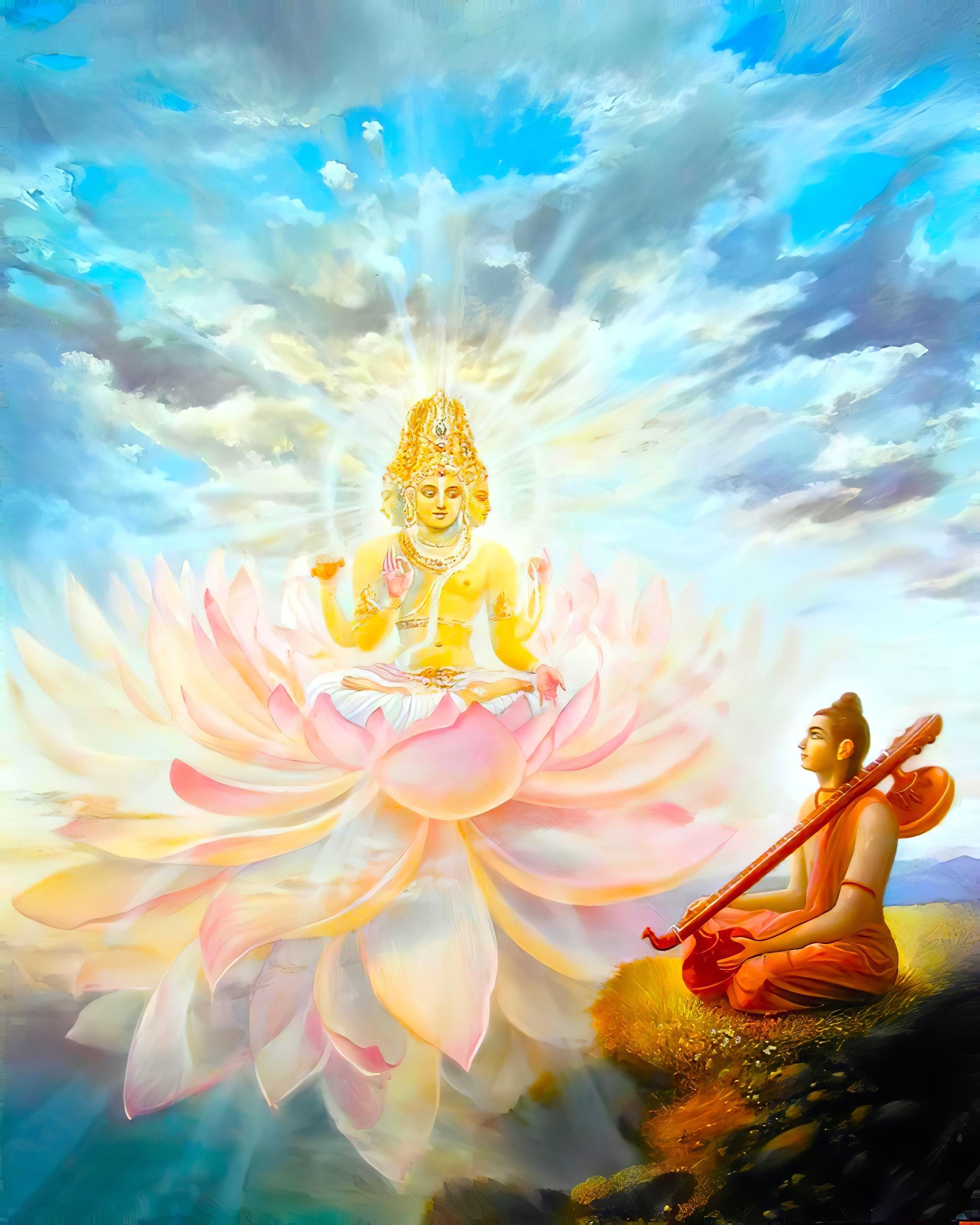
Although very powerful, Brahmā is a mortal being, just like us. However, due to his great qualifications, he receives the responsibility of managing a universe, just like a king or president. It may look like a prestigious position, but in reality it’s a quite difficult job. Most of us already have trouble maintaining a small family with a few children. Imagine having a whole universe depending on you. It’s described, for example, that at the end of the previous manvantara, Brahmā fell asleep briefly, which triggered a partial devastation of the universe. This illustrates how things can go wrong with Brama’s slightest inattentiveness.
We are in the Kali-yuga of the 28th divya-yuga of the 7th manvantara, on the first day of the 51st year of Brahmā. Just like us, Brahmā lives for 100 years. The difference is that his days and years are a lot longer than ours.
The life of Brahmā is divided into two halves, or parārdhas. The first half is already over, and we are now in the second half. The first day of the life of Brahmā was called Brāhma-kalpa (the millennium Brahmā appeared), and the second Pādma-kalpa (the millennium the first creation happened). The current millennium is called the Varāha millennium (because that’s the millennium Lord Varāha appears) or Pādma-kalpa (because in this millennium a new creation takes place following the complete destruction at the end of the first half of the life of Brahmā). The whole life of Brahmā equals just one nimeṣa (half a second) for Lord Mahā-Viṣnu.
“The one hundred years of Brahmā’s life are divided into two parts, the first half and the second half. The first half of the duration of Brahmā’s life is already over, and the second half is now current.
In the beginning of the first half of Brahmā’s life, there was a millennium called Brāhma-kalpa, wherein Lord Brahmā appeared. The birth of the Vedas was simultaneous with Brahmā’s birth. The millennium which followed the first Brāhma millennium is known as the Pādma-kalpa because in that millennium the universal lotus flower grew out of the navel reservoir of water of the Personality of Godhead, Hari.
O descendant of Bharata, the first millennium in the second half of the life of Brahmā is also known as the Vārāha millennium because the Personality of Godhead appeared in that millennium as the hog incarnation. The duration of the two parts of Brahmā’s life, as above mentioned, is calculated to be equal to one nimeṣa [less than a second] for the Supreme Personality of Godhead, who is unchanging and unlimited and is the cause of all causes of the universe.” (SB 3.11.34-38)
Brahmā lives for a total of 311.04 trillion years, an extremely long time. During this period, the universe goes through 36,000 cycles of creation and destruction, corresponding to the passage of his days and nights. After this period, Brahmā finally reaches the end of his life. With his demise, the universe is completely destroyed. All the material elements and all the souls merge then back into the body of Mahā-Viṣnu for a long period in an unmanifest state that lasts for another 311.04 trillion years. After this, the universe is created again. There is a new Brahmā, and a new cycle of 311.04 trillion years starts. Again, all the different cycles repeat.
That’s the secret behind the detailed descriptions of the future offered in the Vedas. Time in our plane works in a circular way, with the same general events repeating cyclically, just like a theatrical performance that is staged again and again, with the same script but different actors. Great sages can see the circular nature of time, and they share this knowledge with us in the Vedas, so we can understand how the cycles work and understand the ultimate futility of material life.
Although time controls everything that is material, time is under the complete control of the Lord. Similarly, time controls everyone who is under the body’s conception of life, from lower animals to demigods, but it doesn’t control pure devotees of the Lord, who live in the transcendental platform.
The 14 Manus
There are 14 Manus in a day of Brahmā, in a sequence that repeats in each of his days. At the end of each manvantara, a process of extinction occurs, with the previous Manu and all demigods leaving their posts. After a long period of managing the universe (an entire manvantara lasts for 306.72 million years), these demigods receive the opportunity of being promoted to Maharloka, from where they continue gradually progressing.
After one team of demigods leaves, the next Manu takes charge of the management of the cosmos, together with a new team of demigods. There is a period of 1.728 million years between two manvantaras called sandhyā (juncture), when things are gradually restored after the previous devastation. From there, the population of the universe again increases, and the different living entities can once more continue with their activities. Apart from managing, the Manus are responsible for disseminating and maintaining religious principles.
Understanding the cycles of the Manus is the key to understanding the chronology of the Śrīmad-Bhāgavatam. At first, the Bhāgavatam may appear to be a book with different pastimes that, despite the deep spiritual significance, are not directly connected. However, when we properly understand the chronology, we can see that, apart from all transcendental knowledge, the Śrīmad-Bhāgavatam provides a historical account of the universe, with precise dates for many universal events that are gradually being confirmed by modern studies. This is in itself proof of the divinity of the Śrīmad-Bhāgavatam and proof of what the Vedas say about the origin of humanity and the process of creation of the world. If, thousands of years ago, human beings were aborigines living in caves and hunting animals, as believed in modern paleontology, how could it be that the authors of the Śrīmad-Bhāgavatam had dates for the creation of the universe and other cosmic events on par with modern estimations? What to say about the details of the structure of the universe that are still potentially ahead of what is known in modern science?
By attentively following the narration of the different Manus in the current day of Brahmā, we can connect the different pastimes to the reign of the particular Manus and, in this way, understand their chronology.
The Manus are called the fathers of mankind because (assisted by the other Prajāpatis) they manage the whole planetary system of Bhū-mandala and are responsible for disseminating religious principles. In the Bhagavad-gītā (4.1), for example, Kṛṣṇa describes how the transcendental science was transmitted by the Sun god to his son Śrāddhadeva, who became the current Manu (Vaivasvata). He, in turn, transmitted it to Ikṣvāku, one of his sons, who became the ruler of the earth. Vivasvān spoke the Bhagavad-gītā to Manu at the beginning of his rule (about 120,400,000 years ago), and according to Prabhupāda (Bg 4.1), Manu transmitted it to Ikṣvāku about two million years ago.
The first manvantara coincides with the advent of Svāyambhuva Manu, who is followed by Svārociṣa Manu, and so on. At the end of each manvantara, there is a partial devastation in which all the demigods, as well as the great sages, are replaced by a new team at the beginning of the reign of the next Manu. Similarly, the Manus are responsible for reestablishing religious principles at the end of each Kali-yuga.
As Śrila Prabhupāda explains (SB 8.14-intro):
“Manu’s duty is to reestablish the system of religion. Manu’s sons execute Manu’s orders, and thus the entire universe is maintained by Manu and his descendants. The Indras are various rulers of the heavenly planets. Assisted by the demigods, they rule the three worlds. The Supreme Personality of Godhead also appears as incarnations in different yugas. He appears as Sanaka, Sanātana, Yājñavalkya, Dattātreya and others, and thus He gives instructions in spiritual knowledge, prescribed duties, principles of mystic yoga, and so on. As Marīci and others, He creates progeny; as the king, He punishes the miscreants; and in the form of time, He annihilates the creation.”
What happens at the end of each day of Brahmā?
At the end of the cycle of creation, all universes are destroyed, and all the souls, as well as the material energy, merge into the body of Lord Mahā-Viṣnu following His process of inhalation. However, what exactly happens at the end of each day of Brahmā? This is described in the Third Canto:
“At the end of the day, under the insignificant portion of the mode of darkness, the powerful manifestation of the universe merges in the darkness of night. By the influence of eternal time, the innumerable living entities remain merged in that dissolution, and everything is silent. When the night of Brahmā ensues, all the three worlds are out of sight, and the sun and the moon are without glare, just as in the due course of an ordinary night.
“The devastation takes place due to the fire emanating from the mouth of Saṅkarṣaṇa, and thus great sages like Bhṛgu and other inhabitants of Maharloka transport themselves to Janaloka, being distressed by the warmth of the blazing fire which rages through the three worlds below. At the beginning of the devastation all the seas overflow, and hurricane winds blow very violently. Thus the waves of the seas become ferocious, and in no time at all the three worlds are full of water.” (SB 3.11.28-31)
At the end of each day of Brahmā, there is a partial destruction of the universe. As a result, all the planetary systems at the bottom of the universe, up to Svargaloka, are completely destroyed, and all living entities (with the exception of great sages who live in the higher planetary systems) are destroyed, with the souls going to sleep in the body of Garbhodakaśāyī Viṣnu. This division occurs because the sages living in these higher planetary systems are engaged in advanced spiritual activities, while ordinary living entities in the lower planetary systems are engaged in material activities using gross material bodies.
It is described that the sun and the moon are not destroyed, but they stop providing illumination, and thus everything becomes dark, in a night that continues for 4.32 billion years.
This suggests that the earth’s satellite, the rocky body that orbits about 238,000 miles from earth and is called “the moon” in modern astronomy, is different from the moon described in the Śrīmad-Bhāgavatam. The moon described in the Bhāgavatam and other Purāṇas is a celestial planet that is presided over by the demigod Soma. It’s larger than the sun and is situated even further from our planet. This moon also emits light, just like the stars. This is explained in the Bhagavad-gītā (10.21) when Kṛṣṇa says, “nakṣatrāṇām ahaṁ śaśī“ (among the stars, I’m the moon).
The planetary system of Svargaloka includes many stars that are situated relatively close to our planet on the cosmic scale. According to Śrīmad-Bhāgavatam. The moon described in the Vedas is the chief among such stars and shares their luminous nature instead of simply reflecting the light of the sun. Because of these differences, Śrila Prabhupāda argued that the Apollo missions didn’t actually reach the moon, since they came to a place that was deserted and filled with rock and sand, and not to the celestial planet described in the Vedas. They went somewhere, but not exactly to the same place described in the Vedas as the celestial moon.
This makes the point that the satellite orbiting our planet and the celestial moon described in the Vedas are two different objects. The moon around our planet could be a gross manifestation of the celestial moon, the way it appears in our gross dimension, or could even be Rahu, as some believe. The main point is to understand that they are not exactly the same. The moon that orbits our planet is destroyed at the end of the day of Brahmā, together with the planet itself, while the celestial moon remains.
Apart from these stars that form Svargaloka, our universe includes many other stars and other structures that are situated much farther from our planet, all the way to the edge of the universe. These stars form the higher planetary systems of Maharloka, Tapoloka, Janaloka, and Satyaloka. Many of them may not even be visible to us. These higher abodes also survive the universal devastation at the end of the day of Brahmā.
In the Śrīmad-Bhāgavatam, it is mentioned that this great fire comes from Lord Ananta, situated at the bottom of the universe, while the Vāyu Purāṇa (2.38) gives a slightly different description, mentioning that the sun becomes red, like an incandescent ball of iron, and its size increases seven times, scorching Bhū-mandala and the heavenly planetary systems, destroying all forms of life in these places. This again points to two different levels of reality: the subtle level of the demigods, and the gross level where we currently live.
The description of the Vāyu Purāṇa offers a description closer to the current theory that our sun will become a red giant in the future, destroying most of the planets in our solar system.
Read the whole book:
« Making Sense of the Vedic Universe, a Higher-Dimensional Reality
This is a publication for thoughtful readers who want to go deeper into Kṛṣṇa consciousness. I publish daily, trying to offer high-quality spiritual content, and all posts are available to free subscribers. If you wish, you can also choose a paid subscription to support this work.
You can also receive the updates on WhatsApp or Telegram.
If you would like to contribute further, you can find the donation links here.
Prabhuji do brahmadeva experience 100 years from his perspective or 311.04 trillion years?