


You can receive new articles directly in your inbox. Subscription is free; donations are welcome.
I used to think that educating children was a very complicated operation. Later I learned it’s much simpler than I thought, and more directly connected with our daily spiritual practice than I initially considered.
When we think about educating a child, we think about teaching a child to act like an adult. When we go on this path, it can quickly become a complicated affair, because just like we have an ego, children also have their ego, and often this approach leads to a conflict between the two. Children who grow up in this way will also notice any kind of discrepancy between the rules imposed by the parents and the way they act, and such discrepancies lead to resentment. As a result, children often grow up averse to following authority, and this leads to more serious problems when they become teenagers.
This also creates difficulties for them in accepting a spiritual master and practicing other aspects of devotional service. We can see that many children of devotees have a natural attraction to devotional service, but at the same time are extremely reluctant to accept any form of disciplinary process, a combination that hampers their progress. A lot of it comes from this.
There is, however, another approach that is actually more in line with what the Vedas teach. What is it?
Instead of trying to teach the child to be an adult, we should act as adults ourselves!
It may sound obvious, but that’s often quite different from what we often do. Frequently, we are not able to control our emotions. We fight with our spouses and other people; we eat without regulation; we act in selfish ways; we are impolite with people, and so on. We do everything that we try to teach children not to do, and as a result, they become resistant and quickly lose faith in us as authorities. When we try to force the children to do things we ourselves are not properly doing, it becomes a simple process of repression.
Walk the talk
Once, a senior devotee told me a story from his childhood. When he was a small child, perhaps 5 years old, he went with his parents to a nearby country by car. They bought several products there, including a big cheese. On the way back, the border guards asked about what they were bringing, and the father showed a few products that were exempt from tax. The border guard asked if there was anything more, and the father said no. At this moment, the child innocently said, “No, Papa, there is also that cheese!” They ended up having to pay a lot in taxes. When they arrived home, the father slapped him; he was fuming. The boy cried, saying that he taught him to always tell the truth! The father became even angrier and chastised him severely. After that, he said he had to reexamine the role of his father as an authority in his life.
Children are extremely efficient in analyzing situations and noticing discrepancies. They can be even sharper than adults in this area. They rarely agree to follow someone who is not walking his talk, even if this person is the father or mother. We can say that children don’t follow what we say; they follow what we do.
When we start acting like adults ourselves, acting in an exemplary way, the children start to automatically learn from our behavior. If a child observes that the father faithfully follows the guru and the same precepts he teaches and that the mother respects the father, the child automatically understands where he is supposed to fit in the system. When this happens, it becomes much easier to keep them on the right path. We can see that the Vedic system of education is based on having teachers with exemplary character, and of course, the parents are the first teachers.
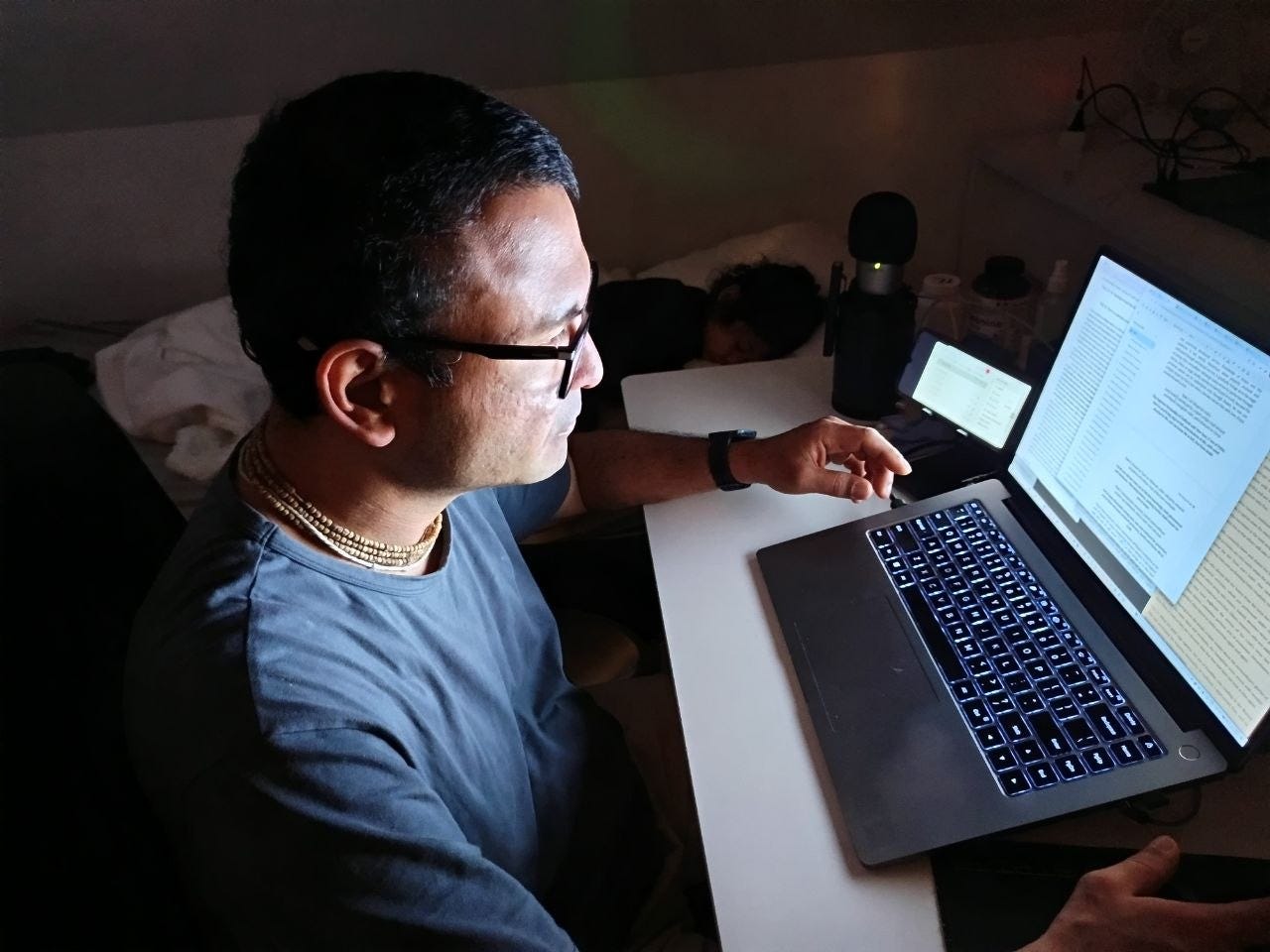
Of course, maintaining such a standard demands a lot of self-control, and that’s where spiritual practice becomes essential. One can question how it is possible to maintain good spiritual practice with a small child. We can observe that many parents have difficulty even in chanting their rounds; what to say about other aspects of spiritual practice. One point I learned here is that it is possible to reserve several hours for spiritual practice daily if we can reconcile it with the child's sleep. Small children typically sleep around 12 hours per day, while adults can go on with 6 or 7. One can just stay with the child in the bed and chant his rounds, study, etc. One can even attend mangala-artik virtually via streaming! Many of my books were written with me working on the computer early in the morning and my daughter sleeping in a bed beside it.
Love and trust
Another component of the Vedic educational system is love and trust. Children need love to grow and develop appropriately. Only when they feel safe and protected can they have the confidence to explore their surroundings and learn. Therefore, caregivers need to love the children under their care.
Love is also the essential factor in disciplining children. When there is a bond of love, children are naturally inclined to accept corrections, while corrections from people with whom a child doesn’t have a bond of affection are often taken as mere oppression, rules that the child observes and tries to bend or bypass as soon as there is opportunity. Even adults have this propensity. We take an objection from a dear person very differently than that of a stranger.
This point about love was one of the greatest mistakes in the early gurukulas in our movement, for example. In Vedic gurukulas, married brāhmanas would open small village schools and would basically accept the children as part of their family. The wife would take care of them as her own children, even bathing and dressing them, and the husband would teach them the sastras. The boys studying in the Vedic gurukulas would thus not be deprived of an environment of love and trust. The children would see the brāhmana and the wife as role models and would do their best to follow their example, and thus they would grow into responsible and devoted adults, capable of passing these qualities to their own children.
In our early gurukulas, however, it was common for immature renunciants to be put in charge of the children, often young brahmacaris with very little life experience, who were struggling to control their own senses and minds. They didn’t have a bond of love with the children, and thus the whole thing would often derail into a mere system of bullying, where the teachers would mistreat the children, and the older children, learning from the example of the teachers, would bully the smaller children, creating a completely hellish system that was the precise opposite of what Prabhupāda was teaching.
This failed experience led to a widespread rejection of the gurukula system and the parents themselves taking charge of their children’s education, which in this situation was a positive step.
The problem is that most of us are victims of a bad education ourselves, and thus we don’t know how to properly raise children either. Each of us has our own stereotyped ideas, and they do not always work. As a result, we again see that many of our children grow up as problematic teenagers and often reject the path of devotional service later in life. As in many other aspects of our devotional life, that’s something we need to learn, and that’s a process that demands a lot of reflection and introspection.
Read more:


This is a publication for thoughtful readers who want to go deeper into Kṛṣṇa consciousness. I publish daily, trying to offer high-quality spiritual content, and all posts are available to free subscribers. If you wish, you can support this work with a monthly contribution. When you subscribe, you can choose between a free subscription and a monthly contribution, and you can switch from a free subscriber to a supporter at any time.
You can also receive updates on WhatsApp or Telegram.
If you would like to contribute further, you can find the donation links here.