

« Making Sense of the Vedic Universe, a Higher-Dimensional Reality
The movement of the sun facing the constellations
“When the sun passes through Meṣa [Aries] and Tulā [Libra], the durations of day and night are equal. When it passes through the five signs headed by Vṛṣabha [Taurus], the duration of the days increases [until Cancer], and then it gradually decreases by half an hour each month, until day and night again become equal [in Libra].
When the sun passes through the five signs beginning with Vṛścika [Scorpio], the duration of the days decreases [until Capricorn], and then gradually it increases month after month, until day and night become equal [in Aries].
Until the sun travels to the south the days grow longer, and until it travels to the north the nights grow longer.” (SB 5.21.4-6)
The movement of the sun around the zodiac (passing north or south of the celestial equator), results in the days becoming longer or shorter, as the seasons go by. The sun goes through the twelve signs during the year.
This explanation becomes easier to follow when we look at the wheel of the zodiac.
The text says, “When the sun passes through Meṣa [Aries] and Tulā [Libra], the durations of day and night are equal.”
These are the two equinoxes (vaiṣuvata), when the sun is aligned with the equatorial plane and the duration of the days and nights is approximately equal at most latitudes. This happens only twice per year, when the sun enters in Meṣa (Aries) and Tulā (Libra). In the modern calendar, this corresponds approximately to March 20 and September 22.
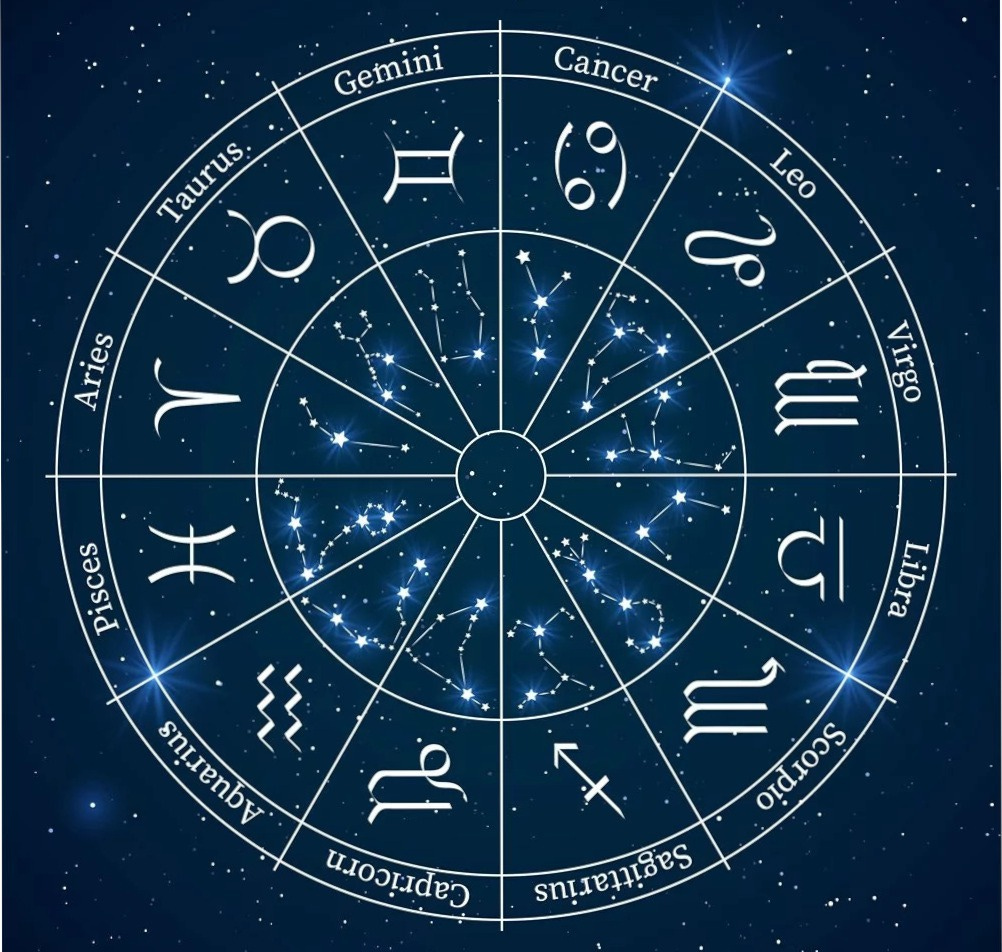
In the model described in these verses, the equator of our planet corresponds also to the celestial equator of Bhū-maṇḍala, since in the Vedic model the earth is not tilted. The same phenomenon should thus be observed in the other planets that compose the planetary system.
Let’s take Aries as the starting point. When the sun enters Aries (nine o’clock on the wheel of the zodiac of the illustration), the day and nights are approximately the same. From Aries, the sun goes to Taurus (Vṛṣabha) and then Gemini (Mithuna) and Cancer (Karkaṭa). Here the sun is moving northward of the equator (udagayana). The practical effect will be opposite in the two hemispheres and will vary according to the latitude. The Bhāgavatam explains it from the point of view of someone in central India. At these latitudes, the transition makes the days longer at a rate of approximately half an hour for each sign, with the sun’s daily arc becoming progressively longer.
When the sun enters Cancer, the days become very long in relation to the nights: approximately 13.5 hours for the days and 10.5 hours for the nights. This is the summer solstice.
After Cancer, there is a reversal. With the sun entering Leo, the days become shorter by about half an hour, and then half an hour more in Virgo. By the time the sun enters Libra, the days and nights are again approximately equal.
We have then the second half of the year, when the sun goes to the southern hemisphere (dakṣiṇa-ayana) and the days become shorter, leading to the colder season. As the sun enters Scorpio and then Sagittarius, the days become progressively shorter, reaching their minimum duration in Capricorn. That’s the winter solstice.
From there, there is again a reversal, with the days gradually increasing as the sun goes through Aquarius and Pisces, until they once more become equal back in Aries. This is also indicated in the text: “When the sun passes through the five signs beginning with Vṛścika [Scorpio], the duration of the days decreases [until Capricorn], and then gradually it increases month after month, until day and night become equal [in Aries].”
In short, the northward movement results in longer days and the southward movement in shorter days. This is a concise explanation of how the movement of the sun results in seasonal change.
What about the sun moving slowly, swiftly, or moderately?
Śukadeva Goswami mentions that “While passing toward the north, toward the south or through the equator, in accordance with the order of the Supreme Personality of Godhead, it is said to move slowly, swiftly or moderately.” What does it mean?
In his commentary to this passage, Śrila Viśvanātha Cakravartī Ṭhākura explains that although the sun spends the same time in each sign (a little over one month), the speed of the change in the duration of the days and nights is not constant. At some points of the year the duration of the days shortens quickly, and at others it increases slowly. This doesn’t mean the movement of the sun changes; it is just the practical phenomenon due to the shifts in the north-south position of the sun relative to Bhū-maṇḍala, which changes the arc of illumination.
This change in the apparent speed of the sun and the movement through the signs of the zodiac are easier to understand when we see the annual path of the sun in the sky (analemma). Let’s thus bring back the same photo we saw a few pages ago. You can notice the movement of the sun through the signs of the zodiac and that the apparent speed of the sun changes during the annual path. The sun appears to move slowly on the two extremes, and faster in between.
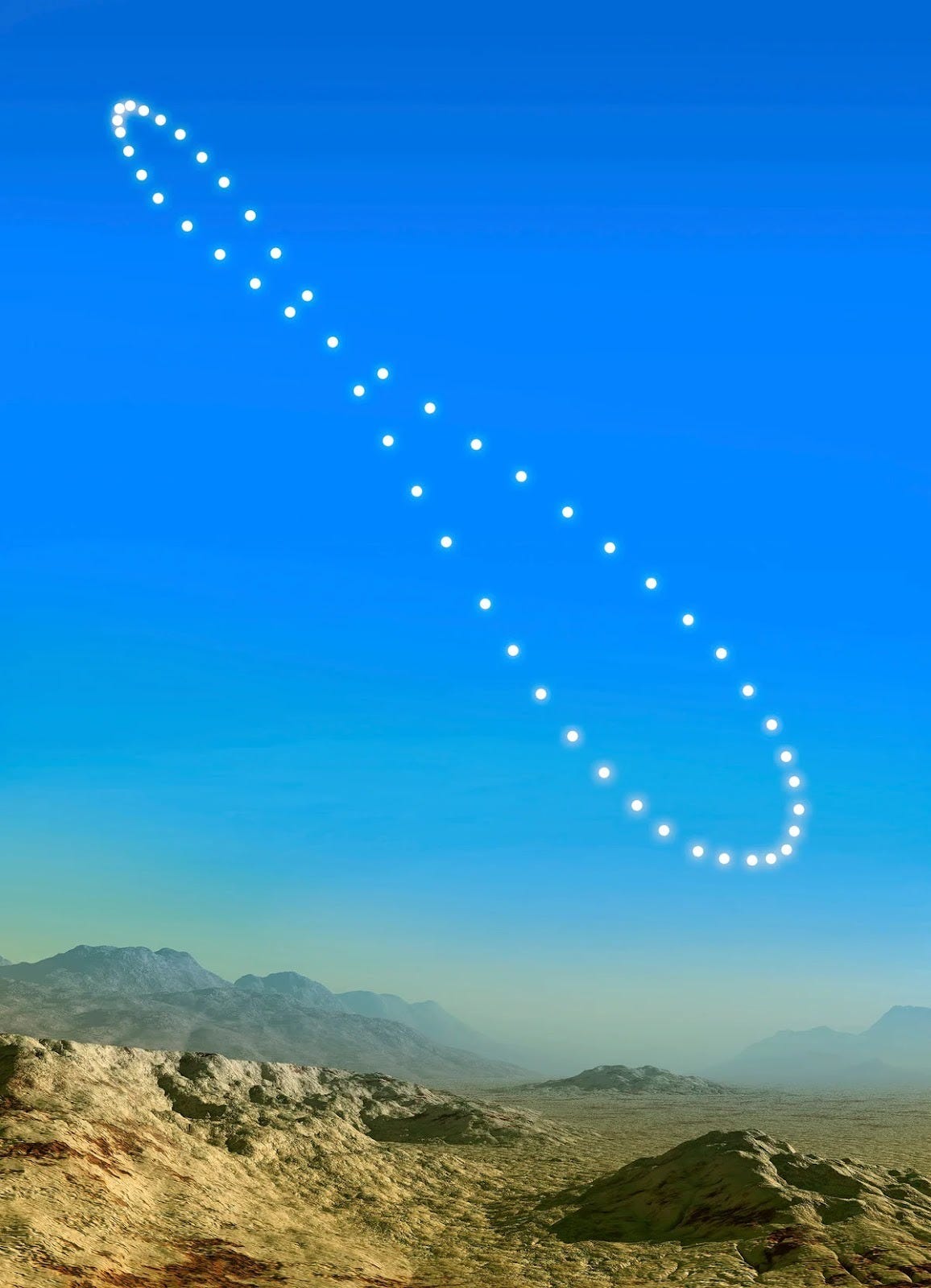
During the uttarāyaṇa period (beginning with the winter solstice), the length of the days increases slowly as the sun moves through Capricorn, Aquarius, etc., from the minimum of the winter solstice. On the other half of the movement, starting from the summer solstice, as the sun moves through Cancer, Leo, etc., the length of the days shortens quickly. During the equinox periods, as the sun moves through Aries and Libra, the change happens at a moderate speed.
In this way, the Śrīmad-Bhāgavatam describes the practical phenomenon that is observable from our planet. The same is also studied in modern astronomy; it is just explained differently. Modern models explain it through the elliptical orbit of the earth around the sun, and the tilt of the earth’s axis, while the Bhāgavatam explains it in terms of the two movements of the sun, moving through the zodiac and around Dhruvaloka.
The movement of the sun is supposed to be similarly observable from the other planets that compose Bhū-mandala. In other words, the sun rises in the east and sets in the west and moves through the signs of the zodiac, producing the seasons; the days last 24 hours, and so on. In this way, all human beings on these different planets should experience the passage of time in the same way. The demigods living on top of Mount Sumeru, on the other hand, see the sun as always moving overhead (similar to what we observe at the north pole). Their days and nights are produced solely by the annual movement of the sun, north and south of the plane of Bhū-mandala, a cycle that takes a whole year. In other words, 24 hours for them equals 360 days for us.
The movement of the sun in relation to Bhū-mandala
The movement of the sun facing the constellations, north and south of the equator, causes the variation in the lengths of the days and nights (explained in modern cosmology by the orbit of the earth around the sun), and also explains the variations in the rate of increase and decrease of the length of the days over the course of the year. This phenomenon applies not only to our planet but to the whole Bhū-mandala.
What an observer at the equator sees as the middle of the sky is the equator of Bhū-mandala. Imagining Bhū-mandala as a planetary system, where each varṣa is a separate planet, as Prabhupāda concluded, the orbit of the sun should be seen according to the same principle in all planets of the planetary system.
In this model, everywhere there is day and night, and the length of the days and nights shifts during the year, exactly as described in these verses. The explanation of Śukadeva Goswami thus works for the whole intermediate system. For the demigods, however, both on top of Mount Sumeru and in Svargaloka, it works differently, as will be explained in the next verses.
One question one could ask is that this model implies that the sun moves north and south of the equator of Bhū-mandala. How is this possible? This is the logical conclusion from the description, since it fits the model, and is directly described in the text by the use of the terms uttarāyaṇa and dakṣiṇāyana (the sun travels “to the south” and “to the north,” producing long and short days, as described on SB 5.21.6), but since everything is possible in Kṛṣṇa’s creation, it can also be that there is some other explanation of how it occurs. However, if we accept Bhū-mandala as a planetary system, and not literally as a set of islands, the idea of the sun moving south of the equator of Bhū-mandala doesn’t sound too implausible, since it is not about crossing solid ground.
Having described the annual movement of the sun, in which it moves to the north and south, resulting in the variation of the lengths of days and nights and the passage of the seasons, Śukadeva Gosvāmī now explains the daily movement of the sun around Mānasottara Mountain.
Read the whole book:
« Making Sense of the Vedic Universe, a Higher-Dimensional Reality
This is a publication for thoughtful readers who want to go deeper into Kṛṣṇa consciousness. I publish daily, trying to offer high-quality spiritual content, and all posts are available to free subscribers. If you wish, you can also choose a paid subscription to support this work.
You can also receive the updates on WhatsApp or Telegram.
If you would like to contribute further, you can find the donation links here.
Hare Krishna, also in your previous article entitled The annual orbit of the sun, it is mentioned that sun is situated in antariksh which is above earthly plane. Then in that case it doesn't make sense that sun is on the equator of bhu mandala.
Hare Krishna prabhuji, is there any reference for bhu mandala to be planetary system and not sold islands. The idea sounds good and also helps to understand northern and southern movement of sun. But a reference would be appreciated. Thanks