

« Making Sense of the Vedic Universe, a Higher-Dimensional Reality
Chapter 5: The movements of the sun
Based on what we learn in school, the sentence “movements of the sun” may sound nonsensical. Which movements, if the sun is stationary in the center of the solar system? However, when we look to the sky, we see that the sun indeed moves, at least from our perspective.
The cosmological model described in the Śrīmad-Bhāgavatam describes the movements of the sun from a geocentric perspective, explaining the sunset and sunrise, as well as the passage of the seasons. Simultaneously, it describes the movements of the sun around Bhū-mandala, in the higher-dimensional reality of the demigods. Somehow, the same model describes both the motions of the sun in the high-dimensional realm of Bhū-mandala and the apparent movement of the sun we see every day in the sky.
In the same way, the same geocentric perspective used to explain the movement of the sun is also used to explain the motion of the stars and planets. The model is thus both practical and literal. It describes both the practical phenomenon we see daily in the sky, and the literal motion of the sun in the higher-dimensional space.
In practical terms, the Vedic model works, and it explains the movements of the sun in a more natural way, namely from the perspective of someone standing on our planet and looking at the sky. Explained in a book, this model can sound complicated, but if exhibited in a planetarium, the model would sound quite natural.
In his description of chapter 5.21 of Śrīmad-Bhāgavatam, Śrila Prabhupāda gives us a synopsis of the whole model:
“The sun is not stationary; it is also moving like the other planets. The sun’s movements determine the duration of night and day. When the sun travels north of the equator, it moves slowly during the day and very quickly at night, thus increasing the duration of the daytime and decreasing the duration of night. Similarly, when the sun travels south of the equator, the exact opposite is true — the duration of the day decreases, and the duration of night increases. When the sun enters Karkaṭa-rāśi (Cancer) and then travels to Siṁha-rāśi (Leo) and so on through Dhanuḥ-rāśi (Sagittarius), its course is called Dakṣiṇāyana, the southern way, and when the sun enters Makara-rāśi (Capricorn) and thereafter travels through Kumbharāśi (Aquarius) and so on through Mithuna-rāśi (Gemini), its course is called Uttarāyaṇa, the northern way. When the sun is in Meṣa-rāśi (Aries) and Tulā-rāśi (Libra), the duration of day and night are equal.
On Mānasottara Mountain are the abodes of four demigods. East of Sumeru Mountain is Devadhānī, where King Indra lives, and south of Sumeru is Saṁyamanī, the abode of Yamarāja, the superintendent of death. Similarly, west of Sumeru is Nimlocanī, the abode of Varuṇa, the demigod who controls the water, and north of Sumeru is Vibhāvarī, where the demigod of the moon lives. Sunrise, noon, sunset and midnight occur in all these places because of the movements of the sun. Diametrically opposite the place where the sunrise takes places and the sun is seen by human eyes, the sun will be setting and passing away from human vision. Similarly, the people residing diametrically opposite the point where it is midday will be experiencing midnight. The sun rises and sets with all the other planets, headed by the moon and other luminaries.”
What does it mean?
Here, the orbit of the sun is explained from the perspective of someone standing on earth and looking to the sky. Every day we see the sunrise and sunset, but as the year goes on, we observe that the sun passes high in the sky during summer, and lower (closer to the horizon) as winter approaches, making the days longer or shorter. Days and nights occur in opposite times on different sides of the globe. What is midday for someone in Brazil is midnight for someone in Japan and vice versa. Similarly, the seasons are also inverted in the northern and southern hemispheres. December, for example, is summer in Brazil.
In modern cosmology, this is explained in terms of two movements: the rotation of the earth and its orbit around the sun. Modern cosmology uses a heliocentric model (the sun at the center), explaining days and nights in terms of the rotation of the planet on its own axis, and the passages of the seasons through the movement of the planet around the sun. In this model, the axis of the planet is tilted; this creates two separate axes: the daily rotation of the planet, which happens on the line of the equator (the celestial equator), and the path of the light of the sun reaching our planet, which is called the ecliptic. The annual movement of the sun on this path makes the days longer in the summer and shorter in the winter, leading to the appearance of the seasons.
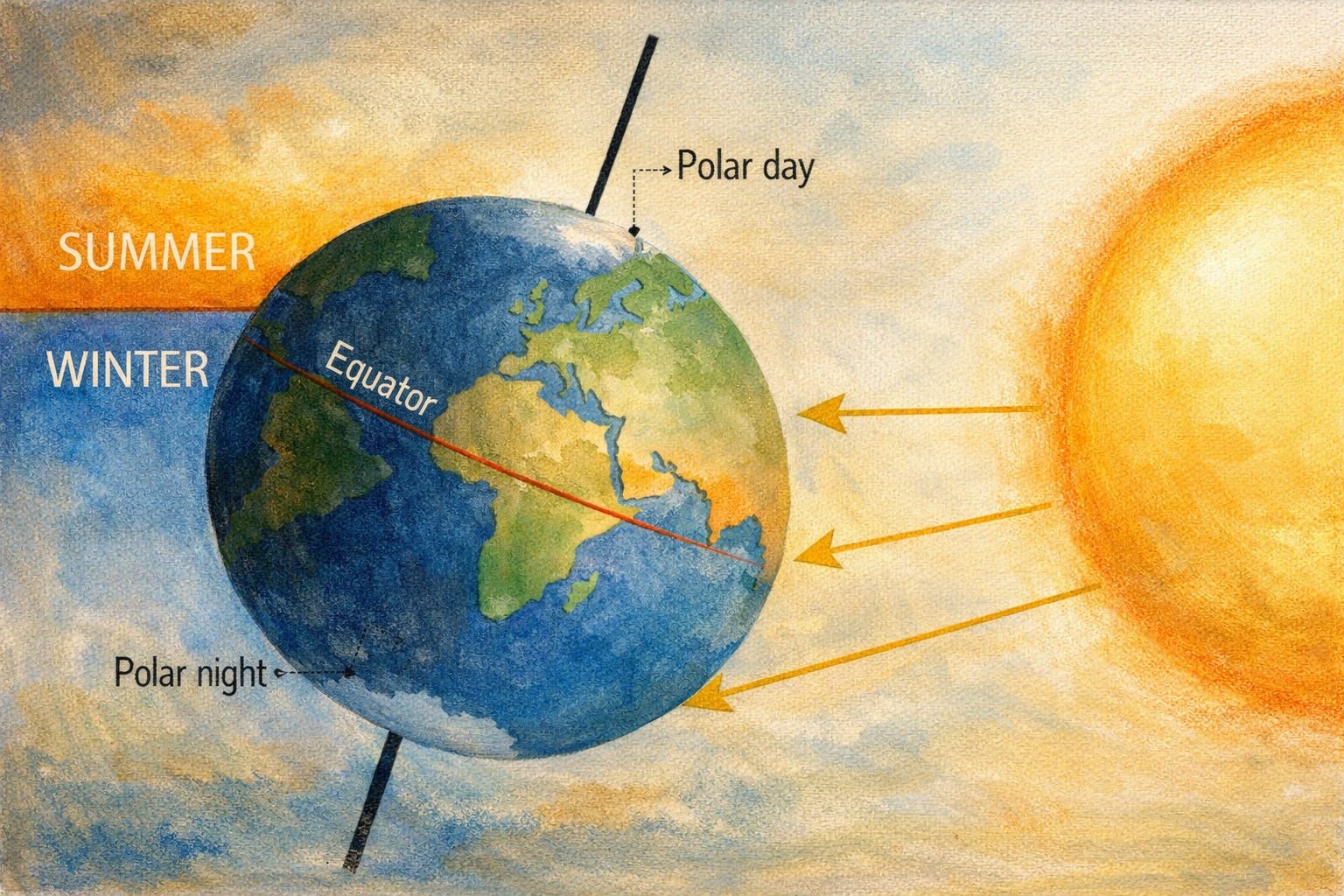
Days and nights in modern cosmology
What about the Vedic model?
The Vedas describe the same two axes. The difference is that the phenomenon is explained in terms of two separate movements for the sun within a geocentric model: the annual orbit of the sun, and the daily movement of the whole sky.
In the Vedic model, the earth is taken as fixed on the plane of Bhū-mandala, and the sun, as well as all the stars and planets, moves around the whole structure.
Śrila Prabhupāda uses the example of a chandelier that rotates. We can imagine all the stars and planets as components of a gigantic chandelier that has its pivot in Druvaloka (the polestar). All the parts of this cosmic chandelier are kept together by ropes of subtle wind, some kind of attraction force that is unknown in modern science. As the whole chandelier rotates, all the parts move together as part of the chandelier, but at the same time, each part has its own motion relative to the other parts. The combination of both motions when observed from our planet results in the movements of the sun, planets, and stars that we see when we look into the sky.
Here we have an illustration showing this chandelier model:
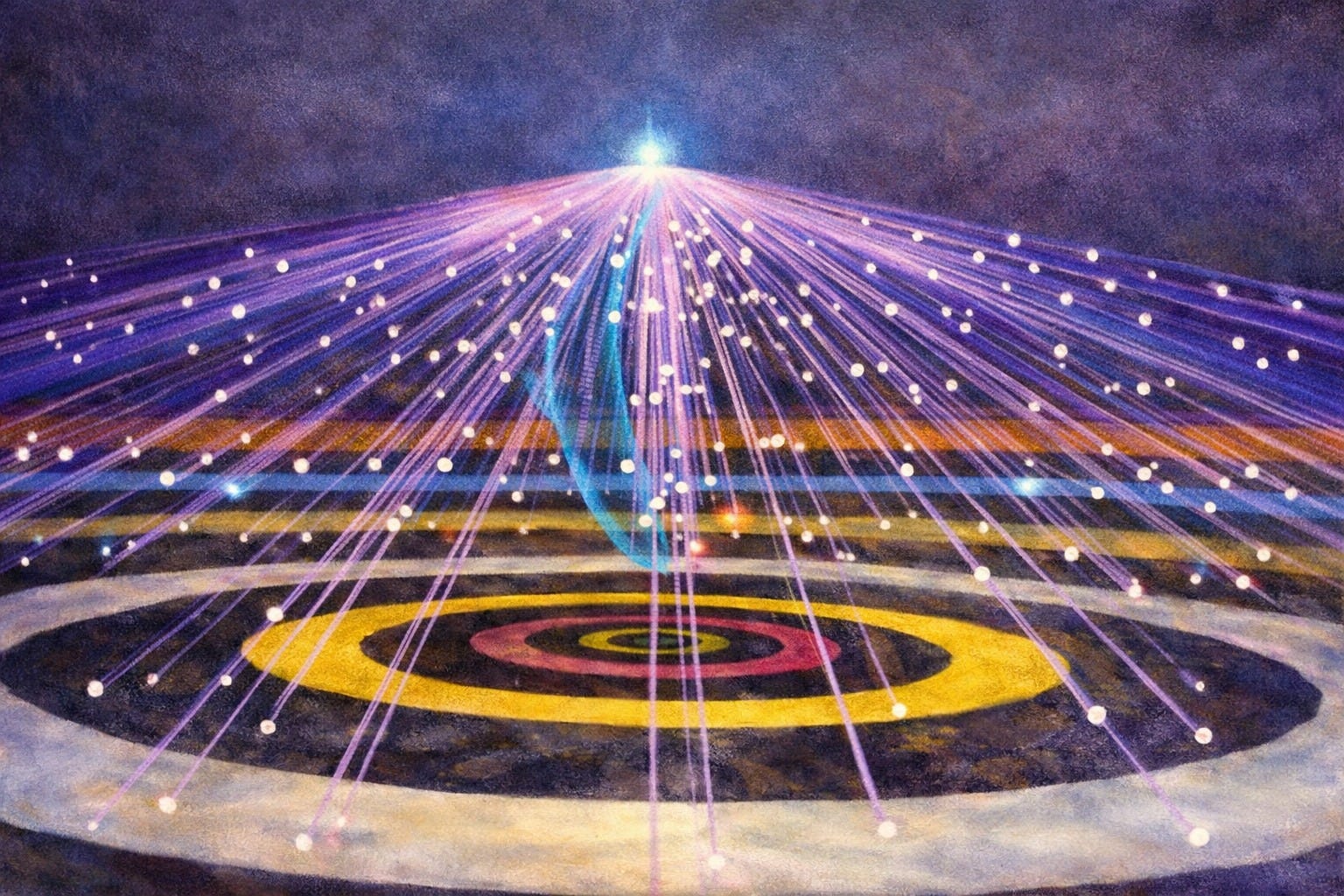
Here you can see Dhruvaloka shining on top of Bhū-mandala, with all the stars, as well as the sun and planets circumambulating it. The whole structure rotates daily, resulting in the passage of the days and nights.
We can imagine something like many particles of dust caught in a whirlwind. All the particles are moving with the whirlwind, but at the same time, each particle is moving independently in relation to the others. In other words, all the particles are moving in relation to the ground, following the general flow of the wind, but each particle moves in a subtly different way, and thus the particles also move in relation to each other.
In this model, the sun circles the sky every 24 hours, following the rotation of the whole sky. This is the clockwise rotation around Dhruvaloka, on the path of the Mānasottara Mountain. This movement is perceived not only by us, but by all inhabitants of Bhū-mandala as the passage of the days and nights we are familiar with.
However, there is also the counterclockwise rotation, which takes one full year to complete. This second movement is the independent movement of the chariot of the sun facing the signs of the zodiac. The two movements go on simultaneously. Thus, from the perspective of someone standing on earth, the sun passes higher in the sky during summer days, and lower during winter days, making the length of days and nights vary according to the seasons.
One way to imagine this model is to imagine a clock with just one arm, which takes 360 seconds to complete a circle. Imagine we put a lamp, representing the sun, at the end of this arm. In this way, the lamp will move in a circle every 360 seconds, just as the sun moves in its circuit in the sky every year.
Now, imagine that the whole clock is attached to a moving arm that rotates horizontally once every second. Now, we can see the whole clock moving very fast in horizontal circles, and at the same time the arm with the lamp in the clock moving in its slower, independent vertical movement. As the horizontal circles go on, the lamp gradually goes up and down.
Now, imagine we turn off all the lights, so the only thing we can see is the lamp on the arm of the clock. Because of the revolving rotating horizontal arm, we would see it moving very fast in a circular movement. However, because the arm is also moving vertically, the lamp would not pass exactly at the same point each time. It would move up and down as the revolutions go on.
Now, imagine we put a camera on the central pivot, turned to the side. What we will see on the screen is very similar to what we see in the sky, with the lamp crossing the screen vertically, and gradually moving to the left and to the right as the revolutions continue.
Of course, the movement of the sun in relation to Bhū-mandala is not fully vertical like a clock, but this is a crude example that can help to visualize it.
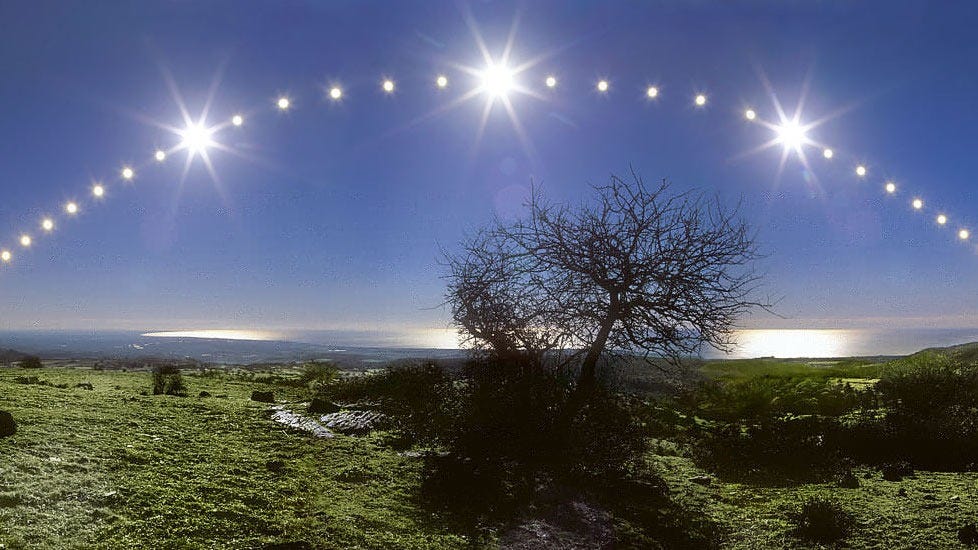
If you take a photo of the sky every day at the same time, for the period of an entire year, and then combine all of them in a single image, you will see that over the year, the sun will make a figure eight in the sky. That’s the annual path of the sun, as observed from our planet. This is called analemma in modern astronomy.
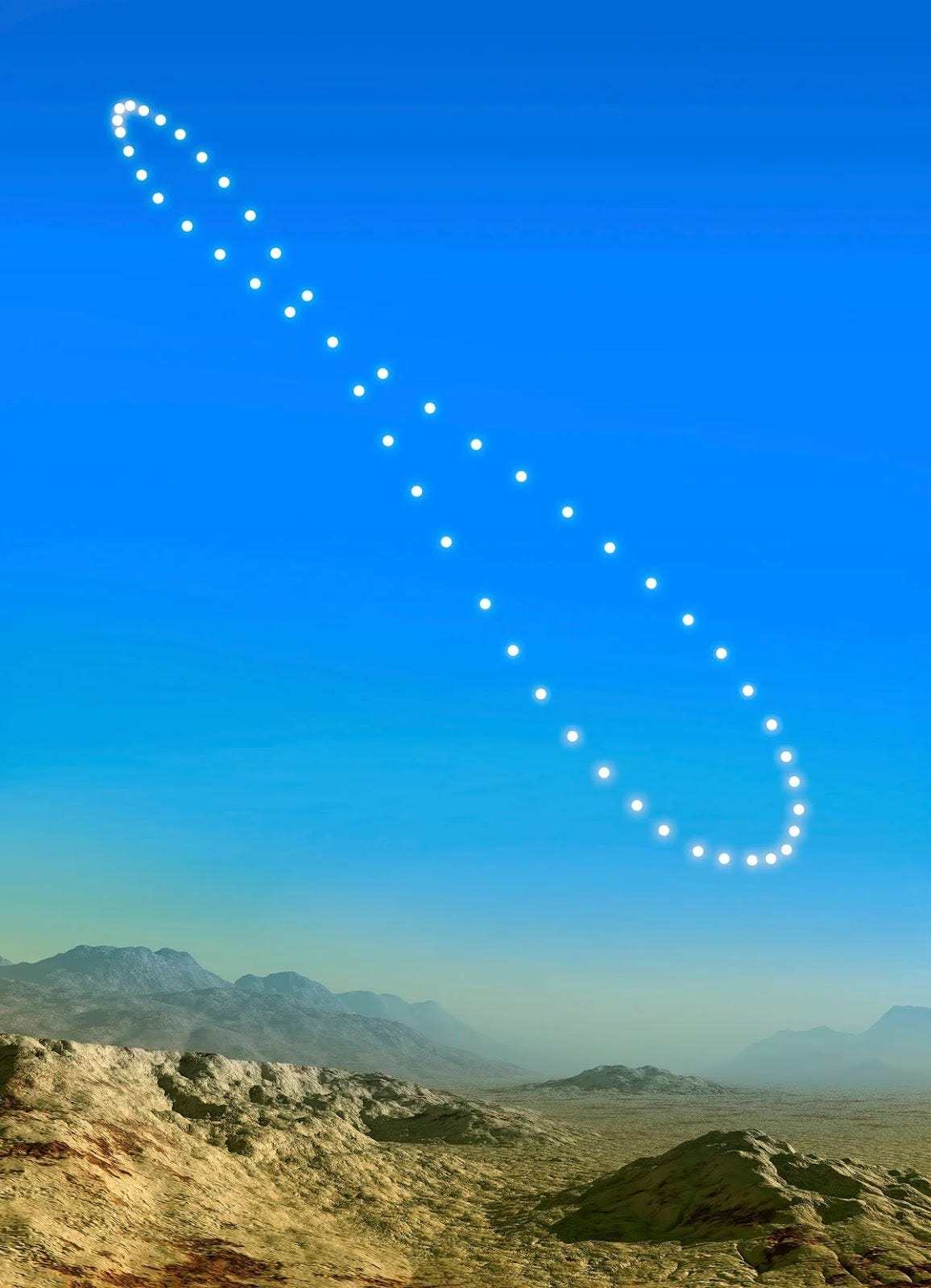
The annual path of the sun in the sky
This model may seem complicated when explained in text, but it can be presented in a simpler way in the form of a working model, showing how the movements work in practice. That was the idea of Prabhupāda in insisting on the construction of the Temple of the Vedic Planetarium. His idea is that having a working model would make regular people understand the system and see the universe through the eyes of the scriptures, as a divine creation. Once we accept that the universe is created by God, life gains a purpose, and we start the process of devotional service.
Read the whole book:
« Making Sense of the Vedic Universe, a Higher-Dimensional Reality
This is a publication for thoughtful readers who want to go deeper into Kṛṣṇa consciousness. I publish daily, trying to offer high-quality spiritual content, and all posts are available to free subscribers. If you wish, you can also choose a paid subscription to support this work.
You can also receive the updates on WhatsApp or Telegram.
If you would like to contribute further, you can find the donation links here.