

« Making Sense of the Vedic Universe, a Higher-Dimensional Reality
The nine divisions of Jambūdvīpa
“In Jambūdvīpa there are nine divisions of land, each with a length of 9,000 yojanas [72,000 miles]. There are eight mountains that mark the boundaries of these divisions and separate them nicely.” (SB 5.16.6)
All the measurements in the description of Śukadeva Goswami are given in yojanas, an ancient Vedic unit of distance used in Sanskrit texts. The length of the yojana can vary according to the context, but Prabhupāda concludes that the descriptions of the Śrīmad-Bhāgavatam are based on a yojana of eight miles.
Jambūdvīpa is described as being circular in form (round like the leaf of a lotus flower), with a length and breadth of 100,000 yojanas (800,000 miles), as confirmed in SB 5.20.2. It’s difficult to conceive something this size, but just for comparison, the equatorial circumference of our planet is about 24,901 miles, which is about 3,113 yojanas. If we do the math, Jambūdvīpa is 2,547 times larger than the total surface area of the earth!
Jambūdvīpa is divided into nine varṣas, or tracts of land, separated by gigantic mountains, whose size is almost inconceivable for us. For example, there are four great mountains surrounding Mount Sumeru (Mandara, Merumandara, Supārśva, and Kumuda), which are 10,000 yojanas, or 80,000 miles high! For comparison, Mount Everest, the highest mountain on our planet, is about 5.5 miles (0.69 yojanas) high. Again, we are speaking about a difference of orders of magnitude.
Taking into consideration the earth’s gravity, the maximum theoretical height for a mountain on our planet (before the rock would start crumbling under its own mass) is about 6 miles, or, in other words, not much taller than the Everest. This indicates that the structures of Jambūdvīpa don’t exist under the same physical constraints as mountains and landmasses of our planet. In other words, these are structures that exist in a higher-dimensional reality, and not exactly in the world we live in.
The verse mentions that there are nine divisions of land in Jambūdvīpa, each with a length of 9,000 yojanas. The boundaries of these tracts of land are marked by eight mountains. This gives a simplified idea of the layout of Jambūdvīpa. The whole island has 100,000 yojanas of length and breadth, and the mountain ranges that divide the varṣas are 2,000 yojanas in length at the base. Most of the varṣas have a length of 9,000 yojanas, but there is an important exception.
In his purport, Prabhupāda gives a Sanskrit quote from the Vāyu Purāṇa, describing the locations of the various mountain ranges that are part of Jambūdvīpa and how they divide the whole island into nine separate tracts of land. This reference is mentioned by Śrīla Viśvanātha Cakravartī Ṭhākura in his commentary, clarifying the information omitted in the simplified model given in this verse:
dhanurvat saṁsthite jñeye dve varṣe dakṣiṇottare; dīrghāṇi tatra catvāri caturasram ilāvṛtam iti dakṣiṇottare bhāratottara-kuru-varṣe catvāri kiṁpuruṣa-harivarṣa-ramyaka-hiraṇmayāni varṣāṇi nīla-niṣadhayos tiraścinībhūya samudra-praviṣṭayoḥ saṁlagnatvam aṅgīkṛtya bhadrāśva-ketumālayor api dhanur-ākṛtitvam; atas tayor dairghyata eva madhye saṅkucitatvena nava-sahasrāyāmatvam; ilāvṛtasya tu meroḥ sakāśāt catur-dikṣu nava-sahasrāyāmatvaṁ saṁbhavet vastutas tv ilāvṛta-bhadrāśva-ketumālānāṁ catus-triṁśat-sahasrāyāmatvaṁ jñeyam
It can be translated in the following way:
“Two varṣas of Jambūdvīpa, the southernmost and the northernmost, are bow-shaped. They are known as Bhārata-varṣa and Uttarakuru-varṣa. The four varṣas adjacent to them are Kiṃpuruṣa-varṣa, Hari-varṣa, Ramyaka-varṣa, and Hiraṇmaya-varṣa. These four varṣas are elongated in form. Because they are long and narrow in the middle, their length is 9,000 yojanas. Ilāvṛta-varṣa, however, [the central tract of land, with Mount Sumeru in the middle and surrounded by mountains on four sides], is quadrangular.
Considering that the Nīla and Niṣada mountain ranges run in parallel across the island all the way to the [salt] ocean, Bhadrāśva-varṣa and Ketumāla-varṣa [situated left and right of Ilāvṛta] also have a bow-like shape. The breadth of Ilāvṛta-varṣa, Bhadrāśva-varṣa, and Ketumāla-varṣa [north to south] should be understood as 34,000 yojanas, but in the case of Ilāvṛta, an extent of 9,000 yojanas can be calculated from the vicinity of Mount Meru, in any of the four directions.”
This verse explains the basic division. Bhārata-varṣa and Uttarakuru-varṣa, as well as Kiṃpuruṣa-varṣa, Hari-varṣa, Ramyaka-varṣa, and Hiraṇmaya-varṣa, are narrow and long, like strips of land that run in parallel. Among them, Bhārata-varṣa and Uttarakuru-varṣa are bow-shaped, because they represent the two extremes of the circle. All these six varṣas are 9,000 yojanas in length, and the mountains adjacent to them are 2,000 yojanas in length at the base. Combined, these six varṣas and the six adjacent mountains are 66,000 yojanas in length.
The middle section, however, is divided into three perpendicular divisions: Ketumāla-varṣa (to the left), Ilāvṛta-varṣa (in the center), and Bhadrāśva-varṣa (to the right). Between them are the Gandhamādana and Mālyavān mountains.
Of the three, Ketumāla and Bhadrāśva are like squares that are bow-shaped or crescent-like on one of the sides (being on the two extremities of the island), while Ilāvṛta is a perfect square, being boxed by line-like mountains on all sides. The total breadth of these three varṣas (north to south) is the same: 34,000 yojanas.
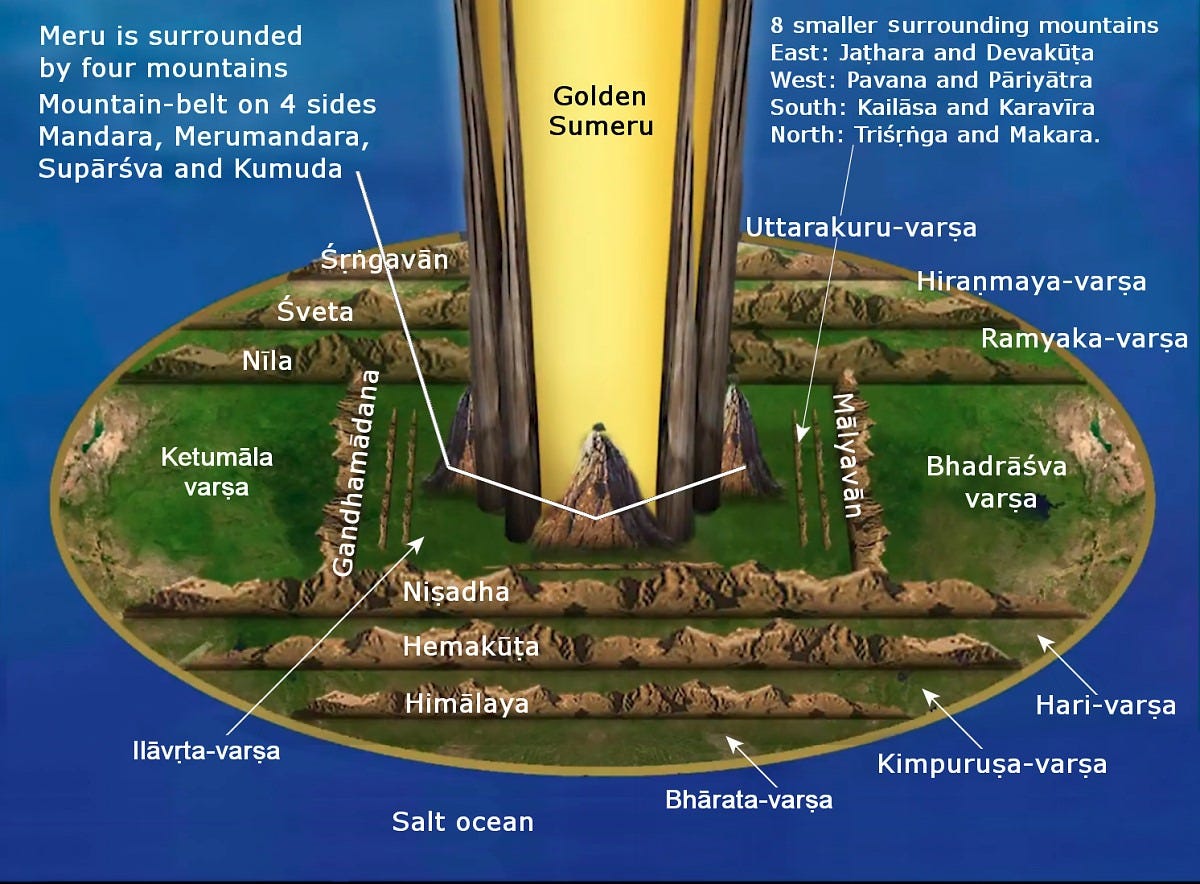
Ketumāla and Bhadrāśva are plain. Ilāvṛta, however, is a special case, because it has Mount Sumeru at the middle. Sumeru’s width at the foot is 16,000 yojanas; therefore, we have 9,000 yojanas from Sumeru to the Nīla mountain (northward), plus the width of Sumeru’s base (16,000 yojanas), plus 9,000 from Sumeru to the Niṣadha mountain (southward), totaling 34,000 yojanas.
Combined with the 66,000 yojanas from the combination of the other varṣas, we have 100,000 in total.
Read the whole book:
« Making Sense of the Vedic Universe, a Higher-Dimensional Reality
This is a publication for thoughtful readers who want to go deeper into Kṛṣṇa consciousness. I publish daily, trying to offer high-quality spiritual content, and all posts are available to free subscribers. If you wish, you can also choose a paid subscription to support this work.
You can also receive the updates on WhatsApp or Telegram.
If you would like to contribute further, you can find the donation links here.