

« Making Sense of the Vedic Universe, a Higher-Dimensional Reality
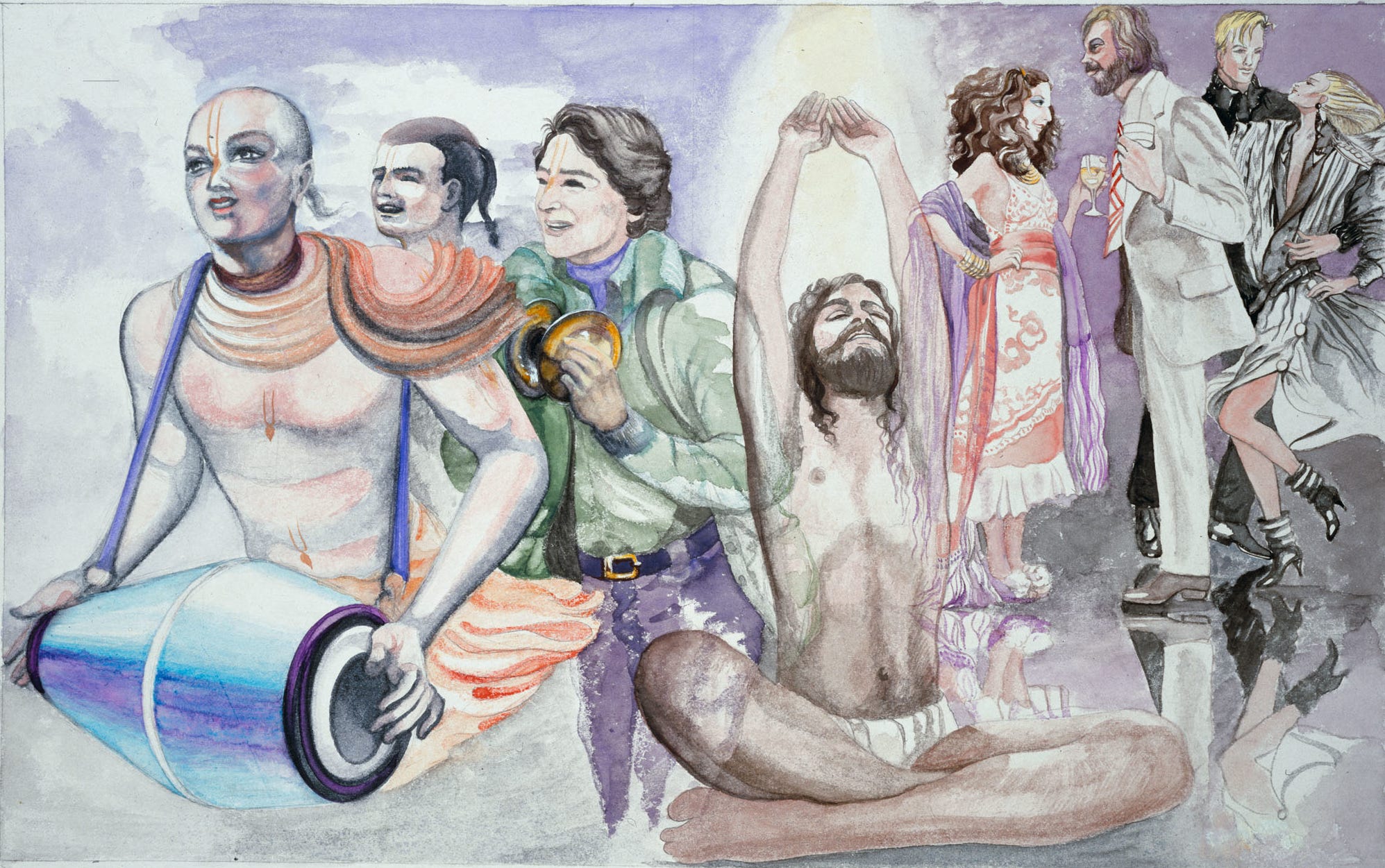
The opportunity of taking birth in Bhārata-varṣa
The final verses of the 19th chapter, starting from 5.19.16, are dedicated to describing Bhārata-varṣa and its importance from the perspective of spiritual realization. These verses are especially important for understanding where we are, and how we can achieve the goal of life, breaking free from the prison of the material world.
Differences in the geographical features mentioned there and the current geography of our planet should not be taken as a contradiction. The verses speak about eternal features, which can be visible or not at a given time. The Mahābhārata, for example, describes the river Sarasvatī, which was very important for the people of previous ages, but it is not currently available. Some speculate it still exists as a subterranean river or as a groundwater reservoir, but in any case it is not present in the same sense as described in the text. Similarly, Govardhana is gradually submerging into the ground and may disappear in the future, as also predicted in the scriptures. These sites may become unavailable for the time being and reappear in other cycles of creation.
Prabhupāda notes that “All these rivers are transcendental. Therefore one can be purified by remembering them, touching them or bathing in them. This practice is still going on.” This sets the proper tone. As mentioned in the Bṛhad-bhāgavatāmṛta, holy places like Vṛndāvana and Jagannātha Pūrī, as well as holy rivers and others exist eternally. They may be available or not on our planet at a given time, and their location may be known or not, but this doesn’t affect their transcendental status. For many centuries, for example, the location of many holy sites in Vṛndāvana were lost, until they were rediscovered by the Six Goswamis. Later, Śrīla Bhaktivinoda Thākura revealed that they are also present in Navadvīpa Dhāma.
“The people who take birth in this tract of land are divided according to the qualities of material nature — the modes of goodness [sattva-guṇa], passion [rajo-guṇa], and ignorance [tamo-guṇa]. Some of them are born as exalted personalities, some are ordinary human beings, and some are extremely abominable, for in Bhārata-varṣa one takes birth exactly according to one’s past karma. If one’s position is ascertained by a bona fide spiritual master and one is properly trained to engage in the service of Lord Viṣṇu according to the four social divisions [brāhmaṇa, kṣatriya, vaiśya and śūdra] and the four spiritual divisions [brahmacārī, gṛhastha, vānaprastha and sannyāsa], one’s life becomes perfect.” (SB 5.19.19)
In his purport, Prabhupāda quotes a long passage from the Vedārtha-saṅgraha, by Śrīla Rāmānujācārya. This passage can be translated as:
“As previously described, the real cause that produces realization of the true nature of parā-bhakti (pure devotion) is the process of bhakti-yoga in itself. This spiritual practice is supported by regulated action based in knowledge from the scriptures, manifested in the form of one’s prescribed duties. As the venerable Parāśara has said, in the verse beginning with the word ‘varṇāśrama’, this is the proper method for elevation. The Supreme Lord Himself, Puruṣottama, the Supreme Brahmān, has descended upon earth for the deliverance of the entire world, declaring the same principle: ‘One who is devoted to his own prescribed work attains perfection’, ‘By worshiping Him, from whom everything has emanated, and by whom this whole universe is pervaded through one’s own prescribed work, a person attains perfection.“
Prabhupāda then quotes the Viṣṇu Purāṇa for additional support, and develops the topic in his purport: “The Supreme Personality of Godhead, Lord Viṣṇu, is worshiped by the proper execution of prescribed duties in the system of varṇa and āśrama. There is no other way to satisfy the Lord.” In the land of Bhārata-varṣa, the institution of varṇāśrama-dharma may be easily adopted. At the present moment, certain demoniac sections of the population of Bhārata-varṣa are disregarding the system of varṇāśrama-dharma. Because there is no institution to teach people how to become brāhmaṇas, kṣatriyas, vaiśyas and śūdras or Brahmācārīs, gṛhasthas, vānaprasthas and sannyāsīs, these demons want a classless society. This is resulting in chaotic conditions. In the name of secular government, unqualified people are taking the supreme governmental posts. No one is being trained to act according to the principles of varṇāśrama-dharma, and thus people are becoming increasingly degraded and are heading in the direction of animal life. The real aim of life is liberation, but unfortunately the opportunity for liberation is being denied to people in general, and therefore their human lives are being spoiled. The Kṛṣṇa consciousness movement, however, is being propagated all over the world to reestablish the varṇāśrama-dharma system and thus save human society from gliding down to hellish life.”
After many, many births, when the results of one’s pious activities mature, one gets an opportunity to associate with pure devotees. Then one is able to cut the knot of bondage to ignorance, which bound him because of varied fruitive activities. As a result of associating with devotees, one gradually renders service to Lord Vāsudeva, who is transcendental, free from attachment to the material world, beyond the mind and words, and independent of everything else. That bhakti-yoga, devotional service to Lord Vāsudeva, is the real path of liberation.” (SB 5.19.20)
Varṇāśrama is a system developed to support the gradual development of devotion to the Supreme Lord, but in itself it is still material. It is mentioned that if one follows the varnāśrama system perfectly for one hundred lives, one can be promoted to Satyaloka. However, even in this case, one will still be part of the material world. To attain the transcendental platform, one has to come into contact with pure devotees and learn the devotional science from them.
Association of pure devotees is thus the main factor for attaining perfection in human life. The institution of varnāśrama-dharma supports the development of devotional service, but if we don’t have the good fortune of being born in a society where it is practiced, we can still attain perfection by associating with pure devotees and being engaged in devotional service from whatever platform we are currently at.
Most people practice different degrees of materialism. Above that is Brahmān realization, when one fully realizes his spiritual nature and qualitative unity with the Supreme. Still higher is Paramātmā realization, where one becomes aware of the form of the Lord, but real liberation is when one realizes his eternal position as an eternal servant of the Supreme Personality of Godhead. This can be learned only from devotees who are cultivating this sublime attitude of transcendental service.
As Prabhupāda mentions, “Devotional service is actual liberation. When one is attracted by the beauty of the Supreme Personality of Godhead and his mind is always engaged at the Lord’s lotus feet, he is no longer interested in subjects that do not help him in self-realization. In other words, he loses all attraction for material activities.”
“Since the human form of life is the sublime position for spiritual realization, all the demigods in heaven speak in this way: How wonderful it is for these human beings to have been born in the land of Bhārata-varṣa. They must have executed pious acts of austerity in the past, or the Supreme Personality of Godhead Himself must have been pleased with them. Otherwise, how could they engage in devotional service in so many ways? We demigods can only aspire to achieve human births in Bhārata-varṣa to execute devotional service, but these human beings are already engaged there.” (SB 5.19.21)
Although life on the heavenly planets is more pleasant in so many ways, the ubiquity of sense gratification makes spiritual progress very difficult. It is easy to pray to Kṛṣṇa and surrender to Him when we see ourselves in a difficult situation, but it is much harder to do the same while living in great material opulence. As long as the path of material progress and gratification is open for us, we tend to put spiritual practice aside.
An easy-going life of material comfort, however, subjects us to the biggest discomfort of all, which is another birth in this material world, possibly in a less privileged position. The demigods thus lament that their material opulence is actually a two-edged sword.
Bhārata-varṣa offers the right combination of spiritual opportunities and material challenges, and this becomes especially clear in Kali-yuga, when we have the opportunity of taking part in the saṅkīrtana movement of Śrī Caitanya Mahāprabhu. Many still try to walk the path of material development, since this is the general tendency of all conditioned souls, but if we can give up our very limited prospects of sense enjoyment, we can achieve in just a very short life what is unavailable even for the inhabitants of heaven.
In a sense, our whole planet is Bhārata-varṣa, and thanks to the contribution of Śrīla Prabhupāda, we can find temples and other places of practice practically anywhere. At the same time, however, the opportunities of self-realization are especially available in India, as described by Śrī Caitanya Mahāprabhu. Prabhupāda uses this point as the basis for his purport to text 21: “There are many facilities in India, Bhārata-varṣa, for executing devotional service. In Bhārata-varṣa, all the ācāryas contributed their experience, and Śrī Caitanya Mahāprabhu personally appeared to teach the people of Bhārata-varṣa how to progress in spiritual life and be fixed in devotional service to the Lord. From all points of view, Bhārata-varṣa is the special land where one can very easily understand the process of devotional service and adopt it to make his life successful. If one makes his life successful in devotional service and then preaches devotional service in other parts of the world, people throughout the world will actually benefit.”
“The demigods continue: After performing the very difficult tasks of executing Vedic ritualistic sacrifices, undergoing austerities, observing vows and giving charity, we have achieved this position as inhabitants of the heavenly planets. But what is the value of this achievement? Here we are certainly very engaged in material sense gratification, and therefore we can hardly remember the lotus feet of Lord Nārāyaṇa. Indeed, because of our excessive sense gratification, we have almost forgotten His lotus feet.” (SB 5.19.22)
Most people are interested in material progress as a way to achieve a more comfortable life, but this is largely misguided, since it is not possible to achieve a really elevated level of comfort on this planet, no matter how much money we have. In societies that follow the Vedic path, this is achieved through the process of karma-kanda, which allows one to achieve real material opulence, by taking birth among the demigods. However, the demigods themselves, who have previously followed this process and achieved the results, conclude that these material achievements are not only useless, but they are factually a stumbling block on the real path of advancement, which is Kṛṣṇa consciousness. They look at us and envy the fact that because the path of material progress is more or less closed to us, we have all the facilities to progress in self-realization. With that in mind, we should not be seduced by the same fruitive path they walked in the past, much less the path of material progress through sinful activities that leads only to the hellish planets.
As Prabhupāda concludes, “The conclusion is that one who has taken birth in the land of Bhārata-varṣa must follow the instructions given personally by the Supreme Personality of Godhead. Yad gatvā na nivartante tad dhāma paramaṁ mama. One should try to return home, back to Godhead, to the Vaikuṇṭha planets — or to the topmost Vaikuṇṭha planet, Goloka Vṛndāvana — to live eternally in full, blissful knowledge in the company of the Supreme Personality of Godhead.”
“A short life in the land of Bhārata-varṣa is preferable to a life achieved in Brahmāloka for millions and billions of years because even if one is elevated to Brahmāloka, he must return to repeated birth and death. Although life in Bhārata-varṣa, in a lower planetary system, is very short, one who lives there can elevate himself to full Kṛṣṇa consciousness and achieve the highest perfection, even in this short life, by fully surrendering unto the lotus feet of the Lord. Thus one attains Vaikuṇṭhaloka, where there is neither anxiety nor repeated birth in a material body.” (SB 5.19.23)
The demigods are not ignorant of the instructions of Kṛṣṇa in the Bhagavad-gītā or the conclusions of the Śrīmad-Bhāgavatam. These scriptures are also available in the heavenly planets, along with all the Vedas. What thus prevents them from simply following these instructions and fully surrendering to Kṛṣṇa? Again, their material opulence gets on the way. One who has a simple life can very easily agree to live in a temple, worship the Lord, and take prasāda, but a rich person will rarely agree to do so. Demigods accept the supremacy of the Lord and worship him, but it is practically impossible for them to fully surrender to the Lord like devotees on earth do.
In a sense, the lives of the demigods are tragic. They are all devotees who are advanced in devotional service, but at the same time are very obstinate in maintaining material desires. This combination eventually leads them to assume a position where they live for 306.72 million years in great opulence. It may sound good in principle, but it doesn’t sound so desirable when we consider that for this very long period they are deprived of the opportunity of joining the Lord in His pastimes in the spiritual world. After this long period is over, demigods can either be promoted to Maharloka for an extremely long path of progression all the way to Brahmāloka, for having a chance of being liberated at the end of the universe together with Lord Brahmā, or take a human birth in Bhārata-varṣa. We are, however, already here, enjoying the opportunity that even the demigods envy.
“An intelligent person does not take interest in a place, even in the topmost planetary system, if the pure Ganges of topics concerning the Supreme Lord’s activities does not flow there, if there are not devotees engaged in service on the banks of such a river of piety, or if there are no festivals of saṅkīrtana-yajña to satisfy the Lord [especially since saṅkīrtana-yajña is recommended in this age].” (SB 5.19.24)
Prabhupāda interprets this verse similarly as SB 5.18.35, taking the message of Śrīmad-Bhāgavatam as a whole to translate yajñeśa-makhā mahotsavāḥ (great festivals of sacrifices for the Lord of sacrifice) as especially meaning saṅkīrtana-yajña. This is the deepest meaning of the verse, since saṅkīrtana is the highest process of sacrifice. Just as there are different levels of understanding of the absolute truth (Brahman, Paramātmā, and Bhagavān), there are different gradations of sacrifice, and the collective chanting of the holy names of the Lord in devotional attitude is the highest of them.
In the dictionary meaning, yajñeśa-makhā mahotsavāḥ can be applied to any important performance of sacrifice, including even sacrifices to demigods. However, a deeper meaning is yajñeśa (the Lord of sacrifice) as meaning the Supreme Lord, and yajñeśa-makhā as meaning the performance of devotional service unto Him. The highest sacrificial performance in devotional service is congregational chanting, which leads to the interpretation of the verse given by Śrīla Prabhupāda. He further sustains this point in his purport: “Of all the sacrifices mentioned in the Vedic literatures, the performance of saṅkīrtana-yajña is the best. Even the performance of one hundred aśvamedha sacrifices cannot compare to the sacrifice of saṅkīrtana. According to the author of Śrī Caitanya-caritāmṛta, if one compares saṅkīrtana-yajña to other yajñas, he is a pāṣaṇḍī, an infidel, and is liable to be punished by Yamarāja. There are many Māyāvādīs who think that the performance of saṅkīrtana-yajña is a pious activity similar to the performance of the aśvamedha-yajña and other such pious functions, but this is a nāma-aparādha. Chanting of the holy name of Nārāyaṇa and chanting of other names are never equal, despite what Māyāvādīs think.”
“Bhārata-varṣa offers the proper land and circumstances in which to execute devotional service, which can free one from the results of jñāna and karma. If one obtains a human body in the land of Bhārata-varṣa, with clear sensory organs with which to execute the saṅkīrtana-yajña, but in spite of this opportunity he does not take to devotional service, he is certainly like liberated forest animals and birds that are careless and are therefore again bound by a hunter.” (SB 5.19.25)
In his purports to this section, Prabhupāda consistently connects Bhārata-varṣa with current India, making the point that this is the place where there is more facility for spiritual advancement. As he mentions:
“The inhabitants of places other than Bhārata-varṣa have facilities for material enjoyment, but they do not have the same facility to take to Kṛṣṇa consciousness. Therefore Śrī Caitanya Mahāprabhu has advised that one who has taken birth as a human being in Bhārata-varṣa must first realize himself as a part and parcel of Kṛṣṇa, and after taking to Kṛṣṇa consciousness, he must distribute this knowledge all over the world.”
This creates a parallel between the description of Jambūdvīpa and earth. Just as in Jambūdvīpa we have the different earthly heavens as places for enjoyment, and Bhārata-varṣa as the place for practicing austerity, we have on earth places like the United States and Europe offering better facilities for material development, and India having more facilities for spiritual emancipation.
This, however, doesn’t mean that devotees in other parts of the world should not be serious in the process of self-realization. As Prabhupāda emphasized in other passages, Kṛṣṇa consciousness is a universal process. It is not even just for human beings, but for all souls, regardless of species, planet, or universe they are born into. It is just that some take the opportunity and others don’t.
In his purport to text 24, Prabhupāda connects the description of a place where the Ganges flows and topics concerning the Lord’s activities are discussed with the district of Nadia, where Śrī Caitanya Mahāprabhu appeared, and then connects it with the temple complex in Mayapur he inaugurated as an ideal place to focus on devotional activities and develop our Kṛṣṇa consciousness. We may not have been born in India, or in the district of Nadia, but if we can take some time aside to visit Mayapur and use his time there to practice devotional service, putting aside all material distractions, we can get the best of the opportunity. Again, the opportunity of developing our devotional service is available to everyone in so many different ways; it is simply that some take it, and others don’t.
“In India [Bhārata-varṣa], there are many worshipers of the demigods, the various officials appointed by the Supreme Lord, such as Indra, Candra and Sūrya, all of whom are worshiped differently. The worshipers offer the demigods their oblations, considering the demigods part and parcel of the whole, the Supreme Lord. Therefore the Supreme Personality of Godhead accepts these offerings and gradually raises the worshipers to the real standard of devotional service by fulfilling their desires and aspirations. Because the Lord is complete, He offers the worshipers the benedictions they desire even if they worship only part of His transcendental body.” (SB 5.19.26)
Although in Bhārata-varṣa there are many worshipers of demigods, even this is not wasted, since the Lord uses this as an opportunity to gradually elevate them to the platform of devotional service. Demigod worship is certainly common in present day India, and it was common even in previous ages. The reason the Vedas offer the process of demigod worship, even though flawed in so many ways, is to offer ordinary people a path of elevation. As Kṛṣṇa explains in the Gītā, demigod worshipers also ultimately worship Him, but do so in an improper way.
Ultimately, however, “Kṛṣṇa does not desire to be worshiped indirectly through the different parts of His body; Kṛṣṇa wants direct devotional worship. Therefore a devotee who directly worships Lord Kṛṣṇa through staunch devotional service, as recommended in Śrīmad-Bhāgavatam, (tīvreṇa bhakti-yogena yajeta puruṣaṁ param), is very quickly elevated to the transcendental position.”
“The Supreme Personality of Godhead fulfills the material desires of a devotee who approaches Him with such motives, but He does not bestow benedictions upon the devotee that will cause him to demand more benedictions again. However, the Lord willingly gives the devotee shelter at His own lotus feet, even though such a person does not aspire for it, and that shelter satisfies all his desires. That is the Supreme Personality’s special mercy.” (SB 5.19.27)
This is a very important verse that shows the process Kṛṣṇa uses to fulfill the material desires of His devotees. When one worships demigods, one may quickly obtain the material facilities he desires, but these benefits will be temporary, which will lead him to repeat the process of worship again and again.
When we worship Kṛṣṇa with material intentions, the desired blessings usually take much longer to be achieved. There are two crucial differences, however.
The first is that, unlike blessings from the demigods, material opulences given by Kṛṣṇa stick with us, for they are bestowed by Lakṣmī Devī herself, and not by Durgā. The second is that together with the material blessings come the needed purification, so that they may not become a stumbling block on our path. Dhruva Maharaja was blessed by the Lord to enjoy life as a king for 30,000 years, but the final result is that he was promoted to the spiritual world.
In this way, Kṛṣṇa satisfies the material desires of His devotees, but in a way that cuts the problem at the root, making them free of material desires. Everyone should thus worship the Lord, regardless of which level they are. Everyone who comes to the Lord is eventually elevated to a platform of devotional service, both the one free of desires and the one full of material desires.
Prabhupāda gives us a beautiful purport for this verse, centered around this passage: “One who engages in the service of the Lord with some motive is called a sakāma-bhakta, and one who serves the Lord without any motives is called an akāma-bhakta. Kṛṣṇa is so merciful that He turns a sakāma-bhakta into an akāma-bhakta. A pure devotee, an akāma-bhakta, who has no material motives, is satisfied simply to serve the lotus feet of the Lord. This is confirmed in Bhagavad-gītā (6.22). Yaṁ labdhvā cāparaṁ lābhaṁ manyate nādhikaṁ tataḥ: if one engages in the service of the lotus feet of the Lord, he does not want anything more. This is the highest stage of devotional service. The Lord is so kind even to a sakāma-bhakta, a motivated devotee, that He satisfies his desires in such a way that one day he becomes an akāma-bhakta. Dhruva Mahārāja, for example, became a bhakta with the motive of getting a better kingdom than that of his father, but finally he became an akāma-bhakta and said to the Lord, svāmin kṛtārtho ’smi varaṁ na yāce: “My dear Lord, I am very satisfied simply to serve Your lotus feet. I do not want any material benefits.” Sometimes it is found that a small child eats dirty things, but his parents take away the dirty things and offer him a sandeśa or some other sweetmeat. Devotees who aspire for material benedictions are compared to such children. The Lord is so kind that He takes away their material desires and gives them the highest benediction. Therefore, even for material motives, one should not worship anyone other than the Supreme Personality of Godhead; one must fully engage himself in the devotional service of the Lord so that all his desires will be fulfilled and at the end he can go back home, back to Godhead.”
“We are now living in the heavenly planets, undoubtedly as a result of our having performed ritualistic ceremonies, pious activities and yajñas and having studied the Vedas. However, our lives here will one day be finished. We pray that at that time, if any merit remains from our pious activities, we may again take birth in Bhārata-varṣa as human beings able to remember the lotus feet of the Lord. The Lord is so kind that He personally comes to the land of Bhārata-varṣa and expands the good fortune of its people.” (SB 5.19.28)
Even a tiny portion of devotional service is more valuable than heaps of pious fruitive activities, because devotional service brings us to a position where we can perform more devotional service, while pious material activities simply bring us to situations where we can enjoy our senses, situations which are, in reality, stumbling blocks to our real progress. When Prabhupāda mentions that to take birth in Bhārata-varṣa, one must perform more pious activities than the demigods; he is referring to this. Usually demigods achieve their positions by executing aśvamedha-yajñas and other grand fruitive performances, but these are not sufficient to make them take birth on earth in a position favorable to practicing devotional service. This position is, however, available for others who practiced devotional service in their previous lives. As Prabhupāda summarizes:
“A foolish person may desire to be promoted to the heavenly planets as a result of his pious activities, but even the demigods from the heavenly planets want to come to Bhārata-varṣa and achieve bodies that may be very easily used to cultivate Kṛṣṇa consciousness.”
He then connects the whole passage with his work in creating a spiritual society that can facilitate one developing devotional service by associating with other devotees who are seriously practicing:
“The Kṛṣṇa consciousness movement is therefore spreading this facility to human society by opening many, many centers all over the world so that people may associate with the pure devotees of the Kṛṣṇa consciousness movement, understand the science of Kṛṣṇa consciousness and ultimately go back home, back to Godhead.”
Read the whole book:
« Making Sense of the Vedic Universe, a Higher-Dimensional Reality
This is a publication for thoughtful readers who want to go deeper into Kṛṣṇa consciousness. I publish daily, trying to offer high-quality spiritual content, and all posts are available to free subscribers. If you wish, you can also choose a paid subscription to support this work.
You can also receive the updates on WhatsApp or Telegram.
If you would like to contribute further, you can find the donation links here.