

« Making Sense of the Vedic Universe, a Higher-Dimensional Reality
The orbit of Rāhu, the dark planet
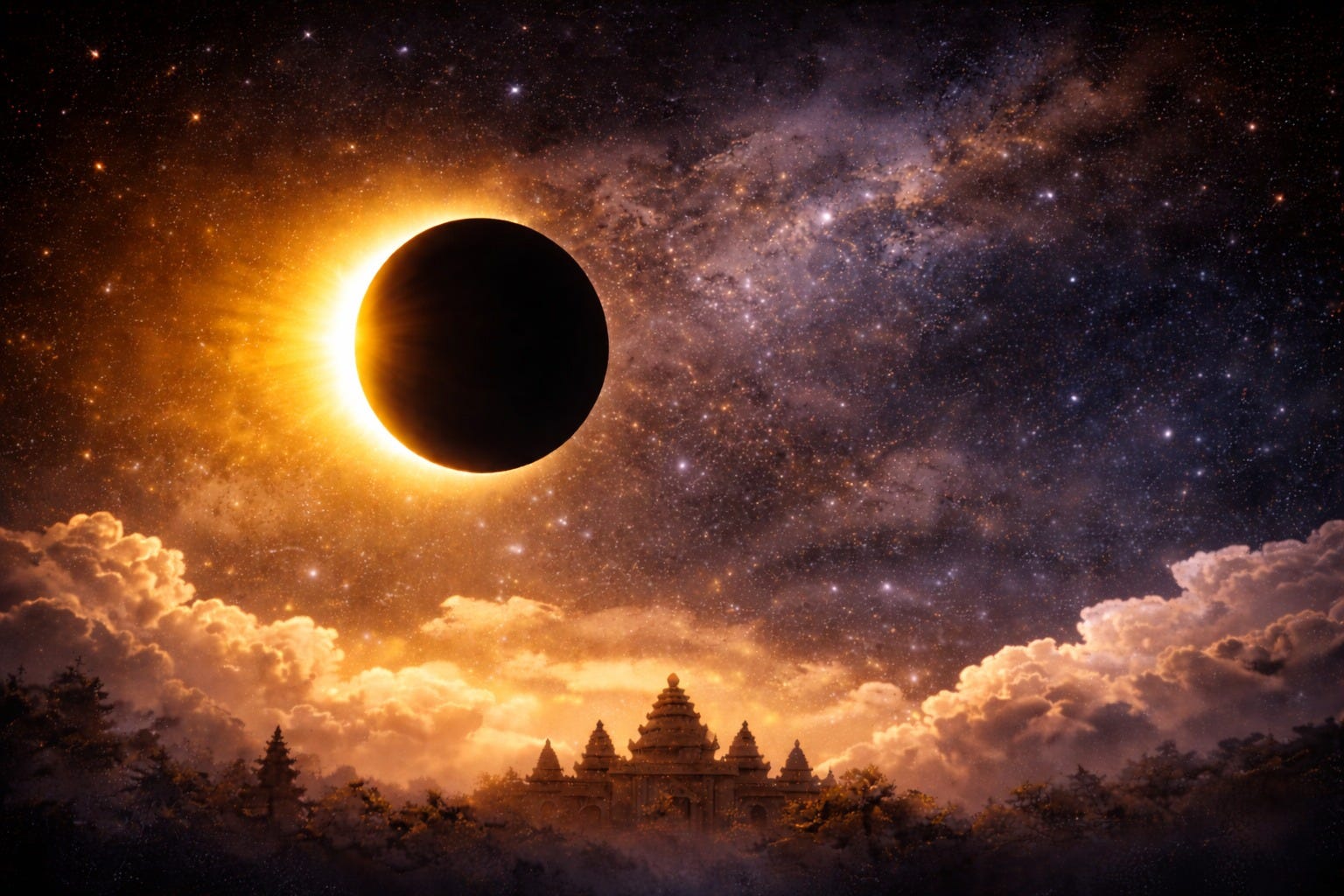
After describing the upper portion of the universe, covering the path of stars that go all the way to Svargaloka and beyond, Śukadeva Goswami now shifts into describing the lower parts of the universe, starting with Rāhu and the abodes of the lower demigods, down to the lower planets, where the asuras live.
“Śrī Śukadeva Gosvāmī said: My dear King, some historians, the speakers of the Purāṇas, say that 10,000 yojanas [80,000 miles] below the sun is the planet known as Rāhu, which moves like one of the stars. The presiding deity of that planet, who is the son of Siṁhikā, is the most abominable of all asuras, but although he is completely unfit to assume the position of a demigod or planetary deity, he has achieved that position by the grace of the Supreme Personality of Godhead. Later I shall speak further about him.
The sun globe, which is a source of heat, extends for 10,000 yojanas [80,000 miles]. The moon extends for 20,000 yojanas [160,000 miles], and Rāhu extends for 30,000 yojanas [240,000 miles]. Formerly, when nectar was being distributed, Rāhu tried to create dissension between the sun and moon by interposing himself between them. Rāhu is inimical toward both the sun and the moon, and therefore he always tries to cover the sunshine and moonshine on the dark-moon day and full-moon night.
After hearing from the sun and moon demigods about Rāhu’s attack, the Supreme Personality of Godhead, Viṣṇu, engages His disc, known as the Sudarśana cakra, to protect them. The Sudarśana cakra is the Lord’s most beloved devotee and is favored by the Lord. The intense heat of its effulgence, meant for killing non-Vaiṣṇavas, is unbearable to Rāhu, and he therefore flees in fear of it. During the time Rāhu disturbs the sun or moon, there occurs what people commonly know as an eclipse.” (SB 5.24.1-3)
These verses clarify the disposition of the sun and the moon. The celestial moon has twice the diameter of the sun and is situated further away from us. In the Vedic model, therefore, solar eclipses are not caused by the moon passing in front of the sun, but by the orbit of Rāhu, a dark planet positioned between the sun and the earth, that is larger than the moon, and sometimes blocks the light of the sun, and sometimes the light of the moon.
The story of Rāhu is described in the Eighth Canto, in the pastime of the churning of the Milk Ocean. When nectar was finally produced, the demons quickly took it and started discussing who should drink it first. The Lord then appeared as Mohinī-mūrti to bewilder them and bring the nectar to the demigods. Rāhu, however, could understand the plan and slipped into the line, sitting between Soma and Surya. To show the potency of the nectar that had been produced, the Lord allowed him to take a sip of the nectar before cutting his head with His Sudarśana cakra. Because his lips had touched the nectar, he didn’t die, becoming instead a giant dark planet. In this form, he can exert his envy toward the sun and the moon by periodically covering them.
This, however, also happens due to the will of the Lord, who allows Rāhu to perform his activities as part of the universal arrangement. He, however, quickly sends his Sudarśana cakra to make sure Rāhu doesn’t spend even a minute more in front of the sun or the moon than he is supposed to. Faced with the cakra, Rāhu is forced to retreat.
Just as Rāhu, there are many other universal forces controlled by demonic or adharmic forces, like Kali-yuga, for example, which is presided over by Kali, who dressed as a king and was chastised by Parīkṣit Maharaja. However, even they are not outside the control of the Supreme Lord. It is just that there is a time for everything.
Dualistic philosophies, such as Zoroastrianism, put forward the idea of a dichotomy between God and evil, but this view is not supported in the Vedas. There is only one Supreme Controller, who is in charge of everything. He controls not only the demigods, but also the demons and other cosmic forces. The reason there is evil is not because there is something out of His control, but just as an instrument for the fulfillment of karma. We bring evil into our lives by performing impious actions. Evil does not come due to negligence or lack of control on Kṛṣṇa’s part, but because we turn our backs to Him.
How to reconcile the existence of Rāhu with the modern cosmological model, of the moon close to the earth and its orbit causing the eclipses?
If we accept both the sun and the moon we see in the sky as gross representations of the celestial bodies described in the Śrīmad-Bhāgavatam, the two explanations don’t sound contradictory. Modern cosmology studies how the phenomenon looks from our gross dimension, while the Bhāgavatam describes the subtle phenomenon behind it, which is observable by the inhabitants of the subtle abodes of Bhū-mandala. These are two levels of reality, and one can choose in which he or she wants to focus.
In any case, Rāhu is described as a dark planet that can’t be directly observed. It influences us, just as the other planets do, but its position can be inferred only indirectly, by calculations and by its passing in front of the sun and the moon. It is a disruptive force, but still operates under the divine government of the Supreme Lord, who can engage even unqualified agents to fulfill certain purposes. However, devotees who are constantly chanting the holy names are always free from their influence.
The planets of the lower demigods
“Below Rāhu by 10,000 yojanas [80,000 miles] are the planets known as Siddhaloka, Cāraṇaloka and Vidyādhara-loka. Beneath Vidyādhara-loka, Cāraṇaloka and Siddhaloka, in the sky called antarikṣa, are the places of enjoyment for the Yakṣas, Rākṣasas, Piśācas, ghosts and so on. Antarikṣa extends as far as the wind blows and the clouds float in the sky. Above this there is no more air. Below the abodes of the Yakṣas and Rākṣasas by a distance of 100 yojanas [800 miles] is the planet earth. Its upper limits extend as high as swans, hawks, eagles and similar large birds can fly.” (SB 5.24.4-6)
The sun is 100,000 yojanas above the plane of Bhū-mandala. Rāhu’s orbit is 10,000 yojanas below the sun, and 10,000 yojanas below Rāhu are the abodes of the lower demigods, the Siddhas, Cāraṇas, and Vidyādharas, who are also described as regular visitors of the celestial varṣas of Jambūdvīpa. The Siddhas can travel at will, without the need of spaceships, while the Vidyādharas are described as traveling in their vimānas. These planets are close to us in the Vedic model, but they are invisible to us, just like the rest of Bhū-mandala.
Between these abodes and our planet, are the subtle realms of the Yakṣas, Rākṣasas, Piśācas, and evil spirits. This connection between spirits and the lower demigods indicates that their bodies are similar in nature. In other words, it is useless to look for them using telescopes, since both their bodies and their abodes are composed of some sort of subtle matter that we can’t interact with in our current bodies. The same appears to apply to the rest of Bhū-mandala, as well as the abodes of the demigods. The sun, moon, and planets are manifested in our reality in forms we can see, but these are not exactly the same higher-dimensional abodes where the demigods live.
In the model of the Śrīmad-Bhāgavatam, these abodes constitute the area around Mount Sumeru, which is the abode of Kuvera. The existence of these abodes so close to us, but still invisible, gives us insight into the nature of the rest of Bhū-mandala, and also reinforces the idea that the sun and moon we see in the sky are not directly the celestial abodes described in the Bhāgavatam, but just gross representations of them in our physical reality.
Read the whole book:
« Making Sense of the Vedic Universe, a Higher-Dimensional Reality
This is a publication for thoughtful readers who want to go deeper into Kṛṣṇa consciousness. I publish daily, trying to offer high-quality spiritual content, and all posts are available to free subscribers. If you wish, you can also choose a paid subscription to support this work.
You can also receive the updates on WhatsApp or Telegram.
If you would like to contribute further, you can find the donation links here.