

« Making Sense of the Vedic Universe, a Higher-Dimensional Reality
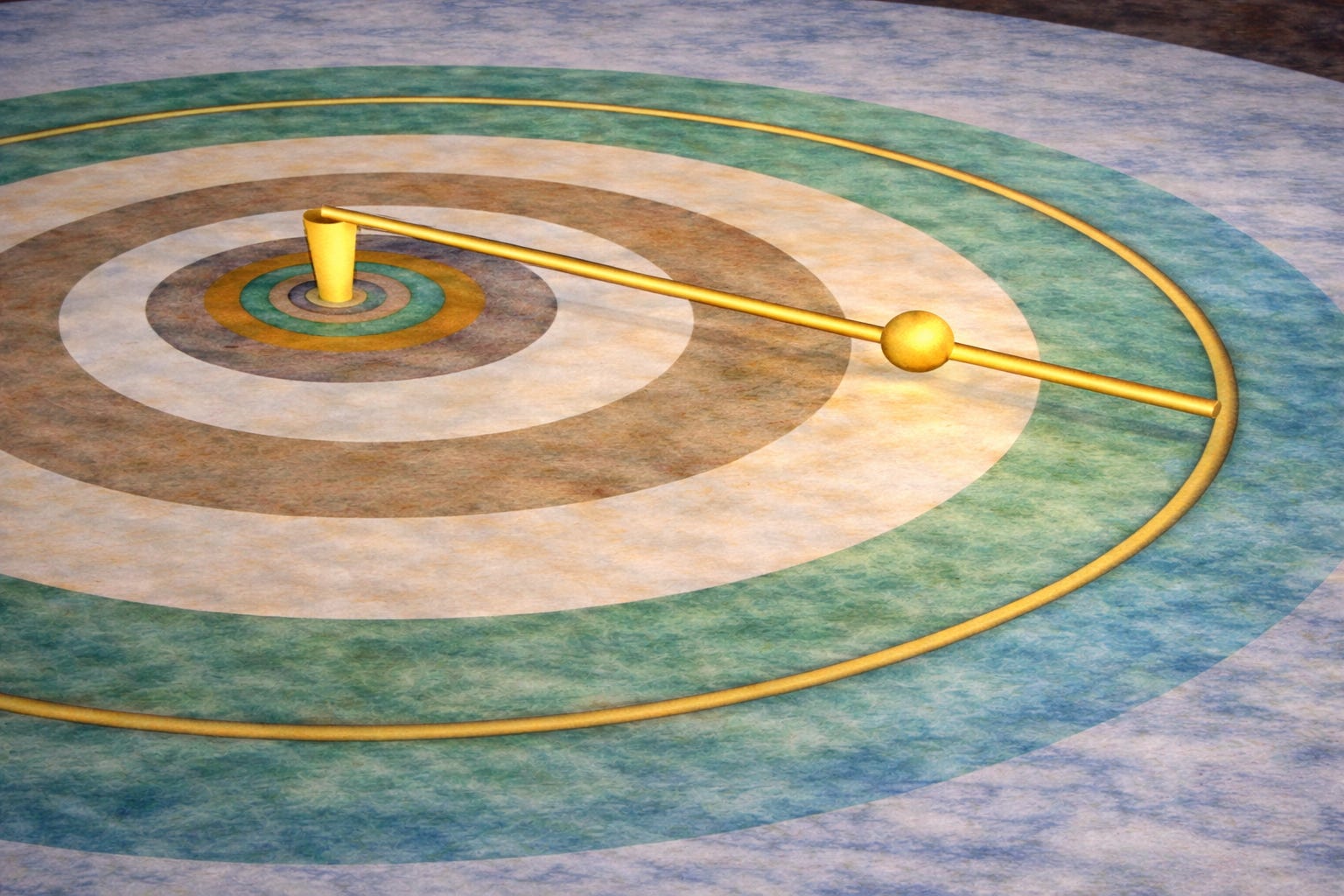
The orbit of the sun
The orbit of the sun around Bhū-mandala takes one year for us, and is divided into two halves (when the sun moves through the south and north of the planetary system). For us, these two halves represent summer and winter, but for the demigods, they represent day and night. In this way, one year for the demigods equals 360 years for us, and the 10,000 years of a lifetime in Svargaloka equals 3,600,000 years of our time.
This is confirmed by Prabhupāda in his purport to SB 5.20.30: “The movement of the sun is confirmed in the Brahmā-saṁhitā (5.52): yasyājñāya bhramati saṁbhṛta-kāla-cakraḥ. The sun orbits around Mount Sumeru, for six months on the northern side and for six months on the southern. This adds up to the duration of a day and night of the demigods in the upper planetary systems.”
As Prabhupāda mentions, this movement of the sun is described by Lord Brahmā himself in his prayers in the Śrī Brahmā-saṁhitā. The sun performs its journey, mounting the wheel of time (kāla-cakra). This movement of the sun around Mount Sumeru is thus a key element in Vedic cosmology, because it is connected with the very passage of time due to the influence of kāla (time), the divine potency of the Lord.
How can this be understood?
The first point is that in modern cosmology, the movements of the planets are explained from a heliocentric perspective, where the sun is orbited by the planets of our solar system, while simultaneously wobbling in an almost circular orbit around the center of the galaxy. Vedic cosmology also gives us a valid model for explaining days and nights, as well as the passages of the seasons and the movements of the stars. It is, however, based on a geocentric model, that puts our planet at the center, as part of Bhū-mandala, with the sun, all the stars, and other cosmic structures, as well as the other planets of the solar system orbiting this structure. Practically speaking, both models work, but the beauty of the Vedic model is that it describes the movements of the sun, planets and stars exactly as we see them when we look to the sky, and all of it from a theistic perspective.
A second point is that the Vedic model is multidimensional, and the description of the Śrīmad-Bhāgavatam speaks about a higher-dimensional reality that is, by definition, beyond the experimental process used in modern science. In this higher dimensional reality, all the intermediate planets appear together in a cosmic structure, and a single sun goes around all of them, creating cycles of days and nights with 24 hours for all the planets of the whole planetary system.
Even if in our gross reality our universe appears to be organized differently, still the knowledge of the Vedas is relevant, because it describes a level of reality superior to what we currently have access to. If we continue developing ourselves, up to the point of becoming demigods or Viṣṇudutas, we will see the universe the way it is described in the Śrīmad-Bhāgavatam.
Modern cosmology concludes that the earth orbits the sun based on the study of gravity. The Vedas also accept the influence of gravity, defining it as the potency of Lord Ananta, which maintains all the planets in their particular orbits. However, the Vedas make the point that the universe operates under the will of the Lord, not simply under mechanical forces. Physical laws and universal constants are just the apparent cause. The real question is who created these laws that conduct the universe so perfectly?
Our planet has a central role in the cosmos, because it is the place where the souls create a new set of karma that will define their destiny. It is also the place chosen by the Lord when He personally descends to play His pastimes, and the place where His divine abodes of Vṛndāvana, Jagannātha Pūri, Navadvīpa, etc. manifest. If He decides that the intermediate planetary system will have the form of a cosmic lotus and not only the sun but all the stars should orbit around it, who can prevent it?
Prabhupāda makes the point that the descriptions given in the Vedas should be given precedence over empirical observations, since, even though empirical observation is also a valid method for obtaining knowledge, it is imperfect and it often results in errors, while the statements of the Vedas come from perfect sources, starting from God himself.
A few points that can be mentioned to support this point:
a) During medieval times, many believed earth was flat, while the Vedas explained it as a sphere since the beginning, giving formulas to calculate its circumference and the distance to the moon and other astral bodies.
b) As we studied previously, scientific calculations for the date of the beginning of the universe and others have been refined over time. In 1929, Hubble calculated the age of our universe at about 2 billion years, a value that was updated to between 4 and 18 billion in 1958, 13.7 billion in 2003, 13.75 billion in 2011, 13.772 in 2013, 13.799 in 2015, and finally 13.801 in 2018. The value given in the Vedas, however, remains constant since the beginning: 13.819 billion years.
c) The idea of multiple universes has existed for a long time in the field of science fiction, but it started gaining serious traction in scientific circles only in the 1980s, with the development of inflationary cosmology. Guth introduced the idea of cosmic inflation in 1981, and later developments by Linde showed that inflation can naturally produce multiple bubble universes. The multiverse theory gained further traction in the 1990s and 2000s, as the string theory evolved. The Vedas, however, have been stating since the beginning that, vast as it may be, our universe is just one amongst millions of other bubble-like universes floating in the causal ocean.
Just as the idea of our universe existing for billions of years and being just one amongst millions of other universes would sound utterly absurd to a medieval mind, other ideas proposed in the Vedas may sound incoherent to us. However, as our understanding increases, not only in terms of experimental knowledge but also in terms of spiritual insight, the explanations given in the Vedas start to make more sense to us.
In any case, even if one is more comfortable with the modern cosmological model, it is undeniable that the universal model of the Vedas is still a valid description of what we observe in the sky: the whole sky circling the polestar, the sun moving throughout the sky with the passage of the months, the visible motions of the planets, etc. It is therefore a valid description of the universe. Even from this perspective, one can appreciate the practical way it describes the movements of the Sun, planets, and other luminaries, as well as its spiritual significance.
Ultimately, the goal of the description of the universe given in the Vedas is to help us to see Kṛṣṇa, the Absolute Truth, behind everything, just as He describes in the Gītā:
“I am the Supersoul, O Arjuna, seated in the hearts of all living entities. I am the beginning, the middle and the end of all beings. Of the Ādityas I am Viṣṇu, of lights I am the radiant sun, of the Maruts I am Marīci, and among the stars I am the moon. Of the Vedas I am the Sāma Veda; of the demigods I am Indra, the king of heaven; of the senses I am the mind; and in living beings I am the living force [consciousness]. Of all the Rudras I am Lord Śiva, of the Yakṣas and Rākṣasas I am the Lord of wealth [Kuvera], of the Vasus I am fire [Agni], and of mountains I am Meru. Of priests, O Arjuna, know Me to be the chief, Bṛhaspati. Of generals I am Kārttikeya, and of bodies of water I am the ocean. Of the great sages I am Bhṛgu; of vibrations I am the transcendental oṁ. Of sacrifices I am the chanting of the holy names [japa], and of immovable things I am the Himālayas. Of all trees I am the banyan tree, and of the sages among the demigods I am Nārada. Of the Gandharvas I am Citraratha, and among perfected beings I am the sage Kapila.”(Bg 10.20-26)
Kṛṣṇa is the essence of everything, and the chief among all classes and groups. When we start seeing Him in all powerful material manifestations, we start seeing the reality behind this illusory cosmic manifestation. The sun as orbiting the earth, or the earth as orbiting the sun is just a matter of convention, since in any case these are relative motions. It doesn’t change the fact that the goal of life is self-realization.
Read the whole book:
« Making Sense of the Vedic Universe, a Higher-Dimensional Reality
This is a publication for thoughtful readers who want to go deeper into Kṛṣṇa consciousness. I publish daily, trying to offer high-quality spiritual content, and all posts are available to free subscribers. If you wish, you can also choose a paid subscription to support this work.
You can also receive the updates on WhatsApp or Telegram.
If you would like to contribute further, you can find the donation links here.