

« Making Sense of the Vedic Universe, a Higher-Dimensional Reality
Chapter 6: The orbits of the planets and stars
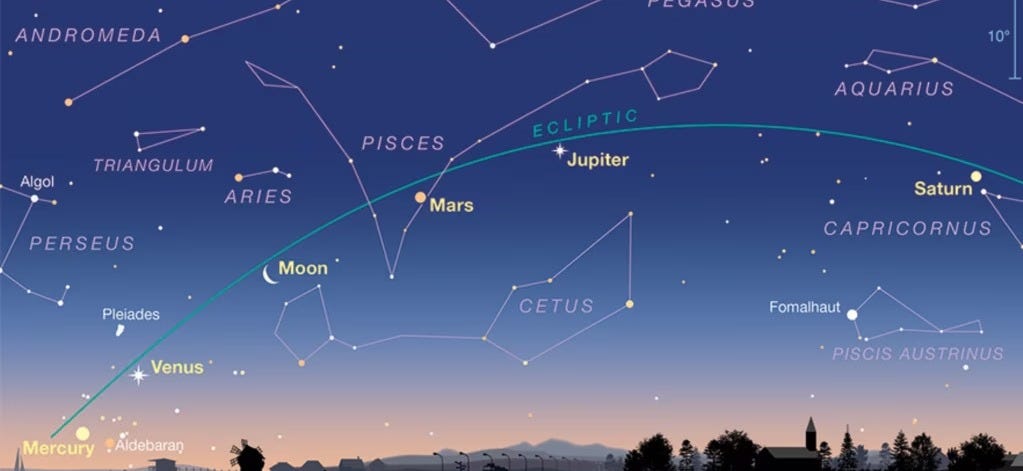
There are millions of stars and planets all over the universe, composing the different planetary systems, but they don’t exert much of an influence over us. Planets such as Mars and Jupiter, however, are the direct instruments of the fulfillment of karma, acting within the frameworks defined by the rāśis and nakṣatras. Their influence over us can be calculated and understood through the study of our birth chart. Vedic astrology is based on the study of the movement of the planets against the background of the nakṣatras and rāśis, as objects of fulfillment of our karma.
The planets, in turn, are ruled by different demigods who oversee our actions. The positions of the planets in our birth chart are not the direct cause of what happens to us, but they are an indication, a visible sign of how karma is affecting our lives. In other words, the planets are the thermometer, not the fever.
From this study, one can understand, for example, that he or she is suffering from a certain condition as the result of actions performed in a previous life, and learn that this can be mitigated by performing certain austerities or worship connected with the Lord. Nowadays, Vedic astrology is frequently misused, and so-called astrologers use it as a means to earn money by selling all kinds of paraphernalia, such as stones and rudrākṣas, as remedies to correct different undesirable influences, but the original process was to bring one to the worship of the Lord as a means to gradually become free from karma.
Why does such a system exist? The point is that life in this material world is not possible without forgetfulness of not only our previous lives but of our eternal relationship with Kṛṣṇa. As long as one remembers he is a pure soul, full of bliss and knowledge, it is not possible to enjoy this material world. Similarly, if we vividly remembered our previous lives, it would be impossible for us to properly connect with our current reality, not to mention that it would be very painful. Imagine remembering sons, daughters, wives, and husbands from many previous lives, people who we loved but will never be able to see again. It would not be possible to live.
Therefore, to make material life possible, and to give effective free will to the souls for performing material actions according to their desire, Kṛṣṇa has to create a system of forgetfulness, in which we don’t remember anything apart from our current lives. At the same time, however, He gives us a system through which we can understand our karma and past actions by studying the positions of the planets in our birth chart, and thus find our way back to Him. Thus, just like everything else in the Vedas, Vedic astrology has the goal of putting one in contact with brāhmaṇas and being gradually guided by them back home, back to Godhead. It is just that it has been misused and abused by unqualified people in modern times.
The Śrīmad-Bhāgavatam does not go into details on the interpretation of astrological charts, but it gives an introduction to the topic, explaining the orbits of the planets and the general influences they exert over us in chapter 5.22. It starts with the iconic question of Maharaja Parīkṣit about the previous explanation of the orbit of the sun and the answer of Śukadeva Goswami:
“King Parīkṣit inquired from Śukadeva Gosvāmī: My dear lord, you have already affirmed the truth that the supremely powerful sun-god travels around Dhruvaloka with both Dhruvaloka and Mount Sumeru on his right. Yet at the same time the sun-god faces the signs of the zodiac and keeps Sumeru and Dhruvaloka on his left. How can we reasonably accept that the sun-god proceeds with Sumeru and Dhruvaloka on both his left and right simultaneously?
Śrī Śukadeva Gosvāmī clearly answered: When a potter’s wheel is moving and small ants located on that big wheel are moving with it, one can see that their motion is different from that of the wheel because they appear sometimes on one part of the wheel and sometimes on another. Similarly, the signs and constellations, with Sumeru and Dhruvaloka on their right, move with the wheel of time, and the antlike sun and other planets move with them. The sun and planets, however, are seen in different signs and constellations at different times. This indicates that their motion is different from that of the zodiac and the wheel of time itself.” (SB 5.22.1-2)
The dual movement of the sun we just studied is not easy to understand. It’s easy for us to understand a single circular or elliptical movement, but it is harder to imagine two independent movements happening simultaneously, like in the case of the sun in the Vedic model.
Recapping:
a) The sun moves clockwise, with Sumeru and Dhruvaloka on its right. This is the daily motion produced by the kāla-cakra through the dakṣiṇāvarta wind. On our planet, this movement is perceived as the sun rising in the east and its setting in the west daily, producing day and night. This movement of the kāla-cakra makes not only the sun, but the whole sky rotate daily, including all the stars and constellations, as well as the other planets.
b) Simultaneously, the sun also moves counterclockwise facing the zodiac, with Sumeru on its left. This is the independent annual course of the chariot of the sun. Different from the daily movement, however, this is not a purely horizontal motion. As explained, this movement causes the sun to move to the north and south of the equator of Bhū-mandala, following the path of the ecliptic. The practical result of this motion is that it makes the days become longer or shorter as we go through the seasons.
The idea of a clockwise and a counterclockwise movement going on simultaneously may appear contradictory at first, but only until we realize the independent nature of these movements. The daily movement is along a fixed circular plane, while the annual movement has a vertical dimension to it. When the two are combined, the practical result is that the sun continuously circles Bhū-mandala, but goes gradually north and south of the equator, in something that resembles a spiral movement. This perfectly describes what we see when we look at the sky.
The example of the potter’s wheel
To make it clear, Śukadeva Goswami gives a practical example. Imagine a potter’s wheel (the rotating platform used to make ceramics). Now imagine a few ants moving on top of it as the wheel turns. In this situation, we have the wheel moving at great speed, and the ants on top of it moving together with it. At the same time, however, each ant has its independent movement. There is thus the movement of the ants relative to each other, and the rotation of the wheel, which is visible to an external observer, and both go on simultaneously. From the perspective of an observer, the ants are all moving in circles, but sometimes an ant appears closer to the border of the wheel, sometimes closer to the center, sometimes an ant is closer to another, sometimes distant, and so on.

In the analogy, the rotation of the potter’s wheel equals the movement of the whole sky caused by the kāla-cakra, to which all luminaries, including all the stars, constellations, the sun, other planets, etc., are subjected. The sun is like an ant on top of this wheel, moving very fast together with the wheel (the daily movement), and at the same time having its own, independent annual movement north and south of the equator. Just as the sun, the other planets, like Mercury, Venus, Mars, etc., all rotate with this cosmic wheel, while simultaneously performing their own independent movements around the sky over the background of the stars and constellations.
The study of the movements of the sun, moon, and planets on the background of the stars is important in Vedic culture, because it is used to make the astrological calculations that help us to understand our position on the wheel of saṁsāra and find our way out.
In modern cosmology, it is accepted that the stars also have their independent movement, but it is very slow compared to the movements of the sun and planets, becoming noticeable only over thousands of years. Vedic cosmology (Sūrya-siddhānta, Āryabhaṭa, etc.) also studies these movements, but they are not mentioned in the Śrīmad-Bhāgavatam, which focuses on describing the motion of the planets. To make it simple, the text takes the background of stars and constellations as fixed, subjected only to the movement of the whole sky, and focuses on describing the movements of the planets on this background.
On the analogy of the potter’s wheel, we can treat the stars and constellations as dots and other marks on the wheel that serve as points of reference for the movement of the ants.
Read the whole book:
« Making Sense of the Vedic Universe, a Higher-Dimensional Reality
This is a publication for thoughtful readers who want to go deeper into Kṛṣṇa consciousness. I publish daily, trying to offer high-quality spiritual content, and all posts are available to free subscribers. If you wish, you can also choose a paid subscription to support this work.
You can also receive the updates on WhatsApp or Telegram.
If you would like to contribute further, you can find the donation links here.