

« Making Sense of the Vedic Universe, a Higher-Dimensional Reality
The origin of everything
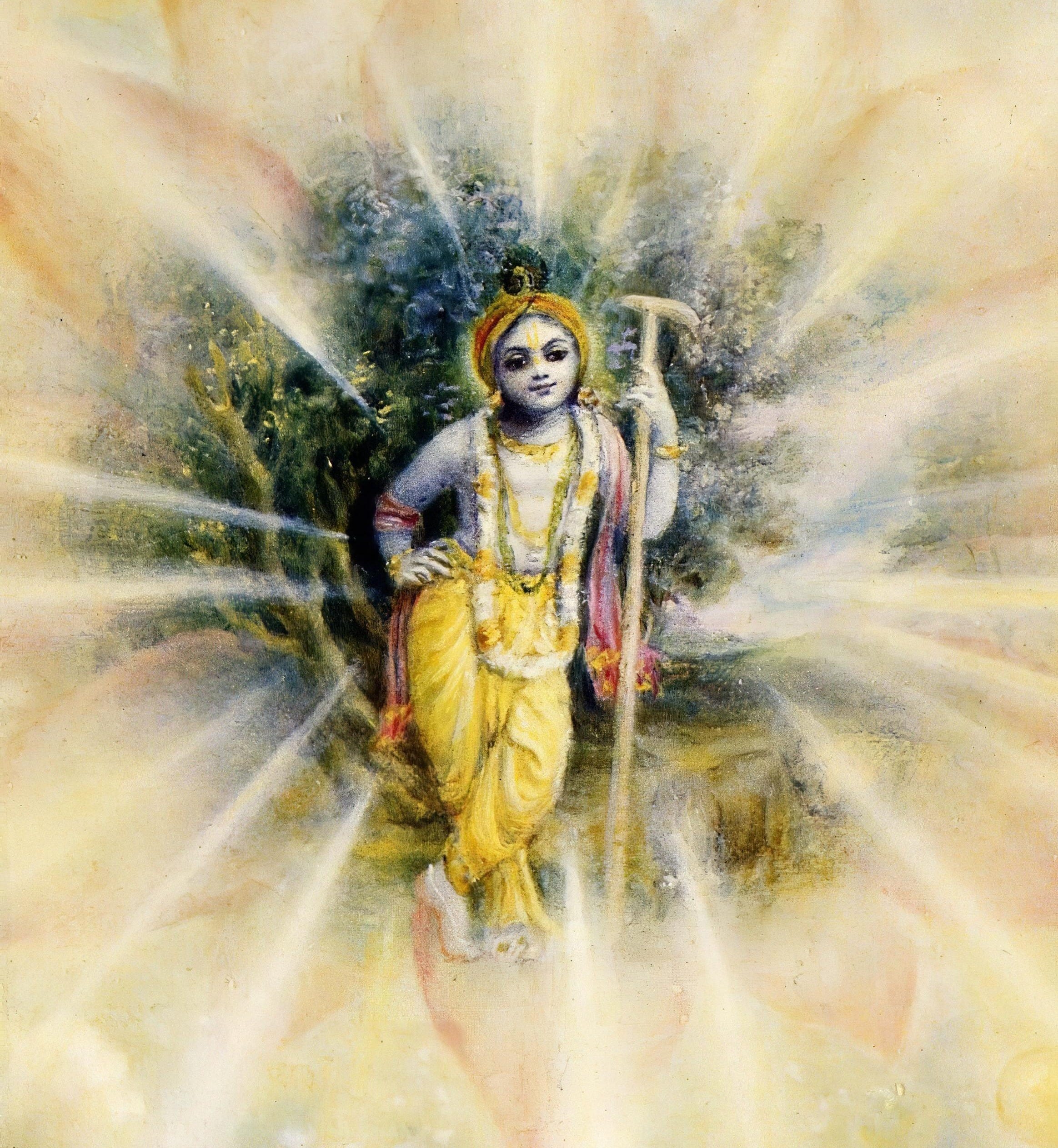
The essential point in Vaiṣnava philosophy, and in the Vedas in general, is the existence of a Supreme Person who is the creator of everything that exists. The universe thus doesn’t appear by chance; it is the result of a planned process of creation.
Who is this supreme person? This is a point of contention between students of the Vedas, but the Śrīmad-Bhāgavatam, after describing different incarnations of the Supreme Brahmān who appear inside the material universe, declares (1.3.28):
ete cāṁśa-kalāḥ puṁsaḥ, kṛṣṇas tu bhagavān svayam
indrāri-vyākulaṁ lokaṁ, mṛḍayanti yuge yuge“All of the above-mentioned incarnations are either plenary portions or portions of the plenary portions of the Lord, but Lord Śrī Kṛṣṇa is the original Personality of Godhead. All of them appear on planets whenever there is a disturbance created by the atheists. The Lord incarnates to protect the theists.”
We thus accept Kṛṣṇa as the Supreme Personality of Godhead and the source of all other incarnations. This by itself saves us many lifetimes of philosophical debate.
The term “Supreme Personality of Godhead” was coined by Prabhupāda to convey a series of philosophical conclusions that are essential to understanding the teachings of the scriptures, including the universe in which we live. This term, by itself, contains some of the main conclusions of the Vedanta-sūtra:
a) God is a person, with desires, activities, and so on.
b) He possesses different energies, or potencies, and acts through them.
c) There are many controllers, incarnations, and powerful people, but Kṛṣṇa is supreme among them. He is the supreme origin; there is nothing behind Him.
Kṛṣṇa has three main potencies: the spiritual or internal potency (which includes the spiritual world), the external potency (which provides the ingredients for the material creation), and the marginal potency (us, the souls who can choose between taking part in one or the other). The material creation is like an inverted image of the spiritual creation. Everything that exists here also exists there, but there it exists in its original form.
Just like a reflection looks like the original image, but it is inverted, the material creation is the opposite of the spiritual world in many ways. It is temporary instead of eternal; it is based on ignorance instead of knowledge, and so on. This idea of an inverted reflection is useful to understand the material creation and appreciate Kṛṣṇa’s ingenuity in creating an illusory world for us, conditioned souls, to play.
The study of the ingredients of a product can help us to understand its nature and what to do with it. So, what are the ingredients of this material world?
The external potency includes matter and Māyā, the illusory potency. Matter is the ingredient of everything that exists in this material world, and Māyā is the potency that makes us identify with it. Māyā is based on ignorance of our real self and on misunderstanding the nature of this world. The antidote for it is transcendental knowledge.
The study of material creation and the study of the universe are two of the branches of this spiritual knowledge. Just studying the universe as a mechanical creation, as done in modern cosmology, often leads to the opposite result, making one conclude that there is no God and thus just increasing one’s ignorance. However, when we study the universe as Kṛṣṇa’s creation, seeing His blue hand behind everything, this study leads to spiritual realization. That’s what we try to offer in this book.
What is the necessity, one may argue, of speaking about Kṛṣṇa in a book that speaks about the universe? Can’t we just skip the theological part and go to the hard facts about the structure of the cosmos? The answer is no. That’s not possible. The cosmic manifestation is inseparable from Kṛṣṇa and loses its meaning when divorced from Him, just as a hand loses its value when cut off from the body. Trying to study the universe separately from Kṛṣṇa is just like trying to know a person by studying the dead body. It will never work.
That’s precisely the mistake made in modern cosmology, and also the mistake made by many students of the Vedas. When Kṛṣṇa is taken out of the picture, the universe is seen as simply the combination of material elements, and its real nature and purpose escape us.
Read the whole book:
« Making Sense of the Vedic Universe, a Higher-Dimensional Reality
This is a publication for thoughtful readers who want to go deeper into Kṛṣṇa consciousness. I publish daily, trying to offer high-quality spiritual content, and all posts are available to free subscribers. If you wish, you can also choose a paid subscription to support this work.
You can also receive the updates on WhatsApp or Telegram.
If you would like to contribute further, you can find the donation links here.
Thank you so much prji ✨